
What Are the 13 Essential Factors to Consider Before Buying Pants?
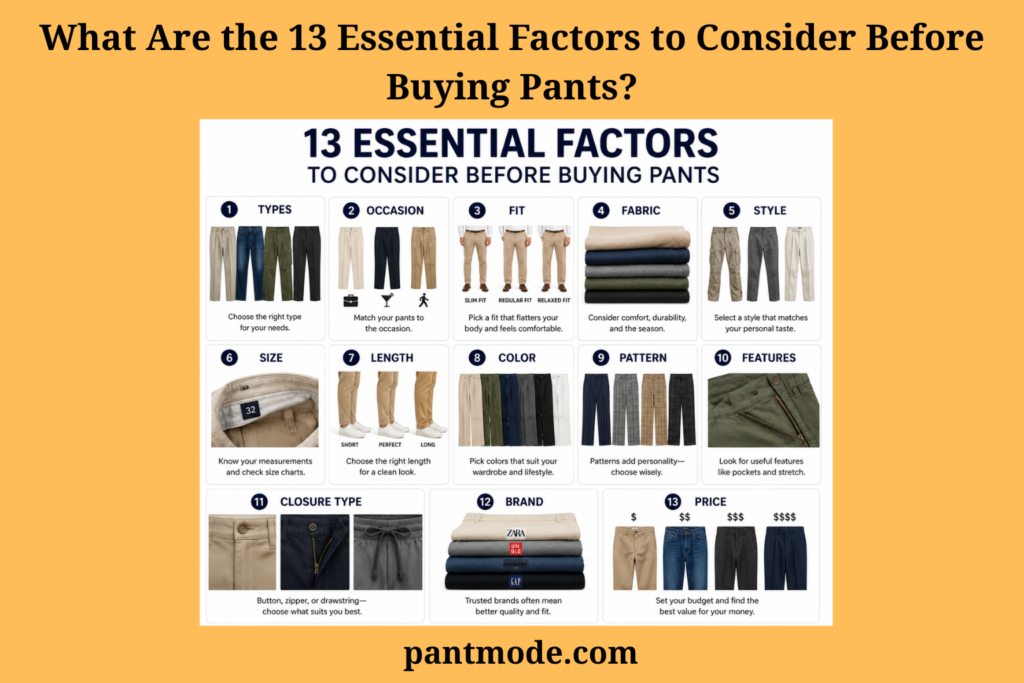
The 13 essential factors to consider before buying pants are types, occasion, fit, fabric, style, size, length, color, pattern, features, closure type, brand, and price.
Buying pants successfully requires more than choosing an attractive style, familiar brand, popular color, or large discount. The strongest purchase fits your body, serves a real occasion, suits the climate, works with your wardrobe, feels comfortable, and provides enough durability to justify its cost.
The 13-factor framework catches common problems before checkout. It prompts you to verify measurements, construction, fabric labels, product descriptions, seller information, and return terms instead of hoping the pants will work after purchase.
Quick Answer
The 13 essential factors to consider before buying pants are types, occasion, fit, fabric, style, size, length, color, pattern, features, closure type, brand, and price. Together, they help you choose pants that fit your body, match your use case, suit your climate, work with your wardrobe, and justify the cost.
Definition
A pants-buying factor is a practical decision point that affects how well pants fit, feel, function, style, wear, and hold value after purchase. Each factor tests a different part of the buying decision.
Key Takeaway
Start with pant type and occasion. Then verify fit, fabric, style, size, length, color, pattern, features, closure type, brand reliability, and price value before checkout.
External sources: This guide uses Federal Trade Commission clothing and textiles guidance for garment-label checks and Federal Trade Commission online shopping guidance for seller, review, total-cost, and return-policy checks.
Figure: the 13 factors work as one purchase filter rather than isolated preferences.
Why should you evaluate key factors before buying pants?
You should evaluate key factors before buying pants because pants must fit your body, match your use case, suit your climate, and justify their cost after repeated wear.
Structured evaluation prevents impulse mistakes. A discounted pair is still a weak purchase when the waist gaps, pockets flare, fabric pills, thighs feel restricted, or the hem does not work with your shoes.
Fit and function should come before brand or price. A familiar logo cannot correct a short rise, twisting leg seam, shallow pocket, rough lining, or fabric that traps heat in your climate.
Each factor catches a different problem. Type checks purpose, occasion checks formality, fit checks body comfort, fabric checks performance, and price checks whether the full garment deserves the cost.
13 Factors Overview Table
| Factor | What It Controls | Main Buying Question |
|---|---|---|
| Types | Garment category | Are these chinos, dress trousers, jeans, joggers, cargos, or another pant type? |
| Occasion | Formality and use | Where will I wear these pants most? |
| Fit | Body comfort and silhouette | Do they fit cleanly through waist, seat, thigh, knee, and leg? |
| Fabric | Comfort, durability, climate | Is the material right for weather, movement, and care? |
| Style | Aesthetic direction | Does the cut match my wardrobe and personal style? |
| Size | Measurement accuracy | Does the actual measurement fit better than the label number? |
| Length | Shoe compatibility | Does the inseam and break work with my footwear? |
| Color | Versatility | Does the color pair with tops, shoes, and outerwear I own? |
| Pattern | Visual effect | Does the pattern improve or complicate styling? |
| Features | Practical function | Are pockets, seams, stretch, adjusters, and reinforcements useful? |
| Closure Type | Security and formality | Does the zipper, button, hook, or drawstring suit the pant type? |
| Brand | Reliability and cut consistency | Is the brand dependable in this pant category, not only recognizable? |
| Price | Value and longevity | Does the cost match quality, wear frequency, and durability? |
Buying boundary: No single pant type, brand, fabric, color, pattern, closure, or price point is best for everyone. The right choice depends on body fit, climate, occasion, wardrobe, comfort needs, and budget.
Which type, occasion, and style factors should guide buying pants?
The type, occasion, and style factors should guide buying pants before fit details because they define the pant’s real purpose.
Choose the category first. Your pant type should match the main job: tailored trousers for formal use, chinos for smart casual wear, jeans for durable casual outfits, joggers for comfort, or cargos for practical storage.
Match formality to the setting. The pant occasion controls whether the fabric, pockets, finish, and silhouette look appropriate. A clean office pair should not carry the same visual signals as outdoor work pants.
Use style to connect purpose with your wardrobe. Your pant style should work with tops, shoes, and outerwear you already own. Wide-leg, pleated, barrel, flared, or cropped pants are useful only when you can build complete outfits around them.
Prioritize your real routine. Office wear may need tailored wool or clean chinos. Weekend wear may suit straight jeans or relaxed cotton trousers. Travel may need stretch, secure pockets, and wrinkle resistance. Rugged work may require reinforcement and a roomier cut.
Occasion to Pant Type Decision Matrix
| Occasion | Best Pant Types | Best Style Direction | Avoid |
|---|---|---|---|
| Formal office | Dress trousers, wool trousers | Tailored, straight, slim-straight | Joggers, cargos, distressed denim |
| Business casual | Chinos, tailored cotton pants, fine trousers | Clean straight or tapered | Overly baggy casual pants |
| Weekend casual | Jeans, chinos, relaxed trousers | Straight, relaxed, cropped | Formal trousers that feel stiff |
| Travel | Stretch trousers, joggers, technical pants | Comfortable, wrinkle-resistant | Tight waist, stiff fabric |
| Outdoor work | Cargos, utility pants, work pants | Reinforced, practical, relaxed | Delicate fabrics |
| Dinner or social | Tailored trousers, dark chinos, clean denim | Polished and fitted | Poor hems or faded fabric |
| Minimal wardrobe | Chinos, straight trousers, dark jeans | Neutral and versatile | Loud patterns first |
| Trend styling | Wide-leg, pleated, barrel, flared | Intentional silhouette | Trend fit with no styling plan |
How should you evaluate fit, size, and length before buying pants?
You should evaluate fit, size, and length before buying pants by checking actual measurements, movement comfort, rise, inseam, and the way the leg line works with shoes.
Check the full body line, not only the waistband. Good pants fit stays secure without digging, lies cleanly over the seat, gives the thighs room to move, and avoids pulling at the crotch or knees.
Use measurements instead of trusting a label. A pants size can vary by brand and cut. Compare the actual waist, hip, front rise, back rise, thigh, knee, hem, and inseam measurements with a pair that already fits you.
Test movement before deciding. Sit, walk, climb a step, and bend lightly. Pocket flare, horizontal thigh lines, crotch pulling, waistband rolling, or knee restriction show that the base cut is wrong.
Test length with the intended shoes. Correct pants length controls whether the hem sits cleanly or pools. No break, slight break, half break, and full break are deliberate choices, not random excess fabric.
View the pants from front, side, and back. A fit can appear clean from the front while the seat collapses, side seam twists, or rear waistband gaps.
Figure: a clean fit requires agreement through the waist, rise, seat, thigh, knee, inseam, and hem.
Sizing and Fit Troubleshooting Table
| Fit Issue | Likely Cause | Fix Before Buying |
|---|---|---|
| Waist gaps at back | Waist too large or rise mismatch | Try a different rise, smaller waist, or tailoring-friendly pair |
| Waist digs in | Waist too small | Size up or choose stable stretch or an adjustable waistband |
| Pocket flare | Seat or hips too tight | Size up or choose a relaxed or athletic fit |
| Horizontal thigh lines | Thigh too tight | Choose an athletic, straight, or relaxed cut |
| Fabric pulls at crotch | Rise too short or seat too tight | Try a higher rise or different cut |
| Excess fabric under seat | Seat too loose or rise too long | Try a slimmer seat or shorter rise |
| Knees feel restricted | Leg cut too tight or fabric lacks stretch | Choose a straighter fit or stable stretch blend |
| Hem pools heavily | Inseam too long | Shorten the length or choose a cleaner break |
| Pants look too short | Inseam too short or wrong shoe pairing | Try a longer inseam or lower-profile shoes |
| Leg twists while walking | Poor cut or seam alignment | Avoid buying the pair |
Which fabric, color, and pattern rules matter when buying pants?
Fabric, color, and pattern rules matter when buying pants because they affect comfort, durability, climate performance, care, versatility, and outfit difficulty.
Choose material by climate and use. The right pants fabric depends on fiber content, weight, weave, stretch, recovery, lining, and care. Lightweight cotton and linen can suit heat, while wool, corduroy, and heavier twill can offer more structure in cooler conditions.
Read the label before paying. Fiber content helps you estimate breathability, shrinkage, stretch, recovery, durability, and maintenance. The FTC clothing and textiles guidance explains labeling and care-information requirements that help buyers inspect textile products more carefully.
Build versatility through color. A useful pants color should pair with several tops, shoes, and outer layers you own. Navy, charcoal, black, olive, khaki, cream, brown, and stone often provide more combinations than a bright seasonal color.
Use patterns with a wardrobe plan. A pants pattern can add personality or change visual proportion, but bold checks, plaids, and stripes usually demand simpler tops and fewer competing details.
Figure: fabric controls performance, color controls reuse, and pattern controls styling difficulty.
Fabric Weight vs. Climate Guide
| Fabric or Material | Best Climate | Best Use | Watch-Out |
|---|---|---|---|
| Lightweight cotton | Warm to mild | Casual pants, chinos | Can wrinkle |
| Heavy cotton twill | Mild to cool | Work pants, chinos, cargos | Can feel stiff |
| Linen | Hot weather | Summer trousers | Wrinkles easily |
| Wool | Cool to mild | Dress trousers, office pants | Needs more careful care |
| Denim | Depends on weight | Casual wear | Heavy denim can feel hot |
| Corduroy | Fall and winter | Seasonal casual trousers | Can look bulky if fit is wrong |
| Polyester blends | Travel and performance | Wrinkle resistance | May feel less breathable |
| Nylon or technical fabric | Outdoor and active use | Utility or travel pants | Can look too casual |
| Stretch blend | Movement-focused use | Slim, athletic, travel pants | Check recovery and pilling risk |
Color and Pattern Decision Table
| Choice | Best For | Styling Benefit | Avoid When |
|---|---|---|---|
| Navy | Office, casual, smart casual | Very versatile | You already own many dark blue pants |
| Charcoal | Work, evening, minimalist outfits | Polished and visually clean | Your wardrobe is mostly warm-toned |
| Black | Urban, formal, minimalist | Easy to dress up | The fabric attracts lint easily |
| Khaki or stone | Casual and warm weather | Classic and light | You need a low-maintenance color |
| Olive | Casual, utility, fall outfits | Pairs with white, navy, and brown | The outfit already has strong military cues |
| Brown | Fall, heritage, smart casual | Warm and rich | Your tops and shoes do not support warm tones |
| Cream or off-white | Spring, summer, elevated casual | Fresh and modern | You need a low-maintenance pair |
| Pinstripe | Formal or elongating effect | Adds a vertical line | It is too formal for your routine |
| Plaid or check | Smart-casual personality | Adds visual interest | Most of your tops are patterned |
| Solid color | Maximum versatility | Easy outfit building | The outfit needs texture or contrast |
How do features and closure type affect buying pants?
Features and closure type affect buying pants because they control daily function, fit flexibility, security, durability, and formality.
Inspect features through real use. Useful pant features include pockets that hold essentials without flaring, reinforced stress points, stable belt loops, a gusset for movement, smooth lining, reliable stretch recovery, and waistband adjusters that do not collapse.
Check construction where stress is highest. Look at the crotch, seat, pocket openings, hems, and closure area. Loose threads, uneven seams, weak bar tacks, twisting lining, or thin pocket bags can reduce durability.
Match the fastening system to the category. A suitable pants closure type should feel secure and support the intended formality. Zippers suit many everyday pants, hook-and-bar closures lie flat on dress trousers, button flies support denim or heritage styles, and drawstrings fit casual or utility use.
Test stretch recovery. Gently pull a low-stress area and release it. Fabric that stays distorted may bag at the knees or seat after repeated movement.
Features and Closure Type Inspection Table
| Detail | Best Use | What to Inspect | Red Flag |
|---|---|---|---|
| Deep pockets | Casual, travel, utility | Pocket size and placement | Pocket flare or sagging |
| Reinforced seams | Work, utility, daily wear | Stitch density and stress points | Loose threads at crotch or pockets |
| Gusseted crotch | Active, work, travel | Extra movement panel and seam balance | Poor seam alignment |
| Waist adjusters | Travel, smart casual, changing waist needs | Side tabs or elastic sections | Weak hardware or rolling elastic |
| Belt loops | Everyday and formal | Loop strength and spacing | Thin loops that pull away |
| Zipper fly | Most everyday pants | Smooth zipper and secure stop | Sticky or weak zipper |
| Button fly | Denim, heritage, casual | Button security | Buttons pulling at waist |
| Hook-and-bar | Dress trousers | Closure lies flat | Gaps or weak hook |
| Drawstring | Joggers, casual, utility | Cord quality and waistband stability | Too casual for intended use |
| Lining | Dress or winter trousers | Comfort and seam finish | Scratchy or twisted lining |
How do brand and price affect buying pants wisely?
Brand and price affect buying pants wisely only when they are judged against fit, fabric, stitching, construction, return policy, wear frequency, and cost-per-wear.
Use brand as evidence, not proof. A reliable pant brand may offer consistent cuts, useful size charts, dependable construction, clear product details, and practical return support. The name alone does not prove that one pair fits your body or deserves its price.
Inspect affordable and expensive pants with the same standard. Check fabric density, stitching, pocket bags, zipper quality, waistband structure, seam alignment, and finish. Affordable pants can provide strong value, while expensive pants can still fail the fit and construction test.
Calculate value through repeated wear. Pants price and value should reflect how often you will wear the pair and how long it should remain useful. A durable wardrobe basic may justify a higher cost because its cost-per-wear falls over time.
For online purchases, verify the complete offer. The FTC online shopping guidance supports reading the full product description, checking sellers and reviews, calculating the total cost, and confirming return and refund terms before paying.
Figure: price becomes value only when fit, fabric, construction, wear frequency, durability, and return support agree.
Price vs. Quality Assessment Matrix
| Price Signal | What It Might Mean | What to Verify | Buy or Avoid Logic |
|---|---|---|---|
| Very cheap | Basic construction or discount | Fabric, seams, zipper, return policy | Buy only if fit and quality pass |
| Mid-range | Potential value zone | Fabric blend, cut, construction | Often a strong cost-per-wear option |
| Expensive | Better fabric, brand markup, or design | Tailoring, fabric, finish, durability | Buy only when quality is visible |
| Designer label | Status or design identity | Does it fit and perform better? | Avoid when the logo is the main value |
| Sale price | Good deal or leftover poor fit | Size, returns, defects, full cost | Buy if it passes the full checklist |
| Trend item | High style impact | Expected wear frequency | Avoid if only one outfit works |
| Wardrobe basic | Long-term use | Color, fit, durability | May justify spending more |
| Workwear or utility | Function-driven cost | Reinforcement, pockets, movement | Buy when the features are real |
Which fit and quality mistakes should you fix before buying pants?
The fit and quality mistakes you should fix before buying pants are the problems that create poor comfort, weak value, bad proportions, returns, or low wear frequency.
Do not use a belt to hide a poor waistband fit. A belt can secure a suitable waist, but it cannot repair major gapping, bunching, incorrect rise, or a seat that is too tight.
Do not trust label size alone. Check actual waist, hip, rise, thigh, knee, hem, and inseam measurements. If the product page does not provide enough information, compare the garment with a known pair or choose a seller with a practical return policy.
Do not ignore fabric and care evidence. A pair can look right but fail through shrinkage, pilling, overheating, dye transfer, stiffness, or poor stretch recovery.
Do not accept the wrong length because the style is attractive. Match the inseam and break to the shoes you plan to wear. Heavy pooling can look careless, while an unintended short hem can disturb proportion.
Use a three-outfit test for trend pieces. Before buying a bold silhouette, color, or pattern, name three complete outfits using clothes you already own. If you cannot, the pair may have low wardrobe value.
Common Pants Buying Mistake and Fix Table
| Mistake | Why It Fails | Better Fix | Result |
|---|---|---|---|
| Buying because of discount only | Price hides poor fit | Use the 13-factor checklist | Better value |
| Ignoring pocket flare | Seat or hip area may be too tight | Try a roomier fit | Cleaner front |
| Overusing a belt to fix waist | Waist bunches and fit collapses | Find a better waistband fit | More polished line |
| Choosing the wrong inseam | Break looks sloppy or accidental | Match length to shoes | Better proportion |
| Ignoring fabric care | Shrinkage or pilling risk | Read label and reliable reviews | Longer useful life |
| Choosing color without a wardrobe plan | Hard to style | Start with versatile colors | More outfit options |
| Buying a bold pattern first | Low versatility | Build solid options first | Easier wardrobe use |
| Paying for brand only | Poor cost-per-wear | Check fit and construction | Smarter spending |
| Ignoring return policy | Risky online purchase | Confirm time, costs, and conditions | Safer buying |
| Ignoring movement test | Pants feel good only while standing | Sit, walk, and bend | Real comfort check |
How can a 13-point checklist help when buying pants?
A 13-point checklist helps when buying pants by forcing every purchase to pass type, occasion, fit, fabric, style, size, length, color, pattern, features, closure type, brand, and price checks.
Use the checklist in order. Identify the category and occasion before judging price. Then check body fit, material, wardrobe compatibility, practical details, seller reliability, and long-term value.
Do not pass a pair because one feature is excellent. Soft fabric cannot correct poor fit, a low price cannot correct weak construction, and a famous brand cannot correct an impractical length.
Ultimate 13-Point Pre-Purchase Checklist
| Factor | Verification Question | Pass |
|---|---|---|
| Types | Is this the correct pant type for my need? | |
| Occasion | Can I wear these pants in my intended setting? | |
| Fit | Do they fit cleanly through waist, seat, thigh, knee, and leg? | |
| Fabric | Does the fabric suit my climate, comfort, and care needs? | |
| Style | Does the silhouette match my wardrobe and personal style? | |
| Size | Does the actual measurement fit better than the label number? | |
| Length | Does the inseam work with my shoes and preferred break? | |
| Color | Can I pair the color with several tops and shoes I own? | |
| Pattern | Does the pattern add value without limiting outfits? | |
| Features | Are the pockets, seams, stretch, lining, and adjusters useful? | |
| Closure Type | Is the closure secure and appropriate for the pant type? | |
| Brand | Does the brand offer reliable fit, quality, and return support? | |
| Price | Is the price justified by quality, frequency of wear, and durability? |
Checklist Decision Rule
A pair should pass all essential checks that apply to its purpose. A failure in fit, movement, fabric suitability, construction, or return safety is usually more serious than a small style preference.
What final rule should guide buying pants?
The final rule for buying pants is to choose the pair that passes the 13-factor test, not the pair that only looks attractive, cheap, trendy, or familiar by brand.
The strongest purchase creates agreement. Type and occasion define purpose; fit, size, and length confirm body compatibility; fabric, color, and pattern control performance and wardrobe use; features and closure support function; brand and price confirm reliability and value.
Place fit, fabric, and real use before discount or logo. Check labels, measurements, construction, full online descriptions, seller information, and return terms before paying.
The right pants are not simply the best-looking pair; they are the pair that fits your body, serves your lifestyle, works with your wardrobe, and earns its price through repeated wear.
Frequently Asked Questions About Buying Pants
The 13 factors are types, occasion, fit, fabric, style, size, length, color, pattern, features, closure type, brand, and price.
Start with the pant type and the occasion because they define the garment’s purpose. Then verify fit, fabric, size, length, and the remaining value factors.
Check the waist, seat, thigh, rise, knee, and leg line while standing, sitting, walking, and bending. Look for waist gaps, pocket flare, pulling, restriction, or excess fabric.
No. Expensive pants are only better when their fit, fabric, stitching, construction, durability, and expected wear frequency justify the higher price.
Check the full product description, actual measurements, fiber and care details, seller information, reviews from several sources, total cost, delivery terms, and return policy.
Conclusion: Buying Pants With the 13-Factor Rule
Buying pants successfully requires a complete decision, not a reaction to one attractive feature. The best pair matches its type and occasion, fits cleanly, uses suitable fabric, works with your wardrobe, and performs through real movement.
Actual measurements, rise, inseam, construction, fiber content, care requirements, features, closure security, seller reliability, and return terms provide stronger evidence than a label, logo, trend, or discount.
Use the 13-point checklist before checkout. Choose the pair that fits your body, serves your lifestyle, works with your wardrobe, and earns its price through repeated wear.