
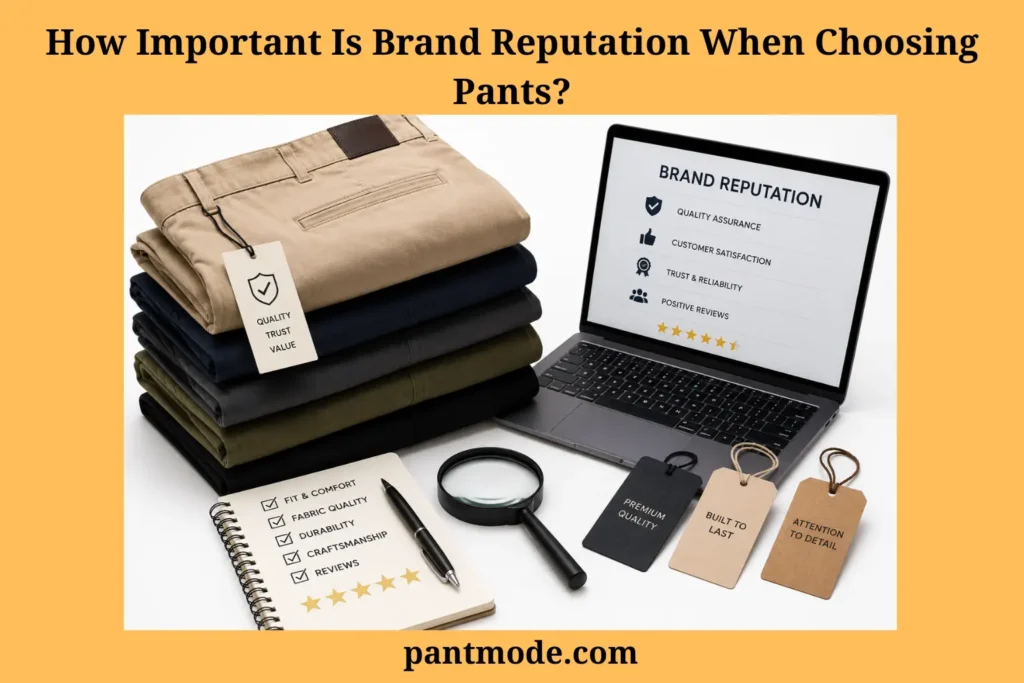
How Important Is Brand Reputation When Choosing Pants?
Pants brand reputation is important when choosing pants because it can reduce uncertainty about fit consistency, construction standards, transparency, service, and long-term customer experience.
Reputation is useful only as a decision signal. The specific pair still needs product-level evaluation through fit, measurements, fabric, construction, current customer evidence, service terms, sustainability claim specificity, certification scope, and value. Within the wider pants-buying factors framework, brand should narrow options rather than replace inspection.
Quick Answer
Brand reputation can reduce uncertainty about sizing, construction, service, transparency, and category experience, but it should only be a starting signal. Verify the actual pants through fabric, measurements, construction, fit, current reviews, return terms, repair or warranty support, sustainability evidence, certification scope, and price value.
Definition
Pants brand reputation is accumulated trust in a brand’s fit consistency, product transparency, category competence, construction standards, service policies, and customer experience. It is a decision signal, not automatic proof of quality.
Key Takeaway
Use pants brand reputation to narrow your options, then verify the actual pair. If the pants would not be worth buying without the logo, reputation is doing too much work.
Source Scope
FTC Green Guides are used only for environmental-marketing claim boundaries and qualification. NMSU Clothing Construction Standards are used only for garment-construction inspection. Neither source proves a brand’s reputation, value, sustainability, or lifespan.
URL Validation
The Brand target is supplied for publication and schema, but it is not marked as a current live public pass. The article therefore does not self-link to Brand, and Price remains unlinked. Only the approved live supporting Pant Factors pages are active.
Brand trust narrows the field; product evidence decides the purchase.
Why Does Pants Brand Reputation Matter When Choosing Pants?
Pants brand reputation matters when choosing pants because it can signal fit consistency, construction experience, service reliability, and transparency before the buyer inspects the specific pair.
Fit consistency can provide a useful starting reference, but different cuts, fabrics, factories, and seasons can still fit differently. Current measurements and actual pants fit remain necessary.
Construction reputation can indicate category experience, while clear return, exchange, repair, warranty, and defect terms can lower post-purchase risk. Neither signal proves durability of the exact pair.
Transparent fiber, sizing, sourcing, and manufacturing information gives the buyer more evidence, but transparency alone is not proof of superior ethics or quality.
Brand Reputation Value Matrix
| Reputation Signal | What It Can Indicate | What It Cannot Prove | What to Verify |
|---|---|---|---|
| Fit consistency | Similar sizing logic across some products | Identical fit across every model | Current measurements |
| Construction reputation | Category experience | Quality of the exact pair | Seams, pockets, waistband, closures |
| Customer support | Lower post-purchase risk | Product durability | Return, exchange, repair, and warranty terms |
| Transparency | More comparison evidence | Superior ethics or quality | Fiber, sourcing, factory, and claim details |
| Heritage | Long-term experience | Current product excellence | Recent products and reviews |
| Premium price | Possible better inputs or service | Better construction by default | Material, finishing, use value |
| Sustainability language | Brand positioning or claim area | Verified environmental performance | Specific evidence and certification scope |
What Actually Defines Trustworthy Pants Brand Reputation?
Trustworthy pants brand reputation is defined by observable evidence such as detailed product information, use-case-appropriate construction, useful sizing data, clear service policies, and repeated customer experience.
Look for clear fiber composition and relevant fabric specifications, but do not treat a prestigious fiber, mill, or origin as full-garment proof. The actual pants fabric must suit the intended activity and care needs.
Useful sizing goes beyond generic labels: waist, seat, rise, thigh, inseam, and leg opening reduce uncertainty without guaranteeing perfect fit. Actual return, warranty, repair, and exchange terms should be read rather than inferred from marketing phrases.
Repeated recent ownership patterns are more useful than isolated praise or complaints.
Quality Indicator vs. Marketing Signal Table
| Quality Evidence | What It Tells You | Weak Marketing Substitute | Verification Method |
|---|---|---|---|
| Fiber composition | Material basis for comfort and care | Premium fabric | Read label or product description |
| Product measurements | Better fit comparison | True to size | Compare with body or reference pants |
| Construction details | Build-quality clues | Expertly made | Inspect seams, pockets, closures |
| Clear return policy | Post-purchase risk level | Easy returns | Read terms and costs |
| Warranty conditions | Defect support boundaries | Guaranteed quality | Read exclusions and limits |
| Repair support | Long-term service possibility | Built to last | Check eligibility and process |
| Specific environmental claim | Claim that can be evaluated | Eco-conscious | Review evidence and scope |
| Repeated customer patterns | Ownership experience | Star rating alone | Read recent reviews across sources |
A fast audit checks current evidence before brand prestige.
How Can You Verify Pants Brand Reputation Against the Actual Pair?
You can verify pants brand reputation against the actual pair by auditing the fabric, construction, sizing, independent feedback, service policies, and transparency before purchasing.
Audit the fiber composition, stretch, disclosed weight, care, climate suitability, seam finishing, belt loops, pocket bags, waistband, buttons, snaps, hooks, and zippers. Recognizable hardware is one signal, not proof of the whole garment.
Compare current garment measurements with the wearer or a well-fitting reference pair. The pants size should come from current product data rather than brand memory.
Then compare recent independent reviews for recurring fit, shrinkage, durability, and service patterns, read return and warranty terms, and inspect functional pant features such as pockets and closures.
5-Minute Brand Trust Audit
| Audit Category | What to Check | Pass Signal | Red Flag |
|---|---|---|---|
| Fabric | Fiber composition, stretch, weight, care | Specific information | Vague premium wording |
| Construction | Seams, pockets, waistband, closures | Clean and purpose-appropriate | Loose stitching or unclear build |
| Sizing | Measurements beyond tag size | Useful garment measurements | Only generic labels |
| Independent feedback | Recurring ownership patterns | Consistent recent feedback | Repeated fit or service complaints |
| Returns | Window, costs, conditions | Clear terms | Hidden or restrictive terms |
| Warranty | Coverage and exclusions | Defects clearly addressed | Vague quality guarantee |
| Repairs | Eligibility and process | Understandable process | Repair claim with no process |
| Transparency | Materials, sourcing, claims | Specific details | Broad unsupported language |
Which Brand Capabilities Should Pants Brand Reputation Signal for Different Use Cases?
Pants brand reputation should signal different brand capabilities for different use cases because work pants, formal trousers, travel pants, commuter pants, and trend pieces require different evidence.
Workwear should show functional construction and repeatable fit; formal trousers should show pattern, drape, finishing, and alteration competence; travel and commuter pants should show mobility, recovery, secure storage, and manageable care; everyday pants should show consistent comfort and repeatable value.
Trend purchases should be judged by expected wear frequency, fit, construction, and price rather than celebrity use or hype. Premium purchases need stronger evidence because prestige alone is not a quality test.
Use-Case-to-Brand-Capability Decision Matrix
| Use Case | Most Important Capabilities | Secondary Factors | Low-Value Signal Alone |
|---|---|---|---|
| Work pants | Reinforcement, abrasion resistance, repeatable fit | Repair or replacement support | Rugged branding |
| Formal trousers | Pattern cutting, drape, finishing, alteration potential | Fabric transparency | Designer label |
| Travel pants | Mobility, recovery, secure pockets, easy care | Weather management | Technical wording |
| Commuter pants | Comfort, durability, pocket security, care ease | Stretch and recovery | Viral popularity |
| Everyday casual pants | Fit consistency, comfort, versatility | Easy maintenance | Logo visibility |
| Trend pants | Fit, expected wear frequency, acceptable price | Styling versatility | Hype or celebrity use |
| Premium pants | Transparent materials, strong construction, clear service | Repair or warranty support | High price alone |
| Newer brand | Product detail, clear policy, current customer evidence | Founder story | Brand age alone |
What Pants Brand Reputation Traps Should You Avoid When Buying?
Pants brand reputation traps mislead buyers when logo visibility, heritage, vague sustainability, viral popularity, or high price replaces inspection of the actual garment.
A logo does not prove construction. Heritage can indicate experience but not current excellence. Viral popularity can reflect marketing momentum and should trigger verification rather than automatic approval or rejection.
Broad environmental language such as green or eco-friendly should be specific and qualified; certifications should be interpreted only within their stated scope. A higher price can reflect labor, materials, design, distribution, exclusivity, retail markup, marketing, or positioning rather than construction quality alone.
Named fibers, mills, hardware brands, and countries of origin can support one part of the evaluation but cannot establish full-garment fit, quality, or value.
Brand Reputation Red Flag Matrix
| Red Flag | Why It Is Insufficient | Evidence to Request | Better Buying Test |
|---|---|---|---|
| Logo is the main appeal | Branding does not prove construction | Fabric and construction details | Would it work without the logo? |
| Heritage is the main proof | Past reputation may not reflect current line | Current product evidence | Inspect recent garments and reviews |
| Sustainability wording is vague | Broad claims may be unsupported | Specific claim and proof | Match claim to evidence |
| Certification is overextended | May cover limited criteria | Standard scope | Do not infer beyond scope |
| Viral hype drives urgency | Popularity may reflect marketing | Long-term feedback | Look for repeated ownership patterns |
| High price is treated as quality | Price includes non-quality factors | Comparable attributes | Compare value and expected use |
| Named fabric is used as proof | Material input is only one factor | Finished construction evidence | Inspect the whole garment |
| Hardware brand is overvalued | Hardware is one component | Operation and installation | Test the closure |
| True to size replaces data | Fit varies by cut and garment | Measurements | Compare with reference pants |
What F50 Checks Verify Pants Brand Reputation Before Purchase?
F50 checks verify pants brand reputation before purchase by turning brand signals, use case, product evidence, service terms, sustainability claims, price value, and logo-removal testing into a controlled decision path.
Trigger the audit when brand reputation is influencing trust, comparison, or rejection. Classify the use case and reputation basis, then require product, fit, construction, service, sustainability, and value evidence.
Red flags include logo premium, heritage overclaim, vague sustainability, certification overreach, viral hype, price-as-quality logic, named-component shortcuts, and unclear policies. Newer brands, premium prices, trend purchases, or logo preference can still be valid when the buyer understands the limits.
Approve only after product-level evidence passes.
F50 Pants Brand Reputation Decision-Control Table
| F50 Step | Control Question | Pass Standard |
|---|---|---|
| Trigger | Is pants brand reputation driving a choice, comparison, trust, or rejection? | Decision situation is clear |
| Classification | What use case, reputation basis, product evidence, service evidence, and price logic apply? | Brand signal is classified first |
| Recommendation | Does the brand capability match the actual pants use case? | Reputation supports a real need |
| Red flag | Is the decision driven by logo, heritage, vague sustainability, hype, price, or named components alone? | Risk is named before purchase |
| Exception | Is a new brand, premium price, trend piece, or logo preference consciously justified? | Exception is bounded |
| Verification | Do fabric, construction, measurements, reviews, policies, claims, and value pass? | Product-level checks pass |
| Source scope | Are FTC and NMSU used only within evidence limits? | No source is stretched |
| URL validation | Are only live approved internal links used? | No self-link, pant-types, non-live, or invented URL |
F50 prevents logo, heritage, hype, and price from replacing product evidence.
What Final Checklist Confirms Pants Brand Reputation Supports the Purchase?
A final checklist confirms pants brand reputation supports the purchase when the specific pair passes fabric, fit, construction, service, transparency, and value checks without relying on the logo alone.
The interactive checks save locally in the browser on the same device.
Fabric and Materials
Sizing and Fit
Construction
Independent Evidence
Service and Support
Sustainability and Transparency
Reputation Traps
Value
Final Logo-Removal Decision Test
Frequently Asked Questions About Pants Brand Reputation
These frequently asked questions about pants brand reputation clarify common buying concerns while keeping brand-level trust separate from product-level proof.
No. Pants brand reputation can reduce uncertainty by signaling experience, sizing communication, service, or category competence, but it does not guarantee that the specific pair has better fabric, fit, construction, durability, or value. The individual garment still needs product-level verification.
A reputable pants brand should provide observable evidence such as useful product measurements, clear fiber composition, purpose-appropriate construction details, transparent service policies, and consistent current customer feedback. Reputation is stronger when several independent signals agree rather than when the decision depends on one logo, rating, or marketing claim.
No. A higher price can reflect materials, labor, design, distribution, exclusivity, marketing, retail positioning, or service as well as construction quality. Compare the actual fabric, measurements, seams, pockets, closures, finishing, policies, and expected wear frequency before deciding whether the price is justified.
A newer brand can still be worth considering when the specific pants have detailed product information, clear sizing, transparent return and defect policies, credible current customer evidence, and construction that suits the intended use. There is no fixed waiting period required; the purchase risk should be judged from the available evidence and price.
What Final Rule Should Guide Pants Brand Reputation When Choosing Pants?
The final rule for pants brand reputation when choosing pants is to trust reputation only after the specific pair proves its fit, fabric, construction, service, transparency, and value.
Use case, current measurements, fabric evidence, construction, customer patterns, service terms, sustainability evidence, certification scope, value, and the logo-removal test should all agree before purchase.
No brand name, logo, price, heritage story, certification, fabric name, mill, hardware brand, country of origin, viral moment, or single review proves the specific pair. Reputation should support evidence, not replace it.
The strongest pants purchase is the one that still makes sense after the brand name is removed.
Conclusion
Pants brand reputation can reduce buying uncertainty, but it should never replace product-level verification. The strongest decision combines relevant brand trust with current evidence from fit, product measurements, fabric, construction, service policies, sustainability claims, certification scope, and expected value.
Use reputation to narrow your options, then judge the actual pair on its own merits. If the pants still make sense after the logo and brand name are removed, the brand is supporting the purchase decision rather than carrying it.