
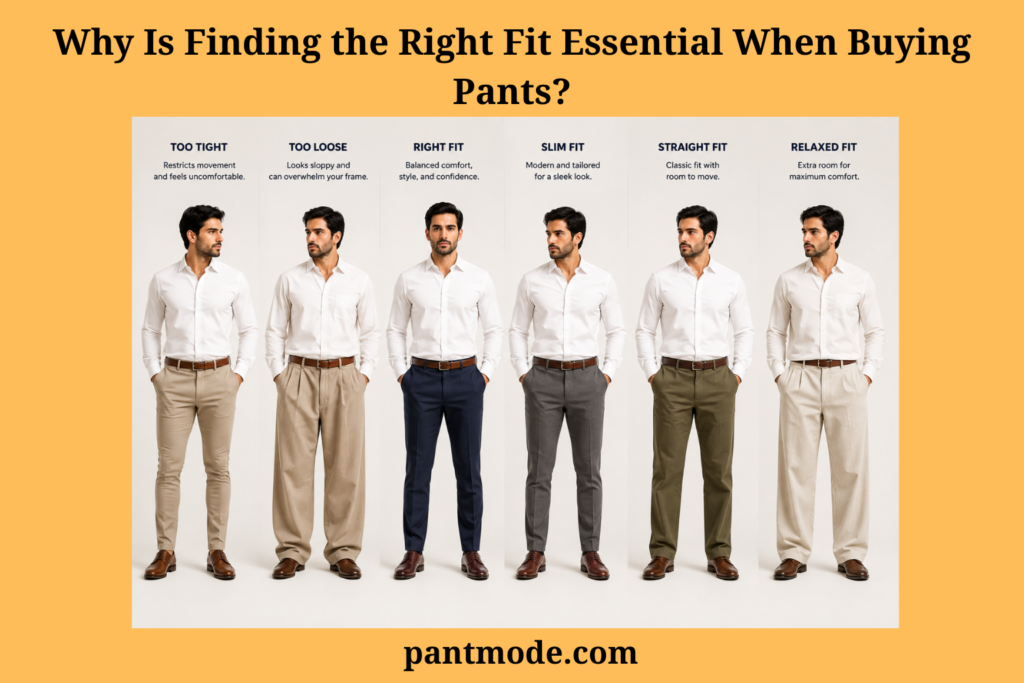
Why Is Finding the Right Fit Essential When Buying Pants?
Finding proper pant fit is essential when buying pants because fit controls comfort, movement, silhouette, garment behavior, and how intentionally the trousers sit on the body.
The size label is only a starting reference. A useful buying decision checks the waist, rise, seat, hip, thigh, knee, leg shape, seam alignment, inseam, break, fabric recovery, and intended silhouette inside the broader buying factors framework.
Different silhouettes use different amounts and placements of ease. Slim, straight, tapered, relaxed, pleated, and wide-leg trousers should not be judged by one universal tightness or smoothness rule.
The safest process is diagnosis first: identify the exact fit symptom, locate the likely cause, compare measurements where useful, then decide whether to change size, rise, cut, garment, or use a realistic alteration.
Quick Answer
Proper pant fit means the waistband stays secure, the rise feels comfortable, the seat and thighs allow movement, the leg shape matches the intended silhouette, the seams hang correctly, and the hem works with the intended footwear.
Fit should be checked while standing, sitting, walking, and bending. If major pulling, pocket distortion, twisted seams, or structural crotch problems remain, another size, rise, cut, or garment may be better than relying on alterations.
Definition
Proper pant fit is the relationship between body measurements, garment measurements, waistband shape, rise, seat room, thigh ease, leg shape, fabric behavior, inseam length, break, and intended silhouette. A proper fit supports movement and comfort while making the trouser shape look deliberate.
Key Takeaway
Diagnose the exact fit area before changing size or considering alterations. Minor length, waistband, or lower-leg refinements may be alterable, while major rise, crotch, seat, thigh, grainline, or seam problems often justify trying another garment.
Figure: proper fit begins with design intent, then checks waist, rise, movement, and hem behavior.
Why Does Proper Pant Fit Matter for Comfort, Movement, and Personal Style?
Proper pant fit matters for comfort, movement, and personal style because it controls how the waistband, rise, seat, thigh, leg shape, and hem behave on the body.
Waistband stability is the first control point. The waistband should remain in place during normal movement without uncomfortable digging, a major uncontrolled gap, or constant slipping.
Rise comfort must work standing and sitting. A rise that looks acceptable while standing can still pull, sag, or ride upward during sitting and bending.
Seat and thigh room determine functional movement. The wearer should be able to walk, sit, and bend without strong stress lines, pocket distortion, or restricted stride.
Intended silhouette changes the fit standard. A slim pant type can sit closer to the leg, while relaxed, pleated, and wide-leg trousers may contain deliberate volume. Neither closeness nor volume is automatically correct or incorrect.
Seams and hems reveal garment behavior. Obvious twisting can signal grain or construction problems, while a dragging hem can create avoidable wear and disrupt the intended break.
Proper pant fit can reduce avoidable stress at tight seams, strained pockets, restricted crotch areas, and dragging hems. This is a fit-management principle, not a guarantee of garment lifespan.
Proper Pant Fit Principles Table
| Fit Area | Proper-Fit Signal | Warning Signal |
|---|---|---|
| Waist | Stays in place without uncomfortable pressure | Digging, major gap, or constant slipping |
| Rise | Feels comfortable standing and sitting | Pulling, sagging, or riding up |
| Seat | Has room without uncontrolled folds | Strong tension or large empty folds |
| Pockets | Lie reasonably flat for the design | Strong flare or distortion |
| Thigh | Allows normal movement | Stress lines or restricted stride |
| Knee | Bends naturally | Immediate strain or severe bagging |
| Leg shape | Matches intended silhouette | Accidental clinging or ballooning |
| Seams | Hang consistently | Obvious twisting or rotation |
| Hem | Works deliberately with footwear | Dragging or unintended crop |
| Overall | Works standing and moving | Requires constant adjustment |
What Common Sizing Problems Prevent Proper Pant Fit?
Common sizing problems prevent proper pant fit when the waist, rise, seat, thigh, fabric behavior, seam alignment, or hem does not match the wearer and intended silhouette.
A waist gap does not always mean the whole garment is too large. Waist-to-hip proportions, waistband shape, and rise can all contribute. If the seat and thighs fit well, another waistband shape or limited waist adjustment may be more useful than sizing down everywhere.
Waist digging can come from size or rise. A smaller waistband, low rise, or mismatched waistband geometry may create pressure even when another area looks acceptable.
Pocket flare can signal upper-block restriction. Hip, seat, or thigh tightness can pull the pocket opening, although pocket construction and fabric can also affect the result.
Crotch pulling and crotch sagging point to different fit paths. Pulling may involve rise, crotch length, seat, or thigh room; sagging may involve excess rise depth, size, or pattern shape.
Knee bagging can reflect weak recovery or fit imbalance. Compare the garment after movement and evaluate pants fabric, construction, and cut rather than assuming stretch alone will fix the issue.
Twisted seams are a stronger structural warning. Visible rotation can reflect grain, construction, or cut problems, making another garment a safer choice.
Sizing Troubleshooting Table
| Fit Problem | Possible Cause | Better Next Step |
|---|---|---|
| Waist gap | Waist-to-hip mismatch, waistband shape, or rise | Try another waistband shape, rise, or minor alteration |
| Waist digs | Waist too small or rise unsuitable | Try another size or rise |
| Waist slides | Waistband or rise geometry mismatch | Try another size, rise, or shape |
| Pocket flare | Hip, seat, thigh restriction, or pocket design | Compare a roomier upper block |
| Crotch pulling | Rise, crotch length, seat, or thigh mismatch | Try another rise or cut |
| Crotch sagging | Rise or crotch shape too large | Try another size or rise |
| Excess seat folds | Seat or rise shape mismatch | Try another cut or pattern |
| Tight thighs | Insufficient thigh ease | Try athletic, straight, or relaxed cut |
| Knee bagging | Fabric recovery or fit imbalance | Test recovery and compare another pair |
| Pants ride up sitting | Rise or thigh room insufficient | Try another rise or cut |
| Twisted seams | Grain, construction, or cut problem | Compare another garment |
| Heavy pooling | Inseam too long | Shorten or select another inseam |
| Unintended crop | Inseam too short | Try longer length |
How Do You Measure Yourself Accurately for Proper Pant Fit?
You measure yourself accurately for proper pant fit by recording the waistband position, waist, hip or seat, thigh, rise references, inseam, outseam, knee, and leg opening before comparing those numbers with the garment.
Start at the intended waistband position. Measure where the trousers are designed to sit rather than automatically measuring the narrowest part of the torso.
Use a non-stretch measuring tape and record the numbers consistently. The Sewing & Craft Alliance measurement guide is used here only for accurate measurement practice and the concepts of wearing ease and design ease.
Measure the hip or seat around the fullest relevant area. This helps evaluate seat room, pocket behavior, and the transition from waistband to upper trouser block.
Measure the thigh at its fullest useful point. This helps identify whether the chosen cut provides enough movement.
Use rise references for diagnosis rather than a universal fit number. Crotch depth and crotch length can help explain pulling, sagging, or sitting discomfort, but garment construction still controls how those values behave.
Measure inseam and outseam for length. Inseam runs from the crotch to the intended hem, while outseam helps establish total trouser length. Compare the result with the intended pants length and footwear.
A well-fitting existing pair can be a useful garment reference. Compare its waistband, rise, thigh, inseam, and leg opening with a new pair when labels are inconsistent.
Numeric-ease boundary: sewing-pattern ease numbers are not universal ready-to-wear fit requirements. Use wearing ease and design ease as concepts rather than fixed shopping thresholds.
Pant Measurement Reference Table
| Measurement | Measurement Area | What It Helps Evaluate |
|---|---|---|
| Waist | Intended waistband position | Waist security |
| High hip | Upper hip where useful | Waist-to-hip transition |
| Hip / seat | Fullest hip and seat area | Seat and pocket fit |
| Thigh | Fullest upper thigh | Mobility |
| Knee | Around or across knee area | Leg-shape movement |
| Crotch depth | Waist to seated surface reference | Rise depth |
| Crotch length | Front waist through crotch to back waist reference | Front/back rise relationship |
| Inseam | Crotch to intended hem | Finished length |
| Outseam | Waistband position to hem | Overall trouser length |
| Leg opening | Finished hem width | Silhouette and footwear interaction |
Figure: wearing ease supports movement, design ease creates shape, and accidental excess reflects a mismatch.
How Should Body and Garment Measurements Be Compared for Proper Pant Fit?
Body and garment measurements should be compared for proper pant fit by accounting for wearing ease, design ease, fabric behavior, and the intended silhouette rather than expecting identical numbers.
Body measurements describe the wearer. Garment measurements describe the finished trousers. The difference between them must be interpreted through fabric, cut, closure, and intended shape.
Wearing ease supports movement. It is the extra room that allows normal sitting, walking, and bending.
Design ease creates the silhouette. Pleated, relaxed, and wide-leg trousers may intentionally contain more volume than slim or tapered trousers.
Accidental excess is different. Uncontrolled folds, sagging, or ballooning can result from the wrong size, rise, cut, or pattern rather than intentional design ease.
Stretch changes interpretation but does not erase fit structure. Some stretch garments can use less positive ease, while rigid woven trousers generally require different movement room. There is no universal elastane percentage or ease number that proves fit.
Use actual garment dimensions instead of trusting the label. Compare the new pair with your body and a known good-fitting pair, and use pants size only as a starting reference.
Body vs Garment Measurement Table
| Comparison Area | Body Measurement Role | Garment Measurement Role | Interpretation |
|---|---|---|---|
| Waist | Body circumference at wear position | Finished waistband size | Must suit intended security and closure |
| Hip / seat | Full body circumference | Garment room through seat | Requires movement plus design intent |
| Thigh | Upper-leg circumference | Finished thigh width or circumference | Must support movement and silhouette |
| Rise | Body depth or length reference | Front and back garment rise | Controls crotch and seat relationship |
| Knee | Body movement area | Garment knee width | Depends heavily on silhouette |
| Inseam | Leg-length reference | Finished inside-leg length | Determines break with footwear |
| Leg opening | Preference and footwear context | Finished hem width | Controls silhouette |
| Ease | Movement requirement | Added garment room | Varies by fabric and design |
Which Pant Cut Supports Proper Pant Fit for Different Fit Needs?
The pant cut that supports proper pant fit for different fit needs is the cut that provides enough room where the wearer moves while preserving the intended leg shape.
For more thigh room, start by trying athletic taper, straight, or relaxed-straight cuts. These options may provide more upper-leg space without requiring the whole garment to become oversized.
For a streamlined preference, try slim-straight, straight, or a soft taper. The fit should remain comfortable during sitting and bending rather than relying on tightness for visual shape.
For greater seat accommodation, consider shaped waistbands, another rise, straight cuts, or relaxed-straight cuts. Sizing up everywhere can create new waist and leg problems.
For high movement, prioritise enough seat, thigh, and knee room. Straight, relaxed, and stretch-compatible cuts are useful starting points, but stretch cannot rescue a structurally wrong cut.
For formal drape, tailored straight, controlled taper, or pleated options may work. Formal trousers do not need to be extremely slim.
For a wide silhouette, verify control rather than reducing volume. Wide-leg, relaxed, and pleated trousers can fit properly when the waist and rise are secure, the fabric drapes consistently, and the hem behaves intentionally.
Body-proportion boundary: these are starting options, not restrictions. No cut is forbidden for any body; final verification depends on movement, waist stability, rise, seat, thigh, drape, and hem.
Body Proportion & Cut Decision Matrix
| Fit Need | Useful Starting Cuts | Priority | Boundary |
|---|---|---|---|
| More thigh room | Athletic taper, straight, relaxed | Thigh and seat mobility | Slim cuts are not forbidden if they fit |
| Streamlined line | Slim-straight, straight, taper | Clean leg shape | Wide cuts remain valid |
| More seat accommodation | Shaped waist, straight, relaxed | Seat and pocket behavior | Do not simply size up everywhere |
| Waist stability | Appropriate rise and waistband shape | Secure waist | Rise preference varies |
| Comfort first | Straight, relaxed, stretch-compatible | Movement | Stretch does not replace correct cut |
| Formal drape | Tailored straight, pleated, taper | Drape and break | Formal does not require extreme slimness |
| Wide silhouette | Wide-leg, pleated, relaxed | Controlled volume | Extra volume must remain intentional |
| Shorter inseam need | Multiple cuts with correct length | Hem and break | Do not ban wider silhouettes |
| Taller inseam need | Straight, relaxed, pleated, wide | Adequate rise and length | Do not assume only wide cuts work |
When Should Alterations Be Used to Finalize Proper Pant Fit?
Alterations should be used to finalize proper pant fit when the trousers are structurally close to fitting well and the remaining issue can be corrected without rebuilding the garment.
Pattern alteration and finished-garment alteration are different. Pattern changes happen before construction. Finished trousers are constrained by seam allowance, pockets, waistband construction, lining, fabric, and cost.
Technical fitting references can explain where a trouser pattern may change. The New Mexico State University pant-fitting guide is used here for waist, hip, thigh, crotch, length, grainline, and pattern-adjustment concepts, not for restrictive body-type styling rules.
Pattern-level adjustability does not prove finished-garment feasibility. A pattern can be changed at the waist, length, leg shape, crotch depth, crotch length, hips, thighs, and back or seat before sewing, but those changes may be difficult or uneconomical after construction.
Hemming is often a practical refinement. If the waist, rise, seat, thigh, and leg shape already work, excess length can often be corrected cleanly.
Minor waist looseness or lower-leg width may be adjustable. Feasibility still depends on seam allowance and construction.
Major rise, crotch, seat, thigh, grainline, or twisted-seam problems are structural warnings. Comparing another size, rise, cut, or garment is usually safer than buying with the expectation of a major rescue alteration.
Alteration Feasibility Table
| Fit Problem | Ready-to-Wear Alteration Outlook | Safer Buying Decision |
|---|---|---|
| Too long | Commonly practical | Hem if everything else fits |
| Slight waist looseness | Often possible depending on construction | Assess waistband and seat first |
| Lower leg too wide | Often possible in limited amounts | Check overall balance |
| Small excess seat issue | Construction-dependent | Tailor assessment |
| Waist too tight | Depends on available seam allowance | Compare another size first |
| Rise too short | Structurally difficult | Compare another rise or cut |
| Severe crotch pulling | Structural | Compare another garment first |
| Thighs substantially too tight | Structural | Choose roomier cut |
| Pocket flare from restriction | Better solved through fit | Change size or cut |
| Major seat mismatch | Complex | Compare another pattern |
| Twisted seams | Poor candidate | Reject garment |
| Grainline distortion | Structural or construction concern | Compare another pair |
Figure: alterations refine close fits; structural mismatch usually calls for another size, rise, cut, or garment.
What F50 Checks Verify Proper Pant Fit Before Buying or Altering Pants?
F50 checks verify proper pant fit before buying or altering pants by turning fit symptoms, likely causes, silhouette exceptions, alteration limits, and movement tests into a controlled decision path.
Trigger: name the visible or physical concern before changing anything. Gapping, digging, flaring, pulling, sagging, twisting, pooling, or movement restriction are different symptoms.
Classification: locate the problem at the waist, rise, seat, hip, thigh, knee, leg, hem, seam, or fabric.
Cause: decide whether size, rise, cut, fabric, length, construction, or intended silhouette best explains the symptom.
Recommendation: match the action to the cause. Change size for a true scale problem, rise for vertical placement, cut for shape mismatch, length for hem issues, or garment for structural construction problems.
Red flag: do not force major crotch strain, severe thigh restriction, twisted seams, grain distortion, or several structural problems into a tailoring plan.
Exception: allow intentional volume in relaxed, pleated, or wide-leg trousers and intentional closeness in slim or tapered designs when movement and garment behavior remain controlled.
Verification: approve the pair only after body and garment measurements, movement tests, silhouette intent, and realistic alteration feasibility agree.
F50 Proper Pant Fit Decision-Control Table
| F50 Step | Control Question | Pass Standard |
|---|---|---|
| Trigger | Is there a visible or physical fit concern? | Symptom is named |
| Classification | Where does it occur? | Exact fit area identified |
| Cause | Is it size, rise, cut, fabric, length, or construction? | Likely cause identified |
| Recommendation | Should the reader change size, rise, cut, garment, or alter? | Action matches cause |
| Red Flag | Is the problem structural? | Structural issues are not forced into tailoring |
| Exception | Is the volume or closeness intentional? | Design intent is respected |
| Measurement | Do body and garment measurements support the diagnosis? | Comparison is consistent |
| Movement | Does the garment work sitting, walking, and bending? | Functional fit passes |
| Alteration | Is the proposed finished-garment change realistic? | Construction permits refinement |
| Verification | Does the garment pass final checks? | Buy, alter conditionally, or reject |
| Source Scope | Are both external sources used within limits? | No unsupported source extension |
| URL Validation | Are internal links Pant Factors only? | No self-link or /pant-types/ URL |
How Can You Verify Proper Pant Fit Before Buying?
You can verify proper pant fit before buying by testing the waistband, rise, seat, thighs, pockets, knees, seams, hem, fabric behavior, and intended silhouette while standing and moving.
Start with standing fit, then move. Check that the waistband stays secure, the rise feels natural, and the silhouette looks intentional before sitting and walking.
Sit normally. The rise should remain comfortable, the waistband should not dig sharply, and the seat and thighs should still provide usable room.
Walk and bend. Normal movement should not create major crotch pulling, strong thigh restriction, or sudden pocket distortion.
Watch the knees and seams. Knees should bend naturally, while side and inseams should hang without obvious twisting.
Check hem and footwear together. The inseam should create the intended break with the shoes you plan to wear rather than being judged in isolation.
Check fabric recovery after movement. Stretch and drape should return acceptably without immediate severe bagging.
Finish with alteration feasibility. A pair that needs a realistic hem or limited refinement may still be a strong buy; a pair with several structural problems is a better candidate for rejection.
Fit-test boundary: do not rely on a universal finger, pinch, or one-inch rule. Fit must be judged through garment behavior, movement, silhouette, and construction.
Dressing Room Verification Checklist
| Fit Test | Pass / Fail |
|---|---|
| Does the waistband remain secure? | |
| Does it avoid uncomfortable digging? | |
| Can the pants stay up without extreme belt tension? | |
| Does the rise feel comfortable standing? | |
| Does the rise remain comfortable sitting? | |
| Does the seat avoid strong pulling? | |
| Does the seat avoid uncontrolled sagging? | |
| Do the pockets remain reasonably controlled? | |
| Can I walk normally? | |
| Can I sit normally? | |
| Can I bend comfortably? | |
| Is there enough thigh room for the design? | |
| Do the knees bend naturally? | |
| Do the seams hang without obvious twisting? | |
| Does the leg shape match the intended silhouette? | |
| Does the hem work with my intended footwear? | |
| Does the fabric recover acceptably after movement? | |
| Is any extra fabric intentional? | |
| Is any proposed alteration minor enough to be realistic? |
Final Proper Pant Fit Checklist
| Final Check | Pass / Fail |
|---|---|
| Is the waistband secure? | |
| Is there no major uncontrolled waist gap? | |
| Does the rise work standing and sitting? | |
| Does the seat have functional room? | |
| Do the pockets behave appropriately? | |
| Can I sit without major crotch pulling? | |
| Can I walk without thigh restriction? | |
| Can I bend comfortably? | |
| Does the knee move naturally? | |
| Does the leg shape match the intended cut? | |
| Do the seams hang correctly? | |
| Does the inseam create the intended break? | |
| Does the hem work with footwear? | |
| Does the fabric behave acceptably after movement? | |
| Is intentional design ease being distinguished from excess fit? | |
| Have I compared measurements where needed? | |
| Is any alteration need realistic? | |
| Would another size, rise, or cut solve the problem more cleanly? |
Frequently Asked Questions About Proper Pant Fit
The waistband should stay in place during normal movement without uncomfortable digging, major uncontrolled gapping, or constant slipping. Waistband shape and rise can matter as much as the labelled size.
No. Relaxed, pleated, and wide-leg trousers can intentionally contain design ease. The key is that the waist, rise, drape, leg shape, and hem behave intentionally while movement remains comfortable.
Pocket flare can suggest restriction through the upper hip, seat, or thigh, although pocket construction and fabric can also affect the result. Compare another size or cut before assuming one cause.
No. Hemming, limited waist adjustment, and limited lower-leg tapering can be practical on some garments, but major rise, crotch, seat, thigh, grainline, or twisted-seam problems often justify trying another garment.
Test the trousers while standing, sitting, walking, and bending. Check waistband security, rise comfort, seat and thigh room, pocket behavior, knee movement, seam alignment, hem and footwear interaction, fabric recovery, and intended silhouette.
Conclusion: What Final Rule Should Guide Proper Pant Fit When Buying Pants?
The final rule for proper pant fit when buying pants is to choose the pair that supports comfort, movement, intended silhouette, and realistic alteration needs before trusting the size label.
Check the waist, rise, seat, hip, thigh, knee, movement, leg shape, seam alignment, inseam, break, fabric behavior, ease, footwear interaction, and alteration feasibility as one system.
No single cut fits everyone, no universal ease number proves fit, and the size label is not proof of fit. Intentional design volume can be correct, while tailoring should refine an otherwise good garment rather than rescue the wrong one.
The best-fitting pants are the pair that stay secure, move comfortably, match the intended silhouette, work with the footwear, and need only realistic adjustments.