
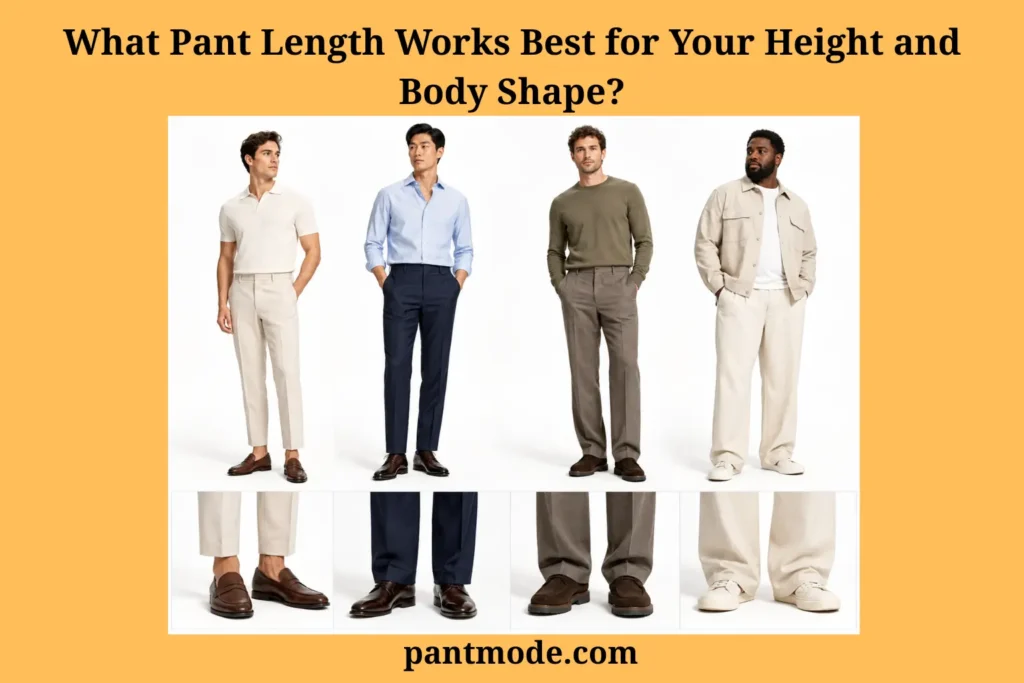
What Pant Length Works Best for Your Height and Body Proportions?
Perfect pant length is chosen by matching the finished hem to your inseam, height, leg proportions, pant silhouette, footwear, fabric drape, occasion, and styling goal.
Height alone does not determine pant length, and a label inseam does not determine the finished hem by itself. Place length inside the broader pants-buying factors framework, then evaluate rise, break, leg opening, fabric drape, footwear, ground clearance, movement, and tailoring readiness.
No single pant length works for everyone, and no break type is universally best. Cropped, no-break, slight-break, medium-break, full-break, and intentionally stacked trousers can all work when the hem is deliberate and compatible with the actual garment and shoes.
Quick Answer
The perfect pant length is the finished hem position that matches your intended silhouette, footwear, inseam, body proportions, fabric drape, occasion, and styling goal.
Cropped pants end intentionally above the normal shoe line. No-break pants reach the shoe without forming a visible fold. Slight-break pants create a small front crease, medium-break pants create a clearer fold, and full-break pants rest more deeply on the shoe without automatically becoming uncontrolled pooling.
Definition
Pant length is the finished trouser hem position in relation to the wearer’s inseam, rise, footwear, leg shape, fabric drape, and intended break. It determines whether the trousers read as cropped, no-break, slight-break, medium-break, full-break, intentionally stacked, or accidentally pooled.
Key Takeaway
Choose pant length by testing the hem with the rise, silhouette, fabric, footwear, and styling context you will actually use. Height and inseam help establish a starting point, but final pant length should be confirmed through footwear, ground clearance, drape, movement, and tailoring checks.
Figure: rise, silhouette, break, footwear, and ground clearance combine to define the finished pant length.
Why Does Pant Length Change the Overall Proportion of an Outfit?
Pant length changes the overall proportion of an outfit because hem placement controls how the trouser line meets the shoe, interrupts or extends visual continuity, and interacts with leg width and fabric drape.
Visual continuity describes how uninterrupted the outfit line appears. A longer clean waist-to-shoe line can extend visual continuity, while a deliberate crop can interrupt that line and emphasize the ankle, sock, or footwear.
Tonal trousers and similarly colored footwear may create a more continuous line, but this is a styling tendency rather than a guaranteed body effect.
Leg width changes how the same inseam behaves. A tapered opening may stop or bunch on a bulky shoe, while a wide opening can fall farther around the shoe and demand more ground-clearance attention.
Heel height, sole thickness, toe shape, shoe volume, and fabric drape all influence the final break. Pant length therefore works together with rise, width, fabric, footwear, and proportion rather than as an isolated number.
What Are the Main Pant Lengths and Breaks You Need to Know?
The main pant length and break options you need to know are cropped length, no break, slight break, medium break, full break, and intentional stacking.
Cropped ends intentionally above the normal shoe line. No break reaches or closely approaches the shoe without a noticeable front fold, so cropped and no-break are not the same.
Slight break creates a small controlled front crease; medium break creates a clearer fold; and full break places more fabric on the shoe and creates a deeper deliberate fold.
Intentional stacking uses repeated controlled gathers near the shoe as part of the styling goal. Pooling is different because excess fabric collapses, bunches, drags, or distorts the intended silhouette.
Figure: cropped, no break, slight, medium, full break, and intentional stacking are distinct hem-to-shoe relationships.
Pant Length & Break Cheat Sheet
| Length / Break | Visual Cue | Typical Styling Direction | Key Check |
|---|---|---|---|
| Cropped | Clearly above normal shoe line | Contemporary or casual | Crop looks intentional |
| No break | Reaches shoe without visible fold | Clean modern tailoring | Hem hangs cleanly |
| Slight break | Small front crease | Smart casual or tailored | Minimal bunching |
| Medium break | Clearer controlled fold | Traditional tailoring | Fabric remains controlled |
| Full break | Deeper rest over shoe | Traditional or relaxed | Avoid uncontrolled pooling |
| Intentional stacking | Controlled repeated gathers | Streetwear or relaxed styling | Stacking appears deliberate |
How Should You Measure Your Inseam and Desired Pant Length Accurately?
You should measure your inseam and desired pant length accurately by using a comparable reference garment first, then confirming the finished hem while wearing the footwear intended for the pants.
Choose a comparable reference pair. Match rise, silhouette, and leg opening where possible. Measure from the crotch seam along the inside leg to the finished hem and record that as a reference inseam rather than assuming the label inseam equals the physical measurement; compare that reference with the available pants size and garment-length information.
Choose the intended break before marking. Decide whether the target is cropped, no break, slight break, medium break, full break, or intentional stacking.
Put on the intended footwear. Heel height, sole thickness, shoe volume, and toe shape alter the hem position. The Sewing.org hemming guide supports marking a pant hem while wearing the proper shoes and notes that substantial shortening may sometimes require hem-area tapering to preserve the original look.
Set the intended rise before marking. The waistband must sit where the trousers will actually be worn; correct pants fit controls that starting position.
Stand naturally, mark or pin the finished hem, then walk. Confirm that the hem does not catch under the shoe, the back hem clears the ground appropriately, and the break remains controlled.
How Should Height, Inseam, and Leg Proportions Influence Pant Length?
Height, inseam, and leg proportions should influence pant length as flexible styling variables, not fixed rules that automatically decide the hem.
A shorter inseam may make no break or slight break useful starting directions for a cleaner line, but a deliberate crop can also work. A taller wearer or longer inseam can use cropped through fuller lengths depending on silhouette, fabric, shoes, and styling goal.
Leg-to-torso proportion can guide comparison. An appropriate rise and controlled hem may extend visual continuity, but that is not a guaranteed body-changing effect.
Height helps frame the decision but does not determine pant length by itself.
Height, Inseam & Proportion Decision Matrix
| Goal / Proportion | Useful Starting Direction | Main Variable to Check |
|---|---|---|
| Cleaner continuous line | No break or slight break | Shoe and leg width |
| Ankle emphasis | Cropped length | Crop position |
| Shorter inseam | No break or slight break may be useful | Silhouette and footwear |
| Longer inseam | Multiple lengths may work | Styling goal |
| Longer torso / shorter leg proportion | Appropriate rise with controlled hem | Waist-to-shoe continuity |
| Longer legs / shorter torso | Cropped through full length | Overall outfit proportion |
| Formal appearance | Slight or medium break may be useful | Trouser and shoe relationship |
| Fashion-led styling | Crop or intentional stacking | Silhouette and fabric |
Which Pant Length Works Best With Straight, Tapered, Wide-Leg, Bootcut, and Flared Pants?
The pant length that works best with straight, tapered, wide-leg, bootcut, and flared pants depends on how each silhouette falls over footwear and how much fabric the hem can control.
Straight trousers can work from cropped through medium break. Slim-straight trousers often work cleanly with no break or slight break, but those choices are not mandatory.
Tapered trousers can be cropped or use several controlled break depths. Wide-leg trousers can be intentionally cropped or worn near full length; check drape, shoe catching, and ground clearance.
Bootcut and flared trousers depend strongly on intended footwear because shoe height and volume change how the lower-leg shape is preserved. Relaxed trousers may use slight break, medium break, or deliberate stacking.
Tailored trousers can range from no break through medium break depending on preference and pant style.
Pant Silhouette-to-Length Decision Matrix
| Pant Silhouette | Useful Length Options | Primary Check |
|---|---|---|
| Straight | Cropped to medium break | Clean vertical fall |
| Slim-straight | No break or slight break often useful | Shoe interaction |
| Tapered | Cropped, no break, slight break, controlled break | Ankle bunching |
| Wide-leg | Cropped or near-full/full | Drape and clearance |
| Bootcut | Footwear-dependent full length | Shoe coverage |
| Flared | Usually longer and footwear-specific | Ground clearance |
| Relaxed | Slight break through intentional stacking | Fabric behavior |
| Formal tailored | No break through medium break | Occasion and footwear |
How Should Footwear and Occasion Affect Pant Length and the Final Hem?
Footwear and occasion should affect pant length and the final hem because shoe shape, sole height, formality, and styling context change how the trouser meets the footwear.
Low-profile sneakers can work with cropped, no-break, or slight-break hems. Chunkier shoes can catch narrower openings, so a slight break or intentional stack may work when controlled.
Loafers commonly pair with clean no-break or slight-break lines; dress shoes can support no break through medium break; boots require shaft, toe, and volume checks; heels and platforms require the final hem to be checked again because clearance changes.
Formal settings often favor clean controlled breaks, casual settings may support crops, and fashion-led settings may support intentional stacking. The selected pant occasion informs the decision without imposing one universal break.
Footwear-to-Hem Compatibility Table
| Footwear | Pant Length / Hem Direction to Test | Main Check |
|---|---|---|
| Minimal sneakers | Cropped, no break, slight break | Clean shoe exposure |
| Chunky sneakers | Slight break or intentional stack | Hem does not catch |
| Loafers | No break or slight break | Clean front line |
| Dress shoes | No break through medium break | Formality and fold control |
| Ankle boots | Slight or fuller break depending on cut | Shaft interaction |
| Heels | Longer footwear-specific hem where silhouette requires | Ground clearance |
| Platforms | Recheck full finished length | Sole height |
How Can You Fix Common Pant Length Mistakes That Disrupt the Intended Silhouette?
You can fix common pant length mistakes that disrupt the intended silhouette by diagnosing whether the problem comes from inseam, break, crop position, shoe volume, leg opening, fabric drape, or ground clearance.
Excess stacking usually means more length is present than the silhouette can control. Pin progressively shorter positions with the priority shoes until the gathers look deliberate.
An accidental crop occurs when the hem lands at an ambiguous point; move the hem toward a clearly deliberate crop or closer to the shoe line. Hem catching can come from a narrow opening, high shoe volume, excess length, or a combination.
Wide-leg dragging is a clearance problem first. A flare that looks cut off may need more footwear-specific length. Uneven hems should be checked on both legs while worn when necessary, and repeated back-hem damage usually indicates excessive ground contact.
Pant Length Troubleshooting Matrix
| Problem | Likely Cause | Better Fix |
|---|---|---|
| Excess stacking | Too much length for intended look | Shorten gradually |
| Accidental crop | Poor crop position | Reposition hem |
| Hem catches on shoe | Opening, shoe, and length conflict | Adjust hem/shoe combination |
| Wide-leg dragging | Insufficient clearance | Hem with footwear on |
| Flare looks abbreviated | Hem too short for silhouette | Reassess with intended shoe |
| Uneven hem | Garment/body asymmetry or marking issue | Pin while worn |
| Back-hem damage | Repeated ground contact | Increase clearance |
| Full break collapses | Too much fabric for drape/leg opening | Reduce break |
How Should You Prepare Pants Before Tailoring Pant Length?
You should prepare pants before tailoring pant length by checking the care instructions, shrinkage risk, intended footwear, waistband position, preferred break, and movement before approving a permanent hem.
Check the care label first. The FTC care-label guidance supports using garment care instructions and warnings as controlling maintenance information.
Shrinkage guidance must remain manufacturer-specific. Pre-washing may be appropriate for some washable trousers when the label and manufacturer guidance support it, but it should not be automatically applied to dry-clean-only, structured, coated, or specialty-finish garments.
Bring the primary footwear, wear the trousers at the intended rise, state the preferred break, check front and back clearance, compare both legs where necessary, and walk in the pinned trousers before approving the alteration.
Ultimate Tailoring Preparation Checklist
| Check | Pass / Fail |
|---|---|
| Check the garment care label. | |
| Check manufacturer-specific shrinkage guidance where relevant. | |
| Decide whether pre-washing is appropriate for this garment. | |
| Do not automatically wash dry-clean-only or structured trousers. | |
| Bring the footwear you expect to wear most often. | |
| Wear the trousers at the intended rise. | |
| Tell the tailor the preferred break or crop. | |
| Confirm the front hem position. | |
| Confirm back-hem ground clearance. | |
| Check both legs independently if necessary. | |
| Walk in the pinned trousers before approving the alteration. | |
| Confirm that fabric drape still supports the intended silhouette. |
Figure: F50 turns a preferred hem into a shoe-aware, silhouette-aware, and tailoring-safe decision.
What F50 Checks Verify Perfect Pant Length Before Purchase or Tailoring?
F50 checks verify perfect pant length before purchase or tailoring by turning break type, silhouette, footwear, proportion, fabric drape, tailoring risk, exceptions, and movement tests into a controlled decision path.
Trigger: define whether the reader is choosing, buying, hemming, troubleshooting, or verifying pant length. Classification: identify style goal, break, silhouette, footwear, proportion, fabric, occasion, and tailoring risk before recommending a hem.
Recommendation: match the classified need to crop, no break, slight break, medium break, full break, or intentional stacking. Red flag: catch dragging, accidental crop, uncontrolled stacking, shoe catching, flare abbreviation, wrong-shoe marking, wrong-rise marking, care-label conflict, and unsupported shrinkage assumptions.
Exception: allow cropped wide-leg, full break, deliberate stacking, tapered pants with a controlled break, height-independent experimentation, and priority-shoe compromise when intentional. Verification: approve only after inseam, break, footwear, rise, silhouette, drape, ground clearance, movement, care, and shrinkage checks pass.
F50 Pant Length Decision-Control Table
| F50 Step | Control Question | Pass Standard |
|---|---|---|
| Trigger | Is the reader choosing, hemming, troubleshooting, or verifying pant length? | Decision context is clear |
| Classification | What break, silhouette, footwear, proportion, fabric, and occasion apply? | Length is classified before recommendation |
| Recommendation | Which pant-length direction fits the classified need? | Hem supports silhouette and footwear |
| Red Flag | Is there dragging, accidental crop, uncontrolled stacking, catching, or care conflict? | Risk is removed or bounded |
| Exception | Is crop, full break, stacking, or shoe-specific length intentionally chosen? | Exception is justified |
| Verification | Does the hem pass rise, footwear, drape, movement, and clearance tests? | Length is approved only after real testing |
| Source Scope | Are Sewing.org and FTC used only within scope? | No source stretching |
| URL Validation | Are internal links approved Pant Factors links only? | No self-link, /pant-types/, or invented URL |
What Final Checklist Confirms You Have Chosen the Right Pant Length?
A final checklist confirms you have chosen the right pant length by testing proportion, silhouette, break, footwear, movement, ground clearance, crop position, fabric drape, shrinkage risk, and styling versatility.
Check that the hem supports the intended visual effect, preserves the trouser shape, uses an intentional break category, works with the actual priority shoes, allows normal walking, and keeps the back hem off the ground.
Check that a crop clearly reads as deliberate, fabric drape remains controlled, care and manufacturer guidance were reviewed before permanent alteration, and any narrow footwear or occasion range is intentional.
Final Pant Length Verification Checklist
| Check | Pass / Fail |
|---|---|
| The pant length matches the intended silhouette. | |
| The break is deliberate rather than accidental. | |
| The hem works with the leg opening. | |
| I tested the pants with the intended footwear. | |
| I can walk without stepping on the hem. | |
| The back hem has practical ground clearance. | |
| Any crop looks clearly intentional. | |
| The fabric hangs naturally without unwanted collapse. | |
| Tapered hems do not catch awkwardly on the shoe. | |
| Wide-leg or flared hems preserve their intended shape. | |
| The waistband sits at the position where I will actually wear the pants. | |
| Height was treated as one variable rather than the sole rule. | |
| Inseam and leg proportions were considered. | |
| Care and shrinkage guidance were checked before permanent alteration. | |
| The final pant length works for the intended styling goal. |
Final Perfect Pant Length Checklist
| Check | Pass / Fail |
|---|---|
| Have I chosen a break category: cropped, no break, slight break, medium break, full break, or intentional stacking? | |
| Have I measured a comparable reference inseam? | |
| Have I set the waistband at the intended rise? | |
| Have I tested the pants with intended footwear? | |
| Does the pant length support the silhouette? | |
| Does the fabric drape cleanly at this hem position? | |
| Does the back hem avoid regular ground contact? | |
| Can I walk naturally without stepping on the hem? | |
| Does the crop, break, or stack look intentional? | |
| Does the finished length work for the primary occasion? | |
| Have I checked the care label before washing or tailoring? | |
| Have I checked manufacturer shrinkage guidance where relevant? | |
| Have I avoided height-only rules? | |
| Have I avoided body-shape-only rules? | |
| Have I avoided treating visual-continuity effects as guaranteed body changes? | |
| Is this the best pant length for my silhouette, shoes, proportions, fabric, and styling goal? |
What Final Rule Should Guide Pant Length Selection?
The final rule for pant length selection is to choose the hem that supports your silhouette, footwear, movement, ground clearance, and styling goal before relying on height or inseam alone.
Confirm height, reference inseam, leg-to-torso proportion, rise, waistband position, silhouette, leg opening, fabric drape, footwear, occasion, break, crop or stacking intent, ground clearance, care guidance, tailoring readiness, and movement as one connected decision.
No universal pant length, inseam-by-height formula, break, crop, body-type restriction, guaranteed visual effect, or automatic wash-before-tailoring rule applies to every pair.
Inseam establishes a useful reference, but the final pant length is the worn hem position that works with the actual trouser, shoes, and styling goal.
The perfect pant length is the one that looks intentional, works with your shoes, preserves the trouser shape, clears the ground, and matches the way you actually wear the pants.