
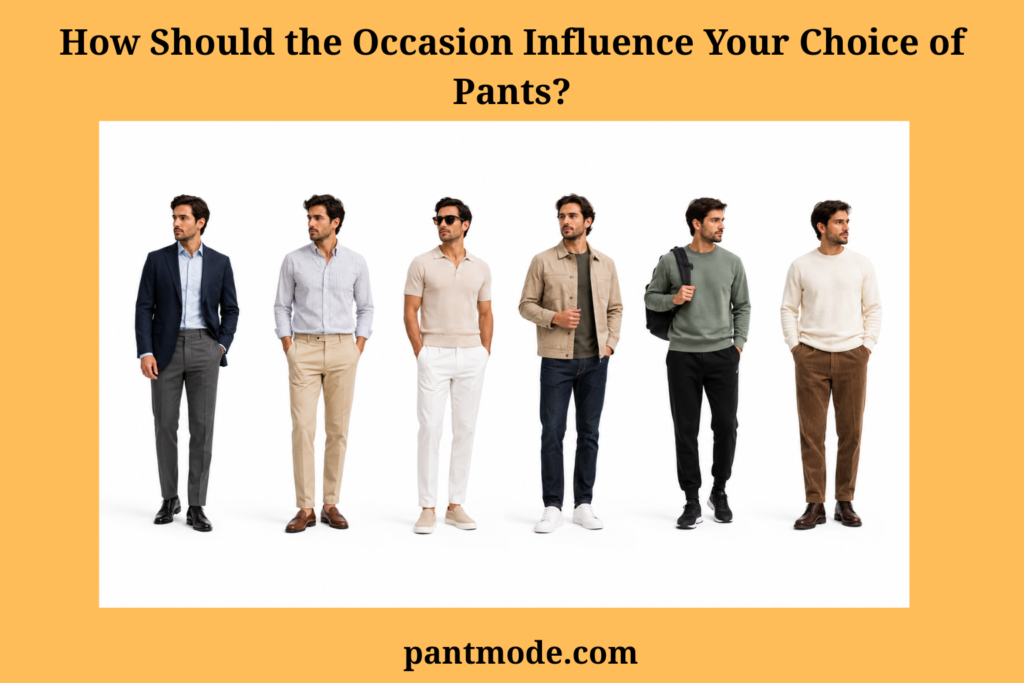
How Should the Occasion Influence Your Choice of Pants?
The occasion should influence your choice of pants by setting the outfit’s required formality, fabric polish, fit cleanliness, color direction, trouser break, closure signal, and footwear compatibility.
Pant choice should begin with event context rather than trend, brand, color, or price. Place occasion inside the wider buying factors framework, then verify the specific trousers.
The main filters are dress code, venue, time of day, season, weather, host expectation, invitation wording, fabric, fit, color, break, closure, jacket relationship, and footwear compatibility.
No pant type works for every occasion. Weddings and galas are event labels rather than complete trouser rules, and black-tie guidance applies only when the outfit uses tuxedo-based formalwear context.
Quick Answer
The occasion should influence your choice of pants by setting the required level of formality, fabric polish, fit cleanliness, color depth, trouser break, closure signal, and footwear compatibility. Casual events allow clean denim, chinos, and relaxed cotton pants; business settings usually need tailored chinos or dress trousers; formal events require polished trousers; and black-tie guidance applies only when the outfit uses tuxedo-based formalwear context.
Definition
Occasion-based pant selection means choosing pants according to the event’s dress code, venue, time of day, season, weather, host expectation, invitation wording, social expectations, and outfit structure.
Key Takeaway
Start with the occasion’s dress code, then choose pants by formality tier, fabric, color, fit, break, closure, jacket relationship, and footwear. The right pants should avoid both underdressing and overdressing.
Figure: classify the event first, then verify fabric, break, footwear, and red flags.
Why Should the Choice of Pants for the Occasion Guide the Outfit?
The choice of pants for the occasion should guide the outfit because trousers form the lower-body signal for formality, comfort, fabric polish, and social appropriateness.
Event context should come before styling details. Venue, time of day, dress code, host expectation, invitation wording, and event purpose determine how polished the trousers need to appear.
Pants form the structural base of the outfit. The wrong fabric, cut, color, closure, or break can make an otherwise coordinated outfit look too casual, too formal, too seasonal, or poorly judged.
Dark raw denim can look sharp without being formal. It may work for a smart casual dinner but still underdress a formal evening wedding or tuxedo-based black-tie event.
The trouser signal must match the setting. Casual events allow texture and comfort, business settings require polish and restraint, and tuxedo-based black tie requires a matching formal context.
Practical demands still matter. Weather, indoor or outdoor setting, travel, standing time, and footwear affect comfort and suitability. The selected pant type should support the event rather than compete with it.
Occasion Pant Formality Spectrum Table
| Formality Tier | Occasion Examples | Best Pants | Fabric Signal | Avoid |
|---|---|---|---|---|
| Casual | Weekend brunch, errands, relaxed meetups | Clean denim, casual chinos, relaxed cotton pants | Denim, cotton twill, soft cotton | Dress trousers that feel too formal |
| Smart casual | Casual dinner, creative office, date night | Dark denim, tailored chinos, five-pocket twill | Smooth cotton, refined twill, stretch chino | Distressed denim or athletic joggers |
| Business casual | Office, work lunch, networking | Tailored chinos, wool-blend trousers, flannel trousers | Cotton twill, wool blend, flannel | Ripped jeans, cargos, shiny technical fabric |
| Business formal | Boardroom, interviews, formal office | Worsted wool trousers, suit trousers, tailored dress pants | Smooth wool, tropical wool, refined blends | Chinos, denim, drawstring pants |
| Semi-formal / cocktail | Evening dinner, cocktail event | Dark tailored trousers, wool trousers, refined pleated pants | Wool, wool blend, smooth structured fabric | Casual chinos or visible utility details |
| Wedding / formal event | Ceremony, reception, gala | Invitation-based suit or refined formal trousers | Seasonally appropriate formal fabric | Denim, cargos, casual joggers |
| Black tie | Tuxedo-based formal event | Tuxedo trousers in matching tuxedo context | Fine wool or formal tuxedo cloth | Suit trousers without tuxedo context |
What Pant Formality Tiers Should Guide the Choice of Pants for the Occasion?
Pant formality tiers should guide the choice of pants for the occasion by moving from casual comfort to smart casual polish, business structure, formal tailoring, and tuxedo-based black-tie context.
The formality spectrum is a decision guide, not a rigid universal rule. Country, workplace, host, culture, venue, and invitation wording can raise or lower expectations.
Casual occasions allow clean denim, relaxed cotton trousers, cargos, or casual chinos. The pants should still look intentional and suitable for the venue.
Smart casual occasions need controlled polish. Dark denim, tailored chinos, five-pocket twill, and refined cotton trousers usually work when the footwear and upper layers support the same level.
Business casual and business formal should be separated. Tailored chinos, wool-blend trousers, or flannel trousers can support business casual, while suit trousers, tailored dress trousers, and worsted wool trousers better support business formal.
Wedding and gala labels require verification. Invitation wording, host expectation, venue, time, season, and jacket level decide whether the trousers should be seasonal formalwear, suit trousers, formal separates, or tuxedo-based trousers.
Black tie applies to tuxedo-based formalwear context. The Emily Post attire guide supports the dress-code hierarchy and formalwear distinctions. It is not used here for fabric, fit, break, or construction claims.
Figure: pant formality rises through cleaner construction, smoother fabric, stronger tailoring, and more precise outfit coordination.
Business Formal vs Black Tie Trouser Table
| Dress Code | Correct Pant Choice | Jacket Rule | Fabric Rule | Common Mistake |
|---|---|---|---|---|
| Business formal | Suit trousers or tailored dress trousers | Usually suit jacket or formal blazer context | Worsted wool, tropical wool, refined wool blend | Wearing chinos or denim |
| Semi-formal | Dark tailored trousers or suit trousers | Jacket usually expected | Smooth wool, wool blend, structured fabric | Wearing casual cotton pants |
| Cocktail | Dark tailored trousers, pleated trousers, refined separates | Jacket often improves polish | Dark, smooth, structured fabric | Overly casual chinos |
| Formal wedding | Suit trousers or refined seasonal formal trousers | Suit or formal jacket expected | Wool, linen blend, or seasonal formal fabric | Treating wedding as one fixed rule |
| Gala | Formal trousers or tuxedo-based trousers depending invitation | Host and dress code decide jacket level | Smooth formal fabric | Treating gala as automatically black tie |
| Black tie | Tuxedo trousers in matching tuxedo context | Must match tuxedo-based jacket context | Fine formal cloth with appropriate tuxedo detailing | Wearing regular suit trousers as tuxedo pants |
How Do Fabric, Fit, Color, Closure, and Break Affect the Choice of Pants for the Occasion?
Fabric, fit, color, closure, and break affect the choice of pants for the occasion because each detail changes how formal, polished, seasonal, and intentional the trousers appear.
Fabric and texture influence the social signal. Denim, canvas, slubby linen, and rugged twill usually read more relaxed, while smooth wool, tropical wool, and refined blends usually read more formal. Use pants fabric to confirm climate, texture, structure, and maintenance needs.
Product information should be checked within the correct source scope. The FTC clothing guidance supports checking textile labels, fiber content, country of origin, and manufacturer or responsible-business identity. It does not determine which fabric is most stylish for an occasion.
Fit affects visual polish and comfort. Casual events can allow relaxed cuts, while formal settings usually benefit from cleaner drape and controlled tailoring. Use pants fit to assess the waist, seat, thigh, and line of the trousers.
Color should support the time and formality. Lighter tones often work well for daytime or warm-weather settings, while navy, charcoal, grey, black, and deeper colors often support business or evening settings. Dark color alone does not make casual fabric formal.
Break must work with the shoes. No break or a slight break can look modern and clean, while a medium break can suit conservative tailoring. Uncontrolled pooling weakens formal polish. Check pants length with the footwear that will be worn.
Closure and waistband details reveal formality. Visible drawstrings and elastic usually signal casualwear, while clean waistbands, buttons, zippers, hook-and-bar closures, and formal finishes usually read more polished.
Jacket coordination must look deliberate. Suit and tuxedo-based trousers require precise jacket relationships, while separates need enough contrast to look intentional rather than almost matched.
Pant Variable Evaluation Table
| Variable | Casual Occasion | Smart Casual Occasion | Formal Occasion | Tuxedo-Based Black-Tie Context |
|---|---|---|---|---|
| Fabric | Denim, cotton, canvas, twill | Chino cloth, refined cotton, five-pocket twill | Wool, wool blend, smooth formal fabric | Formal tuxedo cloth |
| Texture | Rugged or relaxed | Smooth but not stiff | Smooth and structured | Fine and formal |
| Fit | Relaxed, straight, casual taper | Clean straight, tailored chino | Tailored, pressed, structured | Precise formal fit |
| Color | Blue, khaki, olive, brown | Navy, charcoal, stone, olive | Charcoal, navy, black, grey | Usually black or midnight navy |
| Break | No break, slight break, casual crop | No break or slight break | Slight or medium break | Clean formal break |
| Closure | Button, zipper, drawstring if casual | Zipper, button, clean waistband | Hook-and-bar, clean waistband | Formal waistband or tuxedo finish |
| Footwear | Sneakers, boots, casual loafers | Loafers, clean sneakers, boots | Dress shoes, loafers | Formal evening shoes |
Fabric and Time-of-Day Guide
| Occasion Context | Better Fabric Choice | Better Color Direction | Why |
|---|---|---|---|
| Daytime outdoor casual | Cotton, linen blend, light twill | Khaki, stone, olive, light grey | Breathable and relaxed |
| Daytime wedding | Linen blend, tropical wool, refined cotton | Light grey, tan, navy, stone | Polished but climate-aware |
| Evening dinner | Wool blend, smooth cotton, tailored twill | Navy, charcoal, black, deep brown | More refined and evening-appropriate |
| Corporate daytime | Worsted wool, tropical wool, tailored cotton | Navy, charcoal, grey | Professional and structured |
| Cocktail event | Dark wool, wool blend, refined trousers | Charcoal, navy, black | Dressy without tuxedo rules |
| Tuxedo-based black tie | Formal wool or tuxedo cloth | Black or midnight navy | Traditional tuxedo-based formality |
Pant Break and Footwear Matching Table
| Trouser Break | Best Occasion Use | Best Footwear Match | Watch-Out |
|---|---|---|---|
| No break | Modern smart casual, cropped tailored looks | Loafers, clean sneakers, slim boots | Can look too short in formal settings |
| Slight break | Business casual, business formal, weddings | Loafers, derbies, Oxfords, dress boots | Needs accurate inseam |
| Medium break | Conservative formalwear, traditional tailoring | Oxfords, derbies, dress shoes | Can look heavy if fabric pools |
| Full break | Traditional or relaxed tailoring | Substantial dress shoes or boots | Can look sloppy if unmanaged |
| Cropped break | Casual or fashion-forward occasions | Loafers, sneakers, boots | Risk of underdressing formal events |
| Stacked hem | Casual denim, streetwear, boots | Sneakers, work boots, casual boots | Usually wrong for formal trousers |
Which Choice of Pants for the Occasion Works Best for Casual, Smart Casual, Business, Formal, and Black-Tie Contexts?
The choice of pants for the occasion works best when casual, smart casual, business, formal, and black-tie contexts are separated by dress code, venue, host expectation, and outfit structure.
Casual weekend occasions support clean denim, relaxed chinos, cotton trousers, or utility pants. Casual does not mean distressed, stained, or uncontrolled.
Smart casual requires more polish. Tailored chinos, dark denim, five-pocket twill, and refined cotton trousers work best with a cleaner fit and coordinated footwear.
Business casual should look professional without full suit structure. Tailored chinos, wool-blend trousers, flannel trousers, or matte performance trousers can work when they avoid athletic sheen, cargo pockets, visible drawstrings, and overly casual stitching.
Business formal requires stronger tailoring. Worsted wool suit trousers, tailored dress trousers, or tropical wool trousers should align with the jacket, shoes, and conservative setting.
Wedding and gala trousers depend on more than the event label. Use the invitation, host, venue, time, season, jacket level, and stated dress code.
Black-tie trousers belong inside tuxedo-based formalwear. Regular chinos, jeans, or ordinary non-matching trousers do not provide the same context.
Occasion-to-Pant Decision Matrix
| Occasion Type | Recommended Pants | Best Cut | Best Footwear Match | Avoid |
|---|---|---|---|---|
| Weekend casual | Clean denim, relaxed chinos | Straight, relaxed, casual taper | Sneakers, boots, casual loafers | Distressed or sloppy pants |
| Smart casual dinner | Dark denim, tailored chinos, five-pocket twill | Straight, slim-straight, tapered | Loafers, boots, clean sneakers | Gym joggers |
| Creative workplace | Pleated chinos, cropped wool trousers, dark denim | Relaxed tailored, straight | Loafers, boots, minimalist sneakers | Too-formal suit trousers |
| Business casual | Tailored chinos, flannel trousers, wool-blend pants | Tailored straight | Loafers, derbies, dress boots | Cargos, distressed denim |
| Business formal | Suit trousers, dress trousers, worsted wool trousers | Tailored straight, slight taper | Oxfords, derbies, loafers | Chinos or denim |
| Cocktail | Dark tailored trousers, pleated wool trousers | Clean drape, slight taper | Dress shoes or polished loafers | Heavy denim |
| Daytime wedding | Invitation-based seasonal formal trousers | Tailored, breathable | Loafers, derbies | Treating all weddings the same |
| Evening wedding | Invitation-based suit trousers or formal separates | Tailored and structured | Dress shoes | Casual chinos when the code is formal |
| Gala | Host-defined formal or tuxedo-based trousers | Precise tailored fit | Formal dress shoes | Assuming every gala is black tie |
| Black tie | Tuxedo trousers in tuxedo-based context | Formal tailored | Formal evening shoes | Regular chinos, jeans, or non-matching trousers |
How Do Business Formal and Black-Tie Contexts Change the Choice of Pants for the Occasion?
Business formal and black-tie contexts change the choice of pants for the occasion because business formal relies on suit-level polish, while black tie requires tuxedo-based trouser and jacket context.
Business formal trousers support professional authority. Suit trousers, tailored dress trousers, and refined wool trousers can suit interviews, boardrooms, conservative offices, and formal professional events.
Black-tie trousers are not simply black dress pants. The trousers must belong to a tuxedo-based outfit when strict black tie is stated.
Regular suit trousers can still fail strict black tie. They may look polished, but they do not automatically provide tuxedo-based context.
Black-tie optional is more flexible than strict black tie. The invitation wording must control whether a formal alternative is acceptable.
Black-Tie vs Business Formal Red Flag Box
| Question | Business Formal Answer | Black-Tie Context Answer |
|---|---|---|
| Are the trousers part of a business suit? | Usually acceptable | Not enough for strict black-tie context |
| Is the jacket tuxedo-based? | Not required | Required for tuxedo-based black tie |
| Do the trousers need formal tuxedo context? | Usually no | Yes |
| Are chinos acceptable? | Usually no | No |
| Is polished wool enough? | Often yes | Not always |
| Can separates work? | Sometimes | Only if the dress code allows creative or optional black tie |
| Does this apply to every formalwear tradition? | No | No; this applies to tuxedo-based context |
| Main mistake | Dressing too casually for business authority | Replacing tuxedo-based trousers with ordinary dress pants |
How Can You Fix a Choice of Pants for the Occasion That Does Not Match the Setting?
You can fix a choice of pants for the occasion that does not match the setting by identifying whether the mismatch comes from formality, fabric, closure, fit, break, jacket pairing, or footwear.
Shiny technical fabric can look too athletic in a conservative office. Replace it with matte wool, refined cotton, or another polished fabric.
Dark denim can still underdress a formal evening event. Switch to dress trousers, suit trousers, or another invitation-appropriate formal option.
Heavy denim can fail a hot outdoor event. Use a lighter, breathable formal or smart-casual fabric that still matches the dress code.
Visible drawstrings weaken business polish. Replace them with a clean waistband when the event requires professional structure.
Tuxedo trousers without tuxedo context look incomplete. Wear the matching tuxedo-based outfit or choose ordinary formal trousers appropriate to the event.
Length and jacket mismatch can spoil otherwise suitable pants. Correct pooling hems and avoid nearly matching separates that look accidental.
Occasion Mismatch Red Flags Box
| Red Flag | What It Signals | Quick Fix |
|---|---|---|
| Fabric is shiny in a conservative office | Too technical or casual | Choose matte wool or refined cotton |
| Pants have cargo pockets at a formal event | Too utilitarian | Choose clean tailored trousers |
| Denim appears at a formal dinner | Underdressed | Switch to wool or dress trousers |
| Drawstring is visible at a business dinner | Too casual | Choose clean-waistband trousers |
| Heavy fabric at an outdoor summer event | Weather mismatch | Choose linen blend or tropical wool |
| Trousers pool over shoes | Poor length | Tailor to slight or clean break |
| Jacket and trousers nearly match | Accidental mismatch | Use a complete suit or intentional separates |
| Tuxedo trousers without matching tuxedo context | Incomplete formalwear signal | Use tuxedo context or choose formal trousers |
| Casual sneakers with formal trousers | Footwear mismatch | Switch to dress shoes or less formal pants |
| Black pants with casual fabric | False formality | Choose smoother fabric and cleaner construction |
| Wedding trousers ignore invitation wording | Event mismatch | Follow invitation, venue, season, and host expectation |
| Gala outfit assumes black tie | Dress-code mismatch | Check invitation or host guidance |
What F50 Checks Verify the Choice of Pants for the Occasion?
F50 checks verify the choice of pants for the occasion by turning dress code, venue, fabric, formality, red flags, exceptions, and final confirmation into a controlled decision path.
F50 is required because this is a decision-control problem. The reader must move from uncertainty to classification, recommendation, red-flag detection, exception handling, and final verification.
Trigger: identify whether the pants may be too casual, too formal, too seasonal, too technical, or wrong for the jacket and shoes.
Classification: classify the dress code, venue, time, host expectation, invitation wording, and outfit structure before recommending trousers.
Recommendation: match the classification to the correct formality tier and trouser signal.
Red flag: catch denim, cargo pockets, visible drawstrings, athletic sheen, wrong break, jacket mismatch, or tuxedo-context errors.
Exception: allow dark denim, chinos, linen blends, technical trousers, tailored drawstring trousers, separates, black-tie optional, or cultural formalwear only when context supports them.
Verification: approve the trousers only after dress code, fabric, fit, break, closure, jacket, footwear, comfort, source-scope, and URL checks pass.
Figure: F50 converts occasion-based pant selection into a controlled path from uncertainty to final verification.
F50 Occasion Pant Decision-Control Table
| F50 Step | Control Question | Pass Standard |
|---|---|---|
| Trigger | Is the reader choosing pants for a specific event or dress code? | Occasion is known or reasonably inferred |
| Classification | What is the dress code, venue, time, host expectation, and invitation wording? | The event is classified before trousers are recommended |
| Recommendation | Which pant formality tier matches the classification? | Pants match casual, smart casual, business, formal, or tuxedo-based context |
| Red flag | Do the pants show denim, cargo pockets, drawstrings, sheen, wrong break, or jacket mismatch where inappropriate? | Red flags are removed or justified by context |
| Exception | Does the event allow black-tie optional, creative workplace, warm-weather fabric, or cultural formalwear? | The exception is stated and bounded |
| Verification | Do fabric, fit, break, closure, jacket, footwear, and comfort align? | The final choice passes the full decision path |
| Source scope | Are Emily Post and FTC used only within their evidence limits? | No source is stretched beyond scope |
| URL validation | Are all internal links from the Pant Factors cluster only? | No self-link, no Pant Types link, and no invented URL |
What Checklist Helps the Choice of Pants for the Occasion?
A checklist helps the choice of pants for the occasion by testing dress code, venue, time, weather, fabric, fit, break, jacket relationship, footwear, exceptions, and mismatch red flags.
Use the first checklist before getting dressed or buying pants for the event. Use the final checklist when the complete outfit is assembled.
5-Minute Pre-Occasion Pant Selection Checklist
| Step | Question | Pass / Fail |
|---|---|---|
| Dress code | Do I know the expected formality level? | |
| Event label | Am I treating wedding or gala as a label, not a complete trouser rule? | |
| Venue | Do these pants match the venue? | |
| Time of day | Are the color and fabric right for day or evening? | |
| Weather | Will the fabric feel comfortable in the climate? | |
| Fabric | Is the material appropriate for the occasion? | |
| Label check | If buying, have I checked fiber content, country of origin, and responsible-business information where available? | |
| Fit | Do the pants sit cleanly at waist, seat, and thigh? | |
| Break | Does the hem work with the shoes? | |
| Closure | Does the waistband or closure match the formality level? | |
| Jacket | Do the pants match or intentionally contrast with the jacket? | |
| Footwear | Do the pants and shoes belong to the same formality level? | |
| Exception | Is any exception supported by invitation, host, venue, culture, or weather? | |
| Red flags | Do the pants avoid denim, cargo pockets, drawstrings, or sheen when inappropriate? | |
| Final decision | Would the host or setting read the outfit as appropriate? |
Final Occasion-Based Pant Selection Checklist
| Final Check | Pass / Fail |
|---|---|
| Have I identified the occasion’s dress code? | |
| Have I considered venue, time, season, weather, and host expectation? | |
| Have I checked invitation wording when the event is a wedding or gala? | |
| Do the pants match the occasion’s formality tier? | |
| Is the fabric suitable for the event as practical style guidance? | |
| If buying, have I checked fiber content, country of origin, and responsible-business information where available? | |
| Is the color suitable for daytime, evening, casual, or formal use? | |
| Is the trouser fit clean enough for the setting? | |
| Does the break work with the footwear? | |
| Are the pockets, closure, and waistband appropriate? | |
| If wearing a suit or tuxedo-based outfit, do the jacket and trousers match correctly? | |
| If wearing black tie, is this a tuxedo-based formalwear context? | |
| If wearing separates, does the contrast look intentional? | |
| If using an exception, is the exception clearly justified? | |
| Do the pants avoid underdressing the occasion? | |
| Do the pants avoid overdressing the occasion? | |
| Do the pants support comfort for the event length? | |
| Do the pants create the correct social signal? | |
| Is this the best available pant choice for the occasion? |
Frequently Asked Questions About the Choice of Pants for the Occasion
Tailored chinos, dark denim, refined five-pocket twill, and clean cotton trousers usually suit smart casual settings when the fit, footwear, and venue support the same level of polish.
Yes. Tailored chinos can work for many business casual settings, but the fabric, cut, waistband, footwear, and workplace expectations must look professional rather than athletic or relaxed.
Regular suit trousers are not the same as tuxedo trousers in strict tuxedo-based black-tie context. Invitation wording and host expectations should be checked before choosing an alternative.
A wedding label alone is not enough. Use the invitation, venue, time of day, season, host expectation, jacket level, and stated dress code to choose the trousers.
Visible drawstrings, cargo pockets, distressed denim, athletic sheen, poor drape, excessive hem pooling, or a jacket and footwear mismatch can make trousers too casual for the setting.
Conclusion: What Final Rule Should Guide the Choice of Pants for the Occasion?
The final rule for the choice of pants for the occasion is to match the trouser’s formality signal to the event before judging trend, color, brand, or personal preference.
Identify the occasion, dress code, venue, time of day, season, host expectation, and invitation wording. Then confirm fabric, fit, color, break, closure, jacket relationship, footwear, valid exceptions, and final verification.
No single pant type works for every occasion. Casual, smart casual, business casual, business formal, formal, wedding, gala, and tuxedo-based black-tie contexts require different signals.
Fabric and fit should confirm the occasion decision rather than replace it.
The right pants for an occasion are the pair that match the event’s formality, support the setting, work with the footwear and jacket, respect valid exceptions, and still feel comfortable for the full event.