
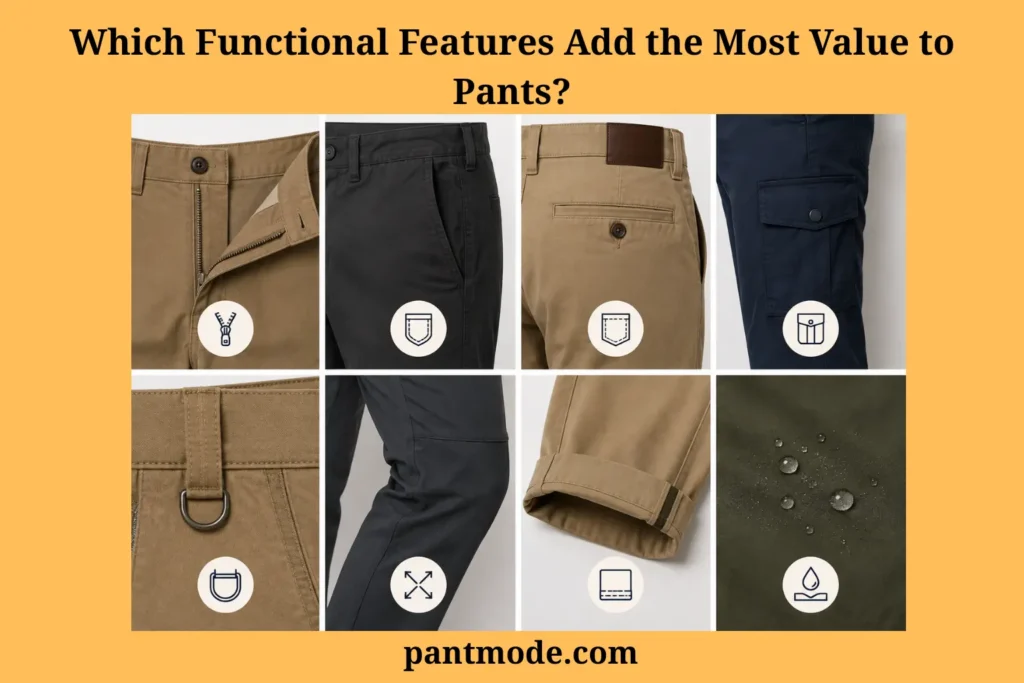
Which Functional Pant Features Add the Most Practical Value?
Functional pant features add the most practical value when they solve real movement, storage, durability, closure, fit-adjustment, visibility, or weather-management problems for the way the pants will actually be worn.
The best feature set depends on activity, environment, carry needs, dress code, maintenance tolerance, visibility needs, comfort priorities, and construction quality. Within the wider pants-buying factors framework, feature count matters less than whether each detail improves a repeated real-life task.
Quick Answer
Functional pant features add the most practical value when they solve real problems such as movement, secure storage, abrasion resistance, closure reliability, fit adjustment, visibility, or light weather handling. Useful features may include secure pockets, reinforced stress points, reliable closures, comfortable waist systems, gusseted crotch construction, articulated knees, reinforced wear zones, reflective details where visibility matters, and DWR where the use case supports it. No feature is universally best; each one must be judged by activity, construction quality, comfort, trade-offs, and actual use.
Definition
Functional pant features are construction details, materials, pockets, closures, mobility elements, reinforcements, visibility details, and finishes that improve how pants perform for a specific activity or lifestyle need.
Key Takeaway
Prioritize functional pant features that solve a problem you actually have. Test movement, storage, hardware, seams, reinforcement, waistband comfort, visibility relevance, weather claims, and trade-offs before paying for extra technical details.
Source Scope
University of Georgia Extension textile quality guidance supports point-of-sale garment checking, labels, fabric finishes, abrasion resistance, and water-repellent, water-resistant, and waterproof terminology. It does not establish DWR-specific chemistry, maintenance, gusset mobility, articulated-knee mobility, bar-tack-specific durability gains, or hardware-brand superiority.
New Mexico State University clothing construction standards support general checks for seams, stitching, pockets, waistbands, zippers, buttons, snaps, hooks, eyes, and fasteners. They do not establish mobility-feature performance, reflective safety certification, DWR performance, or exact lifespan gains.
URL Validation Status
The article is built for https://pantmode.com/pant-factors/features/, but the supplied brief records the target as not yet public-live validated. The article therefore does not self-link to the target in body content and does not activate the Closure Type URL. Only the four approved live Pant Factors links supplied in the brief are active.
Functional value comes from a real use-case benefit that remains worthwhile after trade-offs are considered.
Why Do Functional Pant Features Matter for Comfort, Durability, and Daily Use?
Functional pant features matter for comfort, durability, and daily use because they can solve repeated problems in movement, storage, closure security, abrasion resistance, visibility, weather exposure, and fit adjustment.
A useful feature should solve a repeated problem. A secure zip pocket can matter for frequent travel but may be unnecessary for someone who rarely carries valuables in trouser pockets. Reflective detail may support a low-light bike commute but add no practical value to office trousers.
Context controls value. Articulated knees can support kneeling or climbing when the shaping aligns with the wearer’s knee, while the same construction may add unwanted technical styling to formal trousers. Extra pockets, zippers, panels, and hardware can add bulk, weight, cost, visual complexity, and failure points.
Six poorly placed cargo pockets can provide less utility than two secure, accessible pockets.
| Feature | Primary Value | Best Use Cases | Main Construction Check | Possible Trade-Off |
|---|---|---|---|---|
| Gusseted crotch | Additional shaping or movement space when fit supports it | Cycling, hiking, workwear | Gusset shape and seam quality | Extra seam complexity |
| Articulated knees | Conditional bent-knee shaping support | Hiking, trades, climbing | Dart or panel placement | Technical appearance |
| Security pocket | Item retention | Travel, commuting | Closure and usable depth | Added bulk |
| Reinforced knees | Abrasion-zone support | Trades, outdoor work | Coverage of wear zone | Heat and weight |
| Reinforced stress points | Local construction support | Workwear, carry-heavy daily use | Secure stitching and placement | Minimal visual change |
| Adjustable waistband | Fit flexibility | Travel, work, changing layers | Secure adjuster | May reduce formal appearance |
| Stretch fabric | Mobility | Commute, office, active use | Recovery quality | May lose crisp structure |
| DWR finish | Surface wetting reduction | Travel, outdoor use | Finish description and care needs | Not waterproof by itself |
| Reflective detail | Visibility support in low light | Bike commute, walking, outdoor work | Placement and relevance | Technical appearance |
Which Functional Pant Features Provide the Most Practical Value?
Functional pant features provide the most practical value when they improve movement, storage, durability, closure reliability, waistband comfort, visibility, or surface weather handling for a specific use case.
Gusseted crotch: can create additional shaping or movement space when the pattern and fit support it. It does not prove greater durability or guarantee seam-failure prevention.
Articulated knees: can support bent-knee shaping when the articulation aligns with the wearer’s knee. This is not a quantified mobility claim and does not prove anti-bagging performance.
Security pockets: utility depends on depth, placement, closure, access, and load distribution rather than pocket count alone. Reinforced stress points: can support areas of repeated stress, but exact lifespan claims require product-specific evidence.
Adjustable waist systems: can add fit flexibility but may reduce formality. Reflective details: can support visibility when low-light exposure is real, but small reflective details are not automatically certified safety equipment.
Movement features must also work with the underlying pants fit; a gusset cannot rescue a rise, seat, or thigh cut that is fundamentally wrong.
| Feature | Mobility Benefit | Best For | Does Not Automatically Solve |
|---|---|---|---|
| Gusseted crotch | Additional movement space when pattern and fit support it | Squatting, cycling | Poor overall sizing |
| Articulated knee | Bent-knee shaping support when aligned correctly | Hiking, trades | Weak fabric recovery |
| Stretch woven fabric | Easier movement | Commuting, office | Bad pattern geometry |
| Elastic waistband section | Sitting comfort | Travel, office | Incorrect rise |
| Relaxed thigh cut | More leg room | Work, athletics | Excessive hem volume |
| Knee pleats or darts | Shape during flexion when positioned correctly | Outdoor and work use | Fabric abrasion |
| Visibility Feature | Useful When | Check | Boundary |
|---|---|---|---|
| Reflective trim | Low-light commuting or walking | Placement is visible during real movement | Not automatically certified safety equipment |
| Reflective logo/detail | Supplementary visibility is useful | Size and placement suit the activity | Small details do not replace verified safety gear |
| High-contrast panel | Work or outdoor visibility matters | Contrast remains visible in the intended environment | Certification requires product-specific evidence |
Which Functional Pant Features Should You Prioritize for Travel, Work, Office, and Outdoor Use?
The functional pant features you should prioritize for travel, work, office, and outdoor use depend on the main activity, dress code, movement demand, carry needs, visibility needs, and environment.
Travel: secure pockets, comfortable waistband, durable fabric, and usable front pockets are high-value. Stretch and DWR may help when the trip demands them, but many zippers can add bulk.
Bike commute: seated comfort, stable waistband, secure pocketing, stretch, and optional reflective detail may matter. Reflective trim should not be described as safety certification unless a product standard verifies it.
Trades: reinforced knees, durable seams, strong loops, and useful tool storage can match abrasion and carrying needs, with weight and heat as trade-offs.
Office: clean pockets, comfortable waistband, recovery, and smooth closures can add utility without obvious technical styling. Hiking: mobility, abrasion resistance, secure storage, and relevant weather handling usually matter more than visual ruggedness.
Every scenario should also pass the relevant pant occasion test because visible technical details can conflict with stricter settings.
| Scenario | Priority Features | Useful Extras | Main Trade-Off |
|---|---|---|---|
| Travel | Secure pockets, comfortable waist | DWR, stretch | Added zipper bulk |
| Bike commute | Gusset, stretch, secure pocket, stable waistband | Reflective detail for low-light use | Technical appearance |
| Trades | Reinforced knees, strong loops, durable seams | Knee-pad pockets, tool storage | Weight and heat |
| Office | Clean waistband, recovery, smooth closure | Hidden elastic, discreet stretch | Less traditional tailoring |
| Hiking | Mobility, abrasion resistance, secure pockets | Articulation, DWR, visibility detail where relevant | Reduced formal versatility |
| Everyday | Pockets, durable seams, reliable closure | Stretch, adjusters | Feature overload |
Pocket capacity, closure operation, seam quality, movement, and relevant weather or visibility needs should all be tested directly.
How Can You Test Functional Pant Features Before Buying?
You can test functional pant features before buying by checking whether pockets, closures, seams, reinforcements, waistbands, fabric, visibility details, and movement features work under realistic use.
Pockets: place normal carry items inside, then sit, walk, and bend. Protrusion, fall-out, bouncing, or pressure points are useful red flags.
Zippers: open and close them several times. Snagging, uneven resistance, poor alignment, loose sliders, weak stops, or poorly attached tape matter more than a logo.
Snaps and buttons: should engage reliably without excessive force that strains the fabric. Seams and reinforcement: should be secure and placed where the garment actually experiences stress or abrasion.
Visibility: check whether the reflective or contrasting detail is positioned where it can matter. Movement: sit, walk, bend, climb a step, and perform a shallow squat.
| Component | Good Signal | Red Flag |
|---|---|---|
| Zipper | Smooth movement, secure stops, aligned tape | Snagging or loose slider |
| Snap | Firm engagement | Weak or excessively difficult closure |
| Button | Secure stitching or attachment | Loose shank or pulling fabric |
| Buckle | Appropriate load strength for use case | Flexing or weak attachment |
| Drawcord | Secure anchor and usable adjustment | Pulls out easily |
| Elastic adjuster | Returns and holds tension | Twists or loses tension |
| Belt loop | Reinforced attachment | Stitching pulls under light load |
Which Pocket Designs Make Functional Pant Features Useful Without Creating Unnecessary Bulk?
Pocket designs make functional pant features useful without unnecessary bulk when they hold real items securely, remain comfortable during movement, and collapse cleanly when empty.
Front pockets should provide usable depth and a practical opening. Security zip pockets can retain travel valuables but should remain comfortable while seated. Drop-in thigh pockets should place loads where they do not bounce or restrict movement.
Cargo pockets are useful only when the added capacity is genuinely needed; closure security and clean collapse when empty matter. Rear welt and hidden interior pockets can preserve a cleaner appearance but still need sufficient depth and access.
| Pocket Type | Primary Use | Quality Check | Main Risk |
|---|---|---|---|
| Front slash | Daily essentials | Depth and opening | Items fall out |
| Security zip | Travel valuables | Closure and comfort | Bulk |
| Drop-in thigh | Work or outdoor tools | Placement | Bounce |
| Cargo | Larger storage | Closure and structure | Silhouette bulk |
| Rear welt | Slim storage | Bag depth | Sitting pressure |
| Hidden interior | Cards or passport | Access | Difficult retrieval |
Which Functional Pant Features Are Useful, and Which Are Mostly Gimmicks?
Functional pant features are useful when they solve a practical problem, and they become gimmicks when they add visual complexity without improving movement, storage, durability, closure reliability, comfort, visibility, or weather handling.
More pockets: test real storage rather than count. Metal hardware: judge operation, attachment, load suitability, and corrosion context; engineered polymer can be the better choice in some uses.
DWR: treat it as surface water repellency, not automatic waterproofing. Visible knee panels: test whether they align with actual flexion rather than assuming visual panels equal articulation.
Technical-looking zippers: quality comes from operation and installation, not appearance or brand alone. Reflective trim: is visibility support unless a verified safety standard says more.
| Feature | Good Implementation | Poor Implementation |
|---|---|---|
| Gusset | Properly positioned with clean seams | Decorative insert with no useful movement benefit |
| Articulated knee | Aligns with actual knee flexion | Dart positioned away from knee |
| Cargo pocket | Secure and collapses when empty | Floppy with weak closure |
| Security zipper | Smooth and comfortable | Scratches body or snags |
| Reinforcement | Covers actual wear zone | Random decorative panel |
| Waist adjuster | Holds securely | Slips during wear |
| DWR | Clearly described as surface repellency | Marketed as waterproof without construction support |
| Reflective detail | Placed where low-light visibility matters | Decorative trim with no relevant use case |
What Trade-Offs Should You Consider Before Adding More Functional Pant Features?
You should consider the trade-offs of functional pant features before buying because every added pocket, closure, reinforcement, finish, visibility detail, or mobility detail can increase bulk, weight, stiffness, maintenance, visual complexity, or price.
Extra pockets add storage but also bulk and weight. Reinforced knees can support abrasion zones but add heat and stiffness. A gusset can support movement space when fit supports it but adds seams.
Stretch can improve movement but may reduce crisp structure or depend heavily on recovery. Hidden elastic can improve sitting comfort while making the waistband look less traditional. DWR can reduce surface wetting but needs accurate claim wording and garment-specific care awareness.
Metal and polymer hardware both have valid contexts. Articulation and reflective details can add useful movement or visibility while making the garment look more technical.
The underlying pants fabric affects abrasion, stretch, recovery, drape, heat, and finish behavior, so feature decisions should not be separated from material behavior.
| Feature | Benefit | Potential Trade-Off |
|---|---|---|
| Extra pockets | More storage | Bulk and weight |
| Reinforced knees | Abrasion-zone support | Heat and stiffness |
| Gusset | Movement space when fit supports it | Additional seams |
| Stretch | Ease of movement | Possible loss of crisp structure |
| Hidden elastic | Sitting comfort | Less traditional waistband |
| DWR | Surface water repellency | Finish requires claim and care awareness |
| Metal hardware | Strength in some uses | Weight or corrosion potential |
| Polymer hardware | Light and corrosion-resistant in some contexts | Quality varies |
| Articulation | Bent-knee shaping support | Technical look |
| Reflective detail | Low-light visibility support | Technical look; not automatic safety certification |
| Tool loops | Fast access | Snagging potential |
| Zipper pockets | Security | Slower access |
What F50 Checks Verify Functional Pant Features Before Purchase?
F50 checks verify functional pant features before purchase by turning use case, feature purpose, construction quality, comfort impact, trade-offs, red flags, exceptions, and real movement tests into a controlled decision path.
Trigger: define whether the task is choosing, comparing, inspecting, or rejecting a feature set. Classification: identify use case, primary problem, activity demand, dress code, construction quality, comfort impact, maintenance burden, and trade-offs.
Recommendation: match features to real activity. Red flag: stop for pocket overload, weak closures, poor zipper operation, bad reinforcement placement, DWR overclaim, reflective safety overclaim, brand-name overreliance, or decorative technical styling with no function.
Exception: feature-heavy pants can be right for work, travel, outdoor, carry, or visibility needs, while minimal-feature pants can be better where clean appearance matters. Verification: approve only after movement, storage, hardware, seam, reinforcement, weather, visibility, and trade-off checks pass.
| F50 Step | Control Question | Pass Standard |
|---|---|---|
| Trigger | Is the reader choosing, comparing, inspecting, or rejecting functional pant features? | Decision situation is clear |
| Classification | What use case, feature purpose, dress code, activity demand, and construction quality apply? | Feature need is classified before recommendation |
| Recommendation | Which feature set matches the actual lifestyle problem? | Features solve real needs |
| Red flag | Is there feature overload, weak hardware, poor pocket placement, DWR overclaim, reflective safety overclaim, or brand-name overreliance? | Risk is named before approval |
| Exception | Is a feature-heavy or minimal-feature design justified by use case and dress code? | Exception is clearly justified |
| Verification | Do movement, carry, closure, seam, reinforcement, weather, visibility, and trade-off checks pass? | Pants are approved only after real tests |
| Source scope | Are UGA and NMSU used only within evidence limits? | No source is stretched beyond scope |
| URL validation | Are only live approved internal links used? | No self-link, no /pant-types/, no non-live URL, no invented URL |
F50 prevents feature-count bias by requiring classification, red-flag control, exceptions, and real-use verification.
What Checklist Helps You Evaluate Functional Pant Features Before Purchase?
A checklist helps you evaluate functional pant features before purchase by testing mobility, storage, durability, hardware, visibility, weather handling, fit, appearance, and value against your actual lifestyle.
Use the checklist before keeping the pants. Check states are saved locally in the browser on the same device.
Mobility
Storage
Durability
Hardware
Visibility
Weather / Performance
Fit & Appearance
Value
Final Feature Priority Checklist
What Final Rule Should Guide Functional Pant Features?
The final rule for functional pant features is to choose the details that solve your real movement, storage, durability, closure, fit, visibility, or weather needs without adding unnecessary bulk, weight, cost, or complexity.
Start with the use case, activity, environment, carry needs, dress code, mobility, storage, durability, closures, reinforcement, visibility, DWR, comfort, construction quality, maintenance burden, and trade-offs.
No single feature, pocket design, hardware material, zipper brand, reinforcement panel, gusset, articulated knee, DWR finish, reflective detail, or waistband system is universally best. Function is proven by use-case fit and construction quality, not rugged appearance.
The best functional pant features are the ones you actually use, can move comfortably in, can maintain realistically, and would still choose after removing the marketing language.