
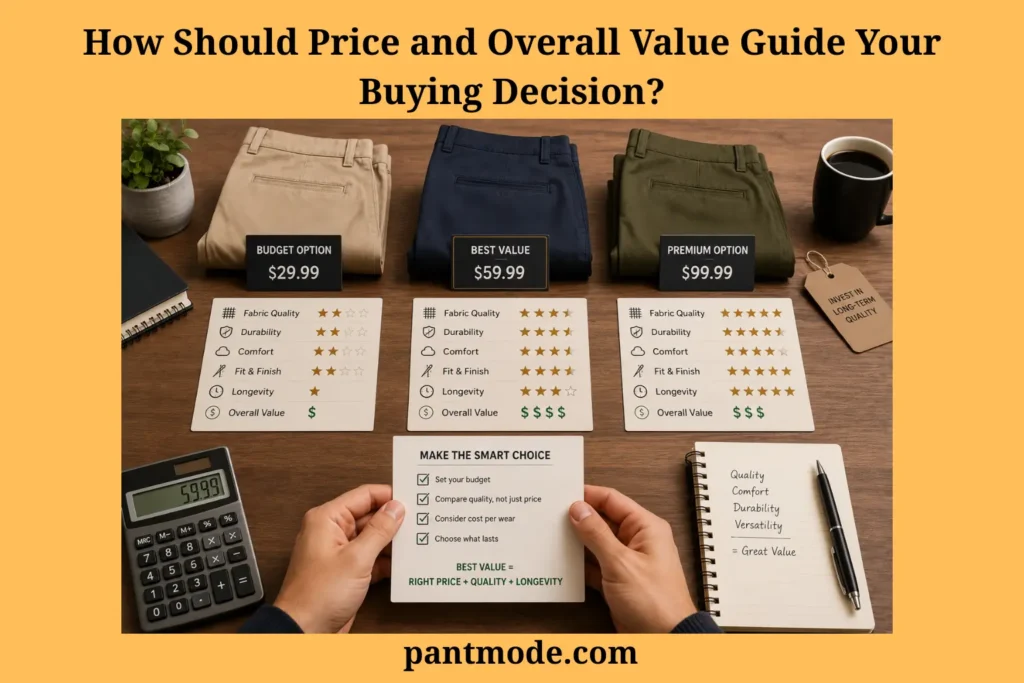
How Should Price and Overall Value Guide Your Pants Buying Decision?
Price and value when buying pants should guide your decision by separating the amount you pay upfront from the practical usefulness you receive through fit, comfort, construction, wear frequency, care, and long-term ownership.
Price is immediate, while value is use-based. A low-priced pair can still be poor value when it fits badly or goes unworn, and a higher-priced pair can be justified when tangible benefits match your actual needs and likely wear. Within the wider pants-buying factors framework, price should be checked after purpose, fit, fabric, sizing, and function are understood.
Quick Answer
Price and value when buying pants are related but not the same. Price is the upfront amount paid, while overall value depends on how well the pants fit, feel, function, wear, match your wardrobe, and justify their total ownership cost. A cheaper pair can be strong value if it meets your needs and gets worn often. A more expensive pair can be poor value if it fits badly, requires costly care, or stays unused.
Definition
Pants price is the immediate financial cost of acquiring the pants. Overall pants value is the practical usefulness the buyer receives relative to acquisition cost, ownership cost, wear frequency, fit, fabric, construction, versatility, care, and repairability.
Key Takeaway
Judge pants by value delivered, not price alone. The best-value pair is the one that fits well, serves a real use, works with your wardrobe, avoids unnecessary ownership costs, and justifies its price through realistic wear.
Source Scope
FTC Apparel and Labeling guidance supports textile fiber-content, country-of-origin, manufacturer or marketer identity, and care-label requirements. Those disclosures help buyers identify what a textile product is and how it should be cared for, but they do not prove value, durability, cost per wear, or brand superiority.
NMSU Clothing Construction Standards support inspection of garment construction such as seams, stitching, pockets, waistbands, zippers, buttons, fasteners, fit, hems, and general construction neatness. They do not establish a universal pants lifespan, a best price point, or guaranteed durability.
URL Validation
PantMode’s buying guide includes Price as a pants-buying factor. The supplied target URL is not currently treated as a live public pass, so this article does not self-link to the Price page. Only approved supporting Pant Factors URLs that currently return usable content are linked in the article body.
A price tag becomes meaningful only after the actual pants pass fit, construction, use, and ownership-cost checks.
What Is the Difference Between price and value when buying pants?
The difference between price and value when buying pants is that price is the immediate cost of acquisition, while value measures how well the pants serve your needs relative to their total relevant cost.
Price starts with the listed purchase amount and can include shipping, applicable taxes, required initial alterations, and other necessary costs needed to make the pants usable. Those numbers describe what must be paid, not whether the garment will fit well or become useful.
Overall value adds fit, comfort, fabric suitability, construction, durability signals, expected wear frequency, wardrobe versatility, care burden, repairability, alteration needs, returns, and warranty support where relevant. A lower price does not automatically create poor value, and a higher price does not automatically create good value.
Price vs. Overall Value Table
| Variable | What Price Shows | What Price Alone Cannot Show |
|---|---|---|
| Purchase cost | Immediate expense | Fit quality |
| Fabric | May affect price | Suitability for wearer |
| Construction | May influence cost | Guaranteed durability |
| Brand | Market positioning | Product quality |
| Versatility | Not directly shown | Future wear frequency |
| Care | Sometimes reflected indirectly | Total upkeep burden |
| Comfort | Not determined by price | Individual experience |
Which Factors Determine price and value when buying pants?
The factors that determine price and value when buying pants include fit, fabric suitability, construction, durability, versatility, care requirements, repairability, alteration needs, and expected wear frequency.
Fit creates use value. Check waist, rise, seat or hip, thigh, inseam, silhouette, and movement comfort. Expensive trousers do not automatically fit better, and a lower-priced pair that fits properly can earn more real wear. Use the current pants fit as a product-level test rather than assuming price predicts comfort.
Fabric creates context value. Verify fiber composition, weight when disclosed, stretch and recovery, breathability, texture, and care needs. The actual pants fabric must suit climate, activity, and care routine.
Construction creates reliability signals. Inspect seams, waistband, pockets, closures, finishing, and reinforcement according to intended use. Durability matters, but no universal lifespan should be assigned.
Versatility, care, and repairability affect the number of realistic wears and the burden of ownership. Count only outfits and situations you genuinely expect to use, and include repair cost only when a realistic repair would restore meaningful future use.
Pants Value Factor Matrix
| Factor | What to Evaluate | Possible Value Contribution | Main Boundary |
|---|---|---|---|
| Fit | Measurements and movement | More frequent wear | Individual comfort varies |
| Fabric | Composition and performance | Comfort and suitability | Premium does not automatically mean better |
| Construction | Seams, waistband, pockets, closures | Reliability | Use-dependent |
| Durability | Stress zones and fabric behavior | Potentially fewer replacements | Lifespan uncertain |
| Versatility | Outfit and occasion compatibility | Higher use potential | Wardrobe-dependent |
| Care | Cleaning and pressing burden | Lower ownership burden | Routine varies |
| Repairability | Alteration and repair options | Potential extended use | Cost varies |
| Support | Returns, warranty, repair help | Lower post-purchase risk | Support does not prove quality |
How Do Ownership Cost and Cost Per Wear Shape price and value when buying pants?
Ownership cost and cost per wear shape price and value when buying pants by showing how the upfront purchase price changes once alterations, care, repairs, and realistic wear frequency are considered.
Step 1: add the purchase price, shipping, applicable known taxes, required initial alterations, and other necessary initial costs.
Step 2: add only relevant ownership costs such as specialized cleaning, pressing, repairs, or replacement closures when they meaningfully differ between options.
Step 3: subtract residual value only when realistic resale evidence exists.
Step 4: estimate cost per wear using realistic expected wears from actual wardrobe habits.
Boundary: Expected wears are a planning assumption, not a guaranteed lifespan.
Ownership Cost Calculation Table
| Cost Input | Include When | Exclude When | Boundary |
|---|---|---|---|
| Purchase price | Always | Never | Upfront price only |
| Shipping | Buyer must pay it | Free or same across options | Do not double count |
| Taxes | Applicable and known | Unknown or equal across options | Keep estimate transparent |
| Initial alterations | Required for wearable fit | Optional or uncertain | Do not hide true acquisition cost |
| Care cost | Meaningfully different from alternatives | Same for all compared pants | Avoid inflated assumptions |
| Repair cost | Predictable or relevant | Purely hypothetical | Do not invent problems |
| Residual value | Realistic resale evidence exists | No clear resale market | Optional only |
Hypothetical Cost-Per-Wear Comparison
| Variable | Pant A | Pant B |
|---|---|---|
| Purchase Price | $50 | $120 |
| Initial Alterations | $0 | $15 |
| Relevant Estimated Care or Repair | $10 | $15 |
| Estimated Ownership Cost | $60 | $150 |
| Estimated Wears | 45 | 150 |
| Estimated Cost Per Wear | $1.33 | $1.00 |
Interpretation: Pant B appears to have the lower estimated cost per wear only under these hypothetical assumptions. The example does not prove Pant B will actually last longer or be better value for every buyer.
Expected wears should come from realistic wardrobe behavior, not an invented ownership period or optimistic lifespan promise.
Which Metrics Help Compare price and value when buying pants at Different Price Points?
The metrics that help compare price and value when buying pants at different price points include cost per wear, expected wear frequency, fit quality, needs coverage, versatility, repairability, replacement risk, and realistic resale value.
Use cost per wear only when both cost and wear assumptions are credible. Expected frequency should reflect actual wardrobe behavior, while fit quality should be checked from measurements and movement rather than price. Compare the current pants size with a known-good pair instead of trusting a nominal size alone.
Needs coverage should test occasion, climate, mobility, storage, formality, care, and durability. Versatility should count only real outfits and settings. Repairability and resale matter only when there is realistic evidence that they can change future ownership cost.
Price-to-Value Decision Matrix
| Price Level | Practical Value | Interpretation |
|---|---|---|
| Lower | Higher | Strong potential value if needs are met |
| Lower | Lower | Low upfront cost but limited utility |
| Higher | Higher | Premium may be justified by useful benefits |
| Higher | Lower | Possible overpayment |
Boundary: High value depends on the buyer’s actual requirements, not on price, brand, prestige, or discount alone.
What Pricing Traps Distort price and value when buying pants?
Pricing traps distort price and value when buying pants when the buyer lets low price, premium price, discounts, unused features, unrealistic wear estimates, or hidden ownership costs replace product-level judgment.
Lowest-price bias ignores minimum requirements. Premium-price bias assumes price proves quality even though design, distribution, exclusivity, marketing, and brand positioning can also raise price. Discount anchoring treats a markdown as proof of usefulness even when fit or construction is weak.
Feature overbuying adds cost for details the wearer may rarely use. Pay more for pant features only when they solve a real repeated need. Cost-per-wear manipulation, ignored alterations, assumed resale, and repair overconfidence can also make a weak purchase look better on paper than it is.
Pricing Trap and False-Economy Matrix
| Trap | Warning Sign | Better Question |
|---|---|---|
| Cheapest bias | “Lowest price wins” | Does it meet my minimum needs? |
| Premium bias | “Expensive means better” | What tangible benefits justify it? |
| Discount anchoring | “Huge sale equals great value” | Is the final price appropriate? |
| Feature overbuying | Paying for unused extras | Will I use this feature? |
| Cost-per-wear manipulation | Unrealistic wear assumption | How often will I truly wear it? |
| Hidden ownership costs | Ignores alterations and care | What will ownership actually cost? |
| Resale overconfidence | Assumes future recovery value | Is there real resale evidence? |
| Repair overconfidence | Assumes every repair is worthwhile | Will repair restore enough future use? |
What F50 Checks Verify price and value when buying pants Before Purchase?
F50 checks verify price and value when buying pants before purchase by turning cost, fit, fabric, construction, wear frequency, ownership burden, pricing traps, and final usefulness into a controlled decision path.
Trigger: identify whether price is being used to compare, justify, reject, or approve the purchase. Classification: classify use case, acquisition cost, ownership cost, fit value, fabric value, construction value, wear frequency, versatility, repairability, and bias risk.
Recommendation: match price to real product evidence. Red flag: stop when cheapness, premium bias, discount anchoring, feature hype, unrealistic wear counts, hidden costs, or assumed resale are carrying the decision. Exception: inexpensive, premium, trend, repair, alteration, or feature-heavy purchases can be valid when the trade-offs are understood. Verification: approve only after practical value passes.
F50 Price and Value Decision-Control Table
| F50 Step | Control Question | Pass Standard |
|---|---|---|
| Trigger | Is the buyer using price to compare, justify, reject, or approve pants? | Decision situation is clear |
| Classification | What use case, cost, ownership burden, fit, fabric, construction, wear frequency, and bias risks apply? | Value situation is classified before approval |
| Recommendation | Does the price match tangible value evidence? | Price is supported by real usefulness |
| Red flag | Is the decision driven by cheapness, premium bias, discount, feature hype, unrealistic wears, or hidden costs? | Risk is named before purchase |
| Exception | Is a cheap, premium, trend, repair, alteration, or feature decision consciously justified? | Exception is clearly bounded |
| Verification | Do fit, fabric, construction, versatility, ownership cost, and realistic wear pass? | Pants are approved only after checks pass |
| Source scope | Are FTC and NMSU used only within evidence limits? | No source is stretched beyond scope |
| URL validation | Are only live approved internal links used? | No self-link, no /pant-types/, no non-live URL, no invented URL |
F50 blocks cheapness bias, premium bias, discount anchoring, and unrealistic wear assumptions before checkout.
What Final Checklist Confirms price and value when buying pants?
A final checklist confirms price and value when buying pants when the specific pair passes need, fit, quality, ownership-cost, cost-per-wear, versatility, and pricing-bias checks.
Use the checklist before purchase. Your selections are saved locally in the browser on the same device.
Need Check
Fit Check
Quality Check
Ownership-Cost Check
Cost-Per-Wear Check
Versatility Check
Pricing-Bias Check
Final Value Decision Question
What Final Rule Should Guide price and value when buying pants?
The final rule for price and value when buying pants is to pay for the pair that proves useful through fit, fabric, construction, realistic wear, manageable care, and true ownership cost.
Start with the purchase reason and upfront price, then verify acquisition cost, fit, fabric, construction, durability signals, versatility, care, alteration cost, repairability, expected wears, estimated cost per wear, pricing traps, and the final value test. No price point proves value alone.
The best-value pants are not always the cheapest or the most expensive; they are the pair that earns enough real wear to justify what they cost.
What FAQ Questions Support price and value when buying pants?
FAQ questions support price and value when buying pants by answering the buyer’s common doubts about cost, wear frequency, quality, discounts, alterations, care, repair, and practical value.
No. A higher price is justified only when the specific pair delivers benefits that matter to you, such as better fit, suitable fabric, stronger construction, useful service, or enough realistic wear to justify the premium.
Yes. Lower-priced pants can provide strong value when they fit well, suit the intended use, meet your construction and fabric requirements, require manageable care, and receive frequent real wear.
Estimate the relevant net ownership cost, then divide it by a realistic number of expected wears. Treat the result as a planning estimate rather than a guaranteed future outcome.
Yes, when they are required or meaningfully different from realistic alternatives. Include necessary alterations and relevant care costs, but do not inflate the comparison with costs that apply equally to every option.
No. A discount changes the amount paid, not the usefulness of the pants. Judge the final selling price against fit, fabric, construction, expected wear, care burden, and realistic alternatives.
Price and overall value should work together, but they answer different questions. Price tells you what the pants cost to acquire; value asks whether the fit, fabric, construction, versatility, realistic wear, care burden, alterations, and repair needs justify that cost in your actual life.
Use cost per wear as a planning tool, not a promise. Compare realistic alternatives with the same standards, control discount and prestige bias, and pay only for features and benefits that support the way you will actually wear the pants.