
What Is the Difference in Movement Between Wide-Leg and Straight-Leg Pants?
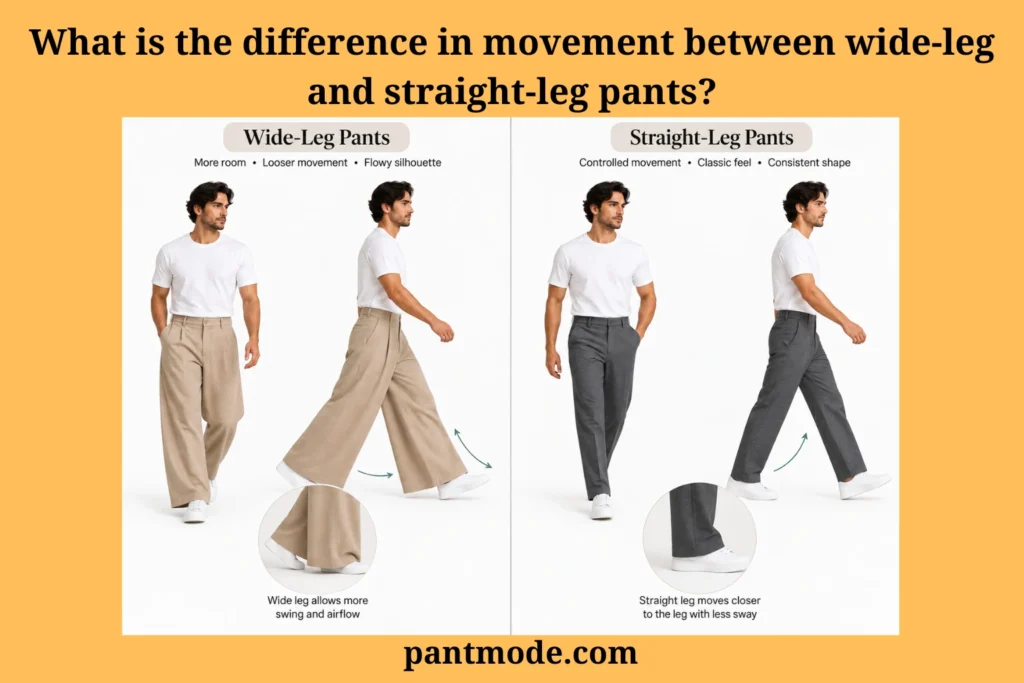
Typical wide-leg and straight-leg pants can move differently because they distribute leg volume, lower-leg clearance, loose fabric, and hem width differently, but actual mobility also depends on fit, rise, fabric, length, and footwear.
Wide-leg and straight-leg are related descriptors, not perfect opposites. Wide-leg primarily describes substantial overall leg width, while straight-leg primarily describes a relatively consistent lower-leg direction. A trouser can therefore be wide overall and still have fairly straight knee-to-hem geometry.
This guide compares typical high-volume wide-leg pants with typical standard-width straight-leg pants for practical movement analysis, while keeping fit, rise, fabric, length, hem width, and footwear separate.
Quick Answer
Typical wide-leg pants often provide more knee and calf clearance but also carry more loose fabric and hem swing. Typical standard-width straight-leg pants usually keep a more contained lower-leg line. Neither silhouette automatically moves better because actual mobility also depends on fit, rise, fabric, length, hem width, and footwear.
Definition
Wide-leg primarily describes substantial overall leg width, while straight-leg primarily describes relatively consistent lower-leg geometry. Because a trouser can be both wide and relatively straight, this guide compares typical high-volume wide-leg pants with typical standard-width straight-leg pants rather than treating the terms as perfect opposites.
How Are Wide-Leg and Straight-Leg Pants Structurally Different, and Where Can They Overlap?
Wide-leg primarily describes greater overall leg width, while straight-leg primarily describes a relatively consistent lower-leg direction, so the two descriptions can overlap in some trousers.
Wide-leg garments usually carry more total volume through the leg and often have broader knee and hem zones. Straight-leg garments are defined more by limited change in lower-leg direction than by one fixed circumference.
Total width and directional geometry are therefore different ideas. A high-volume trouser can keep straight-looking side seams, while a narrower straight-leg trouser can remain standard-width. PantMode’s straight vs. wide-leg silhouettes page owns the deeper structural taxonomy.
Comparison Boundary Matrix
| Attribute | Typical Wide-Leg | Typical Standard Straight-Leg | Can Overlap? |
|---|---|---|---|
| Overall width | Higher | Moderate | Yes |
| Knee width | Usually broader | Usually moderate | Yes |
| Lower-leg direction | Variable | Relatively consistent | Yes |
| Hem width | Often broader | Usually more contained | Yes |
| Thigh fit | Variable | Variable | Fully |
| Rise | Variable | Variable | Fully |
| Length | Variable | Variable | Fully |
| Material | Variable | Variable | Fully |
Which Movement Effects Come From Width, Fit, Rise, Fabric, Length, and Footwear?
Pant movement comes from several interacting design variables, so leg width should not be used as a substitute for fit, rise, fabric behavior, length, or footwear interaction.
Overall width can change lower-leg clearance, fabric volume, lateral swing, and fabric-to-fabric contact. Fit controls seat, hip, thigh, and stride ease. Rise can influence sitting comfort, waistband behavior, and crotch tension, but rise is not identical to crotch depth or crotch length.
Length can change dragging, stacking, stair interaction, and shoe overlap. Hem width changes lower-edge swing and the amount of fabric moving around footwear. Footwear changes effective clearance by altering shoe height, shaft, sole, and shape.
For the wider multi-layer classification framework, see PantMode’s fit & detail pant types.
Movement-Causality Matrix
| Variable | Primary Influence | Wrong Assumption to Avoid |
|---|---|---|
| Overall width | Clearance + fabric volume | Wider always moves better |
| Fit | Seat / thigh mobility | Straight means tight |
| Rise | Waist / crotch behavior | Wide means deeper rise |
| Length | Floor / shoe interaction | Wide always drags |
| Hem width | Swing / overlap | Broad hem always unsafe |
| Fabric | Resistance / drape / stretch | Stretch guarantees mobility |
| Footwear | Effective hem behavior | One shoe type is required |
How Do Wide-Leg and Straight-Leg Pants Differ at the Thigh, Knee, Calf, and Hem During Movement?
The clearest movement differences appear when the garment is evaluated by zone rather than treated as one complete silhouette.
At the thigh, neither label guarantees more room because actual upper-leg fit is decisive. At the knee, typical wide-leg patterns often provide more circumference, although stiffness and pattern ease still affect flexion.
At the calf, wide-leg trousers usually provide greater clearance, while standard straight-leg trousers keep the lower leg more contained. That containment is not the same as restriction because a straight-leg cut can still be regular or relaxed in fit.
More volume may create more inner-leg fabric movement, but that is not automatically a defect. Wider hems also have more swing potential, while straight hems are usually more contained. Sitting comfort depends more strongly on seat and thigh ease, rise, crotch depth, crotch length, and material behavior.
Movement-Zone Matrix
| Zone | Typical Wide-Leg | Typical Straight-Leg | Main Variable |
|---|---|---|---|
| Thigh | Variable, potentially roomy | Slim to relaxed | Fit |
| Knee | Usually more room | Usually more contained | Width + fabric |
| Calf | Greater clearance | Closer containment | Lower-leg width |
| Inner leg | More loose fabric possible | Less excess fabric | Volume |
| Hem | More swing potential | Less swing potential | Hem width |
| Shoe zone | Greater overlap potential | More contained | Width × length |
| Sitting | Variable | Variable | Fit + rise |
How Do Fabric Weight, Rigidity, Drape, Stretch, Growth, and Recovery Change Movement?
Material properties change how the same pant geometry swings, bends, collapses, stretches, clings, and returns to shape.
Weight is fabric mass. Rigidity is resistance to bending. Drape describes how fabric hangs and folds. Stretch describes extension under force, growth describes residual extension after stress or wear, and recovery describes return toward earlier dimensions.
These properties must remain separate. A heavier textile can still drape softly, and a lighter textile can be crisp. Stretch can increase responsiveness, but adequate pattern ease may support mobility without stretch, while poor recovery can contribute to bagging over time.
PantMode’s stretch and pant fit page owns the deeper stretch-fit discussion. ASTM D1388 addresses stiffness through bending behavior, while ASTM D3107 separates stretch, growth, and recovery.
Fabric & Movement Matrix
| Property | Possible Movement Effect | Boundary |
|---|---|---|
| Weight | Changes mass / inertia | Not stiffness |
| Rigidity | Resists bending / collapse | Not weight |
| Drape | Controls fall / folding | Not fit category |
| Stretch | Adds extension | Not recovery |
| Growth | Can create residual looseness | Not stretch itself |
| Recovery | Helps restore shape | Separate from extension amount |
How Do Hem Width, Length, and Footwear Change Walking and Stair Movement?
Hem behavior depends on the interaction between lower opening width, trouser length, material behavior, and footwear rather than on silhouette name alone.
A broad hem with excessive length can create more shoe or floor interaction, while a broad hem with controlled length can move cleanly. Straight-leg pants can also bunch or stack when the length exceeds the intended break.
Flat shoes work with wide-leg pants when the hem is set for that footwear. Elevated footwear changes the effective trouser length and should be checked with the actual shoe. On stairs, loose hems may require more management, so the garment should be tested through realistic step height and movement.
Fit the hem to the intended footwear and movement context rather than one universal floor-clearance measurement.
NMSU’s pants-fit guidance treats pant length, ease, crotch dimensions, knee width, and fit as distinct variables, supporting this interaction-based approach.
Hem × Length × Footwear Matrix
| Combination | Possible Effect | Decision Rule |
|---|---|---|
| Broad hem + excess length | More floor / shoe interaction | Shorten if unintended |
| Broad hem + controlled length | Manageable movement | Verify while walking |
| Straight + excess length | Stacking / bunching | Adjust intended break |
| Cropped straight | More shoe exposure | Coordinate intentionally |
| Wide + flat shoes | Fully workable | Hem for flats |
| Wide + elevated shoe | Effective length changes | Verify with actual shoe |
| Stairs + loose hem | More management required | Test step height / movement |
When Might Wide-Leg or Straight-Leg Pants Better Support Different Movement Goals?
The better direction depends on whether the reader values greater lower-leg clearance, less loose fabric, more flowing movement, easier hem control, or a particular sitting and walking experience.
More lower-leg clearance may favor a wider knee and calf geometry. Less loose lower-leg fabric may favor a more contained straight direction. Sitting comfort should be judged mainly from seat ease, thigh ease, rise, crotch geometry, and material behavior rather than silhouette name.
Flowing visual movement may favor greater width and drape, but the hem still needs to remain manageable. Brisk walking can work in either direction when stride ease, hem behavior, and footwear are coordinated. Stairs likewise depend heavily on length control and actual garment testing.
Movement-Goal Matrix
| Goal | Useful Feature | Possible Direction | Boundary |
|---|---|---|---|
| Greater calf clearance | More lower-leg room | Wide direction | Fit still matters |
| Less loose fabric | Contained lower leg | Straight direction | Not necessarily slim |
| Sitting comfort | Seat / thigh / rise comfort | Either | Silhouette secondary |
| Flowing movement | Width + drape | Often wide | Hem must remain manageable |
| Brisk walking | Stride + hem control | Either | Footwear matters |
| Stairs | Manageable length | Either | Test actual garment |
How Can Common Movement Problems Be Diagnosed in Wide-Leg and Straight-Leg Pants?
Movement problems should be diagnosed from the specific location of restriction or excess fabric before blaming the silhouette or changing the garment size.
Thigh pulling should be checked through thigh ease, seat ease, rise, and material behavior. Knee restriction should be checked through knee circumference, pattern shape, rigidity, and available stretch. Calf catching can involve lower-leg clearance, taper, socks, boots, or fabric.
Hem stepping should be diagnosed through length, hem width, footwear, and material collapse. Fabric wrapping can involve drape, volume, static, wind, moisture, or movement. Inner-leg interference can involve volume, textile surface, length, and drape.
Bagging should be checked through growth and recovery rather than stretch alone. NMSU’s Clothing Construction Standards supports separating ease, seams, waistbands, hems, and construction quality when diagnosing garment behavior.
Movement Troubleshooting Matrix
| Problem | Check First | Possible Direction | Boundary |
|---|---|---|---|
| Thigh pulling | Thigh / seat ease | Different fit / pattern | Not silhouette alone |
| Knee restriction | Knee zone + fabric | More ease / different material | Stretch not only fix |
| Calf catching | Lower-leg clearance | Different geometry | Not waist problem |
| Hem stepping | Length × width × shoe | Re-hem if unintended | No fixed clearance |
| Wrapping | Drape / environment / volume | Material or length change | Not always poor fit |
| Inner-leg interference | Volume + textile behavior | Reduce excess / manage length | Do not auto-size down |
| Bagging | Growth / recovery | Better material behavior | Stretch alone insufficient |
What Mobility Checklist Verifies Wide-Leg or Straight-Leg Pants Before Purchase?
A useful mobility check should test standing, walking, a longer step, sitting, turning, and hem control while keeping silhouette, fit, material, and footwear as separate variables.
Classification
Standing
Walking
Longer Step / Stairs
Sitting / Turning
Material / Hem
Key Takeaway
Wide-leg pants often provide more lower-leg clearance but also carry more loose fabric and hem swing, while standard straight-leg pants usually keep the lower leg more contained. Neither silhouette automatically provides better mobility. Judge movement from the combination of fit, rise, material behavior, leg width, hem width, length, and footwear.
What FAQ Questions Clarify Wide-Leg vs. Straight-Leg Movement?
These five questions clarify the main width, geometry, mobility, and verification boundaries.
Wide-leg pants often provide more lower-leg clearance and more loose fabric movement, while straight-leg pants usually keep the lower leg more contained.
Yes. A trouser can be wide overall and still maintain relatively straight knee-to-hem geometry.
No. Fit, rise, fabric, length, hem width, and footwear can matter as much as width.
Not inherently. Straight-leg pants can be slim, regular, or relaxed in fit.
Walk, take a longer step, sit, turn, and test the hem with the footwear you plan to wear.
What Final Rule Should Guide Wide-Leg vs. Straight-Leg Movement Decisions?
The final rule is to treat leg width as only one movement variable and evaluate fit, rise, fabric, length, hem width, and footwear before deciding which trouser moves better for a specific use.
Choose by the movement behavior you need, then verify the actual garment: wider geometry can add clearance, straighter standard-width geometry can reduce loose fabric, and the final result depends on the whole trouser system rather than the silhouette name alone.
Wide-leg and straight-leg pants can move differently because they distribute width and loose fabric differently, but the silhouette label never tells the whole movement story. Wider geometry often adds knee and calf clearance while also increasing fabric volume and hem swing; standard straight-leg geometry usually contains more of that lower-leg fabric without necessarily being restrictive.
The most reliable decision comes from evaluating the complete system: upper fit, rise and crotch comfort, lower-leg geometry, material behavior, hem width, length, footwear, and real movement tasks such as walking, sitting, turning, and using stairs.