
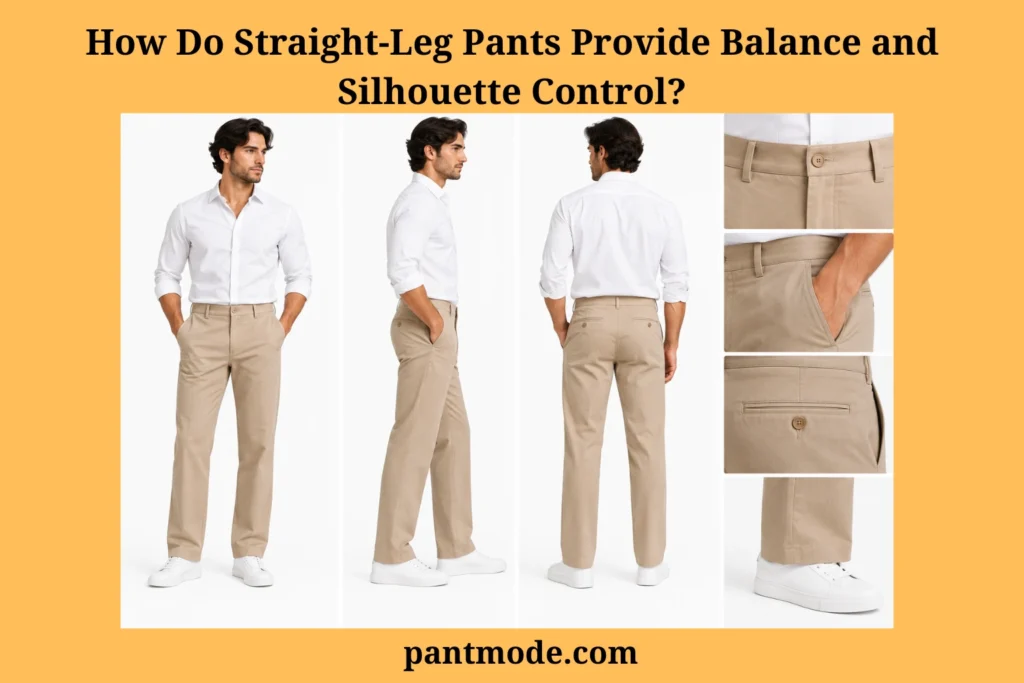
How Do Straight-Leg Pants Provide Balance and Silhouette Control?
Straight-leg pants provide silhouette control through a relatively stable lower-leg line from around the knee to the hem, avoiding the strong narrowing of tapered pants and the lower-leg expansion of bootcut or flared styles.
This stable lower-leg direction can create a visually balanced trouser line because the lower leg changes width less dramatically than neighboring cuts. Seat and thigh shaping can still be slim, regular, relaxed, or tailored without changing the core straight-leg geometry.
Rise, fabric, length, crease, and hem treatment also modify how straight-leg trousers look and move. For the broader classification framework, see PantMode’s fit & detail pant types.
Quick Answer
Straight-leg pants create a visually stable lower-leg outline because their width changes relatively little from around the knee to the hem compared with tapered, bootcut, or flared cuts. Seat and thigh ease, rise, fabric, and length can vary without changing that core geometry.
Definition
Straight-leg pants are trousers whose lower legs follow a relatively consistent direction from around the knee through the hem, without pronounced taper or lower-leg flare. PantMode uses this as a practical classification framework rather than a universal numerical measurement.
What Structural Features Define Straight-Leg Pants?
Straight-leg pants are primarily defined by a relatively consistent lower-leg direction from around the knee to the hem, with neither pronounced taper nor pronounced flare.
The knee works as a useful transition and reference zone because straight-leg identity is read most clearly through the relationship between the knee, lower leg, and hem. Seat and hip shaping can vary, and the thigh can be slim, moderate, or relaxed.
Straight-leg therefore does not mean a perfectly parallel tube from hip to hem. Human anatomy and garment shaping usually create some change through the seat and thigh even when the lower leg remains visually straight.
Straight-Leg Structural Feature Matrix
| Feature | Typical Straight-Leg Trait | Role |
|---|---|---|
| Seat / hip | Shaped to fit | Variable |
| Thigh | Slim to relaxed | Variable |
| Knee | Transition / reference zone | Important |
| Knee-to-hem direction | Relatively consistent | Defining |
| Lower taper | Limited | Defining boundary |
| Lower flare | Limited | Defining boundary |
| Rise | Low / mid / high | Variable |
| Length | Cropped / ankle / full | Variable |
| Fabric | Structured / fluid / stretch | Variable |
Which Straight-Leg Characteristics Define the Silhouette, and Which Can Vary?
Straight-leg classification depends most strongly on lower-leg geometry, while thigh ease, rise, fabric, length, crease, and hem treatment modify how the silhouette looks and fits.
A strong taper moves the garment toward tapered classification. Strong lower-leg expansion moves it toward bootcut or flare. By contrast, low, mid, or high rise; slim or relaxed fit; cropped or full length; stretch; a crease; or a cuff can all appear on straight-leg trousers.
Multi-label descriptions are therefore correct. A pair can be high-rise, relaxed-fit, straight-leg, creased, and full-length at the same time because those labels describe different design dimensions.
Defining vs. Variable Attributes
| Attribute | Role | Main Effect |
|---|---|---|
| Knee-to-hem geometry | Defining | Establishes straight shape |
| Strong taper | Exclusion signal | Moves toward tapered |
| Strong flare | Exclusion signal | Moves toward bootcut / flare |
| Thigh ease | Variable | Changes fit |
| Rise | Variable | Changes waist position |
| Length | Variable | Changes endpoint |
| Crease | Variable | Adds visual line |
| Fabric rigidity | Variable | Changes architecture |
| Drape | Variable | Changes softness / movement |
| Stretch / recovery | Variable | Changes mobility / shape retention |
How Do Straight-Leg Pants Differ From Tapered, Bootcut, Flare, and Wide-Leg Pants?
Straight-leg pants are distinguished from neighboring cuts by the direction and amount of width change below the knee rather than by one hem measurement.
Straight vs. Tapered
Straight legs keep a more stable lower-leg direction, while tapered legs progressively narrow toward the ankle. The deeper boundary belongs on PantMode’s straight vs. tapered page.
Straight vs. Bootcut
Bootcut trousers widen modestly lower in the leg, while straight-leg trousers avoid that controlled expansion. See the dedicated bootcut vs. straight comparison for more detail.
Straight vs. Flare
Flare trousers create a stronger knee-to-hem expansion than bootcut, making the lower leg a more dominant visual feature.
Straight vs. Wide-Leg
Wide-leg trousers carry substantially greater width through much of the leg. A wide-leg pair can still have visually straight side seams, so straight-looking edges alone do not make it straight-leg. The detailed distinction belongs on straight vs. wide-leg.
Adjacent-Cut Comparison
| Cut | Upper-Leg Volume | Knee-to-Hem Direction | Main Signal |
|---|---|---|---|
| Straight | Variable | Relatively consistent | Stable lower line |
| Tapered | Variable | Narrows | Progressive taper |
| Bootcut | Controlled | Mildly widens | Restrained flare |
| Flare | Controlled | Strongly widens | Pronounced flare |
| Wide-leg | Greater overall width | Broad / sustained | High total volume |
How Do Slim-Straight, Regular-Straight, and Relaxed-Straight Fits Differ?
Slim-straight, regular-straight, and relaxed-straight pants share straight lower-leg geometry but differ in how much ease they provide through the seat, hips, and thighs.
Slim-straight uses reduced upper-leg ease with a straight lower leg. Regular-straight uses moderate ease and produces a classic straight presentation. Relaxed-straight adds more upper-leg room while preserving the same basic lower-leg direction.
Tailored straight trousers can use cleaner waistbands, creases, sharper seams, or dressier materials. Straight denim is a material expression rather than a separate geometry.
New Mexico State University’s pants-fit guidance treats waist, hips, thighs, knee, crotch depth, crotch length, and pant length as separate fit variables, supporting the distinction between body ease and silhouette.
Straight-Fit Variation Matrix
| Variation | Seat / Thigh Ease | Lower-Leg Geometry | Main Effect |
|---|---|---|---|
| Slim-straight | Lower | Straight | Narrower presentation |
| Regular-straight | Moderate | Straight | Classic |
| Relaxed-straight | Higher | Straight | Easier volume |
| Tailored straight | Variable | Straight | Polished |
| Straight denim | Variable | Straight | Casual / material-led |
How Do Rise, Fabric Behavior, and Length Change the Straight-Leg Effect?
Rise, fabric behavior, and length can change the visual presentation and movement of straight-leg pants without replacing their underlying lower-leg geometry.
Low, mid, and high-rise pants place the waistband differently, but rise does not define the leg cut. Rise should also remain separate from crotch depth and crotch length, which require their own fit evaluation.
Fabric mass, rigidity, drape, stretch, growth, and recovery also change how clearly the straight line is expressed. ASTM D1388 addresses stiffness through bending-related measurements, while ASTM D3107 separates stretch, growth, and recovery.
Cropped, ankle, and full-length straight-leg pants can all remain straight. No break, slight break, fuller break, and intentional stacking are length treatments that change the endpoint and shoe interaction rather than the base silhouette.
Rise, Fabric & Length Matrix
| Variable | Mechanical Effect | Visual Result | Boundary |
|---|---|---|---|
| Higher rise | Raises waistband | Different visual proportion | Not mandatory |
| Lower rise | Lowers waistband | Different torso / trouser relationship | Not defining |
| Greater rigidity | Holds line | Sharper straight geometry | Not weight |
| Fluid drape | Softer fall | Less architectural line | Still straight-leg |
| Stretch | Allows extension | Greater responsiveness | Not recovery |
| Strong recovery | Returns toward shape | Better shape retention | Separate from stretch |
| Cropped | Earlier endpoint | More shoe / lower-leg visibility | Still straight |
| Full length | Longer endpoint | Greater continuity | Fit with footwear |
| Fuller break | More shoe interaction | More folding | Not new silhouette |
How Can Straight-Leg Pants Support Different Styling Goals?
Straight-leg pants can support many styling directions because their stable lower-leg geometry can work with both controlled and relaxed upper-body volume and with varied footwear.
Clean or tailored styling can use shirts, knits, blazers, creases, and controlled hems. Relaxed styling can use tees, soft knits, oversized shirts, or casual jackets. A tuck, cropped layer, or belt can increase waistband visibility, but waist definition is optional.
Volume-on-volume outfits can use oversized knits, boxy jackets, or long coats when the proportions are intentional. A longer visual line may be encouraged through full-length hems, creases, simpler upper layers, or coordinated footwear, but these are perception tools rather than guaranteed body effects.
Sneakers, loafers, flats, boots, heels, and sandals can all work when hem length, shoe height, and intended break are coordinated.
Straight-Leg Styling Goal Framework
| Goal | Top / Layer Direction | Hem Direction | Footwear | Expected Effect |
|---|---|---|---|---|
| Clean / tailored | Shirt, knit, blazer | Controlled | Loafer, boot, heel, flat | Polished |
| Relaxed | Tee, knit, oversized shirt | Variable | Sneaker, flat, sandal | Easy |
| More visible waist | Tuck, cropped layer, belt | Flexible | Flexible | Stronger waist emphasis |
| Volume-on-volume | Oversized knit, boxy jacket, long coat | Variable | Scale-conscious | Intentional volume |
| Longer visual line | Simple uninterrupted upper | Full or slight break | Coordinated | More continuous line |
Styling Rule
Let the intended outfit goal determine the top, layer, and footwear; do not use styling choices as tests of whether the pants are straight-leg.
How Can Common Straight-Leg Fit, Drape, and Hem Problems Be Diagnosed?
Straight-leg fit problems should be diagnosed from the location and direction of tension, garment ease, crotch geometry, fabric behavior, seam balance, and hem interaction before changing the size or silhouette.
Thigh pulling can come from thigh ease, seat ease, rise, crotch geometry, stretch behavior, size, or pattern shape, so automatically sizing up is not a reliable universal fix. Waist gaping requires separate checks for waist-to-hip relationship, waistband contour, rise, and shaping.
If the lower leg appears tapered, check the actual knee, calf, and hem relationship rather than calf contact alone. Leg twisting can come from grain, seam balance, construction, or wash distortion. NMSU’s construction standards support checking seams, grain, construction quality, waistbands, and hems separately.
Knee bagging should be considered alongside stretch, growth, recovery, wear, and knee ease. Wrinkles should be interpreted by location, direction, persistence, tension, movement, and intended fit rather than treated as defects automatically.
Straight-Leg Troubleshooting Matrix
| Problem | Check First | Possible Adjustment | Boundary |
|---|---|---|---|
| Thigh tension | Ease, seat, rise, stretch | Different fit / cut / size | Do not auto-size up |
| Waist gap | Waist / hip + waistband | Targeted alteration | Rest may fit correctly |
| Lower leg looks tapered | Knee / calf / hem | Reassess cut | Calf contact alone insufficient |
| Leg twisting | Grain / seams / construction | Inspect construction | May not be sizing |
| Knee bagging | Growth / recovery | Better material / fit | Stretch alone insufficient |
| Persistent tension wrinkles | Ease / rise / pattern | Diagnose source | Not every wrinkle is defect |
| Hem stacking | Length / shoe | Adjust if unwanted | Stacking may be intentional |
| Weak straight line | Rigidity / drape / pattern | Change material / cut | Weight alone insufficient |
What Checklist Verifies Straight-Leg Classification and Proper Fit?
A reliable straight-leg check should classify the lower-leg geometry first and then evaluate fit, rise, fabric behavior, length, and movement separately.
Classification
Fit
Material
Lower Leg
Hem & Footwear
Key Takeaway
Classify straight-leg pants from their lower-leg geometry first. A relatively stable knee-to-hem line with limited taper and limited flare is the strongest signal. Fit, rise, fabric, crease, length, and hem treatment can change how the pants look and feel without replacing that core silhouette.
What FAQ Questions Clarify Straight-Leg Pants?
These five questions cover the main definition, fit, neighboring cut, rise, and hem decisions.
Straight-leg pants maintain a relatively stable lower-leg direction from around the knee to the hem, without pronounced taper or flare.
Yes. Slim describes body ease, while straight describes lower-leg geometry.
Tapered pants progressively narrow toward the lower leg; straight-leg pants keep a more consistent lower-leg direction.
Yes. Rise is a separate modifier and does not define the leg silhouette.
There is no universal best break. Choose it for the fabric, footwear, dress code, and intended visual effect.
What Final Rule Should Guide Straight-Leg Pant Classification?
The final rule is to classify straight-leg pants from lower-leg geometry first, then add fit, rise, fabric, length, and styling descriptors as separate layers.
If the lower leg maintains a relatively stable direction with neither strong taper nor strong flare, classify the silhouette as straight-leg first and then describe its fit, rise, material, and length separately.
Straight-leg pants are defined most reliably by their lower-leg geometry rather than by one rise, fabric, hem measurement, body type, or styling formula. The seat and thigh can be slim, regular, or relaxed while the lower leg still remains straight.
Once the silhouette is identified, rise, fabric behavior, length, crease, break, and footwear can be evaluated as separate modifiers. This layered method also makes fit diagnosis more accurate because it prevents thigh ease, crotch fit, calf interaction, wrinkles, or hem behavior from being mistaken for silhouette identity.