
How Does the Leg Shape of Bootcut Pants Compare to Straight-Leg Designs?
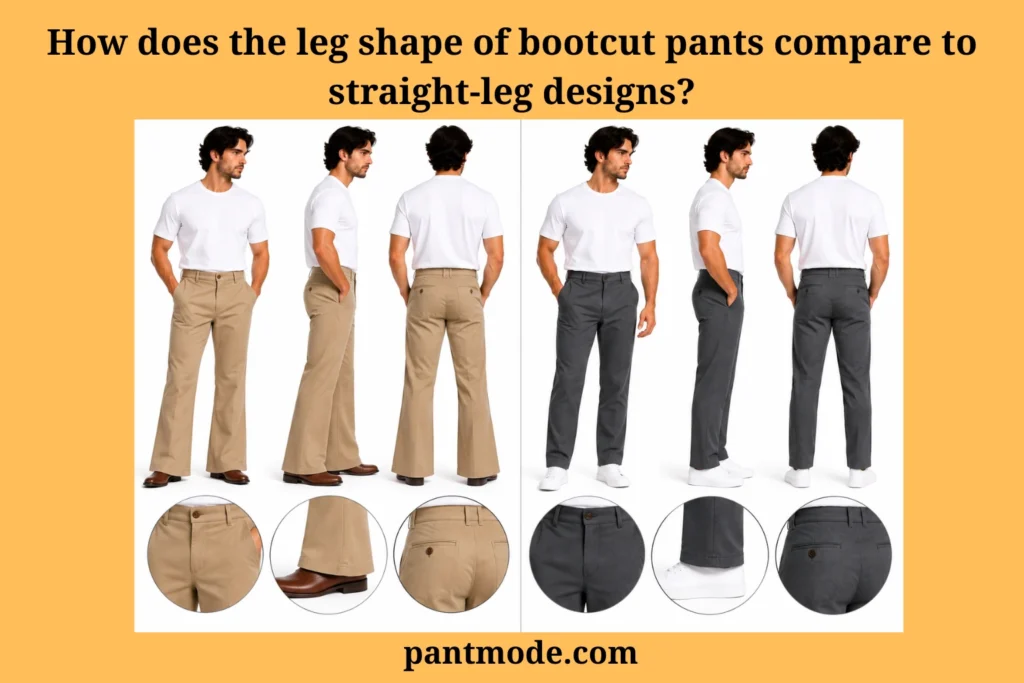
Bootcut and straight-leg pants differ mainly in how their lower-leg width progresses from the knee toward the leg opening.
Straight-leg pants maintain a comparatively consistent lower-leg line, while bootcut pants widen below the knee so the opening becomes broader relative to the knee area.
The distinction should be established from knee, calf, lower-leg, and hem relationships rather than from absolute hem width, overall looseness, garment size, or retail terminology. PantMode’s fit and detail pant types framework provides the broader classification context.
Quick Answer
Bootcut pants become wider below the knee toward the leg opening, while straight-leg pants maintain a comparatively consistent lower-leg width. The most reliable comparison traces knee, calf, and hem relationships rather than judging only the size of the opening.
Definition
Bootcut leg shape: a lower-leg geometry in which the opening becomes wider relative to the knee, producing outward progression toward the hem.
Straight-leg shape: a lower-leg geometry that remains comparatively consistent from the knee toward the opening without intentional flare development.
What Defining Leg-Shape Geometry Separates Bootcut Pants From Straight-Leg Designs?
The defining difference is that bootcut pants widen from the knee toward the lower opening, while straight-leg pants preserve a more consistent knee-to-opening relationship.
Bootcut pants are identified by outward lower-leg progression rather than simply by having a large hem. The line must become wider relative to the knee or lower-knee reference.
By contrast, straight-leg pants retain a comparatively stable lower-leg direction. Minor shaping can occur without changing the complete silhouette into bootcut.
Levi’s jeans fit guide provides a useful manufacturer example: its straight fit is described through knee-to-opening consistency, while its bootcut fit becomes wider from the knee toward the ankle. Levi’s terminology supports the geometric distinction but should not be treated as a universal numerical industry standard.
| Shape | Knee-to-Opening Relationship | Line Direction | Boundary |
|---|---|---|---|
| Straight-leg | Comparatively consistent | Controlled / near-parallel | Normal shaping allowed |
| Bootcut | Opening wider relative to knee | Outward | Must show progression |
| Roomy straight | Large overall width but stable progression | Straight | Not bootcut from width alone |
| Subtle bootcut | Mild systematic widening | Slightly outward | Needs full sequence |
| Borderline | Mixed evidence | Unclear | Qualify result |
Why Does Width Progression Create Different Leg Shapes?
Width progression creates different silhouettes because successive lower-leg dimensions determine whether the garment line remains controlled or moves outward.
If knee, calf, and opening measurements stay comparatively consistent, the visual line remains straighter. If those zones become progressively wider, the seam and silhouette move outward toward the hem.
This is why relative change matters more than absolute size. A pant can have a large opening and remain straight if the rest of the lower leg is similarly wide. A narrower pant can still be bootcut when its opening becomes meaningfully wider than its knee and lower-leg reference.
Which Measurement Landmarks Reveal Bootcut Versus Straight-Leg Geometry?
Thigh, knee, lower-leg or calf, and hem landmarks provide the most useful sequence for tracing how pant width changes.
The thigh gives upper-leg context but should not decide the category. The knee serves as the primary lower-leg reference because the defining bootcut-versus-straight difference generally becomes clearer below that point.
Threads’ pants fitting measurement landmarks use upper-thigh, knee, and calf measurements as meaningful fitting references and treat knee level as an important point in pant geometry. Threads supports the measurement framework, not a universal numerical bootcut cutoff.
| Landmark | Classification Role |
|---|---|
| Thigh | Upper-leg context |
| Knee | Primary lower-leg reference |
| Calf / lower leg | Shows post-knee behavior |
| Hem / opening | Final endpoint |
| Complete sequence | Strongest shape evidence |
How Does Thigh-to-Knee Geometry Compare in Bootcut and Straight-Leg Pants?
Bootcut and straight-leg pants can look similar from the thigh to the knee because their defining difference usually appears farther down the leg.
Both silhouettes may use a straight, slim, regular, or moderately roomy upper leg. That overlap means thigh fit cannot independently establish either category.
The knee becomes the transition into the more decisive geometry. Classification should therefore stay open until the lower leg and opening have been evaluated.
| Upper-Leg Observation | What It Means | Classification Value |
|---|---|---|
| Slim thigh | Low overall upper volume | Context only |
| Regular thigh | Moderate upper width | Context only |
| Roomy thigh | Greater upper width | Context only |
| Similar thigh-to-knee shape | Categories may still diverge below knee | Requires lower-leg evidence |
Where Does Bootcut Shape Begin to Diverge From Straight-Leg Geometry?
Bootcut geometry begins to diverge when the lower leg starts widening relative to the knee reference instead of maintaining the straighter progression associated with a straight leg.
The knee or lower-knee region is a practical reference zone rather than one universal exact divergence point. Pattern blocks, sizing systems, and product designs can place the visible transition at slightly different heights.
The important diagnostic is directional continuity. If the lower-leg line begins moving outward and continues doing so toward the opening, the garment develops bootcut evidence.
How Does Knee-to-Hem Expansion Define Bootcut?
Knee-to-hem expansion defines bootcut when width progressively increases through the lower leg toward the opening.
The strongest bootcut evidence comes from a sequence rather than one endpoint. The knee establishes the reference, the calf reveals whether widening has begun, and the opening confirms whether the outward direction continues.
Minor localized widening is weaker evidence because normal garment shaping can create small dimensional changes without producing a true bootcut silhouette.
| Progression | Interpretation |
|---|---|
| Knee → calf → opening progressively wider | Strong bootcut evidence |
| Knee stable, opening wider only | Incomplete evidence |
| Lower leg begins widening and continues | Strong bootcut evidence |
| Minor localized width change | Weak / borderline |
| No outward progression | Weak bootcut evidence |
The distinction from bootcut and flare-leg designs is also useful: both involve outward lower-leg development, but flare geometry can produce stronger or more expansive widening. This page remains focused specifically on bootcut versus straight-leg progression.
How Does Lower-Leg Width Consistency Define Straight-Leg Pants?
Straight-leg geometry is supported when the knee, lower leg, and opening maintain a comparatively consistent progression instead of moving systematically outward.
Comparatively consistent does not mean mathematically identical at every point. Garment patterns can include minor shaping while preserving an overall straight lower-leg direction.
A roomy straight pant can therefore have a relatively large hem and still remain straight because its knee, calf, and opening retain a controlled relationship.
| Pattern | Interpretation |
|---|---|
| Knee, calf, and opening comparatively consistent | Strong straight-leg evidence |
| Minor normal shaping | Straight-leg remains possible |
| Large overall leg with consistent progression | Roomy straight possible |
| Progressive outward widening | Weak straight-leg evidence |
How Should Knee-to-Hem Proportions Be Compared?
Knee-to-hem proportions should be interpreted by comparing the leg opening with both the knee and intermediate lower-leg geometry rather than reading the opening in isolation.
A roomy straight pant may have a large knee, large calf, and large opening while maintaining little relative change. A slimmer bootcut can use smaller absolute measurements but still widen meaningfully below the knee.
The correct comparison therefore normalizes the opening against the rest of the lower leg. PantMode does not assign a universal knee-to-hem ratio because pattern systems and fit blocks vary.
This same principle also separates bootcut analysis from straight and tapered leg shapes, where the decisive direction moves inward rather than outward.
| Lower-Leg Relationship | Absolute Width | Interpretation |
|---|---|---|
| Stable | Large | Roomy straight possible |
| Stable | Narrow | Slim straight possible |
| Outward progression | Moderate | Bootcut possible |
| Outward progression | Large | Bootcut or stronger flare family; inspect degree |
How Should Borderline Bootcut and Straight-Leg Shapes Be Classified?
Borderline shapes should remain qualified when lower-leg widening is present but too weak or inconsistent to establish confident bootcut geometry.
Start with the knee reference, then examine the calf and opening. If widening appears only at one localized point, evidence remains weak. If the line moves gradually outward across several zones, bootcut evidence becomes stronger.
A qualified result such as “subtle bootcut” or “borderline straight/bootcut” is more accurate than inventing a numerical threshold and forcing a binary category.
Which Geometric Signals Matter Most for Bootcut-vs-Straight Classification?
The strongest evidence comes from knee-to-opening progression and the direction of the complete lower-leg line.
Progressive calf-to-opening widening strengthens bootcut classification, while a comparatively stable knee, calf, and opening relationship strengthens straight-leg classification.
Thigh width and absolute hem width remain contextual. Overall looseness and retail labels are weaker because neither independently describes the relative lower-leg progression.
| Signal | Evidence Strength |
|---|---|
| Knee-to-opening progression | Primary |
| Lower-leg line direction | Primary |
| Progressive calf-to-opening widening | Strong supporting |
| Knee reference relationship | Strong supporting |
| Thigh-to-knee geometry | Contextual |
| Absolute hem width | Contextual |
| Overall looseness | Weak alone |
| Product label | Weak alone |
Which Errors Cause Bootcut and Straight-Leg Pants to Be Misclassified?
Bootcut and straight-leg pants are misclassified when a single width, fit impression, or retail label replaces the full lower-leg progression test.
| Error | Why It Fails | Correct Test |
|---|---|---|
| Wide hem = bootcut | Opening lacks upstream context | Compare knee, calf, and opening |
| Roomy = bootcut | Volume is not flare progression | Trace lower-leg direction |
| Slim = straight | Slim bootcuts can exist | Compare relative progression |
| Any widening = bootcut | Normal shaping can occur | Require systematic expansion |
| Thigh determines category | Upper-leg shapes may overlap | Prioritize lower-leg geometry |
| Label proves cut | Brand terminology varies | Verify the actual garment shape |
How Can Bootcut and Straight-Leg Shapes Be Classified Through a Repeatable Process?
Bootcut and straight-leg shapes can be classified reliably by mapping the complete leg first and then tracing lower-leg progression from the knee toward the opening.
What Checklist Confirms the Final Bootcut-vs-Straight Classification?
The final classification is reliable when the complete lower-leg sequence has been evaluated and multiple geometric signals support the same result.
Garment Landmarks
Progression Analysis
Classification Controls
Final Verification
Key Takeaway
Bootcut expands below the knee, while straight-leg preserves a more consistent lower-leg line. Classify from the full knee-to-calf-to-opening progression rather than from hem width, looseness, garment size, or product naming alone.
Frequently Asked Questions About Bootcut and Straight-Leg Pants
These five questions address the geometry issues most likely to cause confusion when comparing bootcut and straight-leg designs.
Bootcut pants widen below the knee toward the opening, while straight-leg pants maintain a comparatively consistent lower-leg width. The key distinction is lower-leg width progression rather than absolute hem width.
Yes. Their upper-leg geometry can overlap substantially. The defining difference generally becomes clearer when the knee, lower leg, calf, and opening are compared.
The knee or lower-knee region is a useful transition reference, but the exact divergence point varies by pattern and product. Classification should not depend on one universal vertical point.
No. A roomy straight-leg pant can also have a large opening. Bootcut requires systematic outward progression relative to the knee and intermediate lower-leg geometry.
Use qualified language when widening is subtle, localized, or inconsistent. A borderline or subtle-bootcut classification is more accurate than forcing a binary result when the complete lower-leg evidence remains mixed.
What Final Rule Should Guide Bootcut-vs-Straight Classification?
The final rule is to use the knee as the primary reference, follow the lower-leg line through the calf toward the opening, and classify only after the complete progression is clear. Systematic outward widening supports bootcut, while comparatively consistent lower-leg geometry supports straight-leg.
Bootcut and straight-leg pants are most reliably separated by lower-leg width progression rather than absolute hem width, looseness, size, or retail naming. The knee establishes the main reference, the calf reveals whether the lower leg stays controlled or begins expanding, and the opening completes the sequence.
When outward widening continues systematically below the knee, bootcut evidence becomes stronger. When the knee, calf, and opening retain a comparatively consistent relationship, straight-leg classification is better supported. Borderline cases should remain qualified rather than being forced into a category through invented thresholds.