
How Do High-Rise Pants Create Visual Lift and Styling Structure in Lower-Body Outfits?
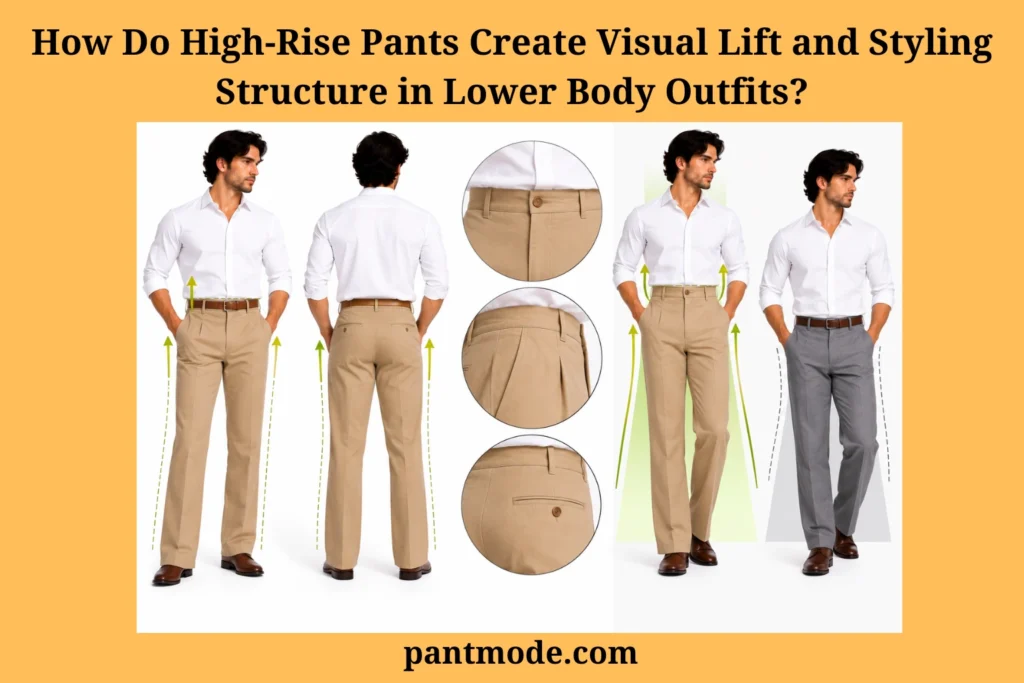
High-rise pants create visual lift and styling structure by placing the visible waist reference higher and organizing the surrounding garment boundaries around that elevated anchor.
The mechanism is visual rather than anatomical. High-rise construction changes where the pants begin and where the outfit can be visually divided; it does not physically lengthen the legs, increase height, or guarantee a slimming effect.
The complete result depends on the waistband, perceived waist reference, top endpoint, visual continuity, outer layers, and leg volume. PantMode’s fit and detail pant types framework provides the broader structural context.
Quick Answer
High-rise pants create visual lift by establishing a higher visible waist reference, which shifts where the lower-body portion of the outfit appears to begin. They create styling structure by giving tops, layers, and the pant silhouette a common visual anchor.
Definition
Visual lift: an optical upward shift in the perceived waist or lower-body starting point.
Styling structure: the visual organization of garment boundaries and volume around a readable waist anchor.
Rise: the garment dimension and construction relationship that determines how the pants sit from the crotch area toward the waistband.
What Do Visual Lift and Styling Structure Mean?
Visual lift and styling structure describe two related but separate effects: a higher perceived lower-body starting point and clearer visual organization around the waist.
Visual lift concerns where the viewer reads the boundary between the upper and lower outfit zones. Styling structure concerns whether the surrounding garments reinforce, soften, or compete with that boundary.
Neither concept changes anatomy. The analysis is about garment placement, proportion, visual hierarchy, and perception.
| Concept | Meaning | Boundary |
|---|---|---|
| Visual lift | Higher perceived lower-body start | Optical only |
| Styling structure | Garment organization around waist anchor | Not automatic |
| Physical waistband | Actual garment position | Not perception itself |
| Perceived waist | Visual reference read within outfit | Can be obscured |
| Styling anchor | Dominant organizing junction | Depends on surrounding garments |
Why Does an Elevated Waistband Create a Higher Visual Reference?
An elevated waistband creates a higher visual reference because it places a prominent garment boundary higher within the outfit.
Pants waistband and waistline construction guidance from Threads treats waistband position and its relationship to the waistline as concrete garment-construction variables. That evidence supports the physical placement step of the mechanism, not a universal claim that high-rise pants scientifically make legs appear longer.
PantMode then treats the physical waistband as the first input in a visual-proportion analysis. The more clearly that elevated boundary can be read, the more readily it can function as a higher visual waist reference.
The physical construction side is explored further in PantMode’s high-rise measurement guide.
How Does the Raised Waist Reference Redistribute Outfit Proportions?
The raised waist reference redistributes perceived outfit proportions by moving the visible division between upper and lower garment zones upward.
When the waist boundary sits lower, the upper garment zone occupies more of the visible vertical composition before the pants begin. When the boundary moves higher, the upper section becomes visually shorter and the lower garment segment appears to begin from a higher point.
If the waistband is hidden or another garment creates a stronger lower boundary, that elevated division may become harder to read even though the pants themselves remain high-rise.
| Reference | Upper Reading | Lower Reading |
|---|---|---|
| Lower waist cue | Relatively longer upper zone | Lower starting point |
| Higher waist cue | Relatively shorter upper zone | Higher lower-body start |
| Hidden waist cue | Ambiguous division | Weaker structure |
| Competing lower cue | Alternative boundary dominates | Lift can weaken |
How Does the Proportion Shift Create Visual Lift?
Visual lift occurs when the elevated waist reference becomes the readable starting point for the lower-body outfit segment.
The mechanism is optical: a higher waist cue establishes a higher lower-body origin, and the visual path beneath that cue occupies more of the outfit’s downward composition. Nothing about the person’s actual leg length changes.
PantMode’s high-rise longer-leg illusion guide focuses specifically on this perceptual outcome and the boundaries needed to describe it accurately.
Why Does the High Waist Function as a Styling Anchor?
The high waist functions as a styling anchor when it becomes the clearest junction between upper garments and the pant silhouette.
A readable anchor gives the outfit an organizing point. The top can terminate above it, at it, or overlap it; an outer layer can frame it; and the pant silhouette can extend downward from it.
The anchor does not need to be fully exposed at every moment. It can remain visually inferable when surrounding garment boundaries still make the waist position understandable.
| Waist Condition | Anchor Strength | Structural Reading |
|---|---|---|
| Clearly visible | High | Explicit junction |
| Inferable | Moderate / high | Structure remains readable |
| Softly overlapped | Moderate | Less rigid structure |
| Fully obscured | Low | Other boundaries may dominate |
| Multiple competing boundaries | Variable | Hierarchy becomes ambiguous |
How Should Top Placement Reinforce the Waist Anchor?
Top placement reinforces the high-rise structure when its endpoint keeps the elevated waist visible, inferable, or intentionally framed.
A top ending above or near the waistband usually leaves the high-rise boundary easy to read. A tucked top can also make that junction explicit. Slight overlap creates a softer boundary without necessarily eliminating the anchor.
A longer untucked top can obscure the waistband, but that does not make the outfit incorrect. It simply changes which boundary becomes visually dominant. The relevant question is whether that softer structure is intentional.
| Top Treatment | Waist Readability | Result |
|---|---|---|
| Ends above waist | High | Strong anchor |
| Ends at waist | High | Clear structure |
| Slight overlap | Moderate | Softer anchor |
| Long untucked | Lower | Waist may be obscured |
| Tucked | High / inferable | Boundary reinforced |
How Does Visual Continuity Preserve the Lower-Body Structure?
Lower-body continuity helps preserve the elevated starting point when the eye can follow the pant silhouette downward without competing breaks becoming more dominant.
The Gestalt principle of visual continuity describes a general tendency to organize visual elements into continuous lines or patterns. PantMode applies that broad design principle to outfit analysis; it is not being presented as a clothing-specific experiment proving a fixed high-rise effect.
A clear waist-to-hem visual path can support a coherent lower-body structure. Repeated strong horizontal boundaries can fragment that path, while one controlled detail may remain fully compatible with the composition.
| Visual Path | Likely Structural Reading |
|---|---|
| Clear waist-to-hem path | Strong continuity |
| Repeated horizontal interruptions | More fragmented |
| One controlled detail | Can remain coherent |
| Strong competing boundary | Can redirect visual hierarchy |
How Should Outer Layers Frame the High-Rise Structure?
Outer layers preserve high-rise structure when they frame the waist reference or leave it inferable instead of unintentionally replacing it with a stronger visual boundary.
A shorter layer can leave the waist explicitly readable. A longer open layer can create an outer frame while still allowing the internal top-to-waist relationship to remain visible. A closed long layer may shift the dominant boundary away from the waistband.
The application is explored in PantMode’s guide to high-rise pants with a blazer, where layer position can be analyzed without turning one blazer length into a universal formula.
| Layer Treatment | Waist Readability | Structural Result |
|---|---|---|
| Short layer | High | Strong waist emphasis |
| Near-waist layer | High / moderate | Clear framing |
| Open long layer | Inferable | Internal structure can remain |
| Closed long layer | Low | Outer boundary may dominate |
| Bulky waist overlap | Reduced | Possible hierarchy conflict |
How Does Leg-Volume Distribution Affect the Lower Structure?
Leg-volume distribution determines how the lower silhouette develops beneath the elevated waist, while rise remains responsible for establishing the upper reference.
A narrower leg concentrates the downward line. A straight leg creates a stable column-like structure, while a wide or expanding silhouette distributes progressively more volume across the lower section.
Straight-leg pants provide one clear example of how leg geometry can remain comparatively stable beneath a high waist. The link is useful as a volume example, not as a claim that straight-leg geometry is inherently superior for high-rise outfits.
| Leg Pattern | Lower-Body Structure |
|---|---|
| Narrower | Concentrated vertical line |
| Straight | Stable column-like line |
| Wide | Broader visual base |
| Expanding | Increasing lower volume |
| Any shape + hidden waist | High-rise reference may weaken |
Which Proportion Conflicts Weaken Visual Lift and Styling Structure?
Visual lift and styling structure weaken when stronger competing boundaries replace the high waist as the dominant organizing cue.
The most common problems are not “wrong clothes” but unclear relationships: a fully hidden waist, a top ending far below the waistband and becoming the dominant division, repeated strong horizontal breaks, or an outer layer that visually replaces the internal waist anchor.
Diagnosis should isolate the variable causing the conflict rather than changing every part of the outfit at once.
| Conflict | Broken Mechanism | Correction |
|---|---|---|
| Waist fully hidden | Anchor disappears | Restore a readable or inferable reference |
| Top creates stronger lower boundary | Division shifts downward | Adjust top endpoint if lift is the goal |
| Too many competing breaks | Continuity fragments | Simplify hierarchy |
| Outer layer dominates | Waist loses priority | Reframe layer relationship |
| Upper and lower volume lack junction | Structure becomes ambiguous | Clarify waist anchor |
| Rise height treated as sufficient | Whole-system logic ignored | Reassess top, layer, continuity, and volume |
How Can High-Rise Outfits Be Built Through a Repeatable Process?
High-rise outfits can be analyzed and adjusted through a repeatable sequence that begins with the physical waistband and ends with verification of the complete visual hierarchy.
What Checklist Confirms High-Rise Visual Lift and Styling Structure?
The final result is reliable when the physical rise, visual waist reference, top placement, continuity, layer hierarchy, and leg volume have been evaluated separately and then recombined.
Waist Reference
Visual Lift
Styling Structure
Claim Boundaries
Key Takeaway
A high waistband starts the mechanism, but the full outfit determines whether the visual lift remains readable. Treat the waistband as the initial visual cue, then evaluate every surrounding garment by whether it reinforces, softens, frames, or competes with that reference.
Frequently Asked Questions About High-Rise Visual Lift
They establish a higher visible waist reference, causing the lower-body portion of the outfit to appear to begin higher. The effect is visual and proportional rather than anatomical.
No. High-rise pants do not change actual leg length. Any lengthening effect discussed in this article refers to visual proportion.
A readable waist reference gives the top, layers, and pant silhouette a common visual junction around which the outfit can be organized.
No. A high waistband can be obscured or visually overridden by tops, layers, or competing boundaries.
No. Tucking can make the waist explicit, but other top treatments can preserve or intentionally soften the high-rise structure.
What Final Rule Should Guide High-Rise Styling Structure?
Treat the waistband as the starting cue, then evaluate every surrounding garment by whether it reinforces, softens, frames, or competes with that visual reference. High rise establishes the potential anchor; the complete outfit determines whether that anchor remains visually effective.
High-rise pants create their strongest visual structure when the elevated waist remains a readable reference within the complete outfit. By moving the visible upper-to-lower garment division upward, the waistband can establish a higher perceived lower-body starting point and therefore create optical visual lift.
The effect remains perceptual rather than anatomical. Top endpoints, waist readability, visual continuity, outer-layer framing, and leg-volume distribution determine whether the elevated waist remains the dominant organizing anchor or is replaced by competing boundaries.