
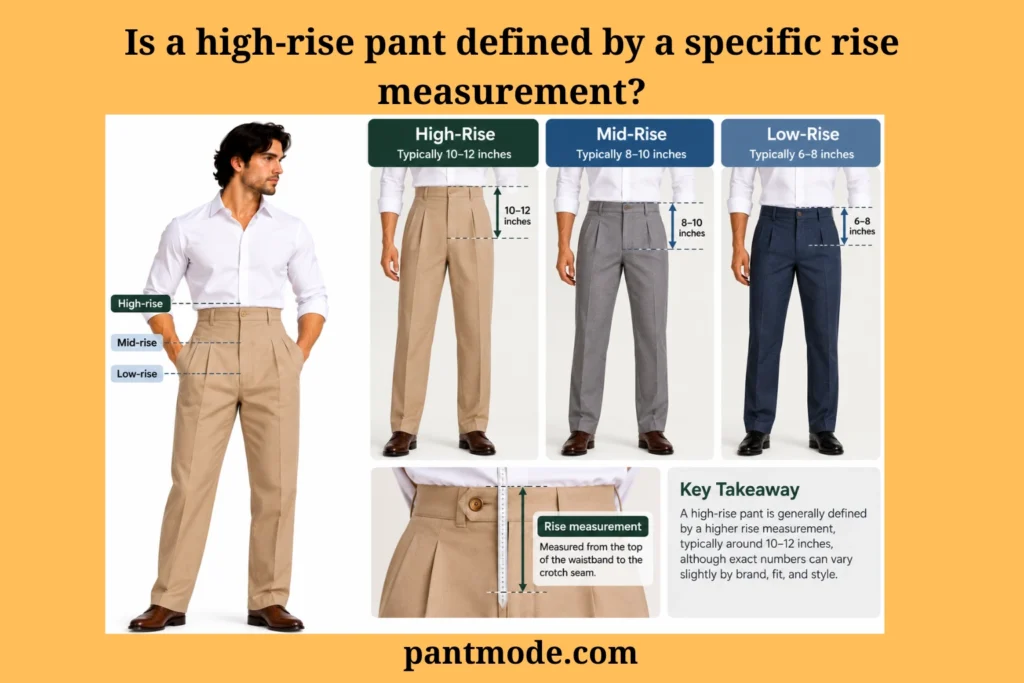
Is a High-Rise Pant Defined by a Specific Rise Measurement?
No single front-rise measurement universally defines high-rise pants. Front rise provides important numerical evidence, but its classification meaning depends on how the garment was measured and the size, garment type, silhouette, comparable rise categories, and manufacturer context.
The first step is therefore to separate the measured dimension from the category assigned to it. Within PantMode’s pant fit and detail features, rise classification is treated as an evidence-led garment classification rather than a universal inch or centimeter cutoff.
Quick Answer
No single front-rise measurement universally defines high-rise pants. A valid classification also requires a consistent measurement method, compatible garment size and type, comparable low-, mid-, and high-rise references, and supporting manufacturer information where available.
Definition
Front rise: a front garment dimension measured between a defined crotch/rise reference and an upper waist or waistband reference according to a stated method.
High-rise classification: a contextual category indicating that the pant sits in the higher-rise portion of an appropriate comparison system.
Borderline rise: a measurement whose category cannot be resolved confidently without additional comparable evidence.
What Role Does Rise Measurement Play in Defining High-Rise Pants?
Rise measurement provides quantitative evidence for classification, but the numerical value does not function as a universal category rule by itself.
The term high-rise pants describes a category, while front rise describes a measured garment dimension. The two are related but are not interchangeable.
| Element | Role |
|---|---|
| Front-rise value | Numerical evidence |
| Measurement method | Comparability control |
| Garment size | Scale and context control |
| Pant style | Product-context control |
| Manufacturer label | Supporting classification evidence |
| High-rise category | Final evidence synthesis |
Key Takeaway
Measure the dimension first; classify it only after the method and comparison context are known.
What Exactly Is Measured as Front Rise?
Front rise is the front portion of the trouser’s rise geometry extending from a defined crotch/rise reference to a defined upper waist or waistband reference.
The measurement convention must be recorded because changing either endpoint changes the reported value. Front rise must also remain separate from back rise, body measurements, waistband width, and crotch depth.
Threads discusses pants rise and style-specific measurements and treats front and back rise as distinct fitting considerations. It also cautions against transferring crotch-seam geometry blindly across different pants styles.
| Measurement | Meaning | Do Not Confuse With |
|---|---|---|
| Front rise | Front crotch/rise reference to upper front waist reference | Back rise |
| Back rise | Rear rise geometry | Front rise |
| Garment rise | Clothing dimension | Body measurement |
| Waistband width | Width/depth of waistband component | Front-rise length |
How Should Front Rise Be Measured for a Valid Comparison?
Front-rise measurements should be compared only when the garment preparation, landmarks, measurement path, and unit convention are compatible.
Why Does a Universal High-Rise Cutoff Fail?
A universal cutoff fails because rise measurements can vary with garment size, product geometry, measurement method, manufacturer system, and the type of pant being evaluated.
Levi’s provides useful product-specific evidence in its manufacturer high-rise specifications. The brief’s source review notes a 10.25-inch front rise for a size-27 720 High Rise product, while other Levi’s high-rise plus-size products can list 12.5 inches at size 18.
The correct conclusion is that different numerical values can exist within a manufacturer’s broad high-rise category. Those numbers should not be converted into universal industry cutoffs.
| Claim | Safe Interpretation | Unsafe Interpretation |
|---|---|---|
| 10.25-inch product labeled High Rise | Product-specific evidence | 10.25 inches universally defines high rise |
| 12.5-inch high-rise specification | Different size/product context | 12.5 inches is the required threshold |
| Manufacturer uses High Rise label | Evidence of manufacturer intent | Industry-wide technical standard |
Which Context Makes a Front-Rise Number Meaningful?
A front-rise number becomes useful classification evidence only after the garment and measurement context are established.
| Context Variable | Why It Matters |
|---|---|
| Measurement method | Controls numerical comparability |
| Garment size | Absolute dimensions can scale |
| Pant style | Pattern geometry varies |
| Fit / silhouette | Prevents unrelated classifications from being mixed |
| Comparable rise categories | Provides the local classification range |
| Manufacturer specifications | Supports product-specific intent |
For example, relaxed and classic fit describes an overall fit axis, not a rise category. Fit and rise should therefore be recorded independently rather than treated as interchangeable labels.
How Does Garment Size Affect High-Rise Classification?
Garment size can change absolute rise measurements, so rise values from substantially different sizes should not automatically be treated as interchangeable thresholds.
The safe approach is to compare the target garment with products in compatible size systems and avoid inventing a fixed scaling formula when none is supplied by the relevant manufacturer or pattern system.
How Does Pant Style Affect Rise Measurement Context?
Pant style matters because jeans, trousers, slacks, and other categories can use different crotch and rise geometry.
Rise should therefore be compared most strongly within equivalent garment types, compatible sizes, and the same measurement method.
A pair of straight-leg pants, for example, can be low-, mid-, or high-rise. Leg silhouette and rise category are separate classification axes.
How Does Front Rise Relate to Intended Waistband Position?
Among otherwise comparable pants, a greater front-rise dimension generally supports a higher intended upper-trouser position.
Actual worn position can still vary with garment ease, waistband construction, sizing, and wearer proportions. Worn position can therefore support classification but should not replace garment measurement.
How Can High-, Mid-, and Low-Rise Pants Be Compared Fairly?
Low-, mid-, and high-rise pants should be compared inside a compatible product and measurement system.
| Relative Evidence | Classification Direction |
|---|---|
| Lower value in comparable system | Lower rise |
| Middle cluster | Mid rise |
| Higher cluster | High rise |
| Near overlap or boundary | Borderline |
The comparison should hold measurement method, garment category, size, and fit/silhouette as similar as reasonably possible. A category such as athletic and slim fit describes another fit dimension and should not be substituted for rise classification.
Which Rise Measurements Should Be Treated as Borderline?
A value should be treated as borderline when it sits near the mid/high transition within the relevant comparison system or when the measurement, manufacturer label, and comparable evidence disagree.
| Decision Question | If No | If Yes |
|---|---|---|
| Same measurement method? | Re-measure or review | Continue |
| Comparable size and product context? | Find better references | Continue |
| Clearly in higher comparative range? | Review boundary evidence | High-rise evidence strengthened |
| Near mid/high overlap? | Use best-supported category | Borderline |
How Should Manufacturer Labels Influence Classification?
Manufacturer labels should be treated as evidence of intended product classification, not as universal technical standards.
| Manufacturer Evidence | Evidence Weight |
|---|---|
| Label + rise measurement + size | Strong supporting evidence |
| Label + measurement but no method | Moderate |
| Label only | Supporting |
| Cross-brand label comparison | Weak without compatible specifications |
| Internal brand category comparison | Stronger contextual evidence |
Which Errors Cause Rise Misclassification?
| Error | False Result | Correction |
|---|---|---|
| Wrong landmark | Wrong number | Standardize landmark |
| Different waistband endpoint | False comparison | Use same endpoint |
| Front/back rise confusion | Wrong variable | Label separately |
| Garment/body measurement confusion | Invalid comparison | Identify measurement type |
| Different size context | Scaling mistaken for category | Match size/context |
| Different pant type | Geometry mistaken for rise class | Compare equivalent styles |
| Manufacturer label only | Overconfidence | Verify specifications |
| Copied internet cutoff | False precision | Require method and context |
| Worn position only | Wearer variation mistaken for construction | Return to garment measurement |
How Can High-Rise Pants Be Classified Repeatably?
What Checklist Confirms a Reliable Rise Classification?
Measurement
Method & Context
Supporting Evidence
Final Classification
Frequently Asked Questions About High-Rise Measurements
No. Front rise is numerical evidence, but high-rise is a contextual classification.
It is the front portion of the pant’s rise dimension measured between defined crotch/rise and upper-waist references according to a stated method.
No. They are separate garment measurements.
Because garment size, pattern geometry, pant style, measurement conventions, and manufacturer systems vary.
Define the method, measure the garment, establish context, compare equivalent products, review supporting evidence, then classify.
What Final Rule Should Guide High-Rise Measurement?
Do not ask only, “What is the rise number?” Ask how the rise was measured, which garment and size it describes, which products are genuinely comparable, and whether the complete evidence places that measurement in the higher portion of the relevant rise system.
A high-rise pant is not defined reliably by one universal inch or centimeter value. Front rise is a measurable garment dimension, while high rise is a contextual classification.
The strongest classification begins with a clearly defined measurement method, records the actual front-rise value, establishes garment size and style context, compares compatible products, and then uses manufacturer information and intended waistband position as supporting evidence.
When the evidence sits near the mid/high boundary or different signals conflict, the accurate result is a qualified borderline classification rather than false numerical precision.