
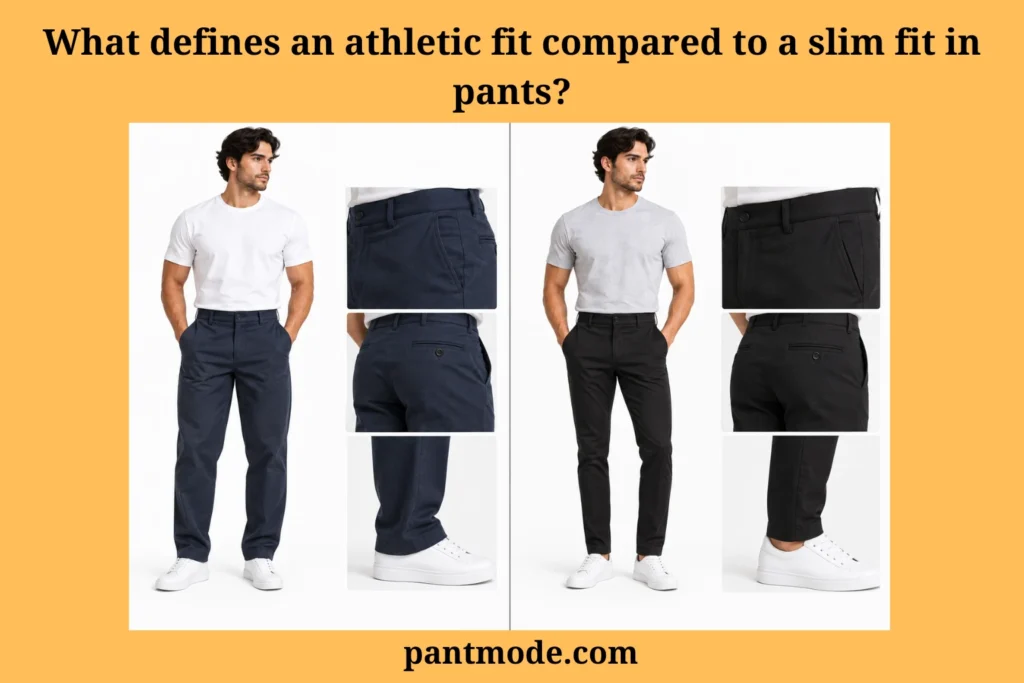
What Defines an Athletic Fit Compared to a Slim Fit in Pants?
Athletic-fit pants usually differ from slim-fit pants by providing greater combined ease through the seat and thighs, while slim-fit pants generally maintain a closer upper-leg relationship.
Both labels are relative rather than universal technical standards. Exact proportions vary by brand, pattern block, grading system, size, garment category, fabric behavior, and design intent, so actual garment behavior matters more than the label alone.
The strongest comparison belongs in the seat, thighs, and total upper-leg room. Rise, lower-leg silhouette, length, hem treatment, and fabric behavior remain separate dimensions. PantMode’s broader fit & detail pant types framework explains those layers in more detail.
Quick Answer
Athletic-fit pants usually provide more combined room through the seat and thighs than comparable slim-fit pants. Slim fit generally follows the upper leg more closely. Athletic fit may be straight or tapered, and slim fit may also be straight or tapered, so lower-leg shape should be classified separately.
Definition
Athletic fit and slim fit are relative pant-fit labels describing how closely a garment relates to the seat, hips, and thighs. Athletic fit generally provides greater upper-leg ease, while slim fit generally uses less ease. Rise, lower-leg silhouette, length, and fabric behavior are separate design layers.
What Is the Core Fit Difference Between Athletic Fit and Slim Fit Pants?
The core difference is upper-leg ease: athletic fit usually provides more room through the seat and thighs than a comparable slim fit, while slim fit generally follows those areas more closely.
Seat and thigh ease are the strongest practical comparison signals. Hip ease can support the classification, while waist shape is too design-dependent to classify the fit by itself.
Knee, calf, and hem behavior increasingly depend on the lower-leg silhouette rather than the upper-leg fit label. An athletic-fit pair does not have to be tapered, and a slim-fit pair does not have to narrow below the knee.
New Mexico State University’s pants-fit guidance evaluates waist, hips, thighs, crotch dimensions, knee, and length as separate variables.
Athletic Fit vs. Slim Fit Zone Matrix
| Fit Zone | Athletic Fit | Slim Fit | Classification Value |
|---|---|---|---|
| Waist | Design dependent | Design dependent | Weak alone |
| Seat | Usually more ease | Usually closer | Strong |
| Hips | Often more room | Often closer | Supporting |
| Thighs | Usually more ease | Usually closer | Strong |
| Rise | Variable | Variable | Separate |
| Knee | Silhouette dependent | Silhouette dependent | Not fit-only |
| Calf | Silhouette dependent | Silhouette dependent | Not fit-only |
| Hem | Silhouette dependent | Silhouette dependent | Not fit-only |
How Is Athletic or Slim Fit Different From Rise, Silhouette, Length, and Fabric?
Athletic and slim describe garment ease, while rise describes waistband placement, silhouette describes leg geometry, length describes the endpoint, and fabric behavior changes how the fit feels and appears.
Fit focuses on seat, hips, thighs, and body ease. Rise describes the vertical relationship between the crotch seam and waistband placement. Rise should remain separate from crotch depth and crotch length because those variables answer different fit questions.
Silhouette covers straight, tapered, wider, and other lower-leg geometries. Length covers cropped, ankle, full, or stacked endpoints. Hem treatment covers no break, slight break, fuller break, or stacking. Fabric behavior includes rigidity, drape, stretch, growth, and recovery.
Fit vs. Other Design Dimensions
| Dimension | Controls | Example | Defines Athletic vs. Slim? |
|---|---|---|---|
| Fit | Seat / thigh ease | Athletic, slim | Yes |
| Rise | Waist placement | Low, mid, high | No |
| Silhouette | Leg geometry | Straight, tapered, wide | No |
| Length | Garment endpoint | Crop, ankle, full | No |
| Hem | Shoe interaction | Break, stack | No |
| Fabric | Material response | Rigid, fluid, stretch | Modifier |
Which Garment Zones Most Reliably Distinguish Athletic Fit From Slim Fit?
Seat ease, thigh ease, and combined upper-leg room are the most useful athletic-vs.-slim comparison signals, while rise, taper, hem width, and fabric can vary independently.
Thigh ease and seat ease carry the strongest classification value because the athletic label usually signals additional room in those areas. Hip ease can support the reading, while movement allowance helps verify whether the pattern functions as intended.
Rise, taper, leg opening, pockets, length, fabric, cuffs, and creases remain variable. One brand’s slim fit may be roomier than another brand’s athletic fit, so cross-brand labels should not be treated as universal measurement standards.
Strong vs. Variable Fit Signals
| Attribute | Role | Main Use |
|---|---|---|
| Thigh ease | Strong signal | Upper-leg room |
| Seat ease | Strong signal | Rear-body allowance |
| Overall upper-leg room | Strongest combined signal | Fit direction |
| Hip ease | Supporting | Confirms pattern relationship |
| Rise | Variable | Waist / crotch relationship |
| Taper | Variable | Silhouette |
| Leg opening | Variable | Lower-leg geometry |
| Fabric | Modifier | Fit expression |
| Length | Variable | Endpoint |
Can Athletic Fit and Slim Fit Use the Same Leg Silhouettes?
Athletic and slim fits can use the same lower-leg silhouettes because fit describes upper-leg ease while silhouette describes the direction and width of the leg toward the hem.
An athletic straight trouser can provide more seat and thigh ease while keeping a straight lower leg. A slim straight trouser can follow the upper leg more closely while using the same lower-leg geometry. PantMode’s straight-leg pants page owns the deeper silhouette definition.
An athletic taper combines additional upper-leg room with narrowing below the knee. A slim tapered trouser combines a closer upper-leg relationship with the same taper direction. Athletic taper is therefore not a synonym for athletic fit, and slim fit is not automatically tapered.
Broader lower-leg geometry can also coexist with either fit. The wide vs. straight movement page explains the movement effect of different leg geometries without using width as a substitute for fit.
Athletic vs. Slim Fit + Silhouette Matrix
| Silhouette | Athletic-Fit Expression | Slim-Fit Expression |
|---|---|---|
| Straight | More upper-leg ease + straight lower leg | Closer upper leg + straight lower leg |
| Tapered | More upper-leg ease + lower taper | Closer upper leg + lower taper |
| Wider lower leg | More upper-leg ease + broader geometry | Closer upper fit + broader geometry where designed |
How Do Fabric Rigidity, Drape, Stretch, Growth, and Recovery Affect the Fit?
Fabric properties change how athletic and slim fits move, hold shape, reveal tension, and retain ease, but material behavior does not replace the underlying pattern fit.
Rigidity describes resistance to bending and can make available volume or close contour more visible. Drape describes how fabric hangs and folds. Stretch describes extension under force, growth describes residual extension after stress or wear, and recovery describes return toward earlier dimensions.
A rigid athletic-fit trouser can still be athletic fit, and a stretch slim-fit trouser can remain slim fit. Pattern ease and material behavior are related but separate. PantMode’s stretch and pant fit page owns the deeper material-fit relationship.
ASTM D1388 addresses stiffness through bending behavior, while ASTM D3107 separates stretch, growth, and recovery.
Fabric & Fit Interaction Matrix
| Property | Athletic-Fit Effect | Slim-Fit Effect | Boundary |
|---|---|---|---|
| Greater rigidity | Holds available volume outward | Makes close fit more obvious | Not weight |
| Fluid drape | Lets added ease fall softly | Softens close contour | Not fit label |
| Stretch | Adds responsiveness | Can improve movement | Not pattern ease |
| Growth | May increase looseness with wear | May reduce close fit over time | Not recovery |
| Strong recovery | Helps retain intended shape | Helps control bagging | Separate from stretch |
When Should You Choose Athletic Fit or Slim Fit?
Choose athletic fit or slim fit according to the amount of upper-leg room, mobility, visual volume, and lower-leg shape you want rather than according to a body-type label.
Athletic fit may better support the goal when you want more thigh room, more seat room, less upper-leg tension, or greater available movement. Slim fit may better support the goal when you want a closer upper-leg line, less visible volume, or a more controlled contour.
If neither works correctly, try another brand, pattern block, size, straight-versus-taper combination, or fabric behavior instead of forcing one label. The related relaxed vs. classic fit page provides another example of relative fit labels being compared through real garment ease.
Goal-Based Fit Selection
| Goal | Likely Direction | Verify |
|---|---|---|
| More thigh room | Athletic | Actual thigh ease |
| More seat room | Athletic | Seat remains controlled |
| Closer upper-leg line | Slim | No restrictive pull |
| Thigh room + taper | Athletic taper | Calf / ankle comfort |
| Close fit + straight lower leg | Slim-straight | Straight geometry |
| Neither fits | Change pattern / brand / silhouette | Do not force label |
How Can Athletic-Fit and Slim-Fit Pants Be Styled Without Rigid Proportion Rules?
Athletic-fit and slim-fit pants can work with fitted, relaxed, oversized, cropped, or layered pieces when the complete outfit intentionally coordinates top volume, jacket length, hem, footwear, and trouser shape.
Athletic-fit pants can work with fitted tops, relaxed shirts, overshirts, knits, blazers, and longer outer layers. Slim-fit pants can also work with fitted or relaxed tops, tees, shirts, knits, blazers, and coats.
Cropped, hip-length, conventional tailored, and long jackets can all work. Footwear should be coordinated with leg opening, hem break, shoe scale, boot shaft, and shoe visibility rather than used as a test of fit category.
Styling Rule
Style the final trouser silhouette intentionally; do not use top, jacket, or footwear choices to determine whether the pants are athletic or slim fit.
How Can Common Athletic-Fit and Slim-Fit Problems Be Diagnosed?
Fit problems should be diagnosed from the location of tension or excess fabric, rise and crotch geometry, taper, pocket construction, material behavior, and movement before changing size or altering the pants.
Pocket flare can come from hip or thigh tension, waistband tension, pocket angle, rigidity, or rise interaction. Thigh pulling can come from thigh ease, seat ease, rise, pattern block, or stretch; automatically sizing up may create new problems elsewhere.
Seat excess can come from overall ease, pattern shape, rise, size, or drape. Waist gaps should be checked through waist-to-hip relationship, waistband contour, rise, and back-pattern shape.
Calf restriction should be diagnosed through taper intensity, calf ease, leg opening, rigidity, and stretch. Crotch tension requires separate checks for rise, crotch depth, crotch length, seat ease, and thigh ease.
Fabric bagging should be considered alongside stretch, growth, recovery, and wear. NMSU’s Clothing Construction Standards supports treating pockets, waistbands, seams, hems, and ease as separate construction variables.
Fit Troubleshooting Matrix
| Problem | Check First | Possible Direction | Boundary |
|---|---|---|---|
| Pocket flare | Hip / thigh ease + pocket construction | Different fit / pattern | Not always size |
| Thigh pulling | Thigh / seat ease | Roomier fit / cut | Do not auto-size up |
| Seat excess | Ease / rise / pattern | Different pattern | Do not auto-tailor |
| Waist gap | Waist / hip + waistband | Targeted alteration if appropriate | Check entire fit |
| Calf restriction | Taper + leg opening | Straighter / roomier lower leg | Not waist problem |
| Crotch tension | Rise + crotch geometry | Different cut / rise | Multiple variables |
| Fabric bagging | Growth / recovery | Better material behavior | Stretch alone insufficient |
| Slim feels restrictive | Ease + pattern + material | Athletic / regular / alternate cut | Label alone insufficient |
What Checklist Verifies Athletic-Fit or Slim-Fit Pants in the Dressing Room?
A reliable dressing-room check should evaluate actual seat and thigh ease, waistband stability, rise and crotch comfort, lower-leg geometry, fabric behavior, and movement rather than trusting the fit label alone.
Comparison Validity
Fit Zones
Waist / Rise / Crotch
Silhouette
Material
Movement
Key Takeaway
Classify athletic and slim fit from actual upper-leg ease first. Athletic fit generally provides more combined seat and thigh room, while slim fit generally maintains a closer upper-leg relationship. Then classify rise, lower-leg silhouette, length, and fabric behavior separately, and let real movement and garment fit outweigh the label alone.
What FAQ Questions Clarify Athletic Fit vs. Slim Fit?
These five questions clarify the core fit difference, silhouette boundary, body-type boundary, and what to do when neither label fits correctly.
Athletic fit usually provides more combined room through the seat and thighs, while slim fit generally follows the upper leg more closely.
No. Athletic describes fit; taper describes lower-leg silhouette.
Yes. Slim-straight is a valid combination because fit and leg geometry are separate.
No. Athletic fit is a garment label, not a body-type requirement.
Try another size, pattern block, brand, lower-leg silhouette, or fabric instead of forcing either label.
What Final Rule Should Guide Athletic vs. Slim Fit Classification?
The final rule is to classify athletic and slim fit from actual upper-leg ease first and treat rise, lower-leg silhouette, length, and fabric behavior as separate design layers.
If two comparable pants differ mainly because one provides greater seat and thigh ease, classify that difference as fit; then describe rise, lower-leg shape, length, and material behavior separately.
Athletic fit and slim fit are best compared through actual upper-leg ease rather than body stereotypes or brand labels alone. Athletic fit generally provides more room through the seat and thighs, while slim fit generally keeps a closer upper-leg relationship.
Rise, lower-leg shape, hem treatment, length, and fabric behavior should be evaluated separately. That layered approach keeps athletic taper distinct from athletic fit, preserves slim-straight and slim-tapered as valid combinations, and makes troubleshooting more accurate because tension, pocket flare, calf restriction, and fabric bagging are diagnosed from their actual causes.