
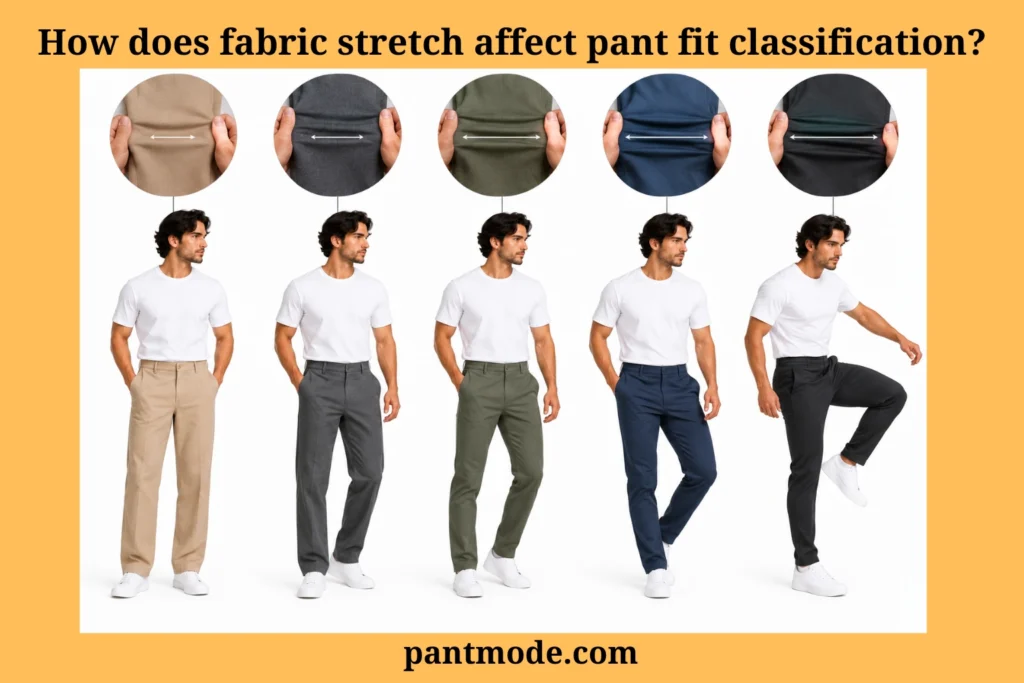
How Does Fabric Stretch Affect Pant Fit Classification?
Fabric stretch affects pant fit classification by changing how the garment accommodates the body during wear, but structural fit and leg silhouette should be identified before material stretch is used as supporting evidence.
The resting dimensions of the pants establish their basic structure. Garment ease describes the relationship between those dimensions and the body, while leg geometry identifies whether the silhouette is straight, tapered, wide, bootcut, or flared.
Extension, stretch direction, growth, and recovery then explain how that structure performs while sitting, walking, bending, and moving. PantMode’s broader fit & detail pant types framework separates these material effects from the structural variables that define the garment.
Quick Answer
Fabric stretch changes how pants accommodate the body and move during wear, but it does not define the fit category by itself. Classify fit and leg silhouette from garment structure, measurements, and ease first; then use stretch direction, growth, and recovery to interpret worn behavior.
Definition
Fabric stretch is the material’s ability to extend under force. Fabric growth is dimensional change that remains after extension, while recovery describes the return toward earlier dimensions. These properties influence pant performance but remain separate from garment ease and structural fit classification.
Stretch + Direction + Growth + Recovery → Worn-Behavior Modifier
What Does Fabric Stretch Mean for Pant Fit Classification?
Fabric stretch is the material’s ability to extend under force, and in pant classification it matters because that extension can increase body accommodation without changing the garment’s original resting measurements.
The amount of extension available in the finished pants depends on more than fiber content. Fabric construction, yarn arrangement, direction of extension, resistance to extension, seam structure, and garment orientation can all affect how much of the textile’s potential stretch is usable during wear.
This is why an elastane percentage alone cannot determine whether pants are slim, relaxed, athletic, or another fit. It can suggest that elastic behavior may be present, but the garment still has to be judged from dimensions, ease distribution, and pattern shape.
ASTM D3107-26 distinguishes stretch-related properties in woven fabrics and provides an important technical boundary: extension, growth, and recovery should not be treated as one interchangeable variable.
| Variable | Meaning | Classification Role |
|---|---|---|
| Extension | Material lengthening while force is applied | Worn-fit modifier |
| Resistance | Effort required to extend the material | Pressure and mobility modifier |
| Direction | Orientation in which extension is available | Zone-specific modifier |
| Growth | Residual dimensional change after loading | Stability diagnostic |
| Recovery | Return toward earlier dimensions | Shape-stability modifier |
| Fiber content | Material composition | Supporting clue only |
How Do Fabric Stretch, Growth, and Recovery Differ?
Fabric stretch, growth, and recovery describe different stages of material behavior: extension under force, dimensional change that remains after extension, and movement back toward the earlier dimensions.
Stretch occurs while the fabric is being loaded. Growth becomes important after that loading because it shows whether some dimensional change remains. Recovery describes how the textile responds after extension and whether it moves back toward its previous size and shape.
A fabric can therefore offer substantial extension while still developing noticeable knee or seat bagging after repeated wear. Conversely, a moderately extensible fabric may retain its shape effectively when its recovery behavior and garment construction are well matched to the design.
| Property | When Observed | Worn Effect | Main Classification Risk |
|---|---|---|---|
| Stretch | During loading | Additional accommodation | Treating material as the fit category |
| Growth | After extension or wear | Residual looseness or deformation | Mistaking bagging for structural ease |
| Recovery | After extension | Return toward previous shape | Assuming recovery determines taxonomy |
How Does Fabric Stretch Differ From Garment Ease?
Fabric stretch and garment ease are different because stretch is a material response, while ease is the dimensional relationship between the garment and the body.
Positive ease means the garment contains more dimensional room than the corresponding body measurement. Zero ease places garment and body dimensions closer together, while intentionally engineered negative ease can rely on material extension when the pattern, construction, and recovery characteristics support it.
A lower-ease design may depend more heavily on usable stretch for mobility, but high stretch does not prove that a garment has low ease. Likewise, a relaxed garment can include stretch fabric while still obtaining most of its movement from structural room.
| Variable | Source | When It Exists | Role |
|---|---|---|---|
| Garment ease | Pattern and measurements | Before wear | Primary fit evidence |
| Fabric stretch | Material behavior | Available during loading | Performance modifier |
| Functional accommodation | Ease + extension interaction | During wear | Supporting worn-fit evidence |
| Growth | Material response | After loading | Diagnostic evidence |
How Do Stretch Direction and Garment Orientation Change Fit Across Pant Zones?
Stretch direction affects pant fit only where the fabric’s available extension is oriented to respond to the forces acting on a specific garment zone.
Across-body extension may help accommodate the hip, seat, or thigh when the fabric is oriented so that its extensible direction runs around those zones. Knee flexion can load the material differently, while lengthwise extension may influence vertical movement through the rise or leg.
Multidirectional fabrics can accommodate motion across more than one axis, but their wider mobility potential still does not determine the pant’s structural fit. Recovery, growth, pattern geometry, and construction remain part of the result.
| Orientation | Pant Zone | Possible Contribution | Boundary |
|---|---|---|---|
| Across garment | Hip / seat | Circumference accommodation | Depends on actual fabric orientation |
| Across garment | Thigh | Pressure and movement response | Does not define the fit label |
| Across garment | Knee | Flexion accommodation | Does not define leg geometry |
| Lengthwise | Rise / knee | Vertical movement | Pattern and material dependent |
| Multi-directional | Multiple zones | Broader mobility | Growth and recovery still matter |
How Should Pant Measurements Be Interpreted When Fabric Stretch Changes Worn Accommodation?
Pant measurements should be interpreted from their resting dimensions first and then considered alongside how the fabric accommodates the body during wear.
Waist, hip, seat, and thigh measurements provide evidence about the body-to-garment relationship. Knee and leg-opening dimensions contribute strongly to leg geometry, while rise dimensions influence how the garment sits through the pelvis and crotch region.
Stretch can change how easily those measured dimensions adapt during movement, but it should not be added to garment measurements through an unsupported percentage formula. A meaningful interpretation requires the actual textile behavior, the direction of extension, and the relevant garment zone.
How Should Fit Labels and Leg Silhouettes Be Classified Separately?
Pant fit labels and leg silhouettes should be classified separately because one describes the body-to-garment relationship while the other describes the geometry of the leg.
Fit labels can include very close, slim, classic, regular, relaxed, or athletic. Leg silhouettes can include straight, tapered, wide, bootcut, or flare. These dimensions can coexist, which is why a garment may be slim and straight, relaxed and straight, or athletic and tapered.
A stretch fabric may increase cling or conformity without changing the underlying geometry. PantMode’s straight-leg pants guide owns the deeper definition of straight-leg structure, while relaxed vs. classic fit and athletic vs. slim fit cover their respective fit relationships in greater detail.
| Classification Layer | Examples | Main Evidence | Stretch Role |
|---|---|---|---|
| Fit | Slim, classic, relaxed, athletic | Measurements + ease distribution | Modifier |
| Very-close fit | Skinny / very close | Low or negative ease + contour | May be important for wearability |
| Silhouette | Straight, tapered, wide, flare | Leg geometry | Can alter cling without redefining geometry |
How Can Identical Pant Measurements Produce Different Worn Fits?
Two pants with similar resting measurements can feel and look different during wear when their extension, resistance, growth, recovery, or drape differ.
Imagine two garments with comparable waist, hip, thigh, knee, and leg-opening dimensions. A low-stretch fabric may preserve a firmer relationship to those measurements, while a more extensible material may follow body movement more closely and produce greater conformity.
That difference can change pressure, comfort, mobility, and visual cling without automatically changing the structural classification. The key question is whether the pattern dimensions and leg geometry changed, or whether the same structure simply behaves differently because of the textile.
What Stretch-Related Signs Can Cause Pant Fit Misclassification?
Stretch-related misclassification occurs when worn behavior such as cling, looseness, bagging, or comfort is mistaken for evidence of a different structural fit or silhouette.
A close-fitting pant that becomes loose may involve material growth or limited recovery, but excess pattern ease or the wrong garment size can produce a similar symptom. Restriction can reflect insufficient ease, low usable extension, high resistance to extension, or a structural sizing problem.
Straight-leg pants can cling through the thigh without losing their straight knee-to-hem geometry. Knee or seat bagging may involve textile growth, repeated loading, recovery behavior, local pattern stress, or more than one variable at the same time.
Construction also remains a separate system. PantMode’s seam positioning guide explains how pattern panels and structural seams can affect fit independently of stretch behavior.
| Symptom | Material Possibility | Structural Possibility | First Check |
|---|---|---|---|
| Feels loose | Growth / limited return | Excess ease | Resting measurements |
| Feels restrictive | Low usable extension | Low ease / wrong size | Relevant fit zones |
| Straight leg clings | High conformity | Close upper-leg fit | Knee-to-hem geometry |
| Knee bags | Growth / incomplete recovery | Local knee stress | Before-and-after wear shape |
| Seat bags | Growth | Seat ease / pattern geometry | Seat dimensions |
Which Stretch Characteristics Best Support Different Pant Fit Goals?
The useful stretch behavior for pants depends on how much structural ease the design provides and how much movement, conformity, and shape retention the garment requires.
Very close fits demand greater attention to usable extension, direction, recovery, and growth because the pattern has less dimensional room available before the fabric begins contributing to accommodation.
Slim fits require a balance between close structural ease, mobility, and shape retention. Classic or regular fits may obtain more movement from built-in room, while relaxed fits can depend primarily on structural ease rather than textile extension.
Athletic fits often redistribute room through specific zones such as the seat and thigh. Straight, tapered, and wide remain silhouette descriptions; stretch may influence their drape or cling but does not independently determine those geometry labels.
Decision Rule
Closer structure generally increases reliance on useful extension, while roomier structure generally relies more on garment ease. Both still need material stability appropriate to the intended design.
How Can Fabric Stretch Be Applied in a Repeatable Pant Fit-Classification Workflow?
Fabric stretch should enter pant classification only after the garment’s structural fit, measurements, ease, and leg silhouette have been identified.
How Can You Verify the Final Pant Fit Classification After Movement and Wear?
The final classification is reliable when the garment’s fit relationship and leg silhouette remain identifiable after realistic movement and material behavior has been evaluated separately.
Begin with the resting garment, then inspect the pants while standing, sitting, walking, bending, and repeatedly flexing the knees. Compare the worn shape with the original measurements and intended silhouette rather than judging from comfort alone.
New Mexico State University’s Making Perfect Pants emphasizes evaluating garment fit and hang through practical body positions, supporting a movement-based verification step instead of relying only on a static visual check.
Structure
Textile Behavior
Wear & Movement
After Wear
Key Takeaway
Classify pant structure before interpreting fabric behavior. Fit labels come from the body-to-garment relationship, silhouettes come from leg geometry, and stretch is then evaluated through extension, direction, growth, and recovery. Material behavior can change conformity, movement, and after-wear shape without automatically changing the structural category.
What FAQ Questions Clarify Fabric Stretch and Pant Fit Classification?
These five questions clarify how fabric stretch interacts with pant fit, ease, textile behavior, measurements, and after-wear deformation.
No. Fabric stretch modifies how pants behave during wear, while measurements, ease, and pattern distribution remain the primary structural evidence for fit classification.
No. Garment ease is dimensional room created by the pattern, while stretch is extension produced by the fabric under load.
Stretch is extension while the fabric is loaded, growth is dimensional change that remains after loading, and recovery describes how the material returns toward its earlier dimensions.
Yes. Extension, resistance, growth, recovery, drape, and fabric construction can change worn conformity and mobility even when the resting measurements are similar.
Knee or seat bagging can involve fabric growth, incomplete recovery, repeated loading, local pattern stress, excess ease, or a combination of material and structural factors.
What Final Rule Should Guide Fabric Stretch in Pant Fit Classification?
The final rule is to classify the pant’s structure first and treat fabric stretch as evidence about how that structure performs rather than as the category itself. Identify fit and leg geometry separately, establish measurements and ease, then use extension, direction, growth, and recovery to interpret worn behavior. Reclassify only when the combined structural evidence supports a different category.
Fabric stretch can substantially change how pants conform, move, and retain their shape, but it should not replace structural fit evidence. Garment measurements, ease distribution, pattern shape, and leg geometry establish the primary classification, while material behavior explains how that structure responds during wear.
The most reliable approach is layered rather than single-variable: establish structure, identify fit and silhouette separately, evaluate the textile’s extension and direction, inspect growth and recovery, then confirm the result through realistic movement and after-wear observation.