
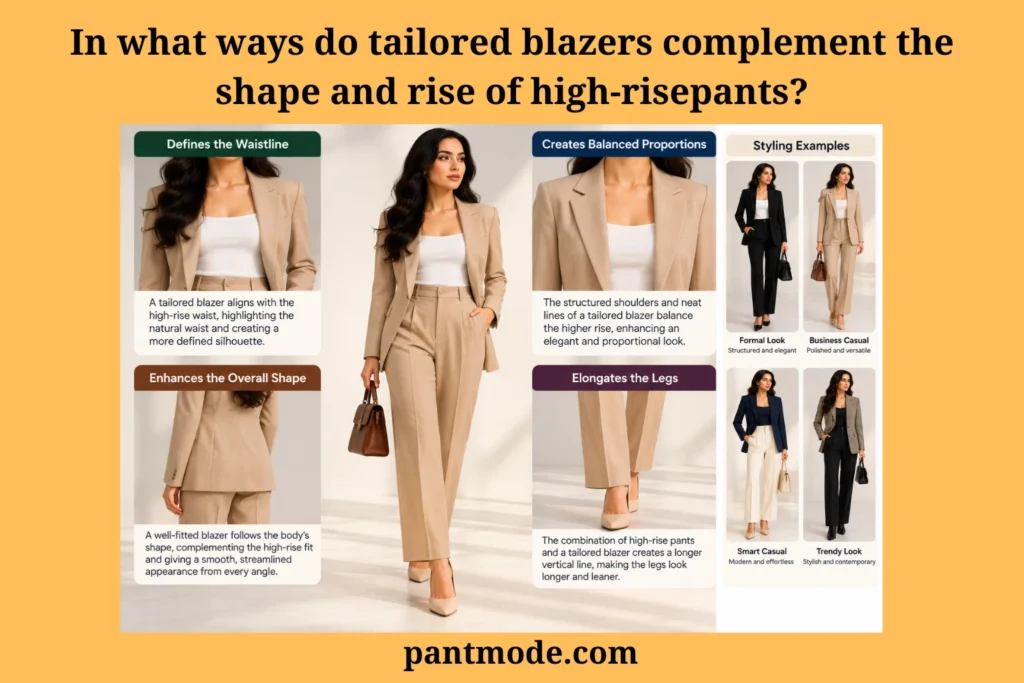
In What Ways Do Tailored Blazers Complement the Shape and Rise of High-Rise Pants?
Tailored blazers complement the shape and rise of high-rise pants when the jacket’s length, shaping, opening, and volume respond coherently to the pants’ elevated waistband and lower-body silhouette.
The pants provide two separate structural signals: rise establishes the upper trouser boundary, while shape establishes the lower-body volume path. The blazer then responds through its endpoint, torso construction, shoulder structure, and opening.
This relationship sits within PantMode’s pant fit and detail features and the broader structure of high-rise pants.
Quick Answer
Tailored blazers complement high-rise pants when the jacket responds to both pant rise and pant shape. Blazer length controls how the jacket meets or covers the elevated waistband, while blazer shaping and volume control how the upper silhouette relates to the pants’ lower-body volume. Blazer opening modifies how clearly the rise boundary remains visible.
Definition
Structural complement: a coherent relationship between the high-rise waistband, pant silhouette, blazer endpoint, jacket shaping, and upper-body volume.
Pant rise: the vertical position of the pant’s upper waist or waistband boundary.
Pant shape: the lower-body silhouette created by hip volume, thigh line, leg width, taper, straightness, flare, and overall volume distribution.
Blazer shaping: torso and waist structure created through pattern shape, seams, darts, panels, or related construction.
Key Takeaway
Read the pants first: rise determines the waist boundary, shape determines lower-body volume, and the blazer should respond to both.
How Do Tailored Blazers Complement High-Rise Pants?
Tailored blazers complement high-rise pants when jacket structure responds to the elevated waistband and lower-body silhouette rather than following one fixed blazer rule.
| Pant Signal | Blazer Response | Structural Outcome |
|---|---|---|
| Elevated waistband | Hem relationship | Controls waist transition |
| Pant shape | Jacket shaping | Controls silhouette relationship |
| Lower-body volume | Shoulder and torso volume | Controls upper/lower visual weight |
| Waist visibility | Opening or closure | Strengthens or softens the rise cue |
What Structural Roles Do High-Rise Pants and Blazers Play?
High-rise pants establish the lower-body boundary and volume path, while a tailored blazer establishes the upper garment’s lower endpoint, waist structure, and torso volume.
| Element | Structural Role |
|---|---|
| High-rise waistband | Upper boundary of the pants |
| Pant shape | Lower-body volume path |
| Blazer hem | Lower boundary of the jacket |
| Blazer waist shaping | Organizes torso structure |
| Shoulder and torso volume | Establishes upper visual weight |
| Opening | Modifies waistband visibility |
How Does Pant Rise Affect Blazer Length?
Pant rise affects blazer length by establishing the elevated boundary that the jacket may reveal, meet, cross, or conceal.
The physical rise itself can be evaluated separately through high-rise measurement. Once the elevated waistband is identified, the blazer hem can be assessed relative to that boundary.
| Blazer Endpoint | Relationship to High-Rise Boundary | Structural Reading |
|---|---|---|
| Above waistband | Rise strongly visible | Clear separation |
| Near waistband | Direct junction | Strong boundary interaction |
| Slightly below waistband | Partly concealed | Softer transition |
| Well below waistband | Rise more concealed | Longer upper overlay |
| Awkward intersection | Competing horizontal cues | Conflict risk |
How Does Pant Shape Affect Blazer Structure?
Pant shape affects blazer response because lower-body width and volume determine the visual mass that the jacket must reinforce, balance, or intentionally contrast.
| Pant Shape | Lower-Body Volume Path | Blazer Review |
|---|---|---|
| Slim | Low volume | Check whether upper structure becomes unnecessarily dominant |
| Tapered | Narrows downward | Check upper weight against the narrowing leg |
| Straight | Stable width | Supports several structured upper responses |
| Wide | Expanded volume | Review jacket endpoint and torso volume together |
| Flared | Expands toward hem | Account for lower-end expansion |
A concrete reference such as straight-leg pants shows why shape needs its own analysis: a stable leg-width path is different from both a tapered and an expanding lower-body volume path.
How Do Pant Rise and Pant Shape Work Together?
Rise and shape must be evaluated together because pants with the same elevated waistband can distribute lower-body volume very differently.
Shape = Lower-Body Volume Path
| Rise | Shape | Structural Implication |
|---|---|---|
| High | Slim | Elevated boundary + low lower-body volume |
| High | Straight | Elevated boundary + stable lower-body width |
| High | Wide | Elevated boundary + expanded lower-body volume |
| High | Flared | Elevated boundary + lower-end expansion |
The related concept of high-rise visual proportion concerns a perceptual effect of the elevated waistband. Blazer compatibility is a different question: it examines how two garment structures interact.
How Should Blazer Length Be Selected?
Blazer length should be selected by evaluating both where the jacket ends relative to the elevated waistband and where that endpoint intersects the dominant pant-volume zone.
Threads discusses tailored-jacket length and shaping as real structural design variables, including overall jacket length, shoulder relationships, seam placement, shaping, and hem position.
This supports treating jacket length as a genuine structural variable. It does not establish one universally correct blazer length for high-rise pants.
| Length Question | What to Evaluate |
|---|---|
| Where does the hem sit relative to the waistband? | Boundary interaction |
| Where does the hem sit relative to the hip and upper leg? | Intersection with pant volume |
| Does the hem create a competing horizontal cue? | Proportion conflict |
| Does the longer endpoint remain intentional? | Overall silhouette coherence |
How Should Blazer Shaping and Volume Respond to Pant Shape?
Blazer shaping and volume should respond to the pant silhouette by creating an intentional upper structure rather than copying the width of the lower garment.
| Pant Volume | Possible Blazer Response | Diagnostic Question |
|---|---|---|
| Low | Fitted, straight, or structured | Does the jacket dominate unintentionally? |
| Moderate | Light shaping or stable straight structure | Is upper visual weight controlled? |
| Expanded | More deliberate upper structure review | Does the jacket respond coherently to lower volume? |
| Flared | Evaluate both upper and lower expansion | Do the two expansion zones compete? |
Volume Rule
Balance does not require equal garment width. Blazer volume and pant volume can differ while still creating a coherent structural relationship.
How Does Waistband Visibility Modify the Pairing?
Waistband visibility changes how clearly the elevated pant boundary is read, but visibility does not independently determine compatibility.
| Blazer State | Rise Visibility | Compatibility Meaning |
|---|---|---|
| Open | Clearer | Rise cue is explicit |
| Partially closed | Moderated | Rise cue remains partial |
| Closed | More implied | Compatibility depends more on overall structure |
| Long + closed | Potentially secondary | Waistband may be concealed without automatic conflict |
How Does Visual Weight Affect the Upper and Lower Relationship?
Upper/lower structural balance depends on how visual weight is distributed across the overall composition, not on making the jacket and pants identical in width.
The general principle of visual weight and balance explains that proportional composition depends on how elements are positioned and weighted relative to the whole.
PantMode applies that general design principle to garment structure. It does not prove that one blazer-and-pant combination is objectively better or more attractive than another.
| Observed Relationship | Diagnostic Reading |
|---|---|
| Upper structure strongly dominates | Review shoulder and torso volume |
| Lower volume strongly dominates | Review jacket structural presence |
| Different widths but coherent hierarchy | Potential complement |
| Intentional contrast with clear structure | Contrast can remain coherent |
How Do Different High-Rise Pant Silhouettes Change the Blazer Response?
Different high-rise silhouettes can require different structural review even when waistband height remains similar.
| Pant Silhouette | Structural Review | Potential Blazer Variable |
|---|---|---|
| Straight-leg | Stable leg-width relationship | Length, shaping, or controlled volume |
| Tapered | Narrowing lower path | Check upper dominance |
| Wide-leg | Expanded lower volume | Review hem and torso volume together |
| Flared | Lower-end expansion | Review upper structure against hem expansion |
| Relaxed | More hip and thigh volume | Review shoulder and torso structure |
Which Structural Conflicts Weaken the Pairing?
Structural conflict appears when blazer boundaries or volume signals compete with the pant’s rise-and-shape system without producing a clear intentional relationship.
| Symptom | Likely Cause | Correction Direction |
|---|---|---|
| Blazer hem cuts awkwardly across the waist zone | Length | Change or reassess endpoint |
| Two waist cues compete | Blazer shaping vs rise | Reassess jacket waist structure |
| Upper garment dominates unintentionally | Excess shoulder or torso volume | Redistribute jacket structure |
| Lower garment dominates unintentionally | Weak upper structure | Reassess blazer volume |
| Opening hides an intended rise cue | Closure state | Review opening or jacket length |
| Rise is blamed for a shape problem | Variable confusion | Separate waistband position from silhouette |
Which Blazer Features Should Be Prioritized?
The blazer should be selected only after the high-rise pant’s two primary signals—rise and shape—have been identified.
| Priority | Variable | Decision |
|---|---|---|
| 1 | Pant rise | Locate elevated waistband |
| 2 | Pant shape | Identify volume path |
| 3 | Dominant pant volume | Identify lower visual weight |
| 4 | Blazer length | Set endpoint relative to waistband and pant volume |
| 5 | Blazer shaping | Organize upper silhouette |
| 6 | Shoulder / torso volume | Review upper visual weight |
| 7 | Opening | Modify rise visibility after core structure works |
| 8 | Complete relationship | Judge final structural coherence |
How Can Blazer and High-Rise Compatibility Be Tested?
The clearest test keeps the high-rise pants constant and changes one major blazer variable at a time.
What Checklist Confirms Structural Compatibility?
Pant Structure
Blazer Structure
Interaction
Claim Boundaries
Frequently Asked Questions About Tailored Blazers and High-Rise Pants
They complement them when blazer length, shaping, opening, and volume respond coherently to pant rise and pant shape.
Blazer length and hem position respond most directly to the elevated waistband.
Blazer shaping, shoulder structure, and torso volume respond most directly to the pant silhouette.
No. Visibility is a modifier, not a requirement.
No. Structural balance does not require identical garment widths.
What Final Rule Should Guide Blazer and High-Rise Compatibility?
Read pant rise first and pant shape second. Then use those two signals to evaluate blazer length, shaping, shoulder and torso volume, and opening. The final judgment should come from the complete structural relationship rather than from one fixed blazer formula.
Tailored blazers complement high-rise pants when the blazer responds to both the elevated waist boundary and the pant’s lower-body volume path.
Blazer length controls how the jacket endpoint relates to the waistband and surrounding pant volume. Jacket shaping and shoulder or torso volume organize the upper silhouette, while the blazer opening modifies how clearly the rise boundary remains visible.
No single cropped, long, fitted, straight, open, or closed blazer structure is universally correct. The strongest pairing is the one whose garment boundaries and volume relationships remain coherent when evaluated together.