
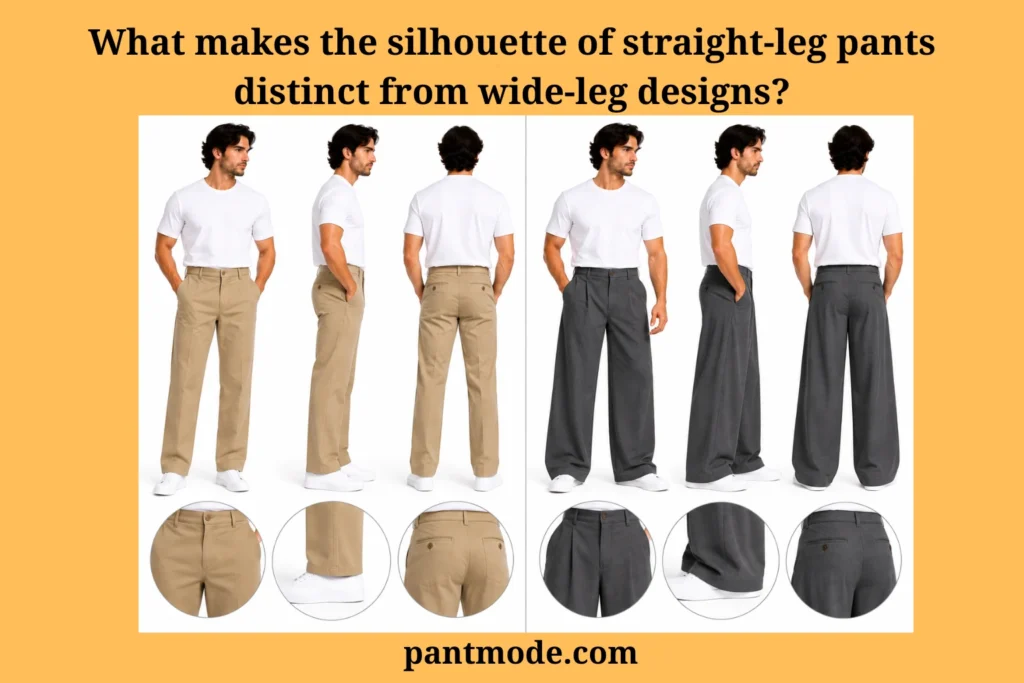
What Makes the Silhouette of Straight-Leg Pants Distinct From Wide-Leg Designs?
Straight-leg pants differ from wide-leg designs because straight-leg primarily describes a comparatively consistent leg-line geometry, while wide-leg describes substantial volume distributed through a meaningful portion of the pant leg.
Both silhouettes can display relatively straight side lines. The stronger distinction is therefore how much width and body clearance the garment carries through the thigh, knee, lower leg, and hem.
Correct classification evaluates geometry and distributed volume separately before combining them. PantMode’s fit and detail pant types framework provides the broader taxonomy for these structural distinctions.
Quick Answer
Straight-leg pants maintain a comparatively consistent leg line with controlled or moderate volume, while wide-leg pants carry substantially greater width and clearance through multiple parts of the leg. Because both can show straight-looking side seams, line direction alone cannot separate them.
Definition
Straight-leg silhouette: a pant silhouette with comparatively consistent leg-line geometry and controlled or moderate volume through the leg.
Wide-leg silhouette: a pant silhouette with substantial width and volume distributed through a large portion of the leg, commonly beginning high in the leg and continuing downward.
What Core Silhouette Difference Separates Straight-Leg Pants From Wide-Leg Designs?
The core difference is that straight-leg pants are primarily defined by comparatively straight leg-line geometry, while wide-leg pants are defined by substantial distributed leg volume.
A conventional straight-leg design can contain some ease without becoming wide-leg. Its width remains controlled enough that the line geometry remains the dominant visual characteristic. PantMode’s straight-leg pants guide covers that geometry in greater depth.
A wide-leg garment places more visual and physical emphasis on sustained width through several zones. PantMode’s wide-leg pants guide explains that category separately.
| Category | Geometry | Volume | Classification Signal |
|---|---|---|---|
| Straight-leg | Comparatively straight | Controlled / moderate | Geometry dominates |
| Roomy straight | Comparatively straight | Moderate | Volume remains contained |
| Wide-leg | Straight or broad | Substantial and distributed | Volume becomes defining |
| Borderline | Mixed | Moderate / substantial | Requires full evidence |
Why Must Leg-Line Geometry and Leg Volume Be Evaluated Separately?
Leg-line geometry and leg volume must be evaluated separately because geometry describes direction while volume describes the amount and distribution of garment space.
Two pants can show similarly straight side seams yet carry very different quantities of fabric through the thigh, knee, calf, and hem. One may form a controlled column; the other may retain broad width throughout most of the leg.
Straightness and width are therefore not opposite values on a single scale. A silhouette can be straight in directional geometry and still qualify as wide-leg when distributed volume becomes the dominant structural feature.
| Geometry | Volume | Likely Reading |
|---|---|---|
| Straight | Controlled | Straight-leg |
| Straight | Moderate | Roomy straight |
| Straight | Substantial | Wide-leg |
| Broad / slightly expanding | Substantial | Wide-leg |
| Mixed | Mixed | Borderline |
Which Measurement Landmarks Help Compare Straight-Leg and Wide-Leg Pants?
The most useful landmarks are the thigh, knee, lower leg or calf, and hem because together they show where volume begins and whether that width remains distributed through the leg.
Threads’ pants fitting and leg measurement guidance distinguishes wider or fuller trouser construction from more streamlined pants and discusses upper-thigh, knee, and calf measurements as useful fitting landmarks. Those measurements support analysis, but they do not create a universal straight-versus-wide cutoff.
The important step is relational comparison. A thigh measurement describes only one zone; the classification becomes meaningful when the knee, lower leg, hem, and total width-retention pattern are evaluated with it.
| Landmark | What It Reveals |
|---|---|
| Thigh | Starting upper-leg volume |
| Knee | Mid-leg width retention |
| Lower leg / calf | Whether volume remains substantial |
| Hem | Final opening |
| Complete sequence | Distribution pattern |
How Does Upper-Leg Volume Help Distinguish Straight-Leg From Wide-Leg Pants?
Upper-leg volume helps distinguish the silhouettes because true wide-leg volume usually becomes evident high in the leg rather than appearing only at the hem.
A roomy straight-leg pant may contain extra thigh space while keeping the overall width comparatively controlled. That localized or moderate room does not automatically make distributed volume the dominant silhouette feature.
Wide-leg construction generally carries stronger upper-leg width into later zones. Thigh evidence is therefore important, but it should be carried forward into the knee, lower leg, and hem rather than used as standalone proof.
| Upper-Leg Pattern | Knee Relationship | Initial Reading |
|---|---|---|
| Controlled | Controlled | Straight-leg evidence |
| Roomy | Moderate | Roomy-straight possibility |
| Substantial | Substantial retained width | Wide-leg evidence |
| Substantial | Rapid reduction | Requires full-leg review |
How Does Full-Leg Width Retention Separate Straight-Leg From Wide-Leg Pants?
Full-leg width retention separates the silhouettes by showing whether substantial width continues through the knee, lower leg, and hem rather than remaining localized.
A controlled straight-leg profile may preserve fairly consistent line direction while carrying moderate width. A wide-leg profile retains much more of its available space through several zones, making distributed volume a persistent feature from the upper leg downward.
A wide hem by itself remains weak evidence. If the thigh and knee are comparatively controlled and most of the extra width appears only near the opening, the complete garment does not show the same volume distribution as a true wide-leg design.
| Thigh | Knee | Lower Leg | Hem | Interpretation |
|---|---|---|---|---|
| Controlled | Controlled | Controlled | Controlled | Straight-leg |
| Moderate | Moderate | Moderate | Moderate | Roomy straight |
| Substantial | Substantial | Substantial | Substantial | Strong wide-leg evidence |
| Controlled | Controlled | Moderate | Wide | Hem-led width; review full geometry |
How Does Body Clearance Differ Between Straight-Leg and Wide-Leg Designs?
Body clearance differs because straight-leg pants may contain moderate ease while wide-leg pants typically maintain substantially more garment space through multiple leg zones.
Garment ease is the dimensional space built between the body and garment. It influences worn room, but ease alone does not establish the silhouette because the same extra space can be localized or distributed differently.
New Mexico State University’s pants measurement and ease guidance treats thigh width, knee width, and ease as distinct fitting variables and notes that width and ease depend on style. These principles support clearance analysis without creating a universal wide-leg threshold.
PantMode’s discussion of wide-leg and straight-leg movement further explains how additional garment space can affect worn movement while remaining separate from the core silhouette classification.
| Clearance Pattern | Distribution | Silhouette Evidence |
|---|---|---|
| Controlled | Consistent but limited | Straight-leg |
| Moderate | Contained through leg | Roomy straight |
| Substantial | Sustained across multiple zones | Wide-leg |
| Localized | One dominant area | Insufficient alone |
How Do Geometry and Distributed Volume Work Together to Classify the Silhouette?
Geometry and distributed volume work together by distinguishing controlled straight silhouettes from broad, high-volume silhouettes that may share similar line direction.
Straight geometry with controlled volume supports straight-leg classification. The same basic directional geometry with moderate volume can produce a roomy straight result. Once substantial width and clearance remain distributed across much of the leg, wide-leg becomes the stronger classification.
PantMode’s wide-leg silhouette guide examines that high-volume structure more specifically.
| Leg Geometry | Distributed Volume | Result |
|---|---|---|
| Straight | Controlled | Straight-leg |
| Straight | Moderate | Roomy straight |
| Straight | Substantial | Wide-leg |
| Broad | Substantial | Wide-leg |
| Mixed | Moderate / substantial | Borderline |
How Can Roomy Straight-Leg Pants Be Distinguished From True Wide-Leg Designs?
Roomy straight-leg pants differ from true wide-leg designs when their added ease remains contained instead of becoming substantial distributed volume through most of the leg.
Both categories can show relatively straight side lines and noticeable body clearance. The key question is whether the extra volume remains moderate or becomes a dominant characteristic across the thigh, knee, lower leg, and hem.
No one absolute width decides this boundary. A defensible classification requires several aligned signals: upper-leg volume, width retention, clearance continuity, and complete silhouette geometry.
| Stage | Geometry | Volume | Result |
|---|---|---|---|
| Controlled straight | Straight | Controlled | Straight-leg |
| Roomy straight | Straight | Moderate | Roomy straight |
| Borderline | Straight / broad | Mixed | Qualified |
| Wide-leg | Straight / broad | Substantial distributed | Wide-leg |
How Should Borderline Straight-Leg and Wide-Leg Silhouettes Be Classified?
Borderline silhouettes should remain qualified when the garment shows more volume than a conventional straight leg but lacks enough sustained distribution for a confident wide-leg classification.
Begin with line geometry, then evaluate upper-leg width and trace how much of that width survives through the knee and lower leg. Clearance should also remain distributed rather than appearing in only one localized zone.
If those signals remain mixed, “borderline” or “roomy straight leaning wide” is more accurate than pretending a universal numerical threshold exists.
Which Evidence Signals Matter Most for Straight-vs-Wide Classification?
The strongest evidence is full-leg distributed volume interpreted together with line geometry.
Thigh and knee volume, lower-leg width retention, and clearance distribution provide strong supporting evidence because they show whether broad space remains continuous. Hem width contributes context but cannot carry the classification alone.
General looseness, garment size, and product naming are weaker signals because each can change without producing true wide-leg architecture.
| Signal | Strength |
|---|---|
| Full-leg distributed volume | Primary |
| Geometry + volume interaction | Primary |
| Thigh / knee volume | Strong supporting |
| Width retention through lower leg | Strong supporting |
| Clearance distribution | Strong supporting |
| Hem width | Supporting only |
| General looseness | Weak alone |
| Garment size | Weak alone |
| Product label | Weak alone |
Which Errors Cause Straight-Leg and Wide-Leg Pants to Be Misclassified?
Straight-leg and wide-leg pants are commonly misclassified when one visible property is treated as proof of the complete silhouette.
Loose pants are not automatically wide-leg because extra ease can remain contained. Straight-looking side lines do not prove straight-leg because high-volume wide legs can also fall vertically. A wide hem provides only endpoint evidence.
The correct test always returns to the whole leg: determine line direction, locate where volume begins, trace whether width remains distributed, and then evaluate clearance.
| Error | Why It Fails | Correct Test |
|---|---|---|
| Loose = wide-leg | Straight pants can be roomy | Test distributed volume |
| Straight line = straight-leg | Wide legs can also fall straight | Add volume evidence |
| Wide hem = wide-leg | Hem is one endpoint | Trace the complete leg |
| Roomy thigh = wide-leg | Ease may be localized | Test volume continuity |
| Large size = wide-leg | Size changes dimensions broadly | Evaluate silhouette relationships |
| Product label = proof | Naming varies | Verify garment geometry and volume |
How Can Straight-Leg and Wide-Leg Pants Be Compared Through a Repeatable Process?
Straight-leg and wide-leg pants can be compared reliably by observing the complete silhouette, mapping several leg zones, separating line direction from volume, and combining the evidence only after each variable has been evaluated independently.
What Checklist Confirms the Final Straight-vs-Wide Classification?
The final classification is reliable when multiple geometry, volume, width-retention, and clearance signals support the same result without relying on an invented cutoff.
Geometry
Volume
Clearance & Boundaries
Classification Control
Key Takeaway
Straightness tells you the direction of the leg line; width tells you how much volume the leg carries. Distinguish straight-leg from wide-leg by combining line geometry with upper-leg volume, full-leg width retention, and clearance distribution rather than relying on looseness, hem width, garment size, or product naming alone.
Frequently Asked Questions About Straight-Leg and Wide-Leg Pants
These five questions address the classification issues most likely to blur the boundary between straight-leg, roomy straight-leg, and wide-leg silhouettes.
Straight-leg primarily describes comparatively consistent leg-line geometry with controlled or moderate volume. Wide-leg describes substantially greater volume distributed through several leg zones, even when its side lines remain relatively straight.
Yes. Wide-leg pants can fall in relatively straight lines. Their defining difference is the larger amount of volume and clearance carried through the leg rather than line direction alone.
Yes. Straight-leg pants can contain noticeable ease while preserving controlled overall volume. Added room does not automatically create the sustained multi-zone volume associated with a wide-leg silhouette.
No. Hem width is only one endpoint. It must be interpreted with thigh, knee, lower-leg, width-retention, and clearance evidence before the whole silhouette can be classified.
Use a qualified classification when the garment carries more volume than a conventional straight leg but lacks enough sustained distribution for a confident wide-leg result. Do not force a binary category when the physical evidence remains mixed.
What Final Rule Should Guide Straight-Leg vs Wide-Leg Classification?
The final rule is to follow the entire leg, identify line direction independently, evaluate how much volume begins in the upper leg, trace whether that width remains distributed through later zones, and then combine geometry with clearance evidence. No single loose area, wide hem, garment size, or retail label should override the complete silhouette.
Straight-leg and wide-leg pants are most accurately distinguished by evaluating leg-line geometry and distributed volume together rather than relying on looseness, hem width, size, or product naming. Straight-leg describes a comparatively consistent line with controlled or moderate volume, while wide-leg makes sustained width a defining feature across several zones.
The repeatable method is simple: map the thigh, knee, lower leg, and hem; separate line direction from volume; inspect width retention and body clearance; then classify only when several physical signals support the same result.