
What Defines Wide-Leg Pants as a Distinct Fashion Silhouette?
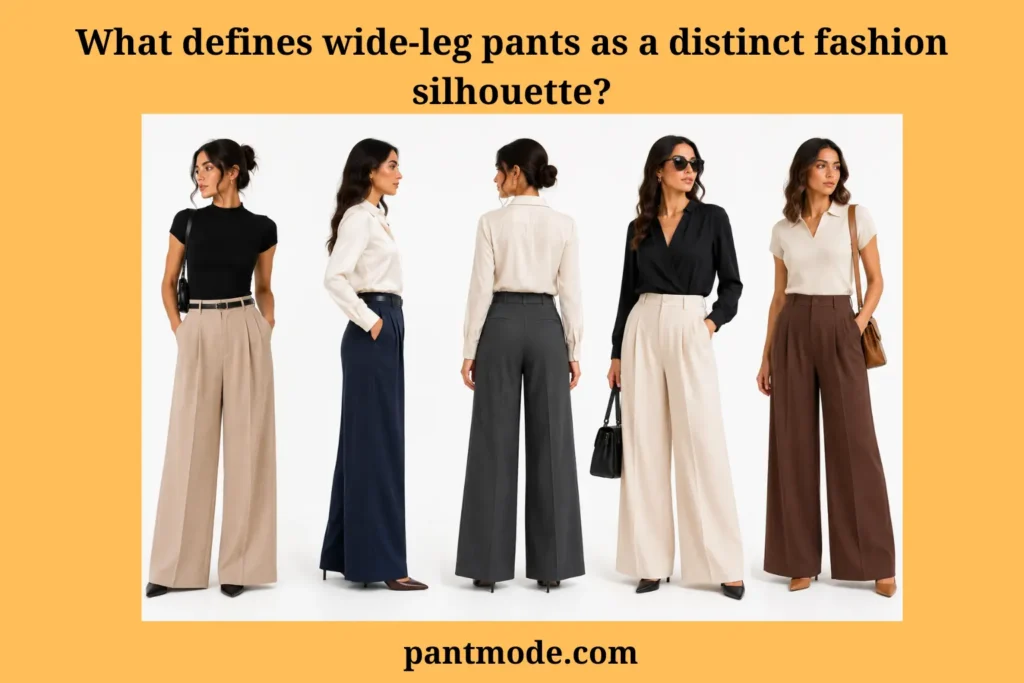
Wide-leg pants are defined by substantial width carried through much of the leg, with meaningful room at the thigh, knee, and lower leg rather than width appearing mainly near the hem.
Exact circumference can vary because wide-leg is a relational silhouette rather than one universal measurement. PantMode classifies the shape by asking where width begins, whether the knee remains broad, how much room continues below the knee, and whether the overall line stays meaningfully wide.
That geometry separates wide-leg trousers from narrower straight-leg cuts, more extreme Palazzo-scale volume, lower-expanding bootcut and flare silhouettes, and cropped categories such as culottes. Rise, pleats, crease, fabric, waistband construction, pockets, and length remain variable. For its professional-use context, see wide-leg pants.
Quick Answer
Wide-leg pants are trousers with substantial room through much of the leg, including meaningful width at the thigh, knee, and lower leg. Their width is carried higher and more continuously than bootcut or flare silhouettes, while standard wide-leg trousers are generally less extreme in scale than Palazzo styles. Rise, pleats, fabric, crease, waistband, and length can all vary.
Definition
Wide-leg pants are a trouser silhouette characterized by sustained leg room through a substantial portion of the thigh, knee, and lower leg. PantMode identifies the category from overall width distribution rather than one mandatory rise, fabric, hem measurement, or styling feature.
Classification starts with where width exists and how long it remains structurally meaningful.
What Structural Features Most Strongly Define Wide-Leg Pants?
The strongest structural features of wide-leg pants are meaningful upper-leg ease, a relatively broad knee, substantial lower-leg room, and width that remains present through much of the leg.
Upper-leg ease establishes that the silhouette begins wide rather than reaching width only near the hem. A broad knee preserves continuity, while lower-leg room confirms that the trouser has not narrowed into a taper or relied on a late flare.
The side seam may look nearly straight, widen slightly, or narrow slightly and still remain wide-leg if meaningful room continues through the full leg architecture. Hem opening supports the classification but cannot classify the garment alone.
New Mexico State University’s Making Perfect Pants treats style, fabric, fit, thigh measurement, knee measurement, ease, and pants length as separate garment considerations. Its technical fit concepts support evaluating room and placement, while PantMode’s taxonomy remains an editorial framework.
Wide-Leg Structural Feature Matrix
| Structural Feature | Typical Signal | Role | Boundary |
|---|---|---|---|
| Upper-leg ease | Meaningful | Primary | Degree varies |
| Thigh width | Roomy | Primary | No universal measurement |
| Knee width | Relatively broad | Primary | Need not equal thigh |
| Lower-leg width | Remains substantial | Primary | Compare flare |
| Width distribution | High / sustained | Primary | Strongest relational cue |
| Hem opening | Broad | Supporting | Hem alone is insufficient |
| Rise | Low, mid, or high | Variable | Does not define silhouette |
| Length | Full, ankle, or cropped | Variable | Category can survive length change |
Which Wide-Leg Features Are Defining, Supporting, and Variable?
Wide-leg pant features should be separated into defining structural signals, supporting visual cues, and variable design choices so that rise, pleats, fabric, or length are not mistaken for requirements.
Defining signals include sustained meaningful width, upper-leg ease, a broad knee, and substantial lower-leg room. Supporting cues include a broad hem, visible continuous volume, a columnar appearance, and limited calf contouring. Variable features include rise, waistband, pleats, crease, pockets, closure, fabric, and length.
Defining vs. Variable Attribute Table
| Attribute | Classification Role | Why It Matters |
|---|---|---|
| Sustained leg width | Defining | Core geometry |
| Upper-leg ease | Defining | Width begins high |
| Broad knee | Defining | Supports continuity |
| Broad lower leg | Defining | Maintains wide silhouette |
| Broad hem | Supporting | Reinforces scale |
| Columnar line | Supporting | Common visual result |
| Rise | Variable | Fit and styling choice |
| Pleats | Variable | Change fullness |
| Crease | Variable | Adds directional structure |
| Fabric | Variable | Changes expression |
| Length | Variable | Changes vertical presentation |
| Waistband | Variable | Construction choice |
How Do Wide-Leg Pants Differ From Straight-Leg, Palazzo, Bootcut, Flare, and Culotte Silhouettes?
Wide-leg pants differ from straight-leg, Palazzo, bootcut, flare, and culotte silhouettes mainly through the amount and distribution of width from the thigh through the knee and lower leg.
For the deeper boundary between the two columnar families, see straight vs. wide-leg pants.
How Does Wide-Leg Differ From Straight-Leg?
Both can produce relatively straight side lines, but straight-leg trousers generally carry less total room through the thigh, knee, and lower leg. The boundary is degree-based rather than a single measurement.
How Does Wide-Leg Differ From Palazzo?
Both use high or continuous width. In PantMode’s framework, Palazzo sits farther toward the very full and sweeping end of the family, while a standard wide-leg trouser can be more restrained, tailored, or columnar. For the full high-volume definition, see Palazzo pants.
How Does Wide-Leg Differ From Bootcut and Classic Flare?
Bootcut and classic flare keep more control above their lower expansion. Wide-leg trousers remain comparatively broad through the knee, while flare-family trousers make widening more meaningful below it. For a deeper flare-family comparison, see bootcut vs. flare.
How Does Wide-Leg Differ From Culottes?
Culottes are strongly associated with cropped trouser construction, and many use broad leg volume. A cropped wide-leg trouser can overlap visually with culotte territory, but length alone should not decide the label. For the cropped-category boundary, see culottes vs. cropped wide-leg pants.
Straight-leg, wide-leg, and flare-family silhouettes differ most clearly in the amount and distribution of width.
Trouser Silhouette Comparison Matrix
| Style | Upper Leg | Knee | Expansion Pattern | Length Role | Core Signal |
|---|---|---|---|---|---|
| Wide-leg | Roomy | Broad | High / sustained | Variable | Continuous substantial width |
| Straight-leg | Moderate | Moderate | Minimal | Variable | Narrower straight column |
| Palazzo | Very full | Very broad | High / continuous | Variable | Extreme continuous volume |
| Bootcut | Controlled | Controlled | Subtle lower | Usually full | Restrained lower widening |
| Classic flare | Controlled | More controlled | Strong lower expansion | Usually full | Knee-to-hem curve |
| Culotte | Variable / full | Variable | Variable | Strongly cropped | Cropped trouser identity |
Which Major Variations Exist Within the Wide-Leg Pant Family?
Wide-leg pants can appear as tailored, relaxed, pleated, fluid, cropped, or extra-wide designs while remaining in the same broad silhouette family when sustained leg room remains structurally present.
Wide-Leg Variation Taxonomy Matrix
| Variation | Volume | Material Expression | Length | Main Character | Boundary |
|---|---|---|---|---|---|
| Tailored wide-leg | Moderate–high | Structured | Usually full | Clean / architectural | Still needs sustained width |
| Relaxed wide-leg | Moderate–high | Soft | Variable | Casual ease | Not simply oversized |
| Pleated wide-leg | High | Variable | Variable | Added front fullness | Pleats optional |
| Flat-front wide-leg | Moderate–high | Variable | Variable | Cleaner surface | Still wide-leg |
| Fluid wide-leg | High | Fluid | Variable | Movement | Fluidity not defining |
| Cropped wide-leg | Moderate–high | Variable | Cropped | Ankle-focused | Compare culotte |
| Extra-wide | Very high | Structured / fluid | Variable | Dramatic scale | Compare Palazzo |
How Does Fabric Behavior Change the Expression of Wide-Leg Pants?
Fabric behavior changes how wide-leg pants hold, soften, or collapse their volume, but material should be treated as an expression modifier rather than the primary category definition.
Weight is material mass; stiffness is resistance to bending; structure is shape retention; drape is how fabric falls; and fluidity is ease of movement through folds. These properties should not be treated as synonyms.
Structured materials can create sharper contours and stronger crease retention. Fluid materials can create softer folds and more motion. Linen can vary in weight and structure, wrinkles naturally, and can support relaxed or tailored wide-leg designs depending on weave, construction, opacity, and finish.
Fabric Behavior Decision Matrix
| Fabric Behavior | Wide-Leg Expression | Useful Direction | Trade-Off | Boundary |
|---|---|---|---|---|
| Structured | Architectural | Tailored silhouette | Less movement | Structure is not weight |
| Medium controlled drape | Balanced | Versatile | Moderate movement | Depends on cut |
| Fluid | Soft / sweeping | Relaxed or elevated | Less shape retention | Fluidity not defining |
| Lightweight linen | Relaxed | Warm-weather | Wrinkling | Linen is not unsuitable |
| Stable knit | Soft structure | Casual use | Less crisp tailoring | Stretch varies |
| Very light or sheer | Airy | Layered use | Opacity | Transparency needs management |
How Can Wide-Leg Volume Be Styled Without Changing the Silhouette’s Identity?
Wide-leg volume can be styled through waist visibility, top length, outer-layer scale, and footwear, but these choices change presentation rather than structural identity.
A fitted or tucked top can create stronger contrast; an untucked top creates a longer upper block; shorter tops expose more trouser line; oversized tops create deliberate volume-on-volume; short jackets reveal more pant architecture; and long layers overlay more of it.
Utah State University Extension presents balance, proportion and scale, emphasis, rhythm, and harmony as general clothing-design principles. They help explain visual relationships but do not create mandatory ratios or classification rules.
Wide-Leg Styling Decision Matrix
| Styling Goal | Upper Direction | Waist Visibility | Layer Direction | Boundary |
|---|---|---|---|---|
| Strong contrast | Fitted / tucked | High | Short / structured | Optional |
| Relaxed column | Untucked / soft | Low | Long / soft | Length should be intentional |
| More trouser emphasis | Short / cropped | High | Short | Not universally better |
| Fashion-forward volume | Oversized | Variable | Oversized / structured | Volume should be deliberate |
| Tailored appearance | Shirt / knit | Moderate | Blazer | Styling does not classify the trouser |
How Should Hem Length and Footwear Be Evaluated on Wide-Leg Pants?
Wide-leg hem length should be evaluated with the intended footwear because shoe height, shoe volume, fabric behavior, and leg opening determine whether the trouser falls cleanly, pools, or drags.
- Set the waistband at its intended position.
- Put on the intended footwear.
- Check front clearance.
- Check the side line.
- Check back clearance.
- Walk.
- Sit and stand.
- Evaluate break or pooling.
- Confirm the width still reads intentionally.
NMSU’s Clothing Construction Standards supports practical evaluation of ease, hems, waist treatments, pleats, pockets, seams, and construction quality without imposing one universal floor-clearance measurement.
How Can Common Wide-Leg Fit and Construction Problems Be Corrected?
Common wide-leg fit problems can be corrected by identifying whether the issue comes from waistband fit, rise, front fullness, leg width, material behavior, inseam, or footwear rather than treating all volume as a problem.
A dragging hem points toward length or shoe mismatch. Waist gaping or pulling points toward fit. Excess front volume may come from pleats, pockets, or stiffness, while a collapsing silhouette may indicate that the textile is softer than the intended design requires.
Wide-Leg Fit Troubleshooting Matrix
| Problem | Likely Cause | Possible Adjustment | Boundary |
|---|---|---|---|
| Hem drags | Excess inseam or shoe mismatch | Re-hem for intended footwear | No universal clearance |
| Waist gaps | Waist / hip mismatch | Alter waistband | Styling cannot fix fit |
| Waist pulls | Size or rise issue | Reassess size or construction | Wide-leg does not mean oversized |
| Excess front volume | Pleats, pockets, or stiffness | Reduce one volume source | Fullness may be intentional |
| Entire leg feels too large | Excess circumference | Compare another cut or tailor | Do not erase intended width |
| Silhouette feels too stiff | Material behavior | Use softer drape | Structure may be intentional |
| Silhouette collapses | Too little stability for intended shape | Use more stable material | Fluidity may be intentional |
| Hem break looks accidental | Length / shoe mismatch | Refit with target footwear | Break varies |
What Checklist Confirms That Trousers Are Genuinely Wide-Leg and Properly Fitted?
A reliable wide-leg verification process should confirm sustained leg width first and then separately check waistband fit, ease, fabric behavior, hem length, footwear, and movement.
The F50 control prevents one detail—such as a broad hem, high rise, pleat, or fluid fabric—from becoming the entire classification.
F50 Wide-Leg Classification Control
| Step | Reader Question | Decision Output |
|---|---|---|
| Upper leg | Is meaningful room present through the thigh? | Strong or weak signal |
| Knee | Does the knee remain relatively broad? | Supports sustained width |
| Lower leg | Does room continue below the knee? | Strong wide-leg signal |
| Expansion | Is width high / continuous or lower-leg driven? | Wide family or flare family |
| Hem | Does the hem support the broad line? | Supporting signal |
| Overall scale | Is width moderate, high, or extreme? | Standard or extra-wide |
| Rise | Low, mid, or high? | Variable |
| Length | Full, ankle, or cropped? | Variable |
| Front | Pleated or flat? | Variable |
| Fabric | Structured or fluid? | Expression modifier |
| Adjacent category | Straight, Palazzo, flare, bootcut, or culotte? | Compare |
| Final decision | Does sustained width dominate? | Confirm or reclassify |
Category identity and good fit are separate decisions: a true wide-leg trouser can still fit poorly.
Wide-Leg Classification Checklist
Adjacent Category Check
Practical Fit Checklist
Final Classification Decision
Key Takeaway
Identify wide-leg pants from the full leg architecture first. Check whether width remains substantial through the thigh, knee, and lower leg, then treat rise, pleats, fabric, length, crease, and waistband style as variable features.
What FAQ Questions Clarify Wide-Leg Pants as a Distinct Silhouette?
These five questions cover the highest-value definition and comparison issues without repeating the full guide.
Wide-leg pants are identified by sustained room through much of the leg, including meaningful width at the thigh, knee, and lower leg. No universal circumference threshold defines the category.
Both can look relatively straight, but wide-leg trousers carry more overall room through the thigh, knee, and lower leg. The distinction is relative scale and sustained width, not one exact measurement.
Within PantMode’s practical framework, Palazzo sits at the fuller and more voluminous end of wide-leg territory, but not every wide-leg trouser has Palazzo-level scale or sweep.
Wide-leg pants carry meaningful width higher through the leg, while bootcut and classic flare silhouettes keep more upper-leg control and make widening more significant lower down.
Yes. Cropped length can preserve wide-leg architecture when thigh, knee, and lower-leg room remain substantial, although very wide cropped styles should also be checked against culotte classification.
What Final Rule Should Guide Wide-Leg Pant Identification?
The final rule for wide-leg pant identification is to classify the trouser from its full leg geometry first and treat rise, pleats, crease, fabric, waistband, length, and styling as secondary variables.
Meaningful upper-leg ease, a broad knee, and substantial lower-leg room carry the strongest classification weight. A narrower overall column points toward straight-leg, extreme continuous volume may move toward Palazzo-adjacent territory, and lower-leg-driven expansion points toward bootcut or flare.
Cropped length creates a culotte edge case, but crop alone should not control the label. Likewise, pleats, creases, fabric, rise, and waistband construction can all change without erasing wide-leg identity.
Wide-leg pants are best identified by sustained, intentional room through the leg—not by one required rise, fabric, pleat, hem length, or styling formula.
Wide-leg pants are defined most reliably by the distribution of width across the full leg. The thigh is roomy, the knee remains relatively broad, and meaningful room continues through the lower leg instead of appearing mainly near the hem.
Once that geometry is confirmed, fabric, rise, pleats, crease, length, waistband construction, styling, footwear, and hem should be evaluated as secondary expression and fit variables. Classification and good fit remain separate judgments: a trouser can be structurally wide-leg and still need fit or hem correction.