
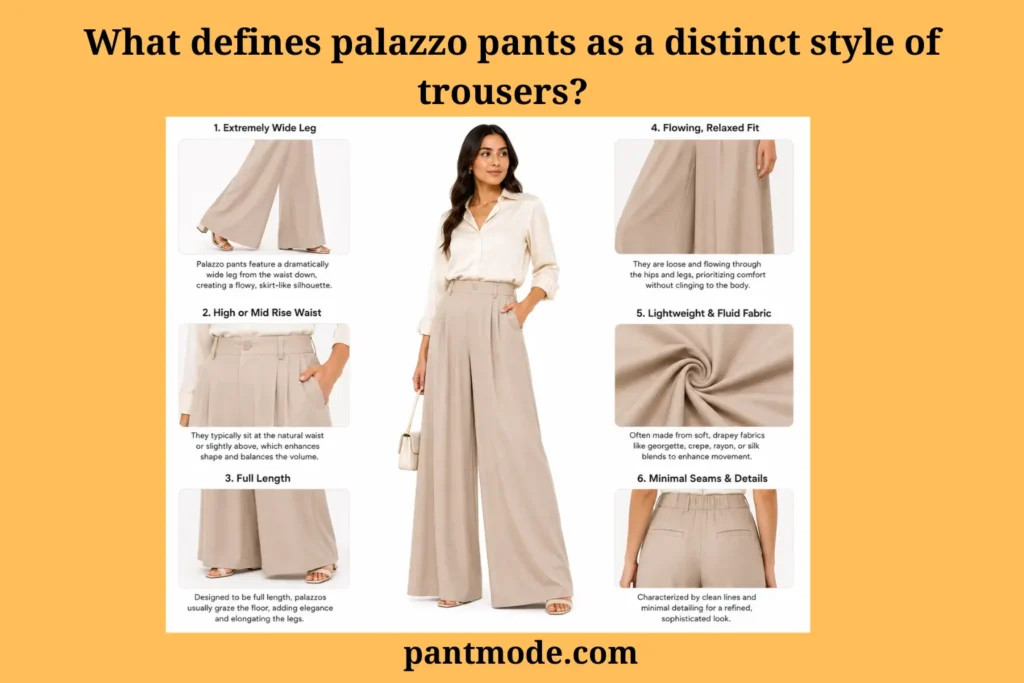
What Defines Palazzo Pants as a Distinct Style of Trousers?
Palazzo pants are very wide-legged trousers whose distinct identity comes primarily from substantial width carried through much of the leg rather than from one mandatory fabric, rise, waistband, pleat treatment, or length.
Reliable dictionary definitions agree on the width signal. Merriam-Webster centers Palazzo pants on extreme wide-leggedness, while Cambridge Dictionary also describes very wide legs and adds soft, light material. Because the material wording differs, PantMode treats very substantial width as the strongest cross-source signal and fabric character as an important expression variable.
Within the broader wide and flared pant types family, Palazzo sits on the high-volume, continuous-width side rather than the knee-driven flare side. PantMode’s taxonomy here is a practical silhouette-classification framework, not a claim that one universal apparel standard defines an exact Palazzo measurement.
Quick Answer
Palazzo pants are extremely wide-legged trousers whose strongest practical identification signals are substantial width carried high through the leg, broad lower-leg volume, and an overall continuous wide silhouette. Fabric, rise, waistband construction, pleats, and length can vary. Palazzo pants differ from classic flares and bell-bottoms because those silhouettes concentrate more of their widening lower in the leg, while standard wide-leg trousers may use less extreme overall volume.
Definition
Palazzo pants are a very wide-legged trouser style. In PantMode’s practical classification framework, Palazzo identity is strongest when generous width extends through much of the leg and creates broad continuous volume rather than a fitted upper leg followed by a knee-driven flare.
Palazzo identity is strongest when very high volume begins high and remains broad through much of the leg.
What Structural Features Most Strongly Identify Palazzo Pants?
The strongest structural signals of Palazzo pants are very substantial leg width, generous fullness high through the leg, broad lower-leg volume, and an overall silhouette that remains wide rather than becoming wide only near the hem.
Upper-leg fullness matters because it shows where the width begins. If the thigh is relatively controlled and the strongest change occurs around or below the knee, the garment is moving toward flare-family geometry instead of Palazzo.
A broad lower leg and hem reinforce the scale, but hem width alone is not enough. Two trousers can have equally large hems while one is continuously broad and the other reaches that width through a dramatic lower-leg flare.
Sweep and skirt-like movement are useful supporting cues, especially in fluid fabrics, but they are not mandatory. A structured Palazzo can hold a more architectural outline while preserving the same high, continuous breadth.
Palazzo Structural Feature Matrix
| Structural Feature | Typical Palazzo Signal | Classification Weight | Boundary |
|---|---|---|---|
| Overall leg width | Very substantial | Primary | No universal measurement |
| Upper-leg fullness | Generous | Primary | Exact starting point varies |
| Width distribution | High or continuous | Primary | Compare with standard wide-leg |
| Broad lower leg | Strong | Primary / supporting | Hem alone is insufficient |
| Sweep or movement | Often strong | Supporting | Structured versions differ |
| Skirt-like effect | Possible | Supporting | Not required |
| Length | Often full | Variable | Cropped forms create edge cases |
| Fabric | Fluid to structured | Variable | Reliable definitions differ |
Which Palazzo Features Are Defining, Supporting, and Variable?
Palazzo features should be separated into primary defining signals, supporting silhouette cues, and variable design details so that common styling traits do not become false classification rules.
Defining signals are the geometry that carries the category: very substantial overall width, high or continuous fullness, broad silhouette scale, and the absence of a strongly fitted-thigh-to-flare pattern.
Supporting cues include sweeping motion, skirt-like visual volume, and a very broad hem. These can strengthen the identification but should not carry the label by themselves.
Variable features include rise, waistband style, pleats, front construction, closure, pockets, fabric, surface finish, and length. Any of these can change without automatically changing the underlying Palazzo geometry.
Palazzo Attribute Hierarchy
| Attribute | Role | Why |
|---|---|---|
| Extreme overall width | Defining | Cross-source core signal |
| High or continuous fullness | Defining | Separates lower-leg flares |
| Broad silhouette scale | Defining | Supports category identity |
| Sweeping movement | Supporting | Depends partly on material behavior |
| Skirt-like effect | Supporting | Not equal in structured versions |
| Broad hem | Supporting | Strong but insufficient alone |
| Fabric type | Variable | Authoritative descriptions differ |
| Rise | Variable | Fit and styling decision |
| Pleats | Variable | Change fullness, not identity alone |
| Waistband | Variable | Construction choice |
| Length | Variable / edge case | Cropped forms require comparison |
How Do Palazzo Pants Differ From Standard Wide-Leg Trousers, Culottes, Flares, and Bell-Bottoms?
Palazzo pants differ from standard wide-leg trousers, culottes, flares, and bell-bottoms mainly through the degree and distribution of leg width, the role of length, and whether expansion is continuous or concentrated lower in the leg.
How Does Palazzo Differ From Standard Wide-Leg Trousers?
Both sit inside broad wide-leg territory, but standard wide-leg trousers can range from moderate to generous width. Palazzo pushes the same high/continuous-width logic toward more substantial upper-leg fullness and broader total scale. PantMode does not use a fake numerical threshold to separate them.
How Does Palazzo Differ From Culottes?
Culotte identity is strongly associated with a cropped wide-trouser form, while Palazzo identity is led first by breadth and continuous width. A cropped Palazzo interpretation is therefore an edge case: it should preserve Palazzo-level volume before the label is considered, and then be checked against culotte logic.
How Does Palazzo Differ From Classic Flares?
Classic flare keeps more upper-leg control and makes meaningful widening clearer lower in the leg. Palazzo carries more volume through the thigh and knee. The broader proportion effects guide explains how continuous width and lower-leg expansion change visual emphasis, but the classification rule here remains geometry-first.
How Does Palazzo Differ From Bell-Bottoms?
Bell-bottoms intensify knee-to-hem contrast with a controlled upper leg and dramatically wider lower leg. Palazzo can have a huge hem too, but it reaches that scale through breadth carried across much more of the leg.
Adjacent Silhouette Comparison Matrix
| Type | Upper-Leg Fit | Width Distribution | Length Logic | Hem | Core Visual Logic |
|---|---|---|---|---|---|
| Palazzo | Full | High / continuous | Commonly full, variable | Broad | Very high continuous volume |
| Standard wide-leg | Variable | High / continuous | Variable | Wide | Columnar width |
| Culotte | Variable / full | Variable | Cropped | Wide | Cropped trouser volume |
| Classic flare | Controlled | Lower expansion | Usually full | Wide | Knee-to-hem curve |
| Bell-bottom | Fitted / controlled | Strong lower expansion | Usually full | Very broad | Dramatic lower-leg contrast |
Which Modern Design Variations Can Palazzo Pants Take?
Modern Palazzo pants can vary in fabric, front construction, structure, length, and scale while remaining within the category when their core broad continuous leg silhouette is preserved.
Palazzo Variation Matrix
| Variation | Volume | Material Expression | Length | Main Effect | Classification Note |
|---|---|---|---|---|---|
| Fluid full-length | High | Fluid | Full | Strong sweep | Classic expression |
| Tailored Palazzo | Moderate–high | Structured | Usually full | Architectural | Core width must remain |
| Pleated Palazzo | High | Variable | Variable | Added fullness | Pleats are not defining |
| Flat-front Palazzo | Moderate–high | Variable | Variable | Cleaner surface | Still Palazzo if width qualifies |
| Cropped Palazzo | High | Variable | Cropped | Compact broad silhouette | Check culotte overlap |
| Exaggerated Palazzo | Very high | Fluid or structured | Variable | Dramatic scale | Extreme category expression |
How Does Fabric Behavior Change the Expression of Palazzo Pants?
Fabric behavior changes how Palazzo pants move, fold, hold width, and interact with the body, but material alone should not override the underlying silhouette classification.
What Does Fluid Drape Do?
Fluid drape creates softer folds, stronger visible movement, and more sweep. That expression aligns closely with the Cambridge description, but fluidity should still be read after the leg geometry is established.
What Does Structure Do?
More structured fabric can preserve a sharper outer contour and produce a broader architectural shape with less skirt-like movement. The result can still be Palazzo when the continuous high-volume leg remains strong.
Why Does Weight Alone Not Predict Palazzo Behavior?
Weight describes material mass, while drape describes how fabric falls and stiffness describes resistance to bending. A heavier material can still drape fluidly, and a lighter fabric can still be crisp.
New Mexico State University’s Making Perfect Pants discusses fabric selection, drape, fit, and silhouette-related length as connected trouser considerations. Those technical principles support evaluating garment behavior but do not define the Palazzo taxonomy.
Fluidity and structure can change how Palazzo breadth appears without becoming the primary classification rule.
Fabric Behavior Matrix
| Material Behavior | Palazzo Expression | Advantage | Trade-Off | Classification Boundary |
|---|---|---|---|---|
| Fluid + light | Strong sweep | Movement | Opacity may need checking | Fabric is not sole classifier |
| Fluid + medium weight | Controlled sweep | Movement with more body | More physical mass | Still width-led |
| Structured | Architectural | Shape retention | Less flowing movement | Palazzo remains possible |
| Sheer + fluid | Airy movement | Visual lightness | Lining or coverage | Transparency ≠ identity |
| Stable woven | Cleaner contour | Controlled silhouette | Less fluidity | Core width still required |
How Do Styling Choices Affect Palazzo Pants Without Changing Their Identity?
Styling choices can change how Palazzo volume is visually balanced, but tops, layers, shoes, and waist treatment do not determine whether the underlying trousers are Palazzo.
Utah State University Extension explains balance, proportion/scale, emphasis, and rhythm as clothing-design principles. They can support broad styling analysis, but they should not be converted into mandatory outfit formulas.
How Should Footwear and Hem Length Interact With Palazzo Pants?
Footwear and hem length affect how Palazzo pants hang and move, but they modify fit and presentation rather than defining the trouser category.
Full-length Palazzo pants should be assessed with the shoes normally intended for them because sole height, heel height, and shoe volume can change floor interaction. Flats, sneakers, sandals, heels, and platforms can all work when the hem is fitted to the actual footwear setup.
Intentionally cropped Palazzo interpretations should look designed rather than accidentally shortened, and they should be checked against culotte overlap because crop length increases category ambiguity.
NMSU’s Clothing Construction Standards support practical checks such as adequate ease, properly located fit details, smooth hems, waist treatments, pockets, pleats, and construction without unwanted strain or excess fullness.
Core Hem Rule
Evaluate the final hem with the footwear normally intended for the garment. No one floor-clearance measurement can define every Palazzo cut, fabric, shoe, or styling goal.
How Can Common Palazzo Fit and Drape Problems Be Corrected?
Common Palazzo fit and drape problems can be corrected by identifying whether the issue comes from length, waistband fit, front fullness, fabric behavior, or unintended excess volume.
Pooling is usually a hem and footwear problem rather than a classification problem. Waist gaping or bunching points to fit and construction. Excess front fullness can come from pleat depth, pocket placement, or fabric stiffness, while a collapsed silhouette may indicate that the material is too soft for the intended architectural effect.
Palazzo Fit Troubleshooting Matrix
| Problem | Likely Cause | Possible Adjustment | Boundary |
|---|---|---|---|
| Excess hem pooling | Too much length or shoe mismatch | Re-hem for intended footwear | Pooling does not redefine category |
| Too much front fullness | Pleats, pockets, or stiff material | Reduce or redistribute fullness | Fullness may be intentional |
| Waist gaping | Waist-to-hip fit mismatch | Alter waistband | Classification is unaffected |
| Waist rolling or bunching | Rise or waistband issue | Reassess fit or construction | Rise is variable |
| Silhouette feels too bulky | Width + material structure | Reduce volume or change material | Do not remove core Palazzo identity unintentionally |
| Silhouette collapses | Material too soft for intended shape | Use more stable fabric | Fluidity may still be intentional |
| Unwanted transparency | Low opacity | Lining, underlayer, or denser fabric | Opacity does not define Palazzo |
What Checklist Identifies Whether Trousers Are Truly Palazzo-Style?
A reliable Palazzo identification check starts with the garment’s width distribution and overall silhouette, then uses fabric, rise, pleats, length, and styling only as secondary evidence.
The F50 control below prevents one trait—such as a broad hem, soft fabric, cropped length, or high rise—from carrying the entire classification.
F50 Palazzo Classification Control
| Step | Reader Question | Decision Output |
|---|---|---|
| Width | Is the leg substantially wide through much of its length? | Strong signal or weak signal |
| Upper leg | Is substantial fullness already present high in the leg? | Strong Palazzo signal |
| Knee | Does the trouser depend on fitted-to-flared contrast? | If yes, compare flare family |
| Hem | Is the lower opening broad enough to sustain the overall volume? | Supporting signal |
| Overall line | Does the garment read as continuously wide? | Palazzo-family signal |
| Movement | Does it sweep or maintain broad architectural volume? | Supporting expression |
| Length | Full or intentionally cropped? | Variable or edge case |
| Fabric | Fluid or structured? | Expression modifier |
| Front / waist | Pleated, flat, high, mid, elastic, tailored? | Variable details |
| Final classification | Do the primary geometry signals align? | Palazzo / adjacent / uncertain |
Fabric, rise, pleats, and length come after the core width-distribution check.
Palazzo Identification Checklist
Final Classification Question
Does the garment’s width distribution—not its fabric, rise, or styling alone—create a clearly broad, continuous Palazzo-level silhouette?
Key Takeaway
Identify Palazzo pants from their overall geometry first. Check how much width exists high in the leg, whether that width remains continuous, and whether the broad hem supports the same silhouette. Then treat fabric, rise, waistband, pleats, and length as modifiers rather than standalone classification rules.
What FAQ Questions Clarify Palazzo Pants as a Distinct Trouser Style?
These five questions cover the classification boundaries most likely to cause confusion.
Yes. Palazzo pants sit within the broad wide-leg family, but they represent a very high-volume expression in PantMode’s practical framework. Their strongest signal is substantial width carried through much of the leg.
Standard wide-leg trousers can use moderate or generous continuous width. Palazzo pants usually push the same geometry farther through greater upper-leg fullness, broader overall scale, and often stronger sweep.
No. Cropped Palazzo interpretations and culottes can overlap visually, but crop length alone cannot settle the category. Check continuous width, overall volume, and the garment’s broader silhouette before labeling it.
Palazzo pants carry substantial width higher through the leg. Classic flares and bell-bottoms keep more upper-leg control and create more of their widening lower in the leg.
Not as a universal rule. Cambridge includes soft, light material in its definition, while Merriam-Webster centers the term on extreme leg width. PantMode therefore treats material as an expression modifier after the core width geometry is checked.
What Final Rule Should Guide Palazzo Pant Identification?
The final rule for Palazzo pant identification is to classify the garment from its overall width distribution first and treat fabric, rise, waistband, pleats, and length as secondary modifiers.
Very substantial width, generous upper-leg fullness, and a broad continuous leg line carry the most classification weight. Standard wide-leg trousers may use less extreme breadth, while classic flares and bell-bottoms rely more strongly on lower-leg expansion.
Cropped length, fluid fabric, structured fabric, pleats, flat fronts, high rise, mid rise, and different waistband treatments can all appear within modern Palazzo interpretations, but none should replace the geometry check.
Palazzo pants are best identified by their exceptionally broad, continuous leg silhouette—not by one mandatory fabric, rise, waistband, pleat treatment, length, or styling formula.
Palazzo pants become easier to identify when the full hip-to-hem line is evaluated before fabric or styling details. The strongest signal is a very broad silhouette with substantial width carried high and continuously through the leg, supported by a correspondingly broad lower section.
Material then changes the expression: fluid fabrics can create sweep, while structured fabrics can create architecture. Rise, waistband, pleats, pockets, length, footwear, and styling remain modifiers. When the primary geometry is uncertain, compare the garment with standard wide-leg, cropped-wide, flare, or bell-bottom categories before assigning the Palazzo label.