
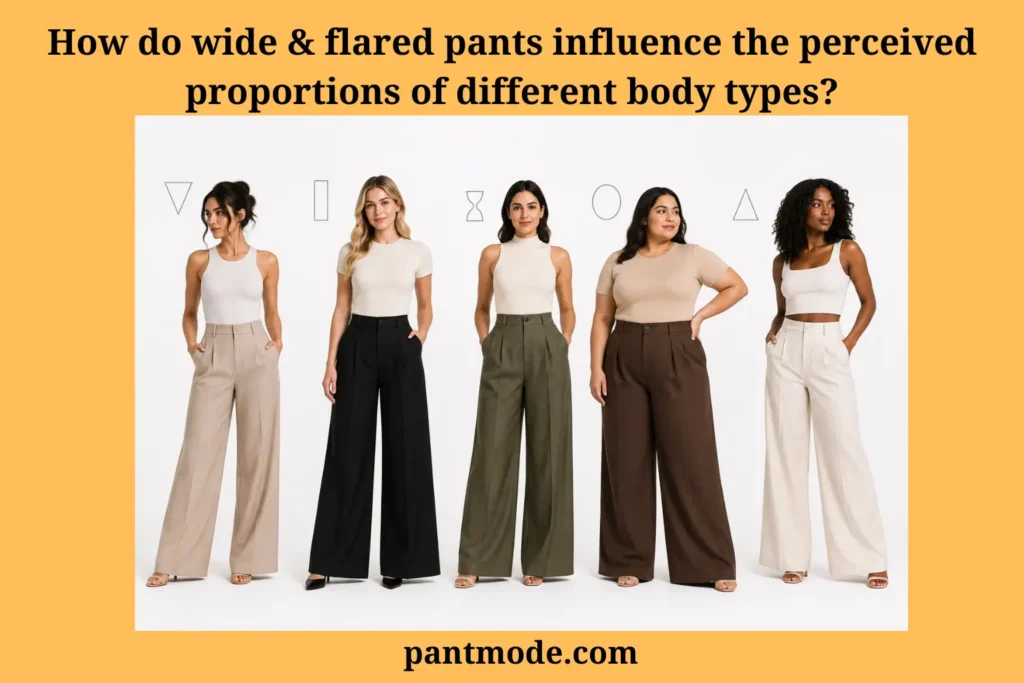
How Do Wide and Flared Pants Influence the Perceived Proportions of Different Body Types?
Wide and flared pants influence perceived proportion by changing where visual width, waist emphasis, vertical continuity, and lower-leg volume appear.
Perceived proportion is a visual relationship created by clothing and styling; it does not change anatomy. Body shape, stature, and torso-to-leg proportion are separate contexts, so none should be used as a one-step rule for deciding what a person can wear.
This guide focuses on the mechanics behind wide and flared pant types. The broader wide and flared pant types page owns the silhouette-family taxonomy, while this page explains how those silhouettes redistribute visual emphasis. See the wide and flared pant types family for the broader silhouette classification.
PantMode Mechanics-First Proportion Framework
PantMode evaluates proportion in five steps so the advice stays tied to garment structure instead of body-type formulas.
Quick Answer
Wide and flared pants influence perceived proportion by changing where visual width, waist emphasis, vertical continuity, and lower-leg volume appear. Wide-leg and palazzo silhouettes distribute width through more of the leg, while bootcut, classic flare, bell-bottom, and kick-flare styles concentrate more expansion lower down. Rise, fabric drape, hem length, footwear, body-shape context, and styling all influence the final effect.
Definition
Wide and flared pant proportion effects are the visual changes created by the relationship between rise, width distribution, flare placement, fabric behavior, hem length, footwear, and the rest of the outfit.
PantMode separates garment geometry, material behavior, visual emphasis, and styling context before drawing a proportion conclusion.
How Do Width Distribution and Flare Placement Change Perceived Body Proportion?
Width distribution and flare placement change perceived body proportion by determining where visual volume stays continuous and where it expands.
A continuous wide-leg line keeps more width from the thigh through the hem, which can read as a long lower-body column. Palazzo pushes that effect toward greater sweep when the cut is full and the fabric has enough drape to move rather than hold a rigid outline.
Flared silhouettes work differently because the upper leg is more controlled. bootcut vs. flare, while classic flare makes the knee-to-hem change more visible. Bell-bottom increases the contrast further, and kick flare combines lower-leg expansion with a shorter, ankle-focused finish.
Hem width alone cannot classify the effect. The bootcut vs. flare comparison becomes clearer when knee width, expansion point, hem opening, fabric behavior, and length are read together.
Optical Mechanics Summary
| Mechanic | What Changes | Possible Effect | Boundary |
|---|---|---|---|
| Continuous leg width | Width remains through the leg | Continuous lower-body column | Not guaranteed elongation |
| Upper-leg control | Less volume above knee | Stronger contrast with flare | Depends on fit |
| Subtle lower widening | Moderate knee-to-hem change | Restrained lower emphasis | Often bootcut-like |
| Strong flare | Greater knee-to-hem contrast | More lower-leg emphasis | Intensity varies |
| Cropped flare | Lower line ends earlier | More ankle and shoe emphasis | Crop alone is insufficient |
| Wide sweeping volume | Width + drape | Greater motion and scale | Fabric matters |
Which Wide and Flared Pant Features Create Specific Visual Effects?
Wide and flared pant features create different visual effects by changing waist placement, visible width, lower-leg contrast, fabric movement, and the continuity of the silhouette.
high-rise leg effect may assign more visual area to the lower body, while a lower visual waist may create more visible torso space. Neither direction is automatically more flattering or comfortable.
The dedicated high-rise leg effect page owns the deeper rise-perception question. Here, rise is one adjustable variable alongside hip ease, thigh width, flare intensity, pleats, pockets, fabric, hem, and footwear.
Pleats and pockets can add or redirect detail and volume, but they are not inherently good or bad. A cleaner front may reduce visual interruption when that is the goal, while deeper pleats can deliberately add movement or fullness.
New Mexico State University’s Making Perfect Pants treats style, fabric, and fit as interconnected pants considerations and discusses waist, hip, thigh, knee, crotch depth, ease, grainline, and silhouette-related length. This guide uses that technical information without adopting the source’s older prescriptive figure-type styling rules as universal advice.
Feature-to-Visual-Effect Matrix
| Feature | Possible Visual Effect | Useful Goal | Boundary |
|---|---|---|---|
| Higher visible waist | May increase visible leg line | More leg emphasis | Torso and comfort matter |
| Lower visible waist | May increase torso space | More torso emphasis | Not inferior |
| Clean front | Less visual interruption | Reduced added front detail | Optional |
| Pleats | More front fullness | Deliberate volume | Not inherently bad |
| Side pockets | More lateral emphasis | Detail or utility | Placement matters |
| Fluid drape | Softer transitions | Movement | May reduce structure |
| Structured fabric | Sharper outline | Shape retention | Structure ≠ weight |
| Full hem | Greater vertical continuity | Continuous line | Footwear matters |
| Cropped hem | Ankle focus | Footwear emphasis | Must be intentional |
How Can Body-Shape Context Change How Wide and Flared Proportion Effects Are Read?
wide and flared body-type fit can change how wide and flared proportion effects are read, but it should be used as an optional visual reference rather than a styling rule.
For a triangle framework, a cleaner front, controlled side detail, or softer drape may reduce additional lateral emphasis when that is the goal; a fuller wide leg, palazzo, or stronger flare can be equally valid when more lower-body scale is intentional.
For an inverted-triangle framework, a fuller leg or stronger flare may move more visible emphasis downward, while controlled wide-leg or subtle bootcut can keep the shift smaller. Neither is required.
For an hourglass framework, a visible waistband can make waist contrast more obvious when desired, while a fluid wide leg or palazzo can soften that contrast when a relaxed line is preferred.
For a rectangle framework, pleats, flare, or a wider hem can add more directional contrast, while clean wide-leg or subtle bootcut can preserve linearity.
The broader wide and flared body-type fit guide owns cross-context fit decisions. This page stays focused on mechanics.
Utah State University Extension’s clothing-design guidance explains balance through visual weight and proportion/scale through size relationships among parts of a garment or ensemble. Those principles support visual-emphasis analysis, not one pant prescription for one body shape.
How Do Stature and Torso-to-Leg Proportion Modify Wide and Flared Pant Effects?
Stature and torso-to-leg proportion modify wide and flared pant effects by changing the scale of the silhouette and where the visible waist divides the outfit vertically.
petite fit or scale, not body shape. A shorter person can have a relatively long or short torso, and the same is true of a taller person.
A higher visible waist may increase the apparent area assigned to the lower body when more leg emphasis is desired. A neutral or lower visual waist may create more visible torso space. Comfort, waistband depth, inseam, top length, and hem can modify either effect.
The petite fit guide owns deeper shorter-stature guidance. Here, shorter stature is treated only as one variable within the larger proportion system.
Taller stature can accommodate subtle or dramatic width depending on intent; more height does not create a requirement for more volume or flare.
A higher or lower visual waist is a styling tool, not a universal prescription tied to height or body shape.
Vertical Proportion Matrix
| Goal | Possible Adjustment | Possible Effect | Boundary |
|---|---|---|---|
| More leg emphasis | Higher visual waist | More visible lower-body area | Not mandatory |
| More torso space | Neutral/lower visual waist | More visible upper-body area | Not inferior |
| Less dominant scale | Controlled width | Reduced visual volume | Fuller remains valid |
| Greater silhouette presence | More width or flare | Increased visual scale | Height does not require it |
| More shoe emphasis | Crop or kick flare | More ankle visibility | Must be intentional |
Which Wide and Flared Features Support Different Proportion Goals?
Wide and flared features support different proportion goals when width, rise, flare intensity, fabric behavior, hem, and footwear all reinforce the same intended visual effect.
For a continuous leg line, full-length wide-leg, palazzo, or a long flare may reduce vertical interruption. For more lower-leg emphasis, classic flare or bell-bottom moves more width below the knee.
For a restrained line, controlled wide-leg or bootcut limits total volume. For stronger visual scale, palazzo, architectural wide-leg, or bell-bottom deliberately increases silhouette presence.
Visible waist styling can create a stronger torso-to-leg break, while kick flare or crop can bring more attention to ankle and footwear. None of these effects is universally preferable.
Proportion Goal Matrix
| Goal | Useful Direction | Mechanism | Boundary |
|---|---|---|---|
| Continuous leg line | Full wide-leg, palazzo, or long flare | Less vertical interruption | Not guaranteed |
| Lower-leg emphasis | Flare or bell-bottom | More width below knee | Styling choice |
| Restrained silhouette | Controlled wide-leg or bootcut | Lower total volume | Not superior |
| Strong visual scale | Palazzo, architectural wide-leg, or bell-bottom | More volume | Intentional |
| Waist emphasis | Visible waistband or tuck | Creates visual break | Optional |
| Footwear emphasis | Kick flare or crop | Reveals shoe | Crop must be designed |
How Does Fabric Behavior Modify Wide and Flared Proportion Effects?
Fabric behavior modifies wide and flared proportion effects because the same pattern can appear crisp, fluid, heavy, soft, collapsed, or sharply defined depending on material properties.
NMSU’s pants guidance supports evaluating fabric selection, drape, fit, and how pant length varies with silhouette. Fabric should therefore be selected for the response the cut needs rather than ranked by fiber name or weight alone.
How Can Upper-Body Styling Reinforce or Redirect Wide and Flared Proportion Effects?
Upper-body styling can reinforce or redirect wide and flared proportion effects by changing waist visibility, top length, jacket length, and competing visual volume.
Design principles such as balance, proportion, emphasis, and rhythm help explain why changing one ensemble element can redirect visual attention. They should not be converted into a mandatory body-ratio formula.
How Do Hem Length and Footwear Change the Final Wide and Flared Proportion Effect?
Hem length and footwear change the final wide and flared proportion effect because shoe height, shoe volume, floor clearance, ankle exposure, and hem opening determine how the lower line ends.
Full-length wide-leg: preserve the intended line without unwanted dragging. Bootcut: allow the restrained opening to interact cleanly with the shoe or boot rather than bunching.
Classic flare: preserve enough length for lower-leg expansion to remain visible. Bell-bottom: ensure shoe volume and hem length do not collapse or distort the larger opening unintentionally.
Kick flare or crop: make ankle and footwear visibility deliberate. Cropped length by itself does not create a kick flare.
NMSU’s Clothing Construction Standards support practical checks around ease, grainline, seams, waist treatments, and hems. These checks help separate a fit or finishing problem from a styling preference.
Final hemming should be tested with the footwear normally intended for the pants. There is no universal floor or ankle measurement that works for every cut, material, leg opening, and shoe.
How Can You Fix Unwanted Proportion Effects in Wide and Flared Pants?
You can fix unwanted proportion effects in wide and flared pants by identifying whether the problem comes from width distribution, rise, flare geometry, fabric behavior, hem length, footwear, or competing outfit volume.
When the silhouette feels visually heavy, determine whether the cause is width, fabric stiffness, a long upper layer, or hem bulk. Reduce the variable that creates the unwanted effect rather than blaming body shape.
When the visible leg line feels interrupted, reassess rise, top length, flare point, hem, and footwear together. A weak flare may be a subtype issue rather than a styling failure, while a dragging hem is primarily a length and footwear problem.
Troubleshooting Matrix
| Problem | Likely Cause | Adjustment | Boundary |
|---|---|---|---|
| Silhouette feels visually heavy | Too much width + stiff material + long layer | Reduce one source of volume | Do not blame body shape |
| Visible leg line feels interrupted | Rise, hem, top, or footwear conflict | Reassess interacting variables | No fixed body rule |
| Flare looks weak | Expansion too subtle or hidden | Check subtype and hem | May actually be bootcut |
| Flare feels misplaced | Expansion geometry inconsistent | Verify subtype | No universal break point |
| Torso feels compressed | Rise or waistband too high/deep | Test another rise or waistband | High rise not mandatory |
| Hem drags | Inseam too long for shoe | Adjust hem | No universal clearance |
| Crop looks accidental | Hem and shoe relationship disconnected | Refine crop or footwear | Must look intentional |
| Hip area looks busier than desired | Pleats, pockets, or stiffness | Simplify detail or drape | Volume may be intentional |
What Should You Verify Before Choosing Wide and Flared Pants for a Proportion Goal?
Before choosing wide and flared pants for a proportion goal, verify that the cut, rise, ease, flare geometry, fabric, hem, footwear, and movement all support the intended effect.
The F50 layer is useful when several variables conflict because it forces the recommendation to begin with the intended effect and end with multi-signal verification.
F50 Proportion Decision Control
| F50 Step | Control Question | Decision Standard |
|---|---|---|
| Trigger | What visual effect is actually wanted? | Define the goal before selecting features |
| Classification | Which silhouette, width pattern, rise, and flare geometry are present? | Identify mechanics first |
| Recommendation | Which feature change best supports the goal? | Change the relevant garment or outfit variable |
| Red Flag | Is one body label, rise, flare point, or hem measurement carrying the whole advice? | Reject single-factor rules |
| Exception | Could another rise, fabric, volume, or hem still serve the same goal? | Keep valid alternatives open |
| Verification | Do geometry, material, comfort, hem, footwear, and styling reinforce the goal? | Choose, modify, or compare |
Final verification combines comfort, cut geometry, fabric response, hem, footwear, and outfit context.
Pre-Purchase Proportion Checklist
Final Decision Question
Key Takeaway
Start with the visual goal, then identify which garment feature creates that effect. Judge rise, width, flare, fabric, hem, and footwear together rather than assigning one pant silhouette to one body type.
What Final Rule Should Guide Wide and Flared Pant Proportion Decisions?
The final rule for wide and flared pant proportion is to identify the visual goal first and then evaluate whether width distribution, rise, flare geometry, fabric, hem, footwear, and styling reinforce that goal together.
Perceived proportion is visual, not anatomical. Body-shape categories may provide context, but stature and torso-to-leg proportion are separate variables, and no category determines one correct silhouette.
A stronger flare can create more lower-leg emphasis, a higher visible waist may assign more visual area to the legs, fluid fabric can soften transitions, and a crop can emphasize footwear—but every effect remains contextual.
The strongest wide or flared proportion choice is not the silhouette assigned to a body type; it is the one whose geometry, material, comfort, and styling create the visual effect the wearer actually wants.
What FAQ Questions Clarify Wide and Flared Pant Proportion Effects?
The most useful FAQs clarify how geometry, rise, flare, fabric, stature, hem, and footwear interact without turning visual effects into universal body rules.
They can create a more continuous lower-body column, but rise, volume, fabric, hem, footwear, and upper-body styling affect the result.
A higher visible waist, a continuous full-length line, limited hem interruption, and coordinated footwear may contribute when that is the intended effect.
No. Rise should also account for torso length, comfort, waistband construction, hem, footwear, and the desired visual balance.
Fuller wide legs, palazzo volume, wider hems, and stronger flares can add lower-body emphasis when that is the styling goal.
Fit the hem with the footwear normally intended for the garment and avoid one universal clearance measurement.
Wide and flared pant proportion is best understood as a mechanics problem: width distribution determines where visual volume sits, rise changes the visible waist split, flare geometry shifts emphasis lower, fabric modifies how sharply the cut appears, and hem plus footwear determine how the lower line finishes.
Body shape, stature, and torso-to-leg proportion can provide context, but none should replace the wearer’s styling goal, comfort, or the garment’s actual construction. A strong proportion decision is verified across geometry, material behavior, movement, hem, footwear, and the whole outfit.