
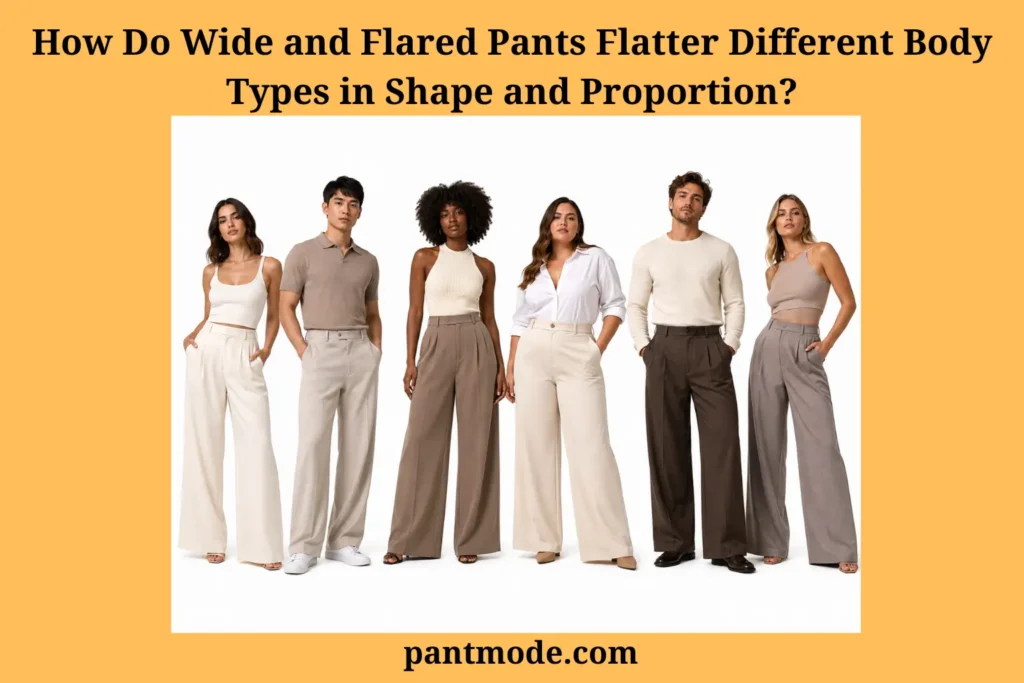
How Do Wide and Flared Pants Flatter Different Body Types in Shape and Proportion?
Wide and flared pants can flatter different body proportions when their rise, leg width, flare point, fabric behavior, hem length, footwear, and styling support the visual effect the wearer actually wants.
In this article, “flattering” means supporting the wearer’s intended visual effect, comfort, fit preference, and styling goal—not correcting, hiding, ranking, or improving a body.
No body type has one required silhouette. Wide and flared pant types such as wide-leg, palazzo, bootcut, classic flare, bell-bottom, and kick flare distribute width differently, and their result changes again with stature, torso-to-leg proportion, rise, fabric, hem, footwear, and upper-body styling.
PantMode Goal-First Fit Framework
PantMode evaluates proportion in this order so body-shape labels remain optional context rather than rules.
Quick Answer
Wide and flared pants can support different body proportions when their rise, width distribution, flare point, fabric, hem, footwear, and styling align with the wearer’s intended visual goal. Wide-leg and palazzo silhouettes distribute more volume through the leg, while bootcut, classic flare, bell-bottom, and kick-flare styles shift more emphasis toward the lower leg. Body shape is only one optional reference; stature, torso-to-leg proportion, comfort, and personal styling intent also matter.
Definition
Wide and flared pant fit describes how trouser width, rise, flare placement, fabric behavior, hem length, and footwear interact with the wearer’s proportions and intended visual effect.
PantMode starts with the wearer’s goal and then tests garment geometry, material behavior, and outfit execution together.
How Do Wide and Flared Pants Change Perceived Body Proportion?
Wide and flared pants can change perceived proportion by redistributing visual width, waist emphasis, vertical line, and lower-leg volume.
A continuous wide-leg pant can create an uninterrupted lower-body column because substantial width remains through much of the leg. A palazzo can extend that effect through additional sweep and movement when the fabric drapes rather than holding a rigid shape.
Bootcut creates restrained widening below the knee, while classic flare makes the lower-leg curve more visible. Bell-bottoms intensify knee-to-hem contrast, and kick flares combine compact lower-leg expansion with deliberate ankle and footwear visibility.
Rise changes where the eye reads the waist. A higher visible waistband may increase the impression of a longer lower-body line, while a lower visual waist may create more visible torso space. These are possible effects, not guaranteed outcomes.
The deeper proportion effects guide owns the broader silhouette-perception explanation; this page applies those mechanics specifically to body-shape context, stature, torso-to-leg proportion, and fit decisions.
Utah State University Extension’s clothing-design principles describe balance as the distribution of visual weight and proportion/scale as the size relationship among parts of a garment or ensemble. Those principles support discussing visual emphasis and balance, but they do not prescribe which pant type a person should wear.
Feature-to-Visual-Effect Matrix
| Pant Feature | Possible Visual Effect | Useful Goal | Boundary |
|---|---|---|---|
| Continuous wide leg | Uninterrupted lower-body column | Continuous line | Not automatic |
| Fluid palazzo | Sweep and movement | Softness / motion | Adds visible volume |
| Subtle bootcut | Restrained lower-leg expansion | Mild lower emphasis | Not classic flare |
| Classic flare | Curved lower-leg widening | Stronger flare | Intensity varies |
| Bell-bottom | Dramatic lower-leg emphasis | Statement silhouette | Goal dependent |
| Kick flare | Ankle and shoe focus | Footwear emphasis | Crop alone is insufficient |
| Higher visible waist | May increase perceived leg line | Leg emphasis | Torso and comfort matter |
| Lower visible waist | May increase visible torso space | Torso emphasis | Not inferior |
| Structured fabric | Sharper outline | Shape control | Structure ≠ weight |
| Fluid fabric | Softer transition | Movement | May reduce crispness |
Which Wide and Flared Pant Features Matter Most for Proportion Goals?
The wide and flared pant features that matter most for proportion goals are rise, waistband position, hip ease, thigh width, flare intensity, fabric behavior, hem length, and footwear interaction.
Leg width determines how much visual volume is carried through the lower body. Flare intensity determines how strongly width shifts toward the hem. Rise and waistband placement change the visible division between torso and lower body.
Hip and thigh ease should first allow comfortable movement and a smooth intended line. Pleats and pockets can then add, organize, or redirect visual volume. Their effect depends on depth, placement, fabric, and the rest of the garment rather than a universal “good” or “bad” rule.
Fabric changes the cut’s visible behavior. Weight, stiffness, structure, and drape are related but separate properties. A light fabric can be crisp; a heavier fabric can still fall fluidly.
For readers specifically evaluating rise as a visual-length tool, the high-rise leg effect page is the closer PantMode topic. A higher rise may support a longer visible leg line, but comfort and torso proportion remain part of the decision.
New Mexico State University’s Making Perfect Pants connects pants success with style, fabric, and fit, and its fitting guidance considers waist, hip, thigh, knee, crotch depth, length, ease, grainline, and silhouette-dependent pant length. This article uses that technical fit information while deliberately not adopting the publication’s older prescriptive figure-type advice as universal modern guidance.
Proportion Feature Matrix
| Feature | Adjustment Range | Possible Effect | Boundary |
|---|---|---|---|
| Leg width | Controlled → full | Changes lower-body visual volume | Fuller is not universally better |
| Flare intensity | Subtle → dramatic | Changes lower-leg emphasis | Goal dependent |
| Rise | Higher → lower | Changes visual waist | Comfort matters |
| Pleats | None → deeper | Redirects front volume | Not inherently good or bad |
| Pocket placement | Minimal → prominent | Shifts visual emphasis | Function also matters |
| Fabric drape | Structured → fluid | Holds or softens shape | Weight ≠ drape |
| Hem | Full → cropped | Changes vertical interruption | Footwear matters |
| Shoe scale | Light → heavy | Changes lower-leg balance | No universal shoe |
How Can Body-Shape Frameworks Inform Wide and Flared Pant Choices Without Creating Rules?
Body-shape frameworks can help organize wide and flared pant choices when they are treated as optional visual references rather than fixed styling rules.
Triangle Framework
If the styling goal is less added emphasis around the hip area, a cleaner front, restrained side details, controlled pleats, and softer drape can reduce additional lateral visual weight. If the goal is deliberately stronger lower-body volume, palazzo, fuller wide-leg, or a stronger flare can be equally valid.
Inverted-Triangle Framework
If the wearer wants more lower-half emphasis, a wider hem, fuller leg, or stronger flare can shift visual weight downward. If the goal is a subtler change, bootcut or controlled flare provides less dramatic expansion.
Hourglass Framework
If visible waist contrast is the goal, a visible waistband, chosen rise, and controlled hip/thigh volume can make that break clearer. If relaxed volume is preferred, palazzo or wider-leg silhouettes can reduce waist emphasis without being a fit mistake.
Rectangle Framework
If stronger shape contrast is desired, pleats, a wider hem, or a visible flare can add directional change. If the goal is to preserve a cleaner linear effect, a simple wide leg or subtle bootcut can do that instead.
The category does not decide the answer; the stated styling goal does. The same garment feature can be useful for one goal and unnecessary for another.
Body Shape & Styling Goal Matrix
| Framework | Goal | Useful Features | Boundary |
|---|---|---|---|
| Triangle | Less added hip emphasis | Clean front, restrained side detail, softer drape | Optional only |
| Triangle | More lower-body volume | Palazzo, fuller wide-leg | Equally valid |
| Inverted triangle | More lower emphasis | Wider hem, fuller leg, stronger flare | Not required |
| Inverted triangle | Subtle shift | Bootcut or controlled flare | Strong flare optional |
| Hourglass | Visible waist contrast | Visible waistband, controlled volume | Waist emphasis optional |
| Hourglass | Relaxed volume | Palazzo or wide-leg | Curves need not stay visible |
| Rectangle | More visual contrast | Pleats, flare, wider hem | Optional |
| Rectangle | Preserve linearity | Clean wide-leg or subtle bootcut | Equally valid |
How Should Wide and Flared Pant Fit Change With Stature and Torso-to-Leg Proportion?
Wide and flared pant fit should respond to stature and torso-to-leg proportion through scale, rise, inseam, hem, and styling rather than fixed height rules.
Stature describes overall height and scale; it is not a body-shape category. A shorter or taller person can also have a relatively long torso, short torso, long visible leg line, or short visible leg line.
For shorter stature, controlled width can reduce silhouette dominance when that is the goal, while fuller volume remains valid when deliberate. A higher visible waist may support a longer perceived leg line; a mid rise may be preferable when the wearer wants more visible torso space or greater comfort.
The dedicated petite fit page owns deeper shorter-frame fitting guidance. Here, shorter stature is treated only as one proportion context among several.
For taller stature, more dramatic width or flare can be easy to integrate, but it is never required. Controlled wide-leg, subtle bootcut, cropped silhouettes, and stronger statement shapes can all work depending on the goal.
Torso-to-leg proportion deserves its own decision. A longer torso with a shorter visible leg line may be styled with a higher visible waist when more lower-body length is desired. A shorter torso may use a neutral or lower visual waist when additional torso space is preferred. Neither direction is inherently more flattering.
Rise and waistband visibility are styling variables, not prescriptions tied to height or body shape.
Stature & Vertical-Proportion Matrix
| Goal | Adjustment | Possible Effect | Boundary |
|---|---|---|---|
| More visible leg line | Higher visual waist + continuous hem | Longer perceived lower-body line | Not required |
| More torso space | Neutral or lower visual waist | Longer visible torso | Not inferior |
| Less dominant volume | Controlled leg width | Lighter silhouette scale | Fuller volume remains valid |
| Stronger scale | Fuller width or flare | Greater silhouette presence | Tall does not require drama |
| Footwear focus | Crop or kick flare | More ankle / shoe emphasis | Crop must be intentional |
| Continuous vertical line | Full-length controlled hem | Less interruption | Shoe and hem must align |
Which Wide and Flared Silhouettes Support Different Styling Goals?
Wide and flared silhouettes support different styling goals when the chosen cut places volume, flare, waist emphasis, fabric movement, and hem interruption where the wearer wants the visual effect.
For a longer perceived leg line, a full-length wide-leg, palazzo, long flare, or bootcut may reduce vertical interruption when the rise, hem, footwear, and top length support the same direction.
For stronger lower-leg emphasis, classic flare, bell-bottom, or kick flare moves more visible width below the knee. For a restrained silhouette, tailored wide-leg or subtle bootcut keeps the geometry calmer without implying that less volume is universally better.
For deliberate scale and movement, palazzo, oversized wide-leg, or bell-bottom can create stronger visual presence. For footwear focus, kick flare or cropped wide-leg exposes more ankle and shoe, but the crop must look intentional.
Styling Goal Matrix
| Styling Goal | Useful Silhouette Directions | Feature Logic | Boundary |
|---|---|---|---|
| Longer perceived leg line | Full-length wide-leg, palazzo, long flare, bootcut | Continuous line | Not automatic |
| Lower-leg emphasis | Flare, bell-bottom, kick flare | Lower expansion | Styling choice |
| Restrained shape | Tailored wide-leg, bootcut | Controlled width | Not superior |
| Strong volume | Palazzo, bell-bottom, oversized wide-leg | Deliberate scale | Requires intent |
| Waist emphasis | Visible waistband + chosen silhouette | Creates visual break | Optional |
| Footwear focus | Kick flare, cropped wide-leg | Ankle visibility | Crop must be intentional |
How Can You Style Wide and Flared Pants to Control Outfit Proportions?
You can style wide and flared pants to control outfit proportions by adjusting waist visibility, upper-body volume, top length, jacket structure, and layering according to the intended silhouette.
Broad design principles such as balance, proportion, emphasis, and rhythm support this flexible outfit-level approach. The styling objective should determine which visual emphasis is useful.
How Do Hem Length and Footwear Affect Wide and Flared Pant Proportion?
Hem length and footwear affect wide and flared pant proportion because shoe height, shoe volume, ankle exposure, fabric behavior, and floor clearance change the way the lower-leg silhouette finishes.
Full-length wide-leg: fit the hem with the intended footwear so the lower-body line stays continuous without unwanted dragging. Classic flare: preserve enough length for lower-leg expansion to remain visible without pooling that hides the shape.
Bootcut: allow the hem to interact cleanly with the shoe or boot rather than bunching at the lower leg. Kick flare and cropped wide-leg: treat ankle exposure as intentional and coordinate the crop with shoe height and volume.
Final hemming should be tested with the footwear normally intended for the pants. A single universal distance from the floor or ankle cannot account for every inseam, leg opening, fabric, shoe height, and intended effect.
NMSU’s Clothing Construction Standards support practical checks such as adequate ease, straight grainline, smooth hems, secure seams, suitable waistband construction, and garment length appropriate to the design. These criteria help separate a styling preference from a true fit or construction problem.
How Can You Fix Common Proportion Problems With Wide and Flared Pants?
You can fix common proportion problems with wide and flared pants by identifying whether the issue comes from leg volume, flare position, rise, fabric behavior, top length, hem, or footwear.
If a wide-leg silhouette feels visually overwhelming, determine whether the cause is leg width, fabric stiffness, long competing layers, prominent pockets, or hem bulk. Change the variable creating the unwanted effect rather than blaming body shape.
If the leg line feels shorter than intended, reassess rise, top length, hem interruption, flare point, and footwear together. If a flare transition feels awkward, verify whether the garment is actually bootcut, classic flare, bell-bottom, or kick flare before changing styling.
If upper- and lower-body volume compete, one area can be simplified or structured—but deliberate volume-on-volume styling remains a valid choice. If the hem drags or a crop looks accidental, correct the mechanical length and footwear relationship first.
Proportion Troubleshooting Matrix
| Problem | Likely Cause | Adjustment Options | Boundary |
|---|---|---|---|
| Wide-leg feels overwhelming | Excess width, stiff material, long layer | Reduce one source of volume | Do not blame body shape |
| Leg line feels shortened | Hem, flare point, rise, footwear mismatch | Reassess interacting variables | No fixed body rule |
| Flare transition feels awkward | Wrong type or fit | Compare bootcut, flare, bell, kick flare | No universal flare point |
| Upper/lower volume competes | Multiple dominant volume areas | Reduce or structure one area | Oversized can be intentional |
| Hem drags | Inseam too long for footwear | Adjust hem | No universal clearance |
| Crop feels accidental | Hem and shoe relationship disconnected | Refine crop or footwear | Crop must be designed |
| Hip area looks busier than intended | Pleats, pockets, stiff fabric | Simplify details or change drape | Added volume can still be intentional |
What Fit Checklist Helps You Choose Wide and Flared Pants for Your Proportion Goals?
A final fit checklist helps you choose wide and flared pants by matching the styling goal with rise, hip and thigh ease, flare position, fabric behavior, hem length, footwear, and comfortable movement.
Use the F50 decision layer when the choice is ambiguous. It prevents a body-shape label, height label, or one garment feature from carrying the entire recommendation.
F50 Proportion Decision Control
| F50 Step | Reader Question | Decision Output |
|---|---|---|
| Trigger | What visual result is the wearer trying to create? | Define the goal before choosing the silhouette |
| Classification | Which wide/flared type and fit geometry are involved? | Identify rise, hip/thigh ease, flare point, hem |
| Recommendation | Which adjustment best supports the goal? | Choose a garment or styling variable, not a body rule |
| Red Flag | Is the advice based only on body label, height, or one feature? | Reject the shortcut and check multiple signals |
| Exception | Could a different rise, fabric, crop, or volume still serve the same goal? | Keep legitimate alternatives open |
| Verification | Do comfort, geometry, fabric, hem, footwear, and outfit balance support the intended effect? | Choose, modify, or compare another silhouette |
A strong fit decision checks comfort, proportion, hem mechanics, and outfit context before assigning a conclusion.
Final Fit & Styling Checklist
Final Fit Decision
Key Takeaway
Do not choose wide or flared pants from a body-type rule alone. Define the styling goal first, then compare rise, hip and thigh volume, flare intensity, fabric behavior, hem length, footwear, and upper-body styling together.
What Final Rule Should Guide Wide and Flared Pant Fit Across Body Shapes?
The final rule for wide and flared pant fit is to choose the silhouette that supports the intended visual goal through comfort, rise, width distribution, flare point, fabric behavior, hem length, footwear, and outfit balance.
Body-shape frameworks can organize options, but they should never decide the result on their own. Stature is separate from body shape, and torso-to-leg proportion is a separate variable again.
Rise can move the visual waist, but no rise is universally best. Wide-leg volume, palazzo sweep, bootcut restraint, flare intensity, bell-bottom drama, and kick-flare ankle emphasis are styling effects—not measures of body quality.
The best wide or flared pant fit is not the one assigned to a body type; it is the one that creates the fit, comfort, and visual balance the wearer actually wants.
What FAQ Questions Clarify Wide and Flared Pant Fit Across Body Types?
The most useful FAQs clarify how wide and flared pant geometry interacts with styling goals without turning body shape, height, rise, or hem into rigid rules.
Wide-leg pants can support many styling goals, but rise, volume, fabric, hem, comfort, footwear, and outfit proportion affect the result. No body shape has one required or prohibited wide-leg formula.
Full-length wide-leg, palazzo, long flare, and bootcut silhouettes may support a longer perceived line when rise, hem, footwear, and upper-body styling reinforce that goal. The effect is not automatic.
No. A higher visible waist is one styling tool. Torso length, comfort, waistband placement, hem, footwear, and the wearer’s preferred visual effect also matter.
A wider hem, stronger flare intensity, fuller wide-leg cut, or palazzo volume can shift more visible emphasis toward the lower body when that is the styling goal.
A cleaner front, controlled pleats, fewer large side details, and softer drape can reduce additional lateral emphasis when desired. Added hip volume is not inherently a fit problem.
They can describe broad width relationships and organize styling ideas, but silhouette choice should still follow comfort, garment mechanics, and the wearer’s preferred effect rather than a fixed body-type rule.
Body shape describes broad width relationships, while stature describes overall height and scale. Torso-to-leg proportion is a separate variable again.
Fit the hem with the footwear normally intended for the pants so the silhouette avoids unwanted dragging, bunching, or accidental-looking crop. There is no universal clearance for every cut and shoe.
Possible causes include excess garment volume, stiff fabric, long competing layers, prominent details, or a hem and footwear relationship that adds extra visual weight.
Yes. Scale, rise, hem, fabric, footwear, comfort, and the desired visual effect matter more than a universal height rule.
Wide and flared pant fit becomes more useful when the question changes from “Which pant belongs to my body type?” to “Which garment feature creates the visual and comfort result I want?” Rise, hip and thigh ease, flare point, fabric behavior, hem, footwear, and upper-body styling all contribute to the answer.
Body-shape frameworks can provide optional context, but stature and torso-to-leg proportion should be evaluated separately. A strong decision combines fit mechanics with personal styling intent and verifies the result through comfortable movement, appropriate hem length, and a coherent outfit proportion.