
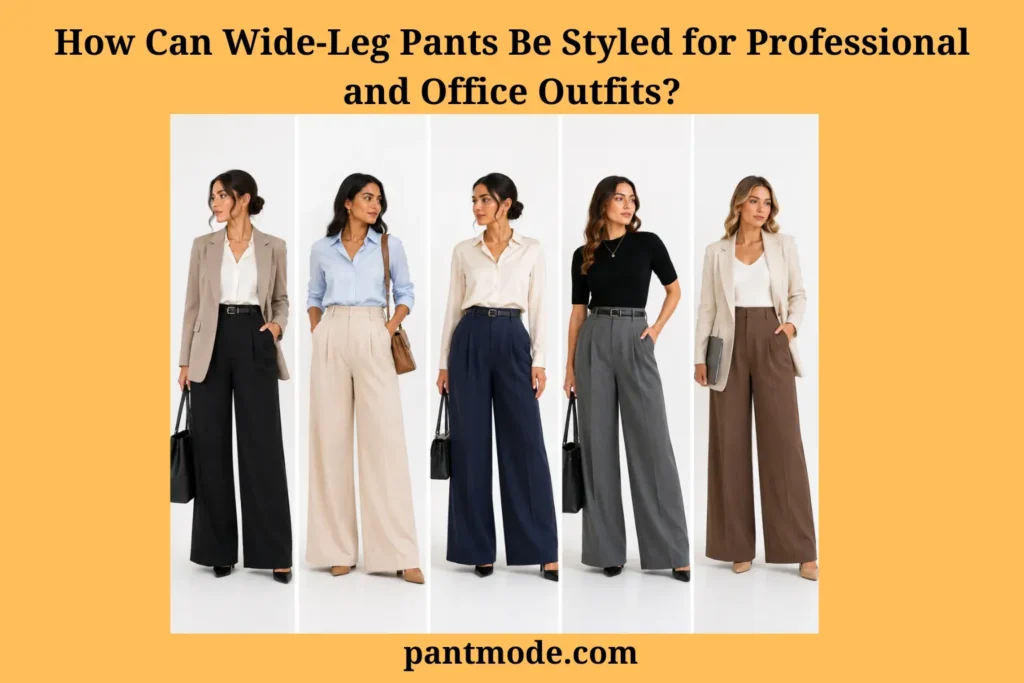
How Can Wide-Leg Pants Be Styled for Professional and Office Outfits?
Wide-leg pants can be styled for professional and office outfits when their cut, fabric behavior, top proportion, outer layer, footwear, hem length, and workplace dress code support the same level of polish.
Conservative corporate, business-professional, business-casual, creative, and warm-weather offices can require different levels of structure, volume, footwear formality, and coverage. Written employer policies, safety rules, client expectations, and event requirements take priority over general styling guidance.
This page focuses on professional use within the broader wide and flared pant types family. Wide-leg office styling does not require a high rise, heels, pointed shoes, mandatory tucking, or a blazer.
Quick Answer
Wide-leg pants can look professional when their cut, fabric, fit, top proportion, outer layer, footwear, and hem match the formality of the workplace. More conservative offices usually call for controlled tailoring, opacity, clean lines, and refined footwear, while business-casual and creative workplaces may allow softer drape, relaxed layers, or clean sneakers where permitted. High rise, heels, pointed shoes, and mandatory tucking are not required.
Definition
Wide-leg office styling is the process of coordinating a broad-leg trouser’s construction, fabric behavior, waistband fit, top and layer proportions, footwear, hem, and workplace dress code so that the complete outfit reads as intentional and professionally appropriate.
PantMode starts with the workplace, then evaluates fit, fabric behavior, upper-body styling, footwear, and hem as one system.
What Makes Wide-Leg Pants Look Polished and Professional Rather Than Accidentally Casual?
Wide-leg pants look polished and professional when fit, fabric behavior, waistband stability, hem finish, upper-body structure, and workplace context make the garment’s volume look deliberate.
For a deeper look at the construction signals behind polished trousers, compare PantMode’s formal trouser features, including waistband structure, pockets, drape, crease, and hem finishing.
Controlled drape can help a broad trouser fall cleanly without collapsing into repeated folds, while adequate structure can keep the intended silhouette visible. Suitable opacity and a secure waistband add practical reliability.
Fit matters just as much as appearance. New Mexico State University’s Making Perfect Pants treats style, fabric, and fit as connected factors, discusses shape retention, drape, wrinkle resistance, lining needs, waist/hip/thigh fit, and notes that pants length varies by silhouette. This page uses those technical points without adopting the source’s older body-prescriptive styling advice.
Professional Signal Table
| Professional Signal | Why It Matters | Possible Result | Boundary |
|---|---|---|---|
| Controlled drape | Reduces uncontrolled collapse | Cleaner trouser line | Fluidity can still work |
| Stable waistband | Maintains intended position | More consistent fit | Construction varies |
| Adequate ease | Prevents strain | Comfortable polish | Ease depends on cut |
| Intentional pleats | Controls front volume | Cleaner tailoring | Fuller pleats can be deliberate |
| Suitable opacity | Supports coverage | Greater workplace reliability | Policy varies |
| Controlled hem | Prevents unwanted dragging | Finished appearance | Break style varies |
| Deliberate top or layer | Organizes outfit volume | More coherent silhouette | Blazer not mandatory |
| Dress-code alignment | Fits workplace context | Appropriate polish | No universal office standard |
How Should Wide-Leg Pants Be Styled Across Different Office Dress Codes?
Wide-leg pants should be styled differently across office dress codes because conservative corporate, business-professional, business-casual, creative, and warm-weather workplaces permit different levels of volume, softness, footwear, and layering.
The broader function and occasion use framework helps separate formal business, business-casual, and more relaxed trouser contexts before styling details are chosen.
Conservative corporate: prioritize tailored construction, controlled width, opaque fabric, clean waist treatments, refined tops, and formal workplace-approved footwear.
Business-professional: allow controlled or moderately fluid tailoring with shirts, blouses, fine knits, refined jackets, and polished shoes.
Business-casual: relaxed tailoring and softer drape can work with knitwear, button-downs, loafers, flats, or clean sneakers where permitted.
Creative office: fuller volume, expressive pleating, oversized tailoring, and flexible footwear may work when the total outfit still looks intentional.
Warm-weather office: prioritize breathability, opacity, neat finishing, and climate-appropriate footwear that remains consistent with workplace policy.
Office Dress Code × Wide-Leg Matrix
| Office Context | Trouser Direction | Fabric Direction | Top / Layer | Footwear Direction | Main Priority |
|---|---|---|---|---|---|
| Conservative corporate | Tailored, controlled width | Structured / controlled | Shirt + structured layer | Refined flats, loafers, pumps, boots | Formality |
| Business-professional | Tailored wide-leg | Controlled drape | Blouse, shirt, fine knit, jacket | Refined footwear | Polish |
| Business-casual | Relaxed tailoring | Moderate structure | Knit, blouse, button-down | Loafers, flats, permitted sneakers | Ease + intent |
| Creative | Expressive volume | Variable | Flexible layering | Context-appropriate expressive shoes | Coherence |
| Warm-weather | Breathable tailoring | Light but sufficiently opaque | Lightweight shirt / layer | Climate-appropriate approved shoes | Comfort + polish |
Utah State University Extension explains balance, proportion/scale, emphasis, rhythm, and harmony as general clothing-design principles. Those ideas support outfit-balance analysis, but they do not create universal workplace rules.
Which Fabric Behaviors, Drape Levels, and Trouser Cuts Support Different Office Dress Codes?
Fabric behavior, drape, opacity, wrinkle response, and trouser construction should be matched to the office context rather than judged from fabric name alone.
Weight, stiffness, structure, drape, opacity, wrinkle behavior, and shape retention are different properties. Structured suiting can support a sharper line, while controlled crepe-like drape can combine movement with polish. Tailored linen can work in some warm-weather or business-casual settings when opacity, finishing, and employer expectations support it.
Pleats change front fullness rather than professionalism by themselves. Shallow pleats can create controlled volume, deeper pleats can make a stronger statement, and flat fronts reduce front interruption. Rise should also be selected for fit and comfort, not treated as a professional badge.
Structure and drape influence polish, but no single fiber name automatically determines office suitability.
Corporate Fabric & Drape Matrix
| Material Behavior | Structure | Drape | Wrinkle Behavior | Useful Office Context | Trade-Off |
|---|---|---|---|---|---|
| Structured suiting | High | Controlled | Lower–moderate | Corporate / professional | Less movement |
| Crepe-type fabric | Moderate | Clean-fluid | Variable | Professional / business casual | Depends on construction |
| Wool / wool blend | Moderate–high | Controlled | Often controlled | Professional | Climate / season |
| Stable knit | Moderate | Soft-controlled | Often lower | Business casual | Less traditional tailoring |
| Tailored linen | Low–moderate | Relaxed | Higher | Warm-weather / some business casual | Visible wrinkles |
| Refined fluid blend | Moderate | Fluid | Variable | Professional / creative | May need lining |
How Should Tops and Waist Visibility Work With Wide-Leg Pants in Professional Outfits?
Tops and waist visibility should work with wide-leg office pants by creating a deliberate relationship between upper-body volume, trouser width, and workplace formality.
A full tuck creates a stronger waist break and reveals more of the trouser line. A partial tuck can create relaxed structure in contexts that permit it. A clean untucked shirt or knit can also look professional when its length, hem, and volume are deliberate.
Waist-length or shorter tops can expose more trouser line, while oversized shirts create volume-on-volume styling that may suit creative or relaxed offices. The deeper proportion effects guide explains how top length and visible waist can redirect visual balance; here those choices are evaluated only through office use.
Office Top & Waist-Visibility Matrix
| Top Treatment | Waist Visibility | Possible Effect | Strong Context | Boundary |
|---|---|---|---|---|
| Full tuck | High | Strong separation | Corporate / professional | Optional |
| Partial tuck | Moderate | Relaxed structure | Business casual | Context dependent |
| Clean untucked top | Low | Longer upper line | Professional / business casual | Length must be deliberate |
| Fine knit | Variable | Controlled softness | Broad office use | Fit varies |
| Waist-length top | High | More trouser emphasis | Modern professional / creative | Policy matters |
| Oversized shirt | Variable | Volume-on-volume | Creative / relaxed office | Must look intentional |
How Should Blazers and Outer Layers Balance Wide-Leg Trousers?
Blazers and outer layers should balance wide-leg trousers by adding the amount of structure, length, and upper-body volume that suits both the trouser and the workplace.
A tailored hip-length blazer can create a conventional professional outline, while a cropped or waist-length jacket can expose more trouser line. An oversized blazer can work in creative or some business-casual environments when shoulder shape, fabric, base layer, and trouser drape create intentional scale.
Longline blazers and coats can extend the outer vertical line and add more volume. Long plus wide is not automatically a styling error; the question is whether the layers move and scale coherently for the workplace.
Blazer Layering Guide
| Layer | Interaction With Wide-Leg Pants | Useful Context | Main Risk | Boundary |
|---|---|---|---|---|
| Tailored hip-length | Adds upper structure | Corporate / professional | Excess stiffness | Not required |
| Cropped / waist-length | Exposes more trouser line | Modern professional | Coverage / context | High rise not required |
| Oversized blazer | Adds deliberate volume | Creative / business casual | Accidental bulk | Can be professional |
| Longline blazer | Creates longer outer line | Professional / creative | Competing volume | Must be coherent |
| Belted layer | Adds waist focal point | Optional polished looks | Over-structuring | Waist emphasis optional |
How Should Office Footwear and Hem Length Work With Wide-Leg Pants?
Office footwear and wide-leg trouser hems should be fitted together because shoe height, shoe volume, hem width, fabric behavior, and workplace dress code determine how the lower silhouette finishes.
Loafers and refined flats can work with floor-clearing or slight-break hems. Pumps or heels change the required inseam but are optional. Boots require attention to shaft and toe volume, while clean sneakers or platforms are workplace-dependent options.
No single professional trouser break applies universally. No break, minimal break, slight break, and fuller break can all be intentional depending on the cut, fabric, shoe, and workplace.
Office Footwear & Hem Matrix
| Footwear | Hem Relationship | Likely Office Context | Possible Effect | Boundary |
|---|---|---|---|---|
| Loafers | Floor-clearing / slight break | Professional / business casual | Structured | Shoe height matters |
| Refined flats | Minimal / slight break | Broad office use | Clean | Pointed toe not mandatory |
| Pumps | Inseam fitted to heel | Corporate / professional | Polished | Heels optional |
| Boots | Hem clears or falls cleanly | Professional / winter | Strong lower anchor | Shaft matters |
| Clean sneakers | Floor-clearing | Permitted business casual / creative | Relaxed polish | Dress code controls |
| Platforms | Dedicated inseam | Creative | Strong scale | Context dependent |
How Can Common Wide-Leg Office Styling and Fit Problems Be Fixed?
Common wide-leg office styling and fit problems can be fixed by identifying whether the conflict comes from trouser length, fabric behavior, front volume, waistband fit, footwear scale, outer-layer volume, or workplace formality.
When the problem is mainly waist balance, seat drape, crease, or trouser break, PantMode’s dress pants fit and tailoring guide provides a closer formal-fit reference.
A dragging hem is mainly a length-and-shoe problem. Waist gaping is a fit issue that styling cannot solve. Excess front volume may come from pleats, pockets, or material stiffness, while an outfit that reads more casual than intended may need adjustment in the top, outer layer, footwear, or fabric rather than abandonment of the wide-leg silhouette.
NMSU’s Clothing Construction Standards support practical checks around adequate ease, excess fullness, waist treatments, pleats, pockets, seams, and hems. Those construction criteria help separate fit problems from deliberate styling choices.
Wide-Leg Office Troubleshooting Matrix
| Problem | Likely Cause | Adjustment | Boundary |
|---|---|---|---|
| Hem drags | Excess inseam | Hem for intended shoe | No universal clearance |
| Hem frays | Repeated floor contact | Adjust length | Consider fabric |
| Shoe disappears awkwardly | Hem width, length, or shoe mismatch | Adjust shoe or hem | Shoe need not always show |
| Front feels too full | Pleats, pockets, stiffness | Reduce one volume source | Fullness may be intentional |
| Waist gaps | Waist / hip mismatch | Alter waistband | Styling cannot fix poor fit |
| Waist bunches | Rise or waistband issue | Reassess fit | High rise not required |
| Blazer + trousers feel excessive | Competing volume | Reduce or structure one area | Volume-on-volume may be deliberate |
| Outfit appears too casual | Fabric, top, shoe, or layer mismatch | Increase polish where needed | Check actual workplace first |
| Wrinkles feel excessive | Material, fit, or maintenance | Press, reassess textile or fit | Natural wrinkles can be acceptable |
What Checklist Verifies That a Wide-Leg Pants Outfit Is Office-Ready?
A wide-leg pants outfit is office-ready when its dress-code fit, trouser construction, fabric, top proportion, outer layer, footwear, hem, and comfort support the same professional intention.
The F50 control prevents one shortcut—such as “always tuck,” “always wear heels,” or “always choose high rise”—from replacing a full workplace decision.
F50 Wide-Leg Office Decision Control
| F50 Step | Control Question | Decision Standard |
|---|---|---|
| Trigger | What workplace and task is this outfit for? | Start with actual context |
| Classification | How formal is the environment? | Corporate, professional, business casual, creative, or warm-weather |
| Recommendation | Which trouser, fabric, top, layer, shoe, and hem best support it? | Build one coherent outfit system |
| Red Flag | Is one fashion rule doing all the work? | Reject mandatory high-rise, heel, tuck, or blazer shortcuts |
| Exception | Could a relaxed or expressive option still comply? | Keep context-dependent alternatives open |
| Verification | Does policy, fit, opacity, comfort, hem, and movement align? | Wear, adjust, or rebuild |
Final verification checks workplace policy, practical fit, fabric behavior, hem, footwear, and all-day movement together.
Office-Ready Verification Checklist
Final Office Outfit Decision
Key Takeaway
Start with the workplace, not a fixed fashion formula. Choose wide-leg trouser fit, fabric, top, layer, footwear, and hem according to the level of polish and practicality the setting actually requires.
What Final Rule Should Guide Wide-Leg Office Styling?
The final rule for wide-leg office styling is to start with the workplace and then make the trouser cut, fabric, top, layer, footwear, hem, and comfort support the same professional intention.
Workplace expectations come first. Trouser fit and volume should look intentional, fabric should provide the level of structure, opacity, and wrinkle behavior needed for the context, and tops or outer layers should manage volume without relying on mandatory tucking or blazer formulas.
Footwear and hem must work together in practice, and the wearer should be able to sit, walk, stand, and move comfortably through the workday.
Wide-leg pants look office-ready when their volume feels intentional, their fit and hem work in practice, and the complete outfit matches the workplace rather than a rigid fashion formula.
What FAQ Questions Clarify Wide-Leg Pants for Professional and Office Outfits?
These five questions cover the most useful office-styling decisions without repeating the full article.
Yes, when their fit, fabric, hem, footwear, and surrounding outfit match the workplace’s required level of polish.
Yes. Relaxed tailoring, fine knits, shirts, loafers, flats, and clean sneakers can work where the workplace permits them.
No. Choose rise according to fit, torso comfort, waistband stability, and styling intent rather than treating high rise as a professional requirement.
No. Full tuck, partial tuck, and clean untucked tops can all work when the length, volume, and workplace context are deliberate.
There is no universal measurement. Check the hem with the exact footwear intended for work and confirm the break, clearance, and movement look intentional.
Professional wide-leg styling works best as a context-first system. Conservative offices may need controlled tailoring and refined footwear, while business-casual, creative, or warm-weather offices may allow softer drape, expressive volume, or relaxed shoes where policy permits.
The strongest outfit aligns dress code, trouser construction, fabric behavior, top and layer proportions, footwear, hem, and all-day comfort. None of those elements—high rise, heels, tucking, pointed shoes, or blazers—needs to become a universal rule.