
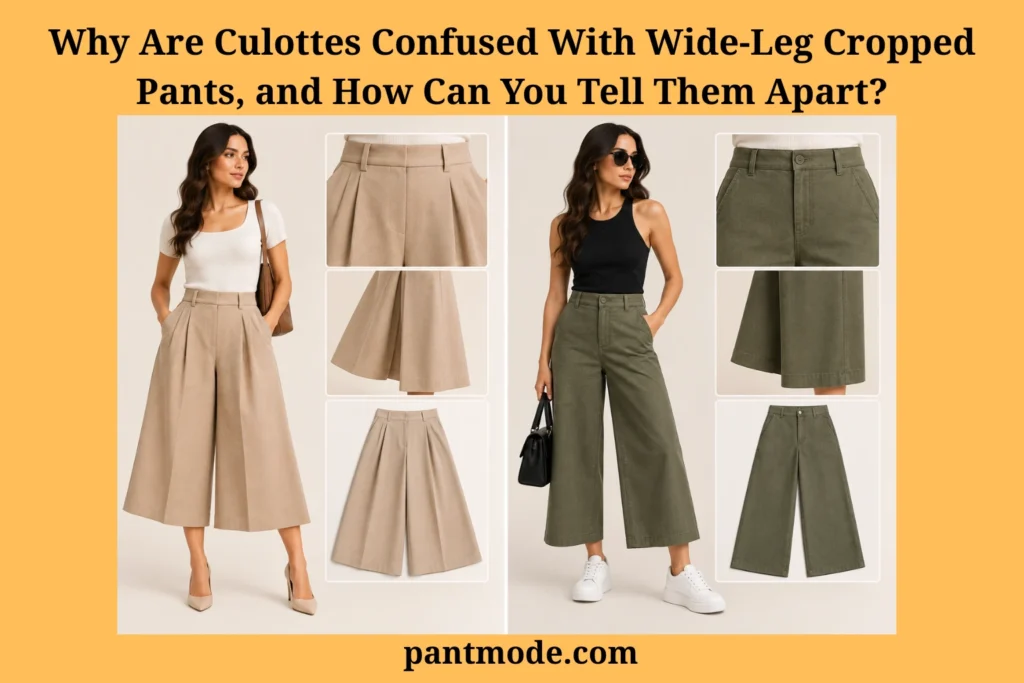
Why Are Culottes Confused With Wide-Leg Cropped Pants, and How Can You Tell Them Apart?
Culottes and cropped wide-leg pants are often confused because both can combine divided trouser construction, shortened length, substantial leg width, and similar drape, while modern fashion terminology allows the two categories to overlap.
The confusion is legitimate rather than a simple naming error. “Cropped wide-leg pants” is the broader descriptive term: it tells you that the garment is shortened and wide through the leg. “Culottes” is a more specific overlapping fashion term commonly associated with cropped divided trousers that often develop some degree of skirt-like visual effect.
Retailer wording can make the boundary less clear because the same garment may be described differently across markets. The broader wide and flared pant types family provides context, while this page focuses only on the comparison decision.
Quick Answer
Culottes and cropped wide-leg pants are often confused because both can be divided trousers with cropped length, substantial leg width, and similar drape. “Cropped wide-leg pants” is the broader descriptive term, while “culottes” is a more specific overlapping fashion term commonly associated with a wide cropped form that may appear partly skirt-like. Some garments can reasonably fit both descriptions.
Definition
In this guide, culottes are treated as cropped divided trousers with meaningful width and a commonly skirt-like visual tradition, while cropped wide-leg pants are the broader category of trousers combining shortened length with a wide-leg cut. The boundary can overlap rather than being universally fixed.
Why Do Culottes and Cropped Wide-Leg Pants Look So Similar?
Culottes and cropped wide-leg pants look similar because both can use divided trouser construction, intentional cropped length, broad legs, and fabrics that create nearly identical silhouettes in still images or movement.
Pleats and gathers can add fullness to either category. Structured fabric can make either garment look more clearly trouser-like, while fluid fabric can make the legs overlap visually and appear more skirt-like during movement.
Photography can increase confusion. Camera angle, pose, movement, model height, footwear height, and overlapping fabric can hide or exaggerate the crotch line and crop. A still image therefore shows the garment from only one viewing condition.
Cambridge Dictionary describes culottes as short trousers that look like a skirt, while Merriam-Webster uses divided-skirt wording. Those definitions help explain why a skirt-like cropped trouser and a cropped wide-leg trouser can visually converge without becoming perfectly standardized categories.
Shared-Feature Matrix
| Shared Feature | Culottes | Cropped Wide-Leg Pants | Why Confusion Occurs |
|---|---|---|---|
| Divided construction | Yes | Yes | Both are trouser-based |
| Cropped proportion | Strong / common | Defining descriptor | Similar vertical scale |
| Meaningful width | Common | Yes | Similar lower-body volume |
| Pleats / gathers | Possible | Possible | Similar fullness |
| Structured fabric | Possible | Possible | Similar trouser appearance |
| Fluid fabric | Possible | Possible | Similar movement |
| Skirt-like effect | Common / supporting | Possible | Visual overlap |
| Retail naming | Variable | Variable | Terminology can overlap |
What Structural Signals Are Most Strongly Associated With Modern Culottes?
The strongest practical culotte signals are divided construction, intentional cropped proportion, meaningful leg width, and a design convention that often creates some degree of skirt-like visual effect.
Separate trouser legs, crop, and width are the strongest structural clues. Skirt-like appearance strengthens the culotte reading, but it should not be made mandatory because structured modern culottes may read more clearly as trousers.
Crotch visibility, pleats, gathers, rise, and fabric type remain weak standalone tests. A visible crotch does not disqualify the garment; a concealed crotch does not prove the label.
The full culotte definition belongs on PantMode’s modern culottes page; this section keeps only the baseline needed for comparison.
Culotte Signal Matrix
| Signal | Classification Role | Strength | Boundary |
|---|---|---|---|
| Divided construction | Core | High | Separates from ordinary skirts |
| Cropped proportion | Core | High | Exact hem varies |
| Meaningful width | Core | High | No fixed circumference |
| Skirt-like visual effect | Supporting | Moderate–High | Degree varies |
| Crotch concealment | Variable | Low | Not required |
| Pleats / gathers | Variable | Low | Not required |
| Rise | Variable | Low | Low, mid, or high |
| Fabric | Variable | Low | Structured and fluid both possible |
Which Features Help Distinguish Culottes From Cropped Wide-Leg Pants, and Which Do Not?
The most useful distinction comes from the whole garment convention and visual structure, while isolated details such as rise, pleats, crotch depth, fabric type, and exact hem position are weak standalone tests.
A stronger culotte reading may come from explicit culotte terminology, greater skirt-like visual potential, or a design that clearly belongs to the cropped divided-trouser tradition. A stronger cropped-wide reading may come from a conventional wide-leg trouser architecture whose shortening is the clearest descriptive feature.
Neither side has exclusive ownership of pleats, gathers, high rises, fluid fabrics, denim, visible crotches, or concealed crotches. Those details modify the garment without creating a universal technical border.
No supporting clue should classify the garment by itself.
Culottes vs. Cropped Wide-Leg Overlap Matrix
| Signal | Leans Culotte | Leans Cropped Wide-Leg | Overlap Rule |
|---|---|---|---|
| Category wording | Culotte terminology is explicit | Broad cropped-wide terminology is explicit | Seller wording supports but does not decide |
| Skirt-like reading | More pronounced | May remain more trouser-like | Either can still overlap |
| Overall fullness | Often moderate to high | Moderate to high | No fixed width threshold |
| Construction | Divided and cropped | Divided and cropped | Shared core geometry |
| Front design | Pleated, gathered, or flat | Pleated, gathered, or flat | Weak standalone clue |
| Fabric | Fluid or structured | Fluid or structured | Material does not decide |
| Final label | Culotte convention strongest | Cropped-wide description strongest | Both is valid when signals genuinely overlap |
How Do Culottes and Cropped Wide-Leg Pants Overlap With Gauchos, Divided Skirts, and Midi Skirts?
Culotte, cropped wide-leg, gaucho, and divided-skirt terminology can overlap, while a conventional midi skirt provides a clearer construction boundary because it does not have separate trouser legs.
Gaucho is often used for cropped wide trousers and can overlap with culotte naming. Without a recognized universal measurement for every market and design tradition, it is better to acknowledge the overlap than invent one numeric boundary.
Divided skirt overlaps strongly with culotte terminology. Merriam-Webster describes a divided skirt as a skirt-like garment divided and seamed like trousers, reinforcing terminology overlap rather than a rigid separation.
Midi skirts are easier to separate structurally: a conventional midi skirt has one continuous skirt body. Full-length wide-leg trousers also differ because they lack the intentional cropped proportion central to this comparison.
For the wider trouser geometry behind the broad-leg side of the comparison, see PantMode’s wide-leg silhouette guide.
Adjacent-Category Matrix
| Garment | Divided Legs | Cropped? | Wide? | Main Boundary |
|---|---|---|---|---|
| Culottes | Yes | Usually | Yes | Core comparison entity |
| Cropped wide-leg pants | Yes | Yes | Yes | Broader overlapping category |
| Gauchos | Yes | Usually | Yes | Terminology can overlap |
| Divided skirt | Yes | Variable | Usually full | Strong lexical overlap |
| Midi skirt | No | Midi | Continuous skirt | No separate legs |
| Full wide-leg pants | Yes | No / full | Yes | Length separates category |
What Visual and Construction Clues Help Identify Culottes When Shopping Online or In-Store?
The most reliable shopping method is to combine construction, crop length, leg width, multiple photographs, product measurements, and product terminology rather than trusting one image or label.
First confirm separate legs, seams, crotch, and waistband. Then check whether the garment is intentionally cropped. If measurements are available, combine inseam with thigh, knee, lower-leg, or hem information rather than reading hem width alone.
Use front, side, back, movement, and garment-only photographs when available. Model height can provide context, but it cannot establish crop length by itself because rise, styling, shoe height, and body proportions change the visual endpoint.
Retailer naming is supporting metadata, not the final classifier.
Online / In-Store Identification Guide
| Inspection Point | Useful Signal | Weak Signal |
|---|---|---|
| Divided construction | Separate trouser legs | Skirt-like appearance alone |
| Crop | Intentional shortened length | One exact calf point |
| Width | Thigh / knee / hem relationship | Hem width alone |
| Photography | Several angles | One posed image |
| Measurements | Inseam + width data | Model height alone |
| Product title | Helpful terminology | Final authority |
| Fabric description | Explains behavior | Category definition |
How Do Fabric, Drape, Pleats, and Crop Length Change the Visual Difference Between the Two Styles?
Fabric behavior, pleats, gathers, and crop length can make culottes and cropped wide-leg pants look more skirt-like, more architectural, or almost indistinguishable without automatically changing the garment category.
Weight ≠ rigidity ≠ structure ≠ drape. Weight is fabric mass; rigidity is resistance to bending; drape describes how material hangs and moves; structure describes the combined shape-holding effect of textile properties and garment construction.
A heavier textile can still drape softly, while a lighter textile can appear crisp. Pleats add directed fullness; gathers distribute fullness from a seam or waistband; a flat front limits front volume. Denim can be used in either category and does not exclude culotte classification.
New Mexico State University’s clothing-construction guidance treats ease, pleats, waistbands, fullness, and hems as separate variables, supporting a multi-factor reading rather than fabric-based labeling.
Material & Construction Matrix
| Variable | Mechanical Effect | Visual Result | Classification Impact |
|---|---|---|---|
| Greater weight | More mass | Stronger physical presence | Not decisive |
| Greater rigidity | Holds form | More architectural | Not decisive |
| Fluid drape | Falls and overlaps | More skirt-like | Supporting only |
| Deep pleats | Adds volume | Fuller silhouette | Variable |
| Gathers | Spreads fullness | Softer volume | Variable |
| Flat front | Controls fullness | More trouser-like | Variable |
| Denim | Often firmer visual reading | Casual / structured | Valid for both |
| Longer crop | Less exposed leg | More midi-like | Variable |
How Should Culottes and Cropped Wide-Leg Pants Be Chosen for Different Occasions?
Occasion suitability depends more on construction, opacity, finish, drape, crop, and the complete outfit than on whether the garment is labeled culottes or cropped wide-leg pants.
Professional settings may favor opaque fabric, clean construction, controlled drape, a deliberate crop, and polished supporting pieces where workplace rules permit the style. Business-casual use can allow softer tailoring, knits, shirts, blazers, loafers, flats, boots, or clean sneakers where appropriate.
Casual pairs can use denim, cotton, softer materials, sneakers, sandals, or flats. Resort styling can prioritize breathable materials and movement, while evening versions can use refined drape, polished surfaces, pleating, crepe, satin, velvet, or similar treatments.
Occasion Rule
Choose by garment construction and finish first; the label alone does not determine formality.
How Should Tops, Layers, and Footwear Work With Culottes and Cropped Wide-Leg Pants?
Tops, layers, and footwear should support the intended crop and volume rather than forcing every culotte or cropped wide-leg outfit into the same waist-defined or leg-lengthening formula.
A tuck, fitted knit, shaped shirt, cropped top, or short jacket can increase waistband visibility, but waist definition is optional. Oversized and untucked tops can work when the length, fabric weight, and total volume are deliberate.
Long coats and jackets can also work. Flats, sneakers, loafers, sandals, boots, heels, and platforms are all possible; coordinate them with crop length, boot shaft, shoe scale, garment width, and intended aesthetic.
How Can Common Classification, Styling, and Fit Problems Be Corrected?
Common problems should be solved by identifying whether the issue comes from category interpretation, crop length, garment width, pleats, fabric behavior, waistband fit, rise, crotch geometry, footwear, or styling rather than blaming the garment category or wearer’s body.
If the category is unclear, recheck crop, width, overall geometry, seller terminology, skirt-like effect, and adjacent labels together. If front volume feels excessive, identify whether the source is pleats, gathers, fabric, pockets, or waistband tension before changing size.
Waist gaping or pulling should be diagnosed through waist-to-hip relationship, rise, waistband contour, and size. Restricted movement requires separate checks for hip ease, thigh ease, crotch depth, and crotch length.
NMSU’s pants-fit guidance separates ease, crotch depth, crotch length, thigh width, knee width, and pant length as distinct variables. For broader troubleshooting beyond this comparison, see PantMode’s pant fit details.
Fit & Classification Troubleshooting Matrix
| Problem | Likely Cause | Adjustment | Boundary |
|---|---|---|---|
| Category unclear | Terminology overlap | Use full signal set | Dual label may be valid |
| Excess front volume | Pleats / gathers / fabric | Modify source | Fullness may be intended |
| Awkward crop | Hem / shoe interaction | Reassess length | No universal calf point |
| Waist gap | Waist / hip mismatch | Target waistband | Other fit may be correct |
| Waist pulling | Size / rise / waistband | Reassess fit | Avoid forced sizing |
| Restricted movement | Crotch / hip / thigh | Refit | Width alone does not ensure ease |
| Fabric collapses | Drape / stability | Choose different behavior | Fluidity may be intentional |
| Wrong silhouette reading | Geometry / material / label conflict | Recheck whole garment | Fabric alone cannot classify |
What Checklist Helps You Classify Culottes and Cropped Wide-Leg Pants Before Buying?
The final classification should combine construction, intentional crop, meaningful width, overall visual convention, product terminology, adjacent-category checks, fabric behavior, and fit rather than relying on one characteristic.
Core Construction
Culotte Signals
Cropped Wide-Leg Signals
Weak Tests to Ignore
Adjacent Categories
Product-Listing Verification
Fit Verification
Key Takeaway
Culottes and cropped wide-leg pants are difficult to separate because they genuinely overlap. Use divided construction, intentional crop, meaningful width, overall visual convention, product terminology, and adjacent-category context together. When both labels fit, acknowledging the overlap is more accurate than inventing a rigid distinction.
What FAQ Questions Clarify Culottes vs. Cropped Wide-Leg Pants?
The most useful FAQs clarify why the terms overlap, which structural signals matter, which popular rules are unreliable, and how shoppers can classify ambiguous garments.
Both can be divided trousers with shortened length, substantial leg width, and similar drape, so their visual appearance often overlaps.
Yes. Some garments legitimately fit both descriptions, and acknowledging that overlap can be more accurate than forcing one exclusive label.
No. A skirt-like visual effect is a useful supporting signal, but it is not a universal requirement.
No. Culottes are cropped relative to full trousers, but no single universal calf point defines the category.
Check multiple photos, divided construction, crop, leg width, available measurements, and product wording together rather than trusting the title alone.
What Final Rule Should Guide Culottes vs. Cropped Wide-Leg Classification?
The final rule is to treat culottes and cropped wide-leg pants as overlapping fashion concepts and classify the garment from its complete construction, crop, width, visual convention, and terminology rather than one rigid test.
When a garment is cropped, divided, and meaningfully wide, use the complete design and terminology context to decide whether “culottes,” “cropped wide-leg pants,” or both is the most accurate description.
Culottes and cropped wide-leg pants are easy to confuse because they share real structural territory. Both can be divided, intentionally cropped, meaningfully wide, pleated or flat-front, structured or fluid, and visually trouser-like or skirt-like depending on the design.
The best classification method therefore avoids one-word product titles, one calf measurement, one photograph, or one styling clue. Start with garment geometry, then consider category convention, terminology, adjacent labels, material behavior, and fit. If both descriptions genuinely fit, dual classification is a valid result rather than a failure to classify.