
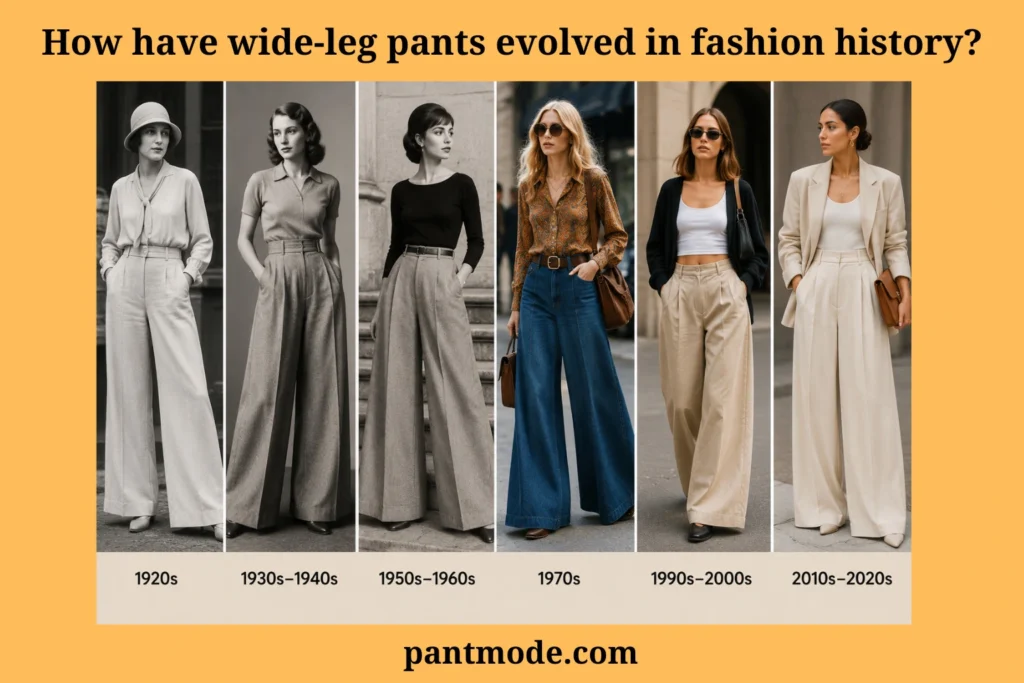
How Have Wide-Leg Pants Evolved in Fashion History?
Wide-leg pants evolved through multiple histories of trouser volume rather than one single invention, with different eras using width for reform, leisure, tailoring, cultural identity, subculture, fashion experimentation, and contemporary reinterpretation.
This history includes true sustained-width trousers and historically related volume-based forms, but related does not mean structurally identical. Zoot trousers, Palazzo trousers, bell-bottoms, Oxford Bags, and 1990s baggy jeans can all use visible volume while placing that volume in different parts of the leg.
For modern professional use, PantMode treats wide-leg pants separately from this historical page. Here the focus is chronology and structural change.
Quick Answer
Wide-leg pants did not emerge from one invention. Their history developed through multiple forms of trouser volume: nineteenth-century dress-reform garments, 1920s Oxford Bags, women’s beach pyjamas and resort trousers, wartime and zoot-suit volume, late-1960s and 1970s Palazzo and flare experiments, 1980s tailoring, 1990s oversized subcultural styles, and later cycles of narrower and wider fits. The key is to trace where volume sits in each garment rather than treating every loose trouser as the same silhouette.
Definition
Wide-leg pants are trousers that maintain substantial width through much of the leg. In historical analysis, PantMode uses “wide-leg history” to trace both true sustained-width trousers and related voluminous forms while clearly identifying structural differences between them.
Master Historical Timeline
Bifurcated reform dress expanded trousered womenswear without being identical to modern wide-leg.
Exaggerated collegiate menswear made broad trouser width highly visible.
Women’s leisurewear used broad trouser forms and widened social acceptance.
Practical trousers and draped-tapered zoot trousers used volume differently.
Continuous breadth coexisted with knee-driven flares and bell-bottoms.
Power dressing and pleated tailoring emphasized structured scale.
Hip-hop, grunge and other youth contexts used looseness differently.
Bootcut, flare, skinny and baggier fits overlapped rather than replacing one another absolutely.
Wider silhouettes became one prominent option within a broader mix of fits.
Historical trousers can all look “big” while using different width-distribution systems.
What Early Trouser Precedents Prepared Fashion for Modern Wide-Leg Silhouettes?
Modern wide-leg pants have earlier precedents in dress reform and other loose bifurcated garments, but those garments should be treated as historical pathways rather than direct equivalents of the modern wide-leg silhouette.
The Victoria and Albert Museum describes the Bloomer within nineteenth-century Dress Reform as a shortened skirt combined with pantaloon-style trousers and connects reform dress with less restrictive movement. That makes it relevant to the social history of bifurcated womenswear, not proof that the modern wide-leg silhouette had already been invented.
Pre-1920 Precursor Matrix
| Precursor | Context | Contribution | Classification Boundary |
|---|---|---|---|
| Bloomer / reform dress | Dress Reform | Expanded visible bifurcated legwear in reform circles | Not modern wide-leg |
| Exercise / reform trousers | Movement and health reform | Connected trousers with mobility | Functional context |
| Other loose historical trouser forms | Variable | Expanded the vocabulary of trouser volume | Use period label and source carefully |
How Did Oxford Bags, Beach Pyjamas, and Resort Trousers Expand Wide-Leg Fashion in the 1920s and 1930s?
Oxford Bags and beach pyjamas made broad trouser volume more visible during the 1920s and 1930s, but they did so through different menswear, leisurewear, and womenswear contexts.
Oxford Bags: Exaggerated Collegiate Menswear
The Oxfordshire Museum identifies Oxford Bags as men’s trousers from the 1920s favored by University of Oxford undergraduates. FIT’s Fashion History Timeline places their growth around 1924–25 and notes that the origin story is contentious. PantMode therefore treats Oxford Bags as a major episode rather than the invention of wide-leg trousers.
Beach Pyjamas: A Womenswear Leisure Path
A Fashion Museum Bath resource documents a 1929 beach-pyjama ensemble with wide flared trousers and states that beach pyjamas helped make trousers more acceptable for women.
1920s–1930s Emergence Matrix
| Form | Main Context | Width Pattern | Historical Role |
|---|---|---|---|
| Oxford Bags | Collegiate menswear | Extremely broad tailored legs | Major episode in exaggerated menswear width |
| Beach pyjamas | Resort / leisure womenswear | Broad, flowing trouser component | Expanded women’s trouser visibility |
| Tailored / resort wide trousers | Fashion and leisure | Variable continuous width | Developed broader trouser vocabulary |
How Did 1940s Utility Trousers and Zoot Suits Give Trouser Volume Different Cultural Meanings?
The 1940s gave trouser volume very different meanings, ranging from practical clothing to the exaggerated draped-and-tapered zoot suit associated with powerful youth and cultural identities.
The Smithsonian National Museum of American History describes Mexican American youths in 1942 who expressed cultural identity through oversized zoot suits and places that history in the context of the 1943 Zoot Suit Riots. Structurally, zoot trousers used exceptional upper-leg drape with a strong taper below, so they are related to trouser-volume history without being classic continuous wide-leg geometry.
Black style histories also belong in the broader zoot story, but no single community should erase another. Cultural attribution should remain specific to the source and setting being discussed.
1940s Volume Classification Matrix
| Form | Upper Leg | Lower Leg | Context | Relationship to Wide-Leg |
|---|---|---|---|---|
| Practical trousers | Variable | Variable | Work / utility | Some examples overlap structurally |
| Zoot trousers | Extremely full | Strong taper | Cultural and style expression | Related volume, not classic continuous wide-leg |
| Tailored relaxed trousers | Roomier | Variable | General tailoring | Evaluate case by case |
How Did Wide and Flared Trousers Change From the 1950s Through the 1970s?
From the 1950s through the 1970s, trouser fashion moved through periods of controlled tailoring and growing experimentation, eventually producing prominent continuous-width Palazzo forms alongside lower-leg flares and bell-bottoms.
FIT’s 1950s overview notes greater acceptance of women’s slacks in some settings, while its 1960s history documents increasingly casual clothing and late-decade flared trousers.
Palazzo: Width Carried High
The New Zealand Fashion Museum documents an Italian Palazzo all-in-one in Vogue New Zealand in 1967, while the Metropolitan Museum of Art discusses wide-cut Palazzo trousers in a Giorgio Armani ensemble from 1979. For structure, see Palazzo pants.
Flare and Bell-Bottom: Width Concentrated Lower
Flares and bell-bottoms keep more control through the upper leg and knee before stronger lower-leg expansion. FIT’s 1970s overview documents flared trousers in the decade. PantMode’s bell-bottom pants page handles that lower-expansion silhouette in depth.
1950s–1970s Silhouette Evolution Matrix
| Period / Form | Width Placement | Main Structural Signal |
|---|---|---|
| 1950s tailored trousers | Variable / moderate | Controlled tailoring |
| 1960s experimentation | Increasingly variable | Expanding trouser vocabulary |
| Palazzo | High / continuous | Full sweeping width |
| Classic flare | Lower expansion | Controlled upper leg |
| Bell-bottom | Dramatic lower expansion | Strong knee-to-hem contrast |
How Did the 1980s and 1990s Reinterpret Trouser Volume?
The 1980s and 1990s reinterpreted trouser volume through different systems: structured and pleated tailoring in the 1980s, and multiple oversized casual, denim, hip-hop, grunge, skate, rave, and streetwear contexts in the 1990s.
FIT’s 1980s overview characterizes the decade through exaggerated scale and power dressing, but that does not make every 1980s trouser wide-leg.
For the 1990s, FIT documents baggy, worn jeans within grunge, while the Museum at FIT explains how baggy jeans and oversized T-shirts were popularized by hip-hop artists and fans during the 1980s and 1990s. These histories overlap in looseness but differ in cultural meaning.
1980s–1990s Volume Matrix
| Context | Typical Volume Direction | Key Material / Construction | Boundary |
|---|---|---|---|
| 1980s tailoring | Structured / full | Pleats, suiting, broad proportion | Not always continuous wide-leg |
| Hip-hop | Baggy / oversized | Denim and casualwear | Distinct cultural history |
| Grunge | Loose / worn | Denim, thrifted casualwear | Not equivalent to hip-hop |
| Skate | Loose where documented | Denim / workwear | Source-specific |
| Rave / club | Variable to exaggerated | Varied materials | Do not universalize |
How Did Wide-Leg Pants Move Through Narrower and Wider Fashion Cycles From the 2000s Into Contemporary Fashion?
From the 2000s onward, wide-leg pants moved through fashion cycles in which narrower cuts became dominant in some markets while wider trousers persisted and later regained broader visibility alongside multiple competing fits.
FIT’s 2000–2009 overview documents flare and bootcut prominence, the rapid spread of skinny jeans by the middle of the decade, and continued baggy wide-legged jeans in some menswear contexts. That evidence is why “wide trousers disappeared” is too absolute.
For later decades, PantMode uses a cautious summary: trouser options diversified and wider fits became one visible option among several. No single comeback year is treated as universal. For denim-specific construction rather than chronology, see wide-leg jeans.
2000s–Contemporary Cycle Matrix
| Period | Main Context | Wide-Leg Position |
|---|---|---|
| Early 2000s | Low-rise, flare and bootcut prominence | Competing silhouette |
| Mid / late 2000s | Skinny / slim expansion in many mainstream settings | Less dominant in some segments, but still present elsewhere |
| 2010s | Increasing silhouette variety | One of several re-emerging options |
| 2020s | Highly diversified trouser fits | One major option among many; no single comeback date |
Which Construction Features Best Distinguish Historical Wide-Leg Eras?
Historical wide-trouser eras are distinguished more reliably by rise, width placement, taper, pleats, fabric, and hem treatment than by decade labels alone.
Oxford Bags carried extraordinary breadth; zoot trousers concentrated volume above a taper; Palazzo preserved continuous width; bell-bottoms intensified lower-leg growth; and 1990s bagginess could come from whole-garment scale or oversizing. For modern geometry, see the wide-leg silhouette guide.
Era Construction Matrix
| Form | Rise Tendency | Width Placement | Taper | Fabric Direction | Primary Signal |
|---|---|---|---|---|---|
| Oxford Bags | Often higher in surviving examples | Broad through leg | Low | Tailoring | Extreme collegiate width |
| Beach pyjamas | Variable | Broad / flowing | Low | Lightweight examples | Leisure volume |
| Zoot trousers | Often high | Upper-leg dominant | Strong | Suiting | Draped then pegged |
| Palazzo | Variable | High / continuous | Low | Fluid or structured | Continuous breadth |
| Flare / bell-bottom | Variable | Lower expansion | Reverse taper outward | Denim / synthetics / other | Knee-to-hem growth |
| 1980s tailoring | Variable | Hip / thigh fullness | Variable | Suiting | Pleated / structured volume |
| 1990s baggy | Variable | Broad whole-leg or oversized | Variable | Denim / casualwear | Scale and looseness |
| Contemporary wide-leg | Low to high | Sustained | Variable | Broad material range | Hybridized design |
Historical claims are strongest when period, source, geometry and cultural context align.
How Can Historical Wide-Leg References Be Used in Modern Outfits Without Turning Into Costume?
Historical wide-leg references work most naturally in modern outfits when one or two recognizable period signals are preserved while the rest of the outfit remains contemporary.
A 1920s–30s reference might preserve broad tailoring, pleats, a higher waist, or long drape. A late-1960s/1970s reference may use Palazzo sweep or flare geometry while keeping those shapes distinct. An 1980s reference can borrow pleated volume or strong tailoring, while a 1990s reference can use relaxed scale or baggy denim.
Modern Adaptation Rule
Keep 1–2 Historical Signals → Modernize the Supporting Outfit
How Should Vintage Wide-Leg Trousers Be Evaluated Before Alteration?
Vintage wide-leg trousers should be evaluated for age, fabric condition, original construction, previous alteration, provenance, and structural weakness before any irreversible tailoring is attempted.
The Metropolitan Museum of Art’s conservation guidance warns that previous alterations can change intended shape and shift tension onto weak areas. The V&A likewise recommends assessing vintage condition before intervention and notes that fragile material may warrant a textile conservator.
An overlong hem should not be cut automatically. First inspect the original hem allowance, previous work, fabric strength, provenance, reversibility, and potential significance.
Historic or fragile garments should be assessed before irreversible tailoring.
Vintage Fit & Alteration Matrix
| Problem | Check First | Preferred Direction |
|---|---|---|
| Excess length | Original hem, previous work, value | Use reversible or conservative hemming where appropriate |
| Waist mismatch | Construction and seam allowance | Tailor only if fabric and structure can safely support it |
| Pleat distortion | Fit, pressing, waistband tension, fabric | Restore before restructuring |
| Weak fabric | Fiber condition and damage | Preserve rather than stress |
| Previous alteration | Original evidence and tension points | Document before changing |
| Costume-like styling | Supporting outfit rather than garment | Modernize surrounding pieces first |
What Checklist Verifies Historical Accuracy, Garment Condition, and Modern Wearability?
A reliable historical wide-leg evaluation separates three questions: whether the reference is historically plausible, whether the garment is structurally what it claims to be, and whether the specific vintage piece is safe and practical to wear.
F50 Historical Classification Control
| Step | Question | Output |
|---|---|---|
| Period | When is the garment or reference from? | Era context |
| Source | What evidence supports it? | Confidence level |
| Historical label | What was it called in period or museum records? | Preserve label |
| Upper-leg width | Where does volume begin? | High / controlled / ballooned |
| Knee | Does width remain or transition? | Continuous / changing |
| Lower leg | Wide, tapered, or flared? | Geometry |
| Cultural context | Who wore it and in what setting? | Meaning without flattening groups |
| Category | True wide-leg or adjacent? | Classify / qualify |
| Modern use | Which historical signal matters now? | Reference cue |
| Vintage condition | Is intervention safe and reversible? | Wear / preserve / alter carefully |
Historical Accuracy Checklist
Structural Classification Checklist
Vintage Condition Checklist
Modern Wearability Checklist
Final Decision
Key Takeaway
Wide-leg history is not one straight trend line. It is a sequence of different experiments with trouser width, rise, taper, drape, culture, and gendered dress conventions. The most accurate history keeps those related silhouettes connected without pretending they are structurally identical.
What FAQ Questions Clarify the History of Wide-Leg Pants?
These ten questions resolve the main origin, comparison, cycle, and vintage-preservation issues without unsupported historical “firsts.”
There was no single first moment. Broad trousers became visible through several pathways, including dress reform, 1920s menswear, and late-1920s and 1930s women’s leisurewear.
No. Oxford Bags were a major 1920s broad-trouser fashion associated with Oxford undergraduates, but earlier loose and bifurcated trouser precedents already existed.
Oxford Bags were extremely broad men’s trousers associated with University of Oxford undergraduates in the 1920s. Their precise origin story remains contested.
Beach pyjamas helped expand the visibility and acceptance of women wearing trousers in leisure and resort settings; a Fashion Museum Bath example dates to 1929.
They are important to the history of trouser volume, but their very full upper leg and strong taper below differ from a classic continuous wide-leg silhouette.
Palazzo forms were visible by the late 1960s and remained important through the 1970s, so they should not be treated as a strictly 1970s invention.
Palazzo carries width high and continuously, while bell-bottoms create much stronger lower-leg expansion from a more controlled knee area.
Loose and oversized trousers appeared across distinct contexts such as hip-hop and grunge, and those contexts should be described separately rather than collapsed into one story.
No. Skinny and slimmer fits became highly prominent in some mainstream markets, while baggier and wide-legged styles continued in other contexts.
Only after checking fabric condition, original construction, previous alterations, provenance, reversibility, and potential historical or resale significance.
What Final Rule Should Guide the History and Classification of Wide-Leg Pants?
The final rule for understanding wide-leg pants history is to trace both the changing location of trouser volume and the cultural context around it instead of treating every broad or baggy trouser as one continuous style.
Dress Reform created an earlier pathway for bifurcated womenswear; Oxford Bags made exaggerated collegiate trouser width highly visible; beach pyjamas expanded women’s leisure-trouser acceptance; zoot suits attached draped-and-tapered volume to important cultural expression; Palazzo and flare systems separated continuous width from lower-leg expansion; and later decades reinterpreted volume through tailoring, denim, subculture, and competing fit cycles.
Wide-leg pants history is best understood as a changing relationship between width, construction, culture, and time—not as one invention or one universal silhouette.
The history of wide-leg pants is a history of repeated experiments with trouser volume rather than a single uninterrupted design line. Different eras placed width at the thigh, through the full leg, below the knee, or above a strong taper, and those structural choices carried different social and cultural meanings.
Accurate interpretation preserves the period’s own garment label and cultural context, then compares its geometry with modern wide-leg classification only where useful. The same principle protects vintage garments: understand the object before changing it.