
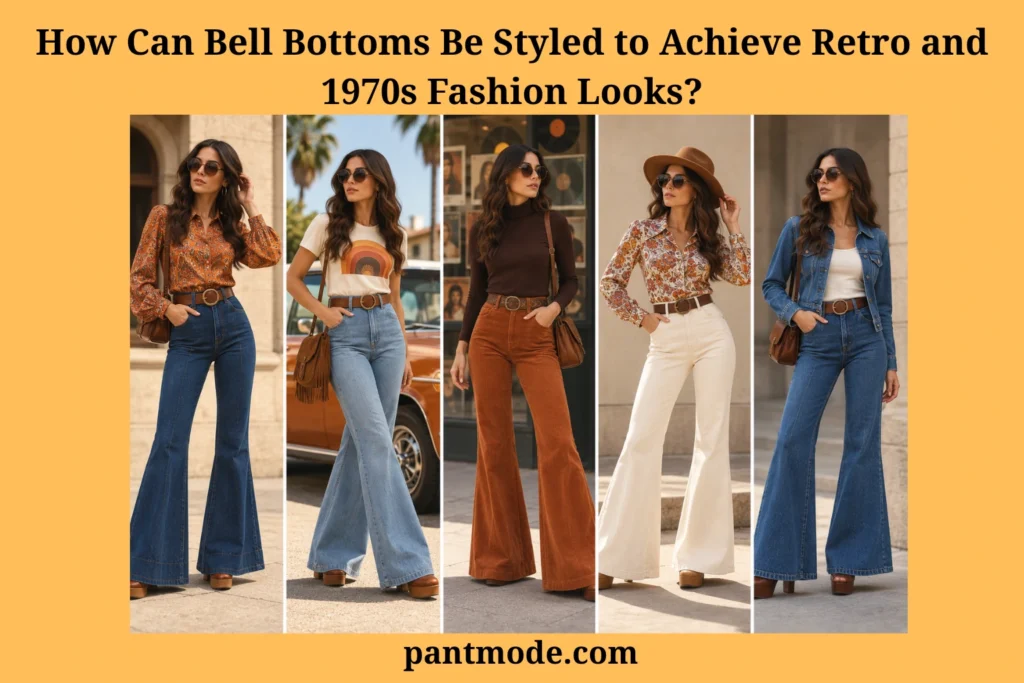
How Can Bell Bottoms Be Styled to Achieve Authentic 1970s Retro Looks?
Bell bottoms can create a recognizable 1970s retro look when their pronounced lower-leg flare is coordinated with one clear period reference, appropriate fabric and texture, intentional upper-body styling, footwear, and hem length.
A convincing result starts with the silhouette. Bell bottoms are not simply any flared trouser: they depend on a stronger lower-leg expansion than a restrained bootcut and a different width pattern from trousers that stay broad higher through the leg.
1970s fashion was diverse. Bohemian, rock, glam, and disco are useful styling reference groups, but they overlap historically and should not be treated as rigid decade boxes. The broader wide and flared pant types family provides context, while this page focuses on bell-bottom styling.
Quick Answer
Style bell bottoms for a recognizable 1970s look by choosing one primary reference—such as bohemian, rock, glam, or disco—and coordinating the trouser’s lower-leg flare, fabric, top, outer layer, footwear, and hem around that direction. Platforms, high rises, and fitted tops can strengthen some period references, but none is universally required.
Definition
Bell bottoms are flared trousers characterized by stronger lower-leg expansion than a restrained bootcut. In PantMode’s practical framework, their identity comes from the contrast between a more controlled upper leg and a pronounced lower flare rather than from one exact rise, knee point, or hem measurement.
What Structural Features Distinguish 1970s Bell Bottoms From Bootcut, Flare, and Wide-Leg Pants?
Bell bottoms are distinguished by lower-leg expansion that becomes much more visually important toward the hem, creating stronger upper-to-lower leg contrast than bootcut and a different width pattern from wide-leg trousers.
The upper leg may be controlled without being skin-tight. The flare commonly becomes visually apparent around the knee-to-lower-leg transition, but there is no universal anatomical release point or hem circumference that every bell bottom must meet. For the broader family comparison, see wide-leg pants.
The Metropolitan Museum of Art documents a 1971 menswear ensemble with bell-bottom trousers, giving direct period evidence for the silhouette. PantMode uses that historical evidence alongside practical geometry rather than inventing a fixed measurement.
For adjacent classifications, compare bootcut pants, the deeper bootcut vs. flare boundary, and the wide-leg silhouette where width is carried higher through the leg.
Bell-Bottom Structural Comparison Matrix
| Silhouette | Upper Leg | Lower-Leg Pattern | Main Signal |
|---|---|---|---|
| Bell bottom | Controlled–moderate | Strong expansion | Pronounced lower flare |
| General flare | Controlled–moderate | Variable expansion | Flare intensity varies |
| Bootcut | Controlled | Restrained widening | Subtle lower expansion |
| Wide-leg | Roomier higher through leg | Broad / continuous | Width carried high |
How Did Bell-Bottom Styling Differ Across Major 1970s Fashion Aesthetics?
Bell-bottom styling changed across the 1970s because hippie-influenced bohemian fashion, rock and glam experimentation, and disco nightlife used different materials, proportions, finishes, and levels of visual drama.
FIT’s 1970–1979 Fashion History Timeline describes the decade as highly varied, from early hippie influence and handcrafted-looking details to later disco glamour, synthetic fabrics, satin, velvet, and sequins.
Bohemian / Hippie-Influenced
Denim, corduroy, crochet, embroidery, suede, and layered or handcrafted-looking texture can communicate an earthy early-decade reference. The point is texture and relaxed construction, not piling every “hippie” cliché into one outfit.
Rock
Denim, leather, velvet, tees, shirts, boots, and stronger outer layers can create a rock-oriented direction. There was no single rock uniform, so the silhouette and a few coherent material cues should do most of the work.
Glam Rock
Richer color, velvet, satin, metallic effects, stronger theatricality, and expressive footwear can support glam. The goal is deliberate drama rather than random decoration.
Disco
Disco styling favors movement, shine, fluidity, sequins, satin, synthetics, and metallic effects. FIT’s Lurex material history connects sparkling metallic yarn effects with 1970s disco culture, but not every disco bell bottom used Lurex.
1970s Aesthetic Reference Matrix
| Direction | Core Character | Useful Materials | Styling Signal |
|---|---|---|---|
| Bohemian | Relaxed / craft-focused | Denim, corduroy, crochet, suede | Texture and layering |
| Rock | Edgier / casual | Denim, leather, velvet | Boots and stronger layers |
| Glam | Theatrical | Velvet, satin, metallics | Deliberate drama |
| Disco | Movement / nightlife | Satin, sequins, synthetics, Lurex | Shine and fluidity |
Which Fabrics and Textures Support Different 1970s Bell-Bottom References?
Fabric and texture help signal the chosen 1970s direction, but no single material makes an outfit historically accurate on its own.
Denim and corduroy can support earthy or casual references; velvet and satin can strengthen rock, glam, or evening directions; synthetics and metallic effects can support disco or fashion-forward interpretations; and crochet or handcrafted texture can reinforce a bohemian signal.
Synthetic material is not automatically historically wrong. The question is whether the material behavior, surface, cut, and styling context work together coherently.
Fabric & Texture Guide
| Material | Useful 1970s Direction | Visual Effect | Boundary |
|---|---|---|---|
| Denim | Bohemian / rock / casual | Structured to broken-in | Wash and weight change the result |
| Corduroy | Earthy / casual | Textured and warm | Wale scale changes appearance |
| Velvet | Rock / glam / evening | Rich surface depth | Not required for glam |
| Satin | Glam / disco | Fluid shine | Can look modern depending on cut |
| Synthetics | Disco / fashion-forward | Varied drape and sheen | Synthetic does not automatically mean accurate |
| Lurex / metallic effect | Disco / glam | Sparkle and visual drama | Use as a signal, not a universal rule |
| Crochet / handcrafted texture | Bohemian | Craft-focused texture | Avoid stereotype overload |
Which 1970s Bell-Bottom Aesthetic Should Guide the Outfit?
The best bell-bottom styling reference depends on whether the outfit should feel earthy, rock-oriented, theatrical, nightlife-driven, or simply modern with a recognizable 1970s signal.
Choose one primary path first. Earthy styling can prioritize craft texture and soft layers; rock can use denim, darker materials, boots, and a stronger outer layer; glam can preserve rich fabric, dramatic flare, or metallic detail; disco can emphasize movement and shine; and modern retro can keep the bell-bottom shape with one or two recognizable period signals while simplifying everything else.
Aesthetic Selection Matrix
| Desired Result | Primary Direction | Preserve | Avoid |
|---|---|---|---|
| Earthy | Bohemian | Texture and craft cues | Costume overload |
| Edgy | Rock | Denim, boots, strong layer | Fixed rock-star uniform |
| Dramatic | Glam | Rich fabric and flare | Random theatrical details |
| Nightlife | Disco | Movement and shine | Treating disco as the whole decade |
| Subtle | Modern retro | Bell-bottom shape + 1–2 cues | Removing all historical signals |
How Should Tops and Layers Work With Bell Bottoms in Different 1970s Looks?
Tops and outer layers should reinforce the selected 1970s reference while allowing the pronounced lower-leg flare to remain intentional rather than forcing one universal fitted-top formula.
Fitted or tucked tops can sharpen contrast for some rock, glam, or disco looks, but they are optional. Soft shirts, flowing tops, knits, and tunic-like layers can support bohemian or relaxed retro directions. Cropped jackets can expose more of the trouser line, while longer layers can create a deliberate long vertical composition.
The Rule of Thirds may be used as an optional composition tool, but it is not an anatomical ideal or a fit requirement.
Top & Layer Matrix
| Direction | Top | Layer | Main Effect |
|---|---|---|---|
| Bohemian | Flowing, fitted, or tunic-like | Suede, crochet, soft jacket | Relaxed texture |
| Rock | Tee, shirt, or knit | Leather, denim, suede | Edgier contrast |
| Glam | Expressive or fitted | Dramatic structured layer | Theatrical |
| Disco | Sleek or fluid | Minimal or statement | Movement |
| Modern retro | Simple contemporary top | Clean jacket or blazer | Updated reference |
How Should Footwear, Flare Width, and Hem Length Work Together?
Bell-bottom footwear and hem length should be planned together because shoe height and shape change where a pronounced flare falls, breaks, skims, or pools.
The Met’s early-1970s platform footwear record supports platforms as a strong period signal, but platforms are not required. Boots, clogs, flats, and lower shoes can also work when the hem is fitted to the chosen shoe.
- Set the trousers at the intended rise.
- Wear the intended footwear.
- Check the front flare.
- Check the side fall.
- Check rear clearance.
- Walk normally.
- Confirm that the flare remains visible.
- Alter only if necessary.
New Mexico State University’s pants-fit guidance treats style, fabric, fit, and garment length as connected variables. That supports fitting the hem to the silhouette and shoe rather than imposing one floor-clearance number.
Footwear & Hem Matrix
| Footwear | 1970s Signal | Hem Consideration | Boundary |
|---|---|---|---|
| Platform | Strong | Longer effective inseam | Not required |
| Boot | Strong / versatile | Flare should clear and fall over shoe | Shaft shape matters |
| Clog | Bohemian / casual | Sole height matters | Contextual |
| Flat / lower shoe | Possible | May need a shorter hem | Historically possible |
| Modern shoe | Retro-inspired | Fit hem specifically | Modern adaptation |
How Can Bell Bottoms Be Modernized Without Losing Their 1970s Reference?
Bell bottoms can feel contemporary while retaining a 1970s reference when the flare remains recognizable and one or two strong period signals are preserved while the supporting outfit is simplified.
A historically faithful recreation should prioritize a period-supported silhouette, period-informed materials, and compatible footwear and upper styling. A modern retro outfit can use a contemporary tee, knit, shirt, blazer, jacket, or shoe while preserving enough 1970s structure or material language to make the reference clear.
The V&A’s 1960s fashion overview also helps prevent a false “suddenly invented in 1970” story by showing flaring trouser outlines and hippie-influenced styling already developing in the late 1960s.
Historical vs. Modern Styling Matrix
| Element | Historically Faithful | Modern Retro |
|---|---|---|
| Trouser | Period-consistent bell-bottom | Modern bell-bottom |
| Fabric | Period-supported | Comparable contemporary effect |
| Top | Period-style | Simplified modern |
| Layer | Period-compatible | Contemporary |
| Shoe | Period-compatible | Modern but hem-coordinated |
| Goal | Recreation | Recognizable reference |
How Can Inaccurate or Costume-Like Bell-Bottom Styling Be Fixed?
A bell-bottom outfit that feels inaccurate or costume-like should be corrected by identifying whether the conflict comes from silhouette, historical reference, material, excess period signals, rise, footwear, or hem rather than removing every retro element.
If too many period cues compete, reduce novelty accessories, prints, and themed details while keeping the bell-bottom silhouette and one strong aesthetic reference. If the fabric feels wrong, evaluate quality, weight, drape, surface, shine, and construction instead of rejecting synthetic fibers automatically.
If the rise or flare transition feels wrong, diagnose fit and pattern rather than forcing a high rise or a universal kneecap release point. If the hem drags, recheck it with the actual footwear.
Styling Troubleshooting Matrix
| Problem | Likely Cause | Adjustment |
|---|---|---|
| Costume-like | Too many clichés | Reduce secondary signals |
| Weak 70s identity | Insufficient reference | Strengthen one main cue |
| Flare looks wrong | Cut or fit mismatch | Reassess geometry |
| Rise feels wrong | Fit / reference mismatch | Change rise or cut |
| Hem drags | Inseam / shoe mismatch | Refit with footwear |
| Fabric looks theatrical | Surface or quality mismatch | Improve material choice |
| Upper leg restricts | Incorrect fit | Reassess size or pattern |
What Checklist Verifies a Successful 1970s Bell-Bottom Look?
A successful 1970s bell-bottom look should pass separate checks for silhouette identity, historical reference, garment fit, fabric, upper styling, footwear, hem, and intended level of historical accuracy.
Bell-Bottom Classification
Historical Reference
Fit
Footwear & Hem
Historical vs. Modern Goal
Key Takeaway
A convincing 1970s bell-bottom outfit needs three things: recognizable bell-bottom geometry, one coherent historical reference, and deliberate coordination of fabric, upper styling, footwear, and hem. Historical recreation can use more period detail; modern retro styling can simplify the supporting outfit without losing the recognizable flare and era signal.
What FAQ Questions Clarify 1970s Bell-Bottom Styling?
Bootcut uses more restrained widening below the knee, while bell bottoms emphasize a stronger, more visually dominant lower flare.
No. Wide-leg pants carry substantial width higher through the leg, while bell bottoms depend more strongly on lower-leg expansion.
No. Platforms are a strong period signal, but boots, clogs, flats, and other shoes can work when the hem is fitted to the actual footwear.
Set the trousers at the intended rise, wear the intended shoes, then check front fall, side line, rear clearance, and walking movement before altering.
Choose one main 1970s reference, keep the bell-bottom silhouette clear, and use only one or two supporting period signals instead of stacking every decade cliché.
What Final Rule Should Guide Authentic 1970s Bell-Bottom Styling?
The final rule is to make the bell-bottom silhouette and one coherent 1970s reference do most of the historical work, then coordinate fabric, upper styling, footwear, and hem without turning optional period details into requirements.
Bell bottoms look convincingly 1970s when pronounced lower-leg flare, one coherent era reference, and deliberate fabric, footwear, and styling choices work together—not when every stereotype from the decade is added at once.
Authentic-looking 1970s bell-bottom styling begins with the cut itself: a more controlled upper leg and a pronounced lower flare. Once that geometry is correct, choose one reference—bohemian, rock, glam, disco, or a restrained modern-retro direction—and coordinate the material, top, layer, footwear, and hem around it.
Historical recreation and modern retro styling can both succeed, but they use different standards. The first asks for more period-supported detail; the second can simplify the supporting outfit while preserving a clear bell-bottom silhouette and enough historical signals to communicate the decade.