
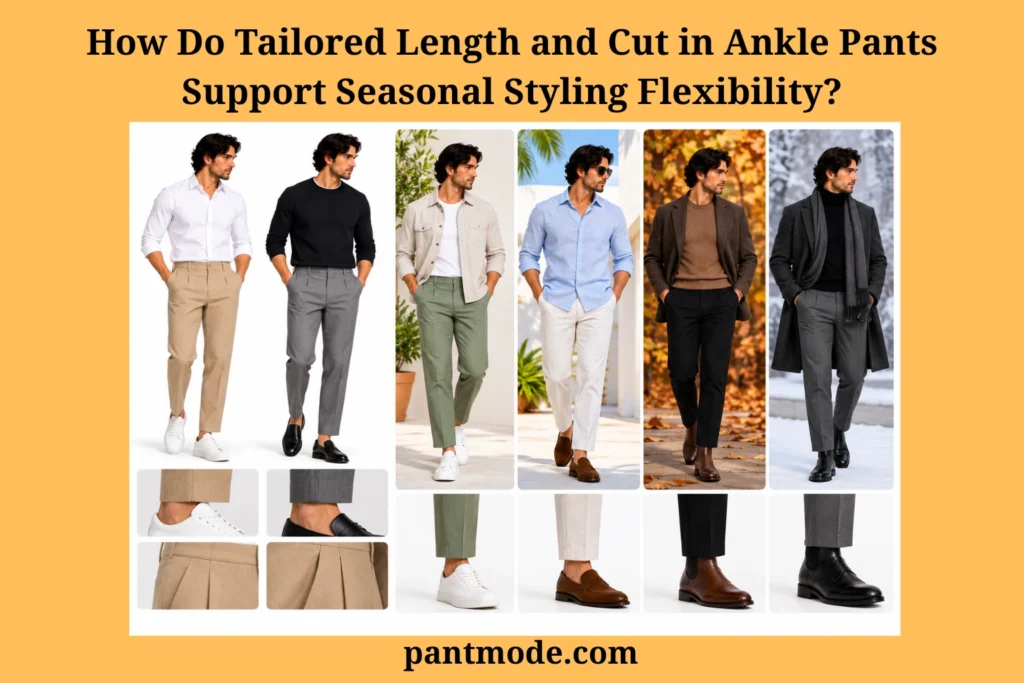
How Do Tailored Length and Cut in Ankle Pants Support Seasonal Styling Flexibility?
Tailored length and cut can make ankle pants structurally flexible across seasonal styling contexts because they establish a stable trouser shape before footwear coverage, lower-leg coverage, or surrounding layer volume changes.
The ankle-level hem creates a controlled lower endpoint. The cut determines how leg width, taper, straightness, leg opening, and volume distribution arrive at that endpoint.
Within PantMode’s pant fit and detail features, seasonal flexibility should therefore be judged through garment structure rather than by assuming that ankle exposure automatically makes a pant suitable for every season.
Quick Answer
Tailored ankle pants can adapt across seasonal styling contexts because their deliberate hem provides a stable lower endpoint while their cut controls the silhouette above it. If the hem, leg opening, and volume distribution remain coherent, footwear and layering can change without requiring the pant’s basic structure to change.
Definition
Tailored ankle length: a deliberately selected hem endpoint near the ankle region that is integrated with the pant’s cut.
Leg opening: the width and shape of the trouser edge at the hem.
Cut: the leg-shape system created by width, taper, straightness, and volume distribution.
Seasonal styling flexibility: the ability of the same ankle-pant structure to remain visually intentional as seasonal styling variables change.
Key Takeaway
Seasonal flexibility begins with stable garment structure; footwear and layering test that structure rather than create it.
How Do Tailored Length and Cut Give Ankle Pants Seasonal Styling Flexibility?
Tailored length and cut create seasonal styling flexibility by combining a deliberate lower endpoint with an organized leg silhouette.
| Structural Variable | Role | Seasonal Interaction |
|---|---|---|
| Tailored length | Defines lower endpoint | Coverage changes below hem |
| Leg opening | Defines edge width | Footwear and sock interface |
| Cut | Controls silhouette | Responds to surrounding layer volume |
| Volume distribution | Controls visual mass | Helps preserve proportion |
| Fabric | Controls material behavior | Determines real material suitability separately |
What Separate Functions Do Length and Cut Perform?
Length controls where the pant stops, while cut controls the shape and volume that arrive at that endpoint.
| Variable | Controls | Does Not Control |
|---|---|---|
| Length | Vertical endpoint | Whole silhouette |
| Leg opening | Edge width | Entire cut |
| Cut | Leg shape | Exact hem height |
| Fabric | Material behavior | Length classification |
How Does Tailored Ankle Length Create an Adaptable Lower Boundary?
An intentional ankle hem creates a predictable lower garment boundary that can be evaluated separately from the pant’s other structural variables.
Threads treats pant length and leg-style construction as deliberate pattern and finishing variables. Its guidance also explains that finished length can be altered while preserving hem width and leg proportions.
This construction evidence supports intentional length as a real garment variable. It does not prove that a specific ankle hem is automatically seasonally or climatically suitable.
The distinction between ankle and cropped pants is therefore important: a deliberately engineered ankle endpoint should not be reduced to the general idea of “shorter pants.”
How Is Tailored Ankle Length Different From Neighboring Shorter Pant Categories?
Tailored ankle length should be classified by its deliberate endpoint and its integration with the pant silhouette rather than by shortness alone.
Capri pants represent a shorter neighboring category, while ankle pants maintain a lower endpoint closer to the ankle region.
The broader family of cropped pant lengths also shows why every shortened trouser should not automatically be classified as an ankle pant.
| Length Condition | Structural Reading |
|---|---|
| Deliberate ankle endpoint | Ankle-pant candidate |
| Temporary rolled full-length hem | Not structurally identical |
| Clearly shorter cropped category | Different length classification |
| Unexpected shortness from poor sizing | Accidental, not tailored |
How Does Cut Create an Adaptable Ankle-Pant Silhouette?
Cut controls how leg volume approaches the ankle hem and therefore determines the structural relationship between the pant body, leg opening, and lower endpoint.
A slim cut carries relatively low volume toward the hem. A tapered cut progressively reduces volume. A straight cut maintains more consistent width, while a wider ankle cut preserves greater lower-leg visual mass.
Straight-leg pants provide one concrete reference for a cut in which leg width remains comparatively consistent rather than progressively narrowing toward the hem.
| Cut | Volume Pattern | Structural Reading |
|---|---|---|
| Slim | Low volume | Narrow endpoint |
| Tapered | Reducing volume | Controlled narrowing |
| Straight | Stable width | Column-like structure |
| Wider | Greater lower-leg volume | Stronger lower visual weight |
How Do Length and Cut Combine to Stabilize Ankle-Pant Proportion?
Length and cut create stable proportion when the hem location, leg-opening width, and leg-volume distribution support the same intentional silhouette.
| Hem Position | Cut | Possible Structural Reading |
|---|---|---|
| Intentional ankle | Slim | Compact lower interface |
| Intentional ankle | Tapered | Progressively controlled endpoint |
| Intentional ankle | Straight | Stable vertical column |
| Intentional ankle | Wider | Greater lower visual weight |
| Accidentally short | Any | Proportion may appear unresolved |
Why Does Stable Proportion Support Seasonal Styling Changes?
A stable ankle-pant proportion can remain visually coherent while surrounding styling variables change because the core distribution of hem position, leg width, and visual mass remains consistent.
The general design principle of visual balance and proportion concerns the relationship between individual elements and the overall composition, including the distribution of visual weight.
PantMode applies that general principle to ankle-pant structure. The source does not directly establish that ankle pants are seasonally flexible or that any specific cut works with any specific footwear.
Structural Interpretation
The pant supplies the stable baseline. Seasonal coverage and layer volume act as controlled changes around that baseline.
How Do Footwear and Lower-Leg Coverage Test the Hem Interface?
Footwear and lower-leg coverage test whether the fixed ankle hem and leg opening remain visually intentional as the space immediately below the pant changes.
| Coverage Condition | Interface Test | Possible Failure |
|---|---|---|
| Low shoe coverage | Does the exposed lower-leg zone remain intentional? | Excessive visual gap |
| Higher shoe coverage | Does the hem remain clear? | Crowding or collision |
| Visible socks | Does the added layer preserve edge clarity? | Fragmented interface |
| Bulky lower coverage | Can the opening accommodate the added visual mass? | Hem/opening conflict |
How Does Layer Volume Test the Ankle-Pant Cut?
Changing surrounding layer volume tests whether the pant’s lower-body visual weight remains proportionally stable when the visual mass above or around it changes.
| Cut | Lighter Layer Context | Heavier Layer Context |
|---|---|---|
| Slim | Minimal lower visual weight | Can appear comparatively light |
| Tapered | Controlled | Can retain a defined lower structure |
| Straight | Stable column | Can preserve visual balance |
| Wider | More lower visual weight | Requires crowding and scale check |
These are diagnostic tendencies rather than universal styling prescriptions.
How Can the Same Ankle Pants Transition Across Seasonal Styling Contexts?
The same ankle pants can transition across warmer, transitional, and cooler styling contexts when their core hem position and cut remain unchanged while coverage and layer-volume variables change around them.
| Styling Context | Variable Change | Pant Structure |
|---|---|---|
| Warmer styling | Less lower-leg coverage and lighter surrounding layers | Same |
| Transitional styling | Moderate coverage and layering | Same |
| Cooler styling | Greater lower-leg coverage and heavier surrounding layers | Same |
What Limits Seasonal Styling Flexibility?
Seasonal flexibility weakens when the pant structure works only under one narrow coverage or layer condition.
| Limitation | Structural Effect |
|---|---|
| Accidental-looking hem | Weak or unresolved lower endpoint |
| Opening too narrow for added coverage | Crowding |
| Opening too wide for the context | Visual disconnection |
| Unstable leg volume | Layer imbalance |
| Unsuitable fabric | Material limitation |
| Climate mismatch | Structural styling cannot compensate |
Which Problems Show Structural Failure?
| Symptom | Likely Cause | Diagnostic Direction |
|---|---|---|
| Hem looks accidentally short | Length | Reassess endpoint |
| Footwear collides with hem | Opening / coverage | Reassess interface |
| Excessive visual gap | Length / coverage relationship | Reassess lower boundary |
| Heavier layers overwhelm pant | Volume distribution | Reassess cut |
| Pant works with only one coverage condition | Interface dependence | Test alternative coverage |
| Structure works but weather suitability fails | Fabric or climate context | Separate material issue |
Which Features Should Be Prioritized When Choosing Adaptable Ankle Pants?
Structural variables should be prioritized before seasonal styling modifiers.
| Priority | Feature | Reason |
|---|---|---|
| 1 | Intentional ankle hem | Creates the stable lower endpoint |
| 2 | Coherent cut | Organizes leg shape |
| 3 | Compatible leg opening | Controls the lower interface |
| 4 | Stable leg-volume distribution | Preserves proportional structure |
| 5 | Multiple coverage compatibility | Tests structural adaptability |
| 6 | Layer-volume tolerance | Tests proportional stability |
| 7 | Context-appropriate fabric | Determines real environmental suitability separately |
How Can Ankle Pants Be Tested for Seasonal Styling Flexibility?
The most reliable test keeps the pant itself unchanged and changes one surrounding variable at a time.
What Checklist Confirms Seasonal Styling Flexibility?
Length & Endpoint
Cut & Volume
Coverage & Layer Tests
Final Boundaries
Frequently Asked Questions About Ankle-Pant Seasonal Flexibility
Through a stable combination of intentional ankle length, leg opening, cut, and volume distribution.
No. Styling flexibility does not equal climate suitability.
It controls the trouser’s lower endpoint.
Tailored length is intentionally integrated with the pant’s cut and silhouette.
It determines how the lower edge interacts with footwear, socks, and exposed lower-leg space.
What Final Rule Should Guide Ankle-Pant Seasonal Flexibility?
Judge seasonal styling flexibility by whether the same intentional hem, leg opening, cut, and volume distribution remain coherent while coverage and surrounding layer volume change. Do not treat an ankle-length label, exposed skin, or a single successful outfit as proof of broad structural adaptability.
Tailored ankle pants achieve seasonal styling flexibility when their hem endpoint, leg opening, cut, and volume distribution create a stable garment structure before seasonal styling variables are introduced.
Footwear coverage, lower-leg coverage, and surrounding layer volume then test that structure. If the hem remains intentional, the opening avoids crowding or excessive disconnection, and the silhouette retains balanced visual weight, the same pant can remain structurally coherent across multiple styling contexts.
This structural flexibility should remain separate from climate performance. Fabric, construction, weather, and use context determine whether the garment is physically appropriate for a particular environment.