
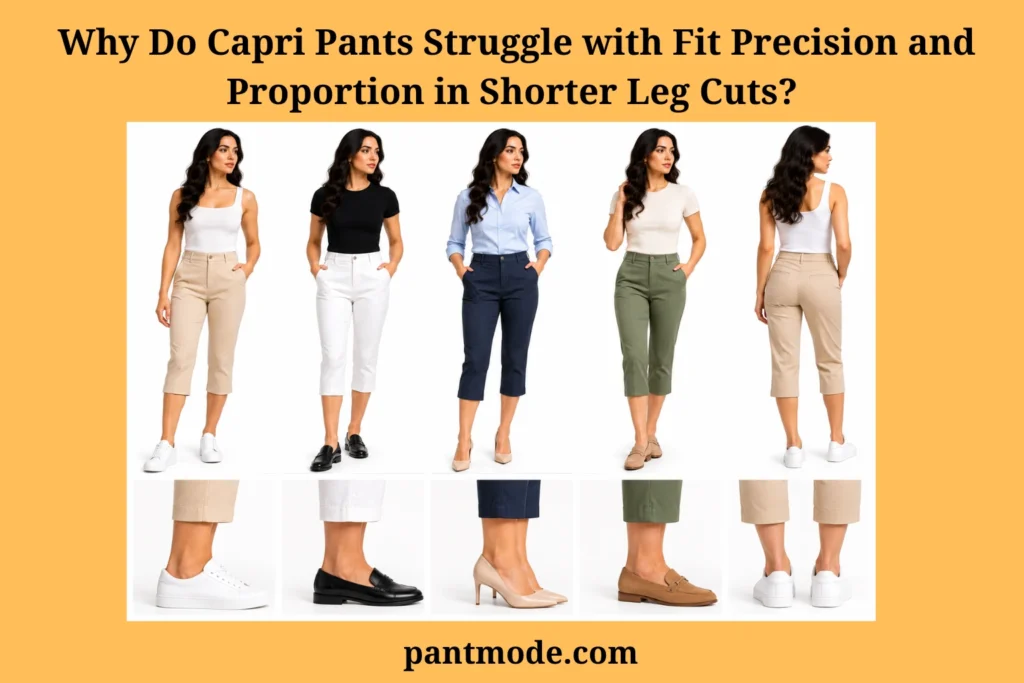
Why Do Capri Pants Struggle with Fit Precision and Proportion in Shorter Leg Cuts?
Capri pants do not inherently fit poorly, but their shortened lower-leg geometry can make certain knee, taper, width, calf, and hem mismatches more noticeable.
The shortened section reduces the distance over which lower-leg shaping develops. A misplaced knee transition, unsuitable taper, incorrect leg width, inadequate calf clearance, or misplaced hem can therefore become more obvious within the shorter geometry.
This technical diagnosis belongs within PantMode’s pant fit and construction details rather than generic styling advice.
Quick Answer
Capri pants can be more sensitive to fit and proportion mismatches because their shortened knee-to-hem section gives shaping and width changes less vertical distance over which to develop. A misplaced knee point, unsuitable taper, tight hem opening, or incorrect hem height can therefore become more obvious, but accurate construction can still produce precise fit.
Definition
Capri fit precision: the degree to which rise, knee shaping, leg width, hem geometry, ease, and relevant wearer measurements align with the intended construction.
Proportional sensitivity: the tendency for structural differences to become more noticeable within the shorter lower-leg section.
Key Takeaway
Short length is not the defect. Fit problems occur when the garment’s measurements, shaping, material behavior, and wearer requirements do not work together.
Why Can Capri Pants Be More Sensitive to Fit and Proportion Errors?
Capri pants can become more sensitive to certain fit mismatches because the knee-to-hem shaping interval is shorter than in comparable full-length pants.
PantMode’s geometric synthesis is simple: when the same positional mismatch occupies a shorter segment, it represents a larger fraction of that segment. This can make the mismatch more conspicuous, but it does not prove that every Capri pant will magnify every error.
| Variable | Mismatch | Observable Signal | Verification |
|---|---|---|---|
| Knee shaping | Too high or low | Displaced taper | Compare knee level |
| Leg width | Too narrow or wide | Restriction or excess fullness | Measure widths |
| Hem height | Wrong endpoint | Length or proportion issue | Verify design intent |
| Hem opening | Too narrow | Calf catching | Measure opening and calf |
| Rise | Incorrect geometry | Pulling or displacement | Check front and back rise |
How Does Shortened Knee-to-Hem Geometry Affect Capri Fit?
Shortened geometry changes the proportional relationship between the knee-shaping region and the final hem.
The closest length-family comparison is Capri and other cropped lengths, but the Capri fit question is not solved by length naming alone. The internal knee-to-hem structure still has to work correctly.
If two otherwise comparable patterns contain the same absolute positional mismatch, that mismatch constitutes a greater fraction of the shorter knee-to-hem segment. This is a geometric relationship, not a guarantee that the wearer will perceive the error identically.
How Does Rise Placement Affect Shorter Capri Cuts?
Rise placement affects Capri fit through the waist-to-crotch structure that positions the upper garment before lower-leg fit is evaluated.
Threads explains that pants fitting measurements and knee level include center-front and center-back rise relationships, wearer measurements, knee level, thigh, and calf considerations.
The source supports the importance of rise and knee-level fit variables. It does not prove that Capri pants universally amplify those errors or establish one universal Capri measurement standard.
| Rise Condition | Possible Signal | Next Check |
|---|---|---|
| Front rise too short | Front pulling or displacement | Confirm front-rise geometry |
| Back rise insufficient | Rear pulling or waistband displacement | Confirm back-rise geometry |
| Rise adequate | Lower-leg problem remains | Move diagnosis to knee, width, calf, or hem |
Why Does Knee Shaping Matter So Much in Capri Pants?
Knee shaping matters because fitted and tapered pant legs often use the knee region as an important transition between upper-leg and lower-leg width.
When that shaping transition is displaced, the taper can begin too early or too late. In a shorter Capri section, the remaining distance to the hem gives the pattern less room to recover visually or physically from the mismatch.
| Knee Condition | Possible Result |
|---|---|
| Knee level correct | Intended transition |
| Shaping too high | Taper begins too early |
| Shaping too low | Taper begins too late |
| Knee correct + tight hem | Problem likely lower in the leg |
| Pattern knee differs from anatomical knee intentionally | Not automatically a defect |
How Does Hem Position Change Capri Proportion?
Hem position determines the garment’s final vertical endpoint relative to the knee, calf, and exposed lower-leg region.
The neighboring classification of ankle and cropped pants helps clarify that hem position is a vertical length variable. It should not be confused with the circumference of the opening at that endpoint.
| Hem Relationship | Technical Question |
|---|---|
| Higher lower leg | Is this the intended design endpoint? |
| Mid-calf region | Is the length correct for the garment specification? |
| Lower calf | Is the opening compatible with the calf at that level? |
| Wider calf area | Does the circumference provide required clearance? |
How Do Leg Width and Hem Circumference Interact?
Leg width controls the shape leading toward the hem, while hem circumference controls the available opening around the lower leg.
Hem Circumference = Horizontal Variable
| Leg Width | Hem Opening | Possible Result |
|---|---|---|
| Narrow | Adequate | Close silhouette with usable clearance |
| Narrow | Too small | Calf catching or movement restriction |
| Moderate | Adequate | Controlled lower-leg volume |
| Wide | Wide | Intentional fuller silhouette |
| Wide | Unexpectedly narrow | Abrupt taper or structural conflict |
How Do Grading, Ease, and Fabric Behavior Modify Capri Fit?
Pattern grading, garment ease, stretch, recovery, drape, and stiffness modify the way Capri geometry behaves, but these are secondary variables rather than automatic explanations for every fit problem.
Pattern Grading
Pattern grading is the systematic dimensional change used to create different garment sizes. It is not the same as simply shortening the hem of an existing trouser.
Fabric behavior also needs to be evaluated separately. Utah State University Cooperative Extension explains that knit materials vary in fabric stretch and recovery, and that poor recovery can allow a material to remain stretched or lose shape during wear.
That material evidence does not prove a Capri-specific defect and does not mean more stretch automatically creates better fit.
The broader relationship between material extensibility and garment dimensions is covered in how fabric stretch affects fit.
| Modifier | What It Can Change | Boundary |
|---|---|---|
| Pattern grading | Size-specific dimensions and proportions | Do not assume faulty grading without evidence |
| Ease | Movement and available room | More ease is not always better |
| Stretch | Dynamic accommodation | Does not repair wrong geometry automatically |
| Recovery | Shape retention after extension | Different from stretch amount |
| Drape | How excess or width hangs | Does not redefine measurements |
| Stiffness | Resistance to bending and shaping | May expose geometry more clearly |
How Do Capri Construction Variables Work as a System?
Capri fit should be evaluated as an interacting system because correcting one measurement does not guarantee that every other relationship is correct.
| Interaction | Diagnostic Focus |
|---|---|
| Rise + waistband | Upper vertical fit |
| Knee + taper | Shape transition |
| Hem height + calf landmark | Vertical endpoint |
| Hem circumference + calf | Clearance |
| Stretch + opening | Dynamic accommodation |
| Grading + length | Size-specific proportion |
| Seam position + leg geometry | Twisting and balance |
Which Symptoms Reveal a Real Capri Fit Problem?
A visible symptom becomes useful diagnostic evidence only after it is connected to a plausible construction cause and confirmed by measurement or movement.
| Symptom | Candidate Cause | Confirmation |
|---|---|---|
| Knee bunching | Knee position, length, or width | Locate the excess and compare landmarks |
| Displaced taper | Knee shaping | Compare taper transition |
| Calf catching | Hem circumference or local width | Measure calf and opening |
| Hem rides upward | Restriction or friction | Walk and bend the knee |
| Pooling or bunching | Excess length or volume distribution | Observe where excess accumulates |
| Twisting | Seam, grain, or balance issue | Inspect trouser seam positioning |
| Disliked silhouette only | Preference | Check movement and measurements separately |
Which Features Should Be Prioritized When Selecting Capri Pants?
Capri construction should be selected by matching the garment’s vertical and horizontal geometry to the intended silhouette, movement requirements, and relevant wearer measurements.
| Priority | Variable | Why It Matters |
|---|---|---|
| 1 | Overall size / waistband | Sets the base garment relationship |
| 2 | Front and back rise | Controls waist-to-crotch geometry |
| 3 | Knee-shaping location | Controls the taper transition |
| 4 | Leg-width profile | Controls volume and ease distribution |
| 5 | Hem height | Sets the vertical endpoint |
| 6 | Hem circumference | Controls local lower-leg clearance |
| 7 | Calf ease | Supports movement at the endpoint |
| 8 | Fabric behavior | Modifies dynamic response |
| 9 | Alteration allowance | Determines correction options |
How Should Capri Pants Be Measured and Corrected?
What Checklist Confirms Precise Capri Fit?
Base Geometry
Knee & Leg Shape
Hem & Clearance
Movement & Verification
Frequently Asked Questions About Capri Fit and Proportion
Their shorter knee-to-hem section can make some shaping, width, and hem mismatches more noticeable, especially in fitted or tapered constructions.
No. Accurate rise, knee shaping, width, hem geometry, and ease can produce precise fit.
Knee level helps determine where shaping and taper transition into the lower leg.
No. Height is vertical; circumference is horizontal.
Not automatically. Stretch modifies accommodation, while recovery affects whether fabric returns toward its original shape.
What Final Rule Should Guide Capri Fit Diagnosis?
Do not diagnose the Capri category itself. Diagnose the variable: measure the garment, separate vertical from horizontal dimensions, identify the most plausible cause, correct one major feature, and retest the complete garment under the same conditions.
Capri pants do not inherently suffer from poor fit. Their shorter knee-to-hem geometry simply makes accurate coordination of rise, knee shaping, leg width, hem height, opening circumference, ease, and fabric behavior especially important.
A visible problem should not be diagnosed from appearance alone. Pulling, bunching, calf catching, twisting, displacement, or an awkward taper should first be connected to a plausible structural variable and then confirmed through measurement or movement.
The most reliable method is to identify the symptom, isolate the variable, measure it, make one targeted correction, and retest the garment without converting personal silhouette preference into a technical fitting defect.