
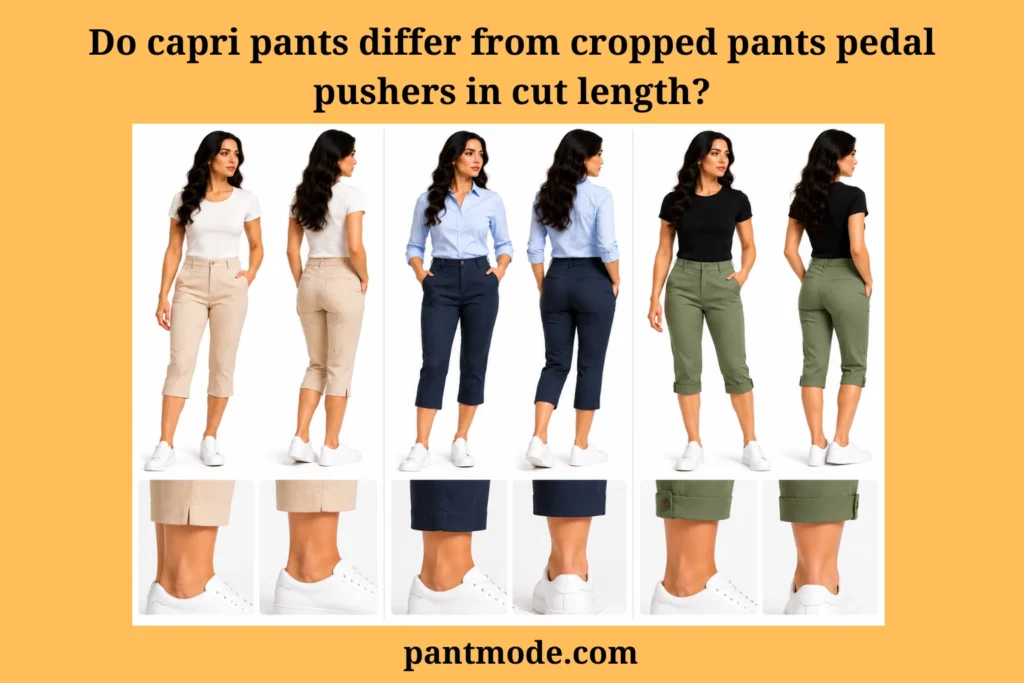
Do Capri Pants Differ from Cropped Pants and Pedal Pushers in Cut and Length?
Capri pants, cropped pants, and pedal pushers can differ in how specifically their shortened length is described, while their leg cuts and terminology may overlap.
PantMode treats cropped pants as the broad working category for intentionally shortened trousers. Capri pants and pedal pushers are more specific shortened descriptions whose intended hem positions often fall within the knee-to-calf region.
The most reliable classification starts with garment structure rather than a product label. Within PantMode’s pant fit and detail features, the sequence is shortening first, hem position second, cut third, measurements fourth, and terminology as supporting evidence.
Quick Answer
Cropped pants are best treated here as the broad PantMode category for intentionally shortened trousers. Capri pants and pedal pushers are more specific shortened descriptions associated with calf-region or below-knee lengths. Their exact hem positions and cuts can overlap, so intended hem location carries more classification weight than inseam or leg cut alone.
Definitions
Cropped pants: PantMode working category for intentionally shortened pants.
Capri pants: a shortened style commonly associated with a calf-region or below-knee endpoint.
Pedal pushers: calf-length or below-knee pants historically associated with cycling.
Key Takeaway
Classify by intended hem position first, cut second, measurements third, and terminology as corroboration; preserve overlap when more than one label fits.
What Are the Main Differences Among Cropped Pants, Capri Pants, and Pedal Pushers?
The main distinction is category scope and intended hem position, not one universally fixed cut or inseam.
| Attribute | Cropped Pants | Capri Pants | Pedal Pushers |
|---|---|---|---|
| Category role | Broad PantMode working class | More specific description | More specific description |
| Shortened construction | Yes | Yes | Yes |
| Typical structural region | Variable shortened endpoint | Calf / below-knee region | Calf / below-knee region |
| Cut | Many forms | Many forms | Historically often closer-fitting |
| Universal inseam | No | No | No |
| Overlap possible | Yes | Yes | Yes |
How Should the Three Terms Be Defined?
Cropped, Capri, and pedal-pusher terminology operates at different levels of specificity rather than as three perfectly isolated technical standards.
The Government of Canada TERMIUM Plus provides official clothing terminology for Capris and pedal pushers. Its terminology associates Capri pants with shortened calf-region usage and pedal pushers with calf-length pants historically linked to bicycle riding.
That source supports the terminology and historical association. It does not establish PantMode’s broader cropped hierarchy or one exclusive modern dividing line between Capri and pedal-pusher garments.
For Capri-specific fit and construction analysis, see Capri pants fit and proportions.
How Does Intended Hem Position Distinguish the Three Styles?
Intended hem position provides the strongest structural evidence because it shows where the shortened garment was designed to end relative to the knee and calf.
The distinction between ankle and cropped pants helps establish the broader length boundary: lower cropped endpoints can approach the ankle, while Capri and pedal-pusher terminology is more strongly associated with the knee-to-calf region.
| Intended Hem Region | Possible Classification Reading |
|---|---|
| Just below knee | Pedal-pusher / cropped possible |
| Upper-to-mid calf | Capri / pedal-pusher overlap possible |
| Calf region | Capri / cropped possible |
| Lower leg above full length | Broad cropped more likely |
| Unclear intended endpoint | Preserve uncertainty |
How Do Their Leg Cuts Differ?
Leg cut modifies the style description but cannot replace length classification.
The distinction between straight and tapered cuts shows why silhouette must be recorded independently from the hem endpoint.
Cut Identifies Silhouette
| Cut | Cropped Pants | Capri Pants | Pedal Pushers |
|---|---|---|---|
| Slim | Possible | Possible | Historically common association |
| Straight | Possible | Possible | Possible |
| Tapered | Possible | Possible | Possible |
| Wider | Possible | Possible | Less characteristic historically |
Why Can Capri and Pedal-Pusher Labels Overlap?
Capri and pedal-pusher labels can overlap because terminology sources place both within calf-length or below-knee territory without one universally standardized dividing line.
The historical cycling association of pedal pushers provides useful terminology context, but it does not make a fitted construction mandatory in every modern use.
| Evidence Combination | Possible Final Description |
|---|---|
| Broad intentional shortening only | Cropped |
| Calf-region endpoint with Capri terminology | Capri |
| Below-knee / calf endpoint with pedal-pusher terminology | Pedal pusher |
| Calf-region structure supports both | Capri + pedal pusher |
| Broad crop plus specific Capri evidence | Cropped + Capri |
| Conflicting or incomplete evidence | Uncertain descriptive label |
Why Can Inseam Mislead Classification?
Inseam is useful measurement evidence, but it cannot independently determine whether a garment is Capri, cropped, or pedal-pusher because style, rise, size, and wearer proportions affect where a given inside-leg length ultimately lands.
Threads explains that pants measurement and fit context should account for style, rise, knee level, calf measurements, and overall garment design rather than treating one dimension as complete proof.
Intended Hem Position = Primary Classification Evidence
| Measurement Evidence | Classification Value | Boundary |
|---|---|---|
| Inseam only | Weak | Cannot define category alone |
| Inseam + size | Better | Still needs hem intent |
| Inseam + rise | More contextual | Still not universal threshold |
| Hem position + knee/calf relationship | Strong | Must reflect intended construction |
| Product specification + structure | Strong corroboration | Retail naming still not absolute proof |
A neighboring lower endpoint such as ankle-length pants also shows why the same numerical inseam can produce different structural outcomes across different garment sizes and proportions.
Which Classification Mistakes Cause the Most Confusion?
| Error | Why It Fails | Correction |
|---|---|---|
| All cropped pants are Capris | Cropped is broader in PantMode taxonomy | Inspect intended hem |
| Capri and pedal pushers never overlap | Terminology can overlap | Preserve overlap where supported |
| One inseam defines category | Measurement requires context | Check hem intent, size, and rise |
| Narrow cut proves pedal pusher | Cut is secondary evidence | Check endpoint first |
| Retail label proves structure | Commercial naming varies | Inspect garment construction |
| Worn hem equals designed hem | Size and wearer proportions alter placement | Check product intent and specification |
| Traditional association is mandatory | Modern constructions vary | Use historical evidence only as context |
How Can the Garment Be Identified Step by Step?
Which Style Should a Shopper Choose?
Shoppers should choose from the actual desired hem position and leg silhouette first, then use measurements and style names to find the closest garment.
| Desired Feature | Best Starting Classification |
|---|---|
| General shortened length | Cropped |
| Calf-region endpoint | Capri may fit |
| Higher below-knee / calf endpoint | Pedal-pusher may fit |
| Fitted calf-length construction | Capri / pedal-pusher overlap possible |
| Exact personal endpoint | Shop by garment specifications |
What Checklist Confirms the Final Classification?
Shortening & Hem
Cut & Measurements
Terminology & Overlap
Final Decision
Frequently Asked Questions About Capri Pants, Cropped Pants, and Pedal Pushers
Cropped pants are treated here as the broad shortened-pant category, while Capri is a more specific calf-region description.
Within PantMode’s working taxonomy, yes, they can fall under the broader cropped category.
Pedal pushers are calf-length pants historically associated with bicycle riding.
They can overlap, but the terms are not necessarily identical in every use.
Yes, if its hem, cut, and terminology legitimately support overlapping descriptions.
What Final Rule Should Guide the Classification?
Identify the intentional shortening, locate the intended hem, compare that endpoint with the knee and calf, describe the leg cut separately, contextualize inseam and rise measurements, then review terminology. If more than one description remains structurally valid, preserve the overlap rather than forcing an exclusive label.
Capri pants, cropped pants, and pedal pushers are best distinguished through intended hem position and structural context rather than by one universal inseam or one leg-cut rule.
Cropped pants serve as PantMode’s broad working category for intentionally shortened trousers. Capri and pedal-pusher descriptions are more specific and can occupy overlapping knee-to-calf regions, while slim, straight, tapered, fitted, and wider silhouettes remain separate cut variables.
The most reliable classification is therefore to identify the shortening, locate the intended hem, describe the cut separately, contextualize the measurements, and preserve overlap wherever the evidence supports more than one valid garment description.