
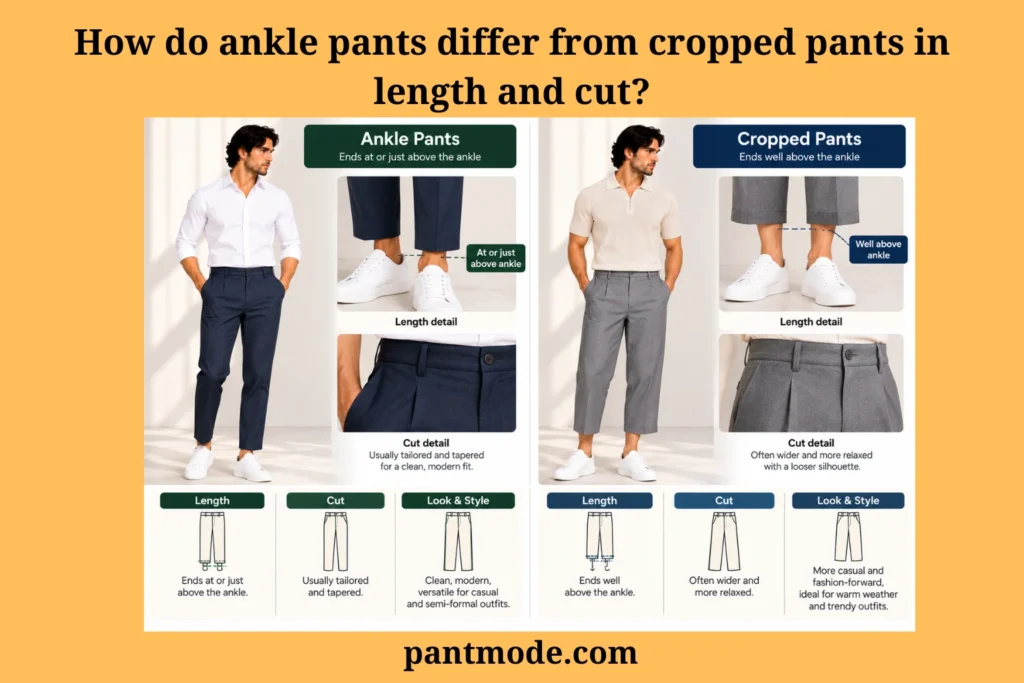
How Do Ankle Pants Differ from Cropped Pants in Length and Cut?
Ankle pants differ from cropped pants mainly through intended hem position. Ankle pants target the ankle region, while cropped pants describe intentional shortening more broadly and may end at different positions on the lower leg.
Cut is secondary because both categories can use slim, tapered, straight, or wider silhouettes. Within PantMode’s pant fit and detail features, length classification should therefore be established before cut is used to describe the silhouette.
Quick Answer
Ankle pants have an intentional hem around the ankle region. Cropped pants are intentionally shorter than conventional full-length pants and can end at different lower-leg positions. Both categories can use slim, tapered, straight, or wide cuts, so intended hem position classifies the garment more reliably than cut alone.
Definition
Ankle pants: pants intentionally designed around an ankle-region endpoint.
Cropped pants: pants deliberately shortened relative to conventional full length.
Overlap: a valid case where a deliberately cropped pant also has an ankle-focused endpoint.
Cut: the leg-shape system created by width, taper, straightness, leg opening, and volume distribution.
Key Takeaway
Classify the intended length first, refine it with hem position, then describe the cut separately.
What Is the Main Difference Between Ankle Pants and Cropped Pants?
The main difference is the specificity of the intended lower endpoint. Ankle pants point specifically toward the ankle region, while cropped pants describe intentional shortening more broadly.
The broader ankle pants category therefore carries a stronger ankle-position cue than the general idea of cropped length.
| Attribute | Ankle Pants | Cropped Pants | Classification Weight |
|---|---|---|---|
| Intentional shortening | Usually present | Required | High |
| Ankle-specific endpoint | Primary cue | Possible | Highest |
| Broader lower-leg endpoint | Less characteristic | Commonly possible | High |
| Cut | Multiple forms | Multiple forms | Secondary |
| Inseam | Supporting | Supporting | Contextual |
| Product label | Supporting | Supporting | Contextual |
How Does Intended Length Distinguish Ankle Pants from Cropped Pants?
Intended length separates an ankle-focused garment from a broadly shortened garment by establishing whether the shorter endpoint is deliberate and where that endpoint is designed to occur.
| Evidence | Classification Direction |
|---|---|
| Not intentionally shortened | Do not classify as cropped from short appearance alone |
| Intentionally shortened | Continue to endpoint analysis |
| Endpoint specifically ankle-focused | Strong ankle evidence |
| Endpoint clearly higher on lower leg | Broader cropped evidence |
| Intent unclear | Borderline or insufficient evidence |
How Does Hem Position Refine the Classification?
Hem position carries the greatest classification weight because it indicates whether the deliberate lower endpoint specifically corresponds to the ankle region or to a broader shortened position above it.
| Intended Endpoint | Stronger Reading |
|---|---|
| Around ankle region | Ankle-focused |
| Above ankle on lower leg | Broadly cropped |
| Considerably higher on lower leg | Cropped or neighboring shorter category |
| Ankle-focused plus crop terminology | Overlap |
| Unclear endpoint | Borderline |
A substantially shorter neighboring category such as capri pants helps demonstrate why not every shortened trouser should be treated as ankle-length.
Why Can’t One Inseam Number Define Ankle or Cropped Pants?
Inseam is measurable, but a number by itself does not reveal the complete structural context needed to classify a shortened pant.
Threads explains that pants measurements and style context must be understood together because different pant styles and pattern structures use measurements differently.
That supports using inseam as contextual evidence. Threads does not define one universal ankle-pant or cropped-pant measurement.
| Inseam Evidence | Interpretive Strength |
|---|---|
| Number alone | Weak |
| Number + garment size | Better |
| Number + size + product intent | Stronger |
| Number + structural hem evidence | Strong |
| Number copied from unrelated brand | Weak |
| One number used as universal cutoff | Reject |
Intended Hem Position = Primary Classification Evidence
How Does Cut Differ When Ankle and Cropped Lengths Overlap?
Cut becomes useful after length classification because it describes the shape of the trouser leg rather than determining whether the garment is ankle-focused or broadly cropped.
| Cut | Ankle Possible? | Cropped Possible? | Classification Role |
|---|---|---|---|
| Slim | Yes | Yes | Secondary |
| Tapered | Yes | Yes | Secondary |
| Straight | Yes | Yes | Secondary |
| Wide | Yes | Yes | Secondary |
Straight-leg pants illustrate the distinction clearly: straightness describes leg shape, but the same straight cut can terminate at full length, ankle length, or a higher cropped position.
Cut Rule
Cut describes how the leg is shaped. Hem position describes where the leg ends.
Which Features Should Receive the Most Classification Weight?
A reliable classification uses a hierarchy rather than treating every clue equally.
| Rank | Evidence | Weight |
|---|---|---|
| 1 | Intended hem position | Highest |
| 2 | Relationship to ankle landmark | High |
| 3 | Intentional shortening | High |
| 4 | Garment-length context | High |
| 5 | Inseam + size context | Moderate |
| 6 | Cut | Secondary |
| 7 | Product terminology | Corroborating |
| 8 | Worn position on one wearer | Weak alone |
Can Ankle Pants and Cropped Pants Overlap?
Yes. Ankle and cropped terminology can overlap when a garment is intentionally shortened and its intended endpoint is specifically ankle-focused.
Real commercial evidence supports this possibility. Nordstrom lists a Splendid product using commercial crop-and-ankle terminology in the same product name.
This proves only that one commercial naming system can combine the two terms. It does not prove that every ankle pant is cropped, every cropped pant is ankle-length, or that the listed product’s inseam defines a universal category threshold.
The wider taxonomy of cropped pant lengths further supports keeping shortened-length categories contextual rather than forcing one universal binary.
How Should Borderline Ankle-vs-Cropped Cases Be Classified?
Borderline garments should be classified from the strongest available structural evidence rather than forced into one category because of a single measurement or commercial label.
| Situation | Best-Supported Verdict |
|---|---|
| Clearly ankle-focused endpoint | Ankle-focused |
| Clearly shortened above ankle | Broadly cropped |
| Ankle-focused + crop terminology | Ankle + cropped overlap |
| Product label conflicts with structure | Review structural evidence first |
| Measurements lack size or garment context | Insufficient evidence |
| Structural evidence remains balanced | Borderline / ambiguous |
Overlapping Evidence → Preserve Overlap
Insufficient Evidence → Preserve Uncertainty
Which Classification Errors Cause the Most Confusion?
| Error | Why It Fails | Correction |
|---|---|---|
| Using one universal inseam | Ignores size and garment context | Interpret measurement contextually |
| Using cut as the main classifier | Both categories can share the same cut | Classify intended length first |
| Assuming taper means ankle | Taper describes silhouette | Check intended endpoint |
| Assuming wide leg means cropped | Width does not define hem position | Separate cut from length |
| Treating product label as structural proof | Commercial terminology varies | Corroborate with structure |
| Using worn position as design intent | Wearer proportions alter visible placement | Separate garment intent from wearer outcome |
| Calling accidental shortness cropped | Intentional shortening is unproven | Confirm design intent |
| Forcing ankle/crop separation | Valid overlap can occur | Allow overlap |
How Can a Garment Be Classified Step by Step?
What Checklist Confirms the Final Classification?
Length Intent
Ankle & Measurement
Cut & Terminology
Final Decision
Frequently Asked Questions About Ankle Pants and Cropped Pants
Ankle pants specifically target an ankle-region hem, while cropped pants describe intentional shortening more broadly.
They can overlap in some naming systems, but the terms should not be treated as universally identical.
No. Cropped pants can use other shortened lower-leg endpoints.
Not reliably by itself. Both categories can be slim, tapered, straight, or wide.
Yes. Real commercial terminology provides examples where both terms are used together.
What Final Rule Should Guide Ankle-vs-Cropped Classification?
Classify the garment’s intended shortening and hem position first, compare that endpoint with the ankle region, interpret inseam only within size and garment context, and describe the cut separately. If both structural and terminology evidence support ankle and cropped readings, preserve the overlap rather than forcing a false binary.
Ankle pants and cropped pants are best separated by intended length and hem position rather than by cut or one numerical inseam.
Ankle pants carry the more specific ankle-region position cue. Cropped pants describe the broader condition of intentional shortening and can terminate at several lower-leg positions. Slim, tapered, straight, and wide cuts can occur in either category, so silhouette cannot replace length classification.
The safest final rule is to classify the length first, refine the result with the ankle landmark, describe the cut separately, and preserve overlap whenever the structural and terminology evidence support both terms.