
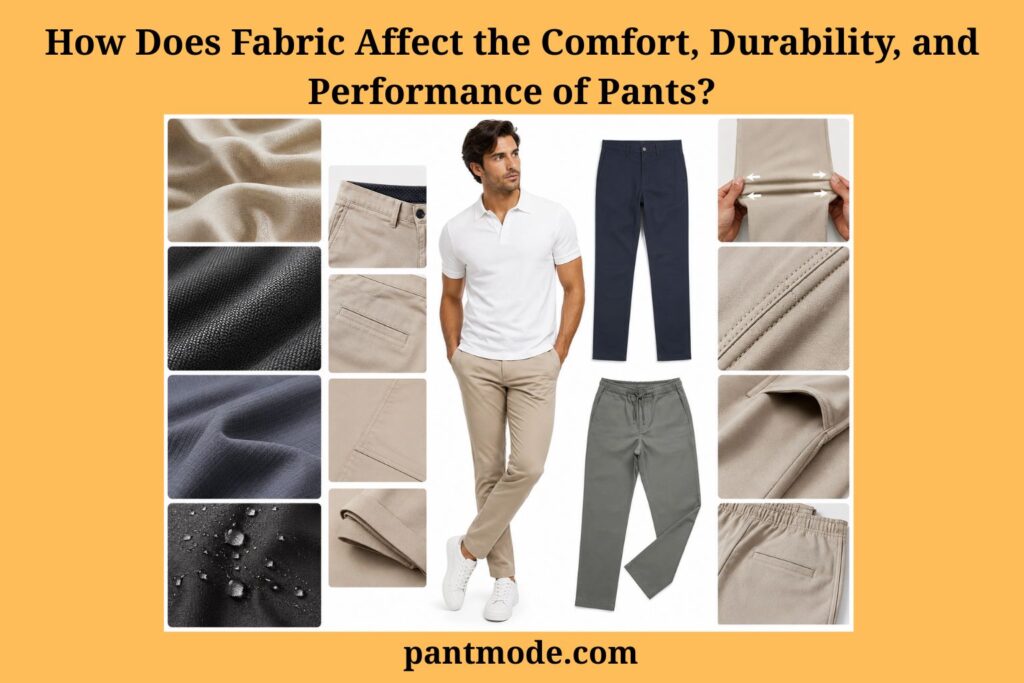
How Does Fabric Affect the Comfort, Durability, and Performance of Pants?
Pants fabric affects the comfort, durability, and performance of pants because fiber content, fabric weight, textile construction, stretch recovery, finishing, and care requirements influence how trousers behave in real use.
Fabric choice should begin with the use case. Place the fabric decision inside the wider buying factors framework, then match the textile system to activity, climate, movement, abrasion, appearance, and maintenance.
Fiber name alone is not enough. Cotton, linen, wool, nylon, polyester, and elastane can behave differently depending on yarn, weight, density, weave or knit structure, stretch mechanism, recovery, finishing, garment construction, and care.
No single pants fabric is best for every activity. The practical sequence is activity → climate → construction → performance → care.
Quick Answer
Pants fabric affects comfort, durability, and performance through fiber content, textile construction, fabric weight, density, stretch, recovery, surface stability, moisture behavior, finishing, and care requirements.
Lightweight or more open constructions may support warm-weather comfort, structured fabrics may suit demanding use, and stretch blends may improve mobility when recovery is also adequate. The correct pants fabric depends on the complete textile system and use case rather than fiber name alone.
Definition
Pants fabric is the textile system used to make trousers, including its fiber content, yarn characteristics, weave or knit structure, fabric weight, density, stretch, recovery, finishing, and care behavior. It affects how pants feel, move, drape, resist wear, retain shape, and respond to maintenance.
Key Takeaway
Choose pants fabric by matching the textile system to the activity and climate, then confirm construction, weight, stretch, recovery, durability requirements, appearance, functional finishes, and care instructions.
Figure: real performance comes from fiber, yarn, construction, recovery, finishing, use, and care together.
Why Does Pants Fabric Influence Comfort, Durability, and Overall Performance?
Pants fabric influences comfort, durability, and overall performance because fiber type, weight, yarn characteristics, weave or knit construction, finishing, and garment use interact in real wear.
Fiber type is only one variable. Yarn structure, density, weight, finishing, cut, and activity can change how the same fiber feels and performs.
Two cotton fabrics can behave very differently. A lightweight cotton plain weave may feel lighter and allow more air movement, while a dense cotton twill may provide greater structure and a firmer surface. Both are cotton, but construction changes drape, airflow, moisture behavior, and abrasion exposure.
Heavier construction can add structure without guaranteeing durability. Weight alone does not prove fiber strength, yarn quality, weave quality, seam strength, or lifespan.
Lightweight construction can support thermal comfort without guaranteeing breathability. Airflow also depends on openness, density, moisture behavior, fit, and environmental conditions.
Canvas can suit rugged use, lighter linen constructions can suit warm-weather casual use, wool constructions can support dress trousers, and technical synthetic fabrics can support movement-focused use. The appropriate pant type still changes the textile requirement.
Fiber-source boundary: the University of Georgia fiber guide is used only for fiber-level characteristics. Construction relationships in this article are practical textile guidance rather than claims attributed to that source.
Comfort vs Durability Comparison Table
| Fabric Direction | Comfort Potential | Durability Potential | Main Trade-Off | Typical Use Direction |
|---|---|---|---|---|
| Lightweight linen | Often comfortable in warm conditions | Construction-dependent | Wrinkling | Warm-weather casual wear |
| Cotton twill | Familiar hand and moderate comfort | Often useful for everyday wear | Can retain moisture | Chinos and casual/work wear |
| Dense denim | Structured feel | Often suited to repeated wear | Weight and stiffness | Casual and rugged use |
| Wool fabric | Drape and thermal versatility | Construction-dependent | Care sensitivity | Office and dress trousers |
| Nylon fabric | Lightweight potential | Strong fiber-level abrasion properties | Can feel technical | Outdoor and travel use |
| Polyester fabric | Easy-care potential | Useful wear and shape-retention properties | Comfort varies by construction | Travel and performance |
| Stretch blend | Mobility potential | Depends on base fabric and recovery | Elastic component can degrade | Commuter and fitted trousers |
Which Pants Fabric Properties Support Breathability, Stretch, and Recovery?
The pants fabric properties that support breathability, stretch, and recovery include fabric weight, openness, fiber behavior, weave or knit construction, stretch mechanism, and recovery quality.
Airflow depends on construction rather than fiber name alone. Lighter or more open fabrics may support airflow, while density, weave or knit openness, moisture behavior, garment fit, and environmental conditions also affect thermal comfort.
Linen, lightweight cotton, tropical-weight wool, and technical fabrics can all work in warm conditions depending on construction. No universal breathability ranking should be inferred from fiber name alone.
Stretch can come from mechanical construction, knit structure, elastomeric fibers, or fabric geometry. Elastane percentage alone does not prove stretch amount, stretch direction, four-way stretch, comfort, recovery, or durability.
Recovery is separate from stretch. A fabric can move far yet return poorly toward its original dimensions. Poor recovery may contribute to knee bagging or seat sagging, but cut, repeated bending, fabric quality, and pants fit also matter.
Figure: stretch supports movement; recovery helps the knees, seat, and silhouette return after movement.
Breathability, Stretch, and Recovery Comparison Table
| Material / Construction | Airflow Potential | Stretch Potential | Recovery Potential | Main Boundary |
|---|---|---|---|---|
| Lightweight linen | Often high in open/light constructions | Low natural stretch | Limited | Depends on weave and weight |
| Lightweight wool | Can support airflow in suitable construction | Usually limited unless engineered | Often useful shape recovery | Construction-dependent |
| Lightweight cotton | Moderate to good depending on weave | Limited unless blended or engineered | Varies | Can retain moisture |
| Cotton stretch blend | Construction-dependent | Moderate | Quality-dependent | Elastane percentage alone is insufficient |
| Nylon stretch blend | Construction-dependent | Moderate to high | Often designed for movement | Finished performance varies |
| Polyester stretch blend | Construction-dependent | Moderate to high | Construction-dependent | Surface and comfort vary |
| Knit fabric | Highly variable | Often higher than rigid woven fabric | Variable | Knit structure controls behavior |
| Mechanical-stretch woven | Construction-dependent | Moderate | Can be stable | Must be judged in actual garment |
How Do Weave, Yarn, Density, and Fabric Weight Affect Pants Fabric Durability?
Weave, yarn, density, and fabric weight affect pants fabric durability because textile structure influences surface stability, abrasion behavior, tear behavior, drape, and repeated-wear performance.
Dense structures may provide more surface stability and material against rubbing. Density alone does not prove quality or abrasion resistance.
Twill is a common structured direction for chinos and workwear. Performance still depends on fiber, yarn, weight, finishing, seams, and real use.
Canvas is a rugged construction direction. It can support demanding wear, though greater structure may reduce drape and increase weight.
Weight is not a durability score. A heavier textile can feel more substantial, while fiber strength, yarn construction, density, finishing, seam quality, abrasion exposure, and maintenance still determine performance.
Reinforced woven systems are designed for demanding use. Ripstop-style grids may be designed to help control tear spread, but product-specific testing is required for quantified tear claims.
Fabric Construction and Durability Table
| Construction Feature | Potential Effect | Typical Direction | Boundary |
|---|---|---|---|
| Dense twill | Structured surface and useful wear resistance | Chinos and workwear | Density alone does not prove quality |
| Canvas | Rugged structure | Workwear | Can reduce drape and increase weight |
| Reinforced woven construction | Designed for demanding use | Outdoor and utility pants | Performance needs product-specific evidence |
| Ripstop-style grid | Designed to help limit tear spread | Outdoor and utility use | Do not infer universal tear-test superiority |
| Lightweight open weave | Can support airflow | Warm-weather use | Usually prioritizes comfort over ruggedness |
| Knit structure | Can support mobility | Active and lounge pants | Recovery and pilling vary |
| Higher fabric weight | More material and structure | Cold-weather or rugged styles | Weight alone does not guarantee durability |
Which Pants Fabric Blends Work Best for Different Performance Needs?
The pants fabric blends that work best for different performance needs are the textile systems that match activity, climate, movement, abrasion exposure, appearance, and care requirements.
“Best” means best matched to the task. Outdoor walking may favor technical woven nylon or polyamide and suitable stretch blends for mobility and wear exposure without implying waterproofness or DWR.
High-mobility activities may favor lightweight stretch knits or woven fabrics. Cycling and commuting benefit from knee mobility plus recovery. Office trousers often prioritize wool, wool blends, cotton twill, or refined performance fabrics whose surface suits the intended pant occasion.
Travel often rewards recovery and manageable care. Hot climates can suit lightweight linen, cotton, tropical-weight wool, or breathable blends depending on construction. Workwear can favor dense twill, canvas, or reinforced construction when friction is high.
Activity-to-Fabric Decision Matrix
| Activity | Fabric Direction to Consider | Primary Benefit | Main Warning |
|---|---|---|---|
| Hiking / outdoor walking | Technical woven nylon/polyamide or suitable stretch blend | Mobility and wear resistance | Do not infer waterproofness |
| Running / high movement | Lightweight stretch knit or woven fabric | Mobility and drying potential | Avoid weak recovery |
| Bike commute | Stretch woven or structured blend | Movement and shape retention | Watch knee bagging |
| Office | Wool, wool blend, cotton twill, refined performance fabric | Drape and polish | Avoid excessive technical shine |
| Travel | Synthetic or blended stretch fabric | Recovery and manageable care | Check comfort and care label |
| Hot climate | Lightweight linen, cotton, wool, or suitable blend | Thermal comfort | Construction matters |
| Workwear | Dense twill, canvas, suitable reinforced construction | Abrasion demands | Weight alone is insufficient |
| Lounge | Soft knit or cotton blend | Comfort | Weak recovery may cause bagging |
How Can You Diagnose and Reduce Common Pants Fabric Failures?
You can diagnose and reduce common pants fabric failures by matching visible problems such as pilling, shrinkage, knee bagging, surface abrasion, fading, lost stretch, or reduced finish performance to likely textile, use, and care factors.
Pilling has multiple contributors. Friction, fiber characteristics, yarn construction, surface instability, laundering, and garment use can all contribute.
Shrinkage can involve fiber behavior, finishing, heat, agitation, moisture, and care mismatch. Follow the actual care label rather than a universal wash-temperature rule.
Knee bagging can reflect recovery, repeated bending, cut, stretch system, and fabric structure. Evaluate recovery and movement room together.
Lost stretch may involve heat, wear, chemical exposure, or elastic degradation. Avoid treatments prohibited by the garment instructions instead of using universal elastane rules.
DWR is a surface-repellency finish, not automatic waterproofing. Dirt, contamination, wear, and finish degradation may reduce beading. For DWR and other functional pants features, follow manufacturer-specific maintenance rather than a universal heating or re-treatment process.
Fabric Failure Troubleshooting Table
| Problem | Possible Contributors | Safer Response |
|---|---|---|
| Pilling | Fiber, yarn, friction, surface behavior, laundering | Review construction and care |
| Shrinkage | Fiber, finishing, heat, agitation, care mismatch | Follow actual care label |
| Knee bagging | Recovery, cut, stretch system, repeated bending | Compare recovery and fit |
| Lost stretch | Heat, wear, chemical exposure, elastic degradation | Follow stretch-garment care instructions |
| Fading | Dye, laundering, light, abrasion | Follow care guidance and reduce unnecessary exposure |
| Abrasion | Friction or unsuitable construction | Choose fabric suited to use |
| Reduced DWR performance | Finish condition, contamination, or wear | Follow manufacturer instructions |
| Wrinkling | Fiber and construction characteristics | Choose according to wrinkle tolerance |
How Should Different Pants Fabric Types Be Washed and Maintained?
Different pants fabric types should be washed and maintained according to the garment care label, fiber behavior, construction, color, stretch system, functional finish, and manufacturer instructions.
The garment label controls maintenance. The FTC care-label guidance is used here only for care instructions, washing or dry-cleaning directions, warnings, and care-method communication.
Cotton twill, linen, wool, stretch blends, nylon, polyester, DWR-treated fabrics, and denim can all require different treatment depending on the finished garment. Not all cotton uses the same wash method, not all wool requires dry cleaning, and no universal elastane temperature or DWR reactivation rule should override the label.
Fabric-Specific Care Matrix
| Fabric Direction | Primary Care Principle | Main Risk | Boundary |
|---|---|---|---|
| Cotton twill | Follow garment care label | Shrinkage and fading | Do not invent universal temperature |
| Linen | Follow label and accept natural wrinkling | Creasing and possible shrinkage | Construction varies |
| Wool | Follow exact garment instructions | Felting, shrinkage, or shape change | Not all wool requires identical care |
| Stretch blend | Avoid treatment prohibited by label | Elastic degradation | Fiber percentage alone is insufficient |
| Nylon / polyester | Follow garment or technical-care instructions | Heat or finish damage | Construction varies |
| DWR-treated fabric | Follow manufacturer technical-care directions | Finish-performance loss | No universal reactivation rule |
| Denim | Follow label and product construction | Fading, shrinkage, stretch loss | Raw and stretch denim differ |
What F50 Checks Verify the Right Pants Fabric for Comfort, Durability, and Performance?
F50 checks verify the right pants fabric for comfort, durability, and performance by turning use case, climate, construction, stretch, recovery, wear risk, care requirements, and finish boundaries into a controlled decision path.
Trigger: identify whether the main need is thermal comfort, mobility, durability, abrasion resistance, moisture behavior, recovery, easy care, polish, or a functional finish.
Classification: classify activity, climate, abrasion exposure, stretch need, recovery need, appearance, and care tolerance.
Recommendation: match the textile direction to the classified requirement rather than choosing by fiber name alone.
Red flag: catch unsuitable weight, poor recovery, excess technical shine, fabric/activity mismatch, care-label conflict, DWR misunderstanding, and fiber-name-only assumptions.
Exception: allow unusual fabric choices when the real use case supports them.
Verification: approve the fabric only when activity, climate, construction, stretch, recovery, durability, moisture behavior, finish limits, and realistic maintenance make sense together.
Figure: the F50 path verifies use case, climate, structure, recovery, finish boundaries, and realistic care.
F50 Pants Fabric Decision-Control Table
| F50 Step | Control Question | Pass Standard |
|---|---|---|
| Trigger | Is there a specific use case or fabric problem? | Need or failure is identified |
| Classification | What climate, activity, movement, wear, and care needs exist? | Fabric requirement is classified |
| Recommendation | Which textile direction fits those requirements? | Recommendation matches primary need |
| Red Flag | Is there weak recovery, wrong weight, finish confusion, care conflict, or construction mismatch? | Risk is removed or bounded |
| Exception | Does the context justify an unusual fabric choice? | Exception is explained |
| Verification | Do comfort, construction, recovery, durability, finish, and care checks pass? | Fabric is acceptable |
| Source Scope | Are UGA and FTC used only within their evidence limits? | No source stretching |
| URL Validation | Are all internal links Pant Factors only? | No self-link, /pant-types/, or invented URL |
What Final Checklist Helps You Choose and Maintain the Right Pants Fabric?
A final checklist helps you choose and maintain the right pants fabric by testing activity, climate, construction, stretch, recovery, durability demands, finish behavior, care requirements, and maintenance tolerance.
Check climate and activity first, then construction, stretch direction, recovery, friction exposure, functional finishes, and care burden. Do not use fiber name, GSM, elastane percentage, or DWR as a shortcut for complete performance.
Ultimate Pants Fabric Care Checklist
| Care Check | Pass / Fail |
|---|---|
| Have I read the garment care label? | |
| Can I realistically follow the required cleaning method? | |
| Have I avoided inventing a universal wash temperature? | |
| Have I checked whether heat is restricted? | |
| Have I considered stretch-fiber sensitivity? | |
| Do technical finishes require manufacturer-specific instructions? | |
| Have I separated DWR care from generic washing advice? | |
| Do I understand the fabric’s wrinkle tendency? | |
| Do I understand possible fading or pilling trade-offs? | |
| Does the maintenance burden fit my routine? | |
| Am I following the actual garment rather than a generic fiber rule? |
Final Pants Fabric Selection Checklist
| Selection Check | Pass / Fail |
|---|---|
| Have I identified the primary use case? | |
| Have I identified the climate? | |
| Have I considered expected abrasion? | |
| Am I evaluating construction, not fiber name alone? | |
| Is the fabric weight appropriate? | |
| Is the density appropriate? | |
| Does the weave or knit suit the activity? | |
| Does the fabric provide enough mobility? | |
| Does the stretch direction match the movement need? | |
| Does the fabric recover after bending? | |
| Does the moisture behavior suit the activity? | |
| Is a functional finish present? | |
| Do I understand what that finish does? | |
| Have I avoided treating DWR as waterproofing? | |
| Have I avoided judging stretch by elastane percentage alone? | |
| Have I avoided judging durability by weight alone? | |
| Can I follow the care label realistically? | |
| Is the maintenance burden acceptable? | |
| Is this pants fabric appropriate for my comfort, durability, performance, appearance, and care needs? |
What Final Rule Should Guide Pants Fabric Selection?
The final rule for pants fabric selection is to choose the textile system that matches the activity, climate, movement, durability, appearance, and care requirements before trusting fiber name alone.
Confirm activity, climate, comfort, fiber, yarn, construction, weight, density, stretch, recovery, abrasion exposure, moisture behavior, functional finishes, and care as one connected decision.
No universal best fiber, weight, stretch percentage, or breathability winner exists. DWR is not automatic waterproofing, and the garment care label should control maintenance.
The best pants fabric is the textile system that feels comfortable, performs for the intended activity, handles the expected wear, and can be maintained according to the garment’s real care requirements.