
Do High-Rise Pants Create the Illusion of Longer Legs?
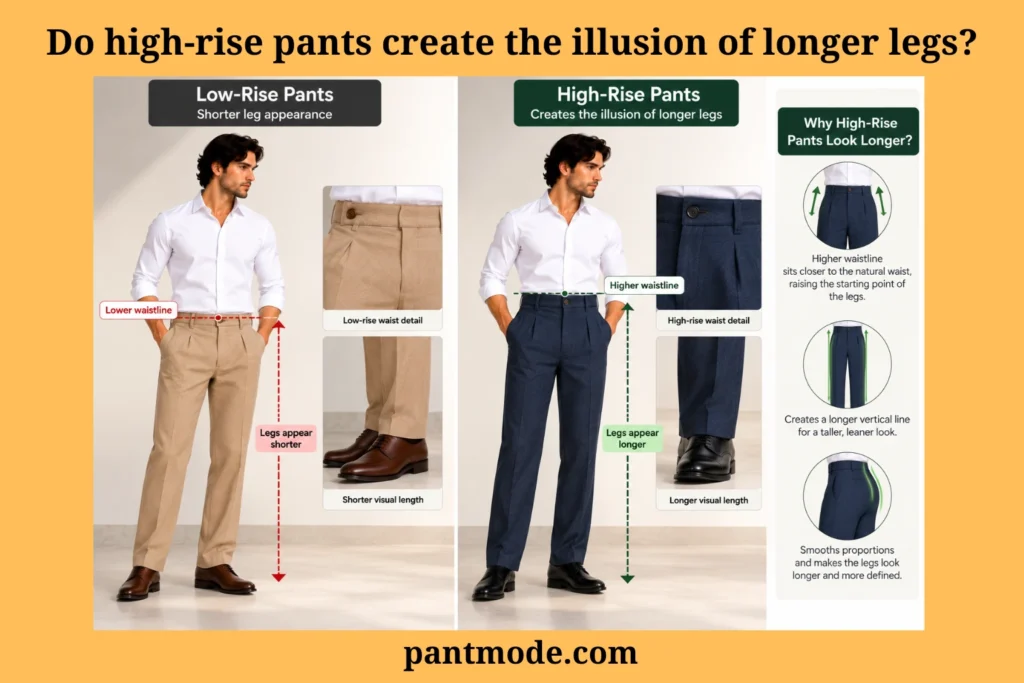
Yes. High-rise pants can create the illusion of longer legs when a clearly higher visible waistband shifts the perceived starting point of the lower body upward and increases the apparent vertical proportion assigned to the legs.
The effect is visual and conditional. It does not physically lengthen the legs, increase inseam, change anatomy, or increase actual height.
Within PantMode’s pant fit and detail features, this effect should be evaluated as a controlled visual-proportion mechanism rather than a universal styling rule.
Quick Answer
High-rise pants can make the legs appear longer when a clearly higher waistband shifts the perceived beginning of the trouser-covered lower body upward. This can increase the apparent vertical proportion assigned to the legs. The effect is visual and conditional; it does not change anatomical leg length, inseam, or height.
Definition
Longer-leg illusion: a perceived increase in the proportion of the visible figure assigned to the legs or lower body.
Perceived leg start: the visually inferred upper beginning of the lower-body region, not the anatomical origin of the leg.
Apparent lower-body span: the visible vertical region the eye reads as belonging to the lower body.
Visible waistband boundary: the readable upper edge of the trouser region.
Key Takeaway
The rise-driven effect begins with a readable higher trouser boundary—not with an actual change to the body or physical leg length.
How Can High-Rise Pants Create the Illusion of Longer Legs?
The mechanism begins when the visible upper boundary of the trouser moves higher. If that boundary remains clearly readable, the eye can assign a larger vertical portion of the visible figure to the trouser-covered lower body.
That higher apparent starting point can make the lower-body region seem longer relative to the visible torso region. PantMode treats this as a visual-proportion synthesis rather than a guaranteed outcome.
The direct parent category, high-rise pants, describes the higher-rise garment type. The longer-leg illusion is a separate perceptual consequence that must be observed rather than assumed from the label alone.
What Is the Difference Between Actual and Perceived Leg Length?
Actual leg length is anatomical, while perceived leg length is a visual interpretation affected by the boundaries and proportions presented by clothing.
| Variable | Physical or Visual? | Changed by Rise? |
|---|---|---|
| Anatomical leg length | Physical | No |
| Inseam | Garment measurement | Not by rise alone |
| Perceived leg start | Visual | Potentially |
| Apparent lower-body span | Visual | Potentially |
| Longer-leg illusion | Visual | Potentially |
The distinction is important because high-rise measurement concerns physical garment dimensions and rise classification, while this page concerns how a visible boundary can alter perceived proportion.
How Does the Higher Waistband Boundary Change Visual Proportion?
The waistband can change visual proportion because it establishes the readable upper edge of the trouser-covered region at a different vertical position.
Threads demonstrates that a pant waistline can be deliberately altered upward during pattern construction. Its guidance on raising the trouser waistline supports the construction premise that waistline position is a controllable garment boundary.
Threads does not establish the longer-leg illusion itself. The connection between a higher boundary and a perceived lower-body start is PantMode’s visual-analysis synthesis.
How Can a Higher Boundary Shift Perceived Leg Start?
When the trouser boundary moves higher and remains visually readable, the eye can interpret a larger portion of the visible figure as belonging to the lower body.
The perceived leg start is not the anatomical hip joint or femur origin. It is the visually inferred upper beginning of the lower-body region created by the garment’s visible segmentation.
Higher Visible Boundary → Potentially Higher Perceived Lower-Body Start
Why Can a Higher Perceived Start Make the Legs Look Longer?
A higher perceived lower-body start can make the leg region appear longer because more visible vertical space is grouped into the lower-body segment.
The Gestalt principle of visual continuity describes how visual elements can be grouped into continuous lines or paths. PantMode applies that general perception principle to trouser boundaries and vertical proportion.
The source does not directly test high-rise pants. It supports the broader visual principle, while the trouser-specific causal model remains PantMode synthesis.
How Does the Effect Compare Across Low-, Mid-, and High-Rise Pants?
The rise effect can be compared by changing waistband height while keeping major visual variables as similar as possible.
| Rise | Boundary Position | Perceived Start | Potential Apparent Span |
|---|---|---|---|
| Low | Lower | Lower | Shorter |
| Mid | Intermediate | Intermediate | Intermediate |
| High | Higher | Higher | Longer |
| High, waistband hidden | Weak visual cue | Unclear | Effect may weaken |
Which Variables Must Be Controlled Before Attributing the Effect to Rise?
Rise can be treated as the main visual variable only when competing factors are controlled closely enough that they do not explain the result instead.
| Variable | Why It Must Be Controlled |
|---|---|
| Subject or mannequin | Different proportions alter the baseline |
| Pose | Changes visible proportions |
| Camera / viewpoint | Perspective can lengthen or shorten apparent segments |
| Silhouette | Leg geometry modifies visual flow |
| Leg width | Changes lower-body shape |
| Hem length | Changes the lower endpoint |
| Footwear | Can add an independent vertical cue |
| Upper-garment boundary | Can hide or replace the trouser boundary |
| Waistband visibility | Determines whether the rise cue remains readable |
How Does Trouser Silhouette Modify the Longer-Leg Effect?
Trouser silhouette can strengthen, soften, or redirect the vertical reading below the waistband, but silhouette remains a secondary modifier rather than the source of the rise-driven mechanism.
For example, straight-leg pants can provide a relatively continuous leg line, but that line is separate from the effect created by moving the upper trouser boundary.
The same principle applies to relaxed and classic fit. A looser fit can change the visible lower-body geometry, but it does not itself define the rise-driven perceived starting point.
Silhouette = Secondary Modifier
Which Modifiers Can Strengthen or Weaken the Illusion?
| Modifier | Effect on Main Cue |
|---|---|
| Visible waistband | Strengthens the boundary |
| Hidden waistband | Weakens the boundary |
| Smooth waist/hip fit | Keeps the boundary readable |
| Fit distortion | Adds competing signals |
| Continuous trouser line | Supports visual flow |
| Strong horizontal interruption | Breaks continuity |
| Different hem | Changes the lower endpoint |
| Different footwear | Creates another vertical cue |
| Different camera angle | Changes perspective independently |
Why Might High-Rise Pants Fail to Create the Effect?
High-rise pants may fail to create a clear longer-leg illusion when the waistband boundary is hidden, visually weak, distorted, or overshadowed by another changed variable.
| Failure | Cause | Correction |
|---|---|---|
| Waist hidden | Upper boundary is unreadable | Expose or identify the trouser boundary for comparison |
| Small rise difference | Weak causal change | Compare clearer rise categories |
| Different hem | Lower endpoint changed | Match hem length |
| Different silhouette | Competing geometry | Match silhouette |
| Different footwear | Lower visual endpoint is confounded | Match footwear |
| Camera difference | Perspective changed | Standardize viewpoint |
| Fit distortion | Wrinkles or pulling add visual noise | Control fit quality |
Which High-Rise Pants Best Support the Longer-Leg Illusion?
The strongest candidates are pants whose waistband is clearly higher than the comparison garment and remains visually readable without major confounding variables.
| Selection Signal | Why It Matters |
|---|---|
| Clear rise difference | Creates a meaningful boundary change |
| Readable upper boundary | Allows the eye to identify the new starting point |
| Comparable silhouette | Reduces shape confounding |
| Controlled hem | Keeps the lower endpoint stable |
| Limited horizontal interruptions | Supports vertical continuity |
| Observed upward perceived start | Confirms the mechanism is actually visible |
| Observed increase in apparent lower-body span | Supports the final longer-leg impression |
How Can the Longer-Leg Illusion Be Tested?
A controlled comparison is the best way to determine whether the effect is genuinely rise-driven rather than caused by another visual variable.
What Checklist Confirms a Genuine Rise-Driven Effect?
Perceptual Boundary
Observed Effect
Comparison Controls
Claim Boundaries
Frequently Asked Questions About High-Rise Pants and Longer-Looking Legs
They can. A higher visible waistband can shift the perceived lower-body starting point upward and make the leg region appear proportionally longer.
No. The effect is visual only.
No. Rise and inseam are separate garment dimensions.
It creates a visible boundary that helps define where the trouser-covered lower body appears to begin.
No. Waist visibility, silhouette, fit, hem, pose, and viewpoint can alter the result.
What Final Rule Should Guide the Longer-Leg Illusion Test?
Change the rise, control the competing visual variables, and then judge whether the perceived lower-body starting point and apparent vertical span actually changed. If silhouette, hem, footwear, pose, or camera viewpoint also changed, the entire result should not be attributed to rise.
High-rise pants can create longer-looking proportions when a genuinely higher and visually readable waistband shifts the perceived beginning of the lower body upward.
The effect is perceptual rather than anatomical. It does not increase inseam, physical height, or actual leg length. Its strength depends on whether the higher boundary remains readable and whether competing variables such as silhouette, hem, footwear, fit distortion, pose, and camera viewpoint are controlled.
The strongest conclusion therefore comes from a controlled comparison in which rise changes while the other major visual variables remain comparable.