
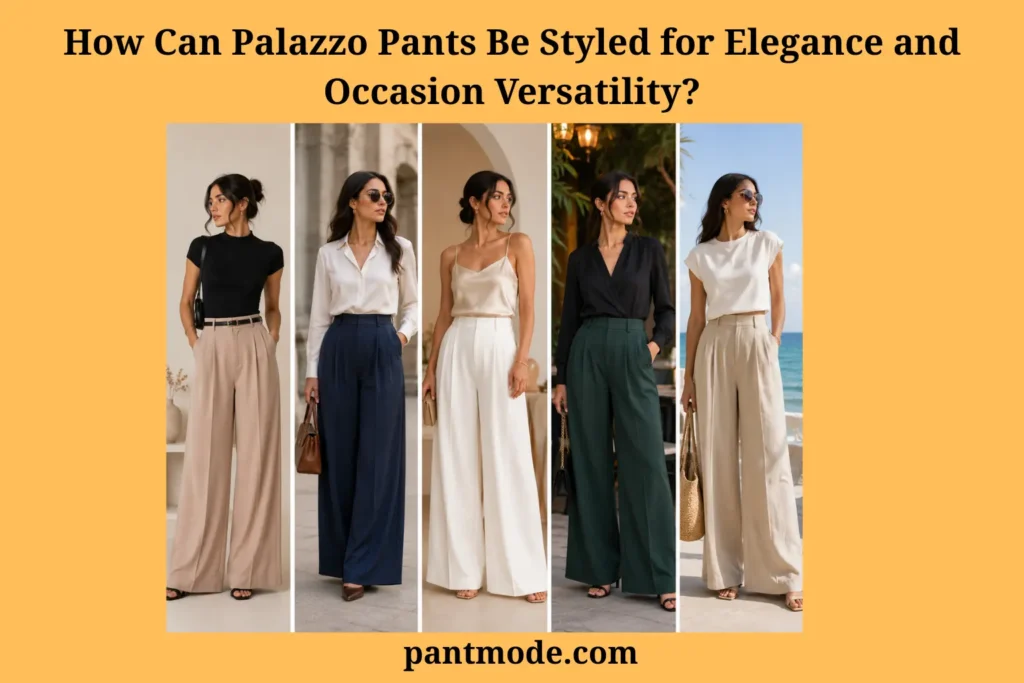
How Can Palazzo Pants Be Styled for Elegance and Occasion Versatility?
Palazzo pants can be styled for elegant and versatile outfits by matching their flowing leg volume with fabric behavior, top proportion, waist placement, footwear, hem length, and the formality of the occasion.
They can work for casual, professional, resort, smart-casual, and evening settings without requiring one fixed formula. A high rise, fitted top, tuck, or heel can be useful in some outfits, but none is mandatory.
Palazzo sits within the broader wide and flared pant types family, yet its styling challenge is specific: substantial continuous leg width and drape create more movement, so fabric, upper-body scale, footwear, and hem must work together.
PantMode Palazzo Styling Framework
Use one connected sequence rather than copying a fixed outfit.
Quick Answer
Palazzo pants can be styled for casual, professional, resort, smart-casual, and evening settings by coordinating their wide flowing silhouette with the right fabric behavior, top proportion, waist treatment, footwear, and hem length. Fluid fabrics create more movement, structured fabrics create a cleaner outline, and the top can be fitted, tucked, cropped, relaxed, or oversized when its proportions are intentional. Heels are optional; the hem should be fitted to the footwear actually worn.
Definition
Palazzo pants styling is the process of balancing their generous continuous leg width with fabric drape, waist placement, upper-body volume, layers, footwear, hem length, and occasion requirements.
Which Palazzo Design Features Control the Styling Effect?
Palazzo styling begins with continuous leg volume, fabric drape, rise placement, waistband construction, and hem length because these features determine how the garment moves and balances with the rest of the outfit.
How Does Continuous Leg Volume Create the Palazzo Styling Baseline?
Palazzo trousers carry generous width through much of the leg, so the silhouette reads as broad and sweeping rather than widening only near the hem. That width creates the styling baseline: tops, layers, and shoes are judged against a large moving lower-body shape rather than a narrow leg.
The deeper classification of the Palazzo silhouette belongs to PantMode’s mapped definition page; this styling guide uses only the anatomy needed to make outfit decisions.
How Does Drape Change the Palazzo Silhouette?
Fluid drape produces softer folds and more visible movement. Firmer structure preserves a sharper outline and can reduce how much the leg collapses into folds. Neither behavior is inherently better: the useful choice depends on the intended occasion and silhouette.
How Does Rise Placement Change Waist and Leg Proportion?
A higher visible waist may create a stronger waist break and assign more visual area to the lower body. A mid rise can create a more neutral torso-to-leg division. Comfort, torso proportion, waistband depth, and top length should decide whether either effect is useful.
Why Does Hem Length Become Important With Wider Palazzo Legs?
Because the leg opening is broad, excess inseam can create dragging and repeated pooling, while a full-length hem that is too short can interrupt the intended sweep. Final hemming should therefore be checked with the footwear actually intended for the outfit.
Palazzo Styling Baseline
Volume → Drape → Waist → Hem → Outfit. Read these as one system rather than separate styling tricks.
How Should Fabric Behavior Guide Palazzo Pants Styling?
Fabric behavior should guide Palazzo pants styling because drape, structure, opacity, weight, surface finish, and wrinkle behavior determine how the same wide silhouette reads in different settings.
Which Properties Support Professional Palazzo Styling?
Professional use usually benefits from controlled drape, sufficient structure, dependable opacity, a stable waistband, restrained wrinkle behavior, and clean finishing. Crepe constructions, refined suitings, and stable woven blends are examples, not requirements.
Which Properties Support Evening Palazzo Styling?
Evening styling can use fluid movement, a refined surface, deliberate drape, and sufficient coverage. Silk fabrics, satin-weave fabrics, fluid crepes, and lined chiffon-type constructions can support that direction when the total garment and dress code are appropriate. Satin is a weave/surface direction, not a fiber.
Which Properties Support Casual and Resort Palazzo Styling?
Casual and resort outfits often prioritize breathability, easy movement, lighter construction, and a comfortable hand. Linen, cotton, breathable blends, and fluid cellulosic fabrics can work, but opacity and finishing still need to be checked.
Why Should Fabric Name Alone Not Determine Formality?
Formality depends on more than fiber name. Surface finish, weave or knit construction, weight, drape, opacity, lining, wrinkle behavior, waistband quality, seam finish, and surrounding garments all change the result.
New Mexico State University’s Making Perfect Pants supports evaluating style, fabric, fit, drape, ease, waistband comfort, and silhouette-related length. Its older figure-type advice is not used here as a universal modern styling rule.
Palazzo Fabric & Occasion Matrix
| Fabric Behavior | Example Direction | Strong Use Cases | Drape | Opacity / Lining | Main Trade-Off |
|---|---|---|---|---|---|
| Controlled + polished | Crepe or refined suiting | Professional, smart-casual | Controlled | Usually stronger coverage | Less sweep |
| Fluid + refined | Silk fabric, satin weave, fluid crepe | Evening | High | Verify coverage | More care |
| Lightweight + breathable | Linen, cotton, breathable blends | Resort, casual | Relaxed | Varies | Wrinkle potential |
| Very fluid + sheer | Chiffon-type construction | Layered evening | Very high | Lining often needed | Transparency |
How Can Palazzo Pants Be Styled Across Casual, Professional, Resort, Smart-Casual, and Evening Occasions?
Palazzo pants can move across casual, professional, resort, smart-casual, and evening occasions when fabric, top structure, layering, footwear, and hem length support the requirements of each setting.
For broader professional comparisons beyond Palazzo-specific styling, see wide-leg pants.
How Can Palazzo Pants Work in Polished Casual Outfits?
Use relaxed but controlled fabric with a clean tee, simple knit, casual blouse, or relaxed shirt. Sneakers, loafers, flats, or sandals can work when the hem is fitted to them. The priority is ease that still looks intentional.
How Should Palazzo Pants Be Styled for Professional Settings?
Use controlled drape, sufficient opacity, clean front construction or controlled pleating, and a polished shirt, blouse, or fine knit. A blazer can add structure when the workplace calls for it. The actual dress code still determines whether the outfit is appropriate.
How Can Palazzo Pants Work for Resort and Warm-Weather Dressing?
Breathable, lighter constructions and fluid movement work well with sleeveless tops, relaxed shirts, or lightweight knitwear. Sandals or espadrille-type footwear can keep the lower line light, but opacity and sunlit transparency should still be checked.
How Can Palazzo Pants Work for Smart-Casual Styling?
Refined drape paired with a fine knit, tucked or structured shirt, and a short jacket can bridge ease and polish. Loafers, boots, or refined sneakers can work when the context allows them.
How Can Palazzo Pants Transition Into Evening or Formal-Leaning Outfits?
A refined surface, fluid drape, elegant blouse, camisole, shaped top, or tailored layer can create an elevated result. Refined flats, sandals, pumps, or heels are all possible; formality comes from the full outfit and dress code rather than shoe height alone.
Palazzo Occasion Outfit Formula Matrix
| Occasion | Palazzo Direction | Top | Layer | Footwear | Styling Priority |
|---|---|---|---|---|---|
| Casual | Relaxed fluid | Tee, knit, casual blouse | Optional | Sneakers, flats, sandals | Ease + proportion |
| Professional | Controlled / structured | Shirt, blouse, fine knit | Blazer | Loafers, pumps, flats | Polish + line |
| Resort | Lightweight / breathable | Sleeveless or relaxed top | Light overshirt | Sandals, espadrille-type shoes | Airflow + movement |
| Smart-casual | Refined fluidity | Knit or tucked shirt | Short jacket | Loafers, boots, refined sneakers | Balance |
| Evening | Fluid / refined | Elegant blouse or shaped top | Optional tailored layer | Refined flats, sandals, heels | Drape + finish |
How Should Tops, Tucking, and Waist Placement Balance Palazzo Volume?
Tops, tucking, and waist placement balance Palazzo volume by controlling how clearly the upper body is separated from the trousers and how much visual emphasis sits at the waist.
When rise placement is the main decision, compare the waistband and torso interaction with high-rise pants.
When Does a Fitted Top Create Useful Contrast?
A fitted top creates strong contrast with the generous Palazzo leg and can make the waist or trouser volume more visible. It is a styling option, not a requirement.
When Should a Top Be Tucked?
A full tuck creates the clearest waist definition, a partial tuck creates moderate emphasis, and an untucked top creates a longer, more relaxed torso line. Choose according to the outfit goal and comfort.
How Can Cropped Tops Change Palazzo Proportion?
A cropped top can reveal more waistband and shorten the upper visual block, which may increase lower-body emphasis. Dress code, comfort, and preferred coverage still matter.
Can Oversized Tops Work With Palazzo Pants?
Yes. Control top length, shoulder structure, fabric weight, footwear scale, and total visual volume so the combination looks deliberate rather than accidental.
How Can the Rule of Thirds Be Used Without Becoming a Rule?
An approximate one-third/two-thirds composition can be a visual styling technique, but it is not an ideal body ratio or a requirement. Longer upper proportions can be equally intentional.
Utah State University Extension’s design-principles guidance supports using balance, proportion/scale, emphasis, rhythm, and harmony to evaluate how clothing elements relate. It does not prove one top length or proportion formula is universally correct.
Top & Proportion Styling Matrix
| Styling Goal | Top Direction | Waist Visibility | Likely Effect | Boundary |
|---|---|---|---|---|
| Strong waist definition | Fitted / tucked | High | Clear upper/lower break | Optional |
| Relaxed elegance | Soft untucked | Low | More continuous flow | Length must be deliberate |
| More visible lower-body line | Cropped / tucked | High | More trouser emphasis | Not universally better |
| Fashion-forward volume | Oversized | Variable | Volume-on-volume | Must look intentional |
| Professional structure | Shirt or knit + blazer | Moderate/high | Controlled polish | Dress code matters |
How Should Jackets and Outer Layers Work With Palazzo Pants?
Jackets and outer layers work with Palazzo pants when their length, structure, and fabric weight support rather than accidentally compete with the trousers’ volume and movement.
How Should Footwear and Hem Length Work Together With Palazzo Pants?
Footwear and hem length should be planned together with Palazzo pants because shoe height, shoe volume, leg opening, and fabric drape determine whether the wide hem falls cleanly, pools, or drags.
How Can Flats Work With Palazzo Pants?
Loafers, pointed flats, ballet flats, sandals, and low-profile sneakers can all work when the hem is fitted around the chosen shoe height and the footwear suits the occasion.
How Can Heels Change the Palazzo Silhouette?
Heels change the shoe-to-hem height and may require a longer inseam. They can alter floor clearance and the visible lower line, but they are not required for elegance.
How Can Platforms or Chunkier Footwear Work With Wide Hems?
Their larger scale can visually support greater leg volume when that is intentional. The hem must be fitted to platform height rather than reused from a lower shoe.
How Should Evening Footwear Interact With Fluid Palazzo Fabric?
Refined flats, sandals, pumps, or heels can all work. Choose according to dress code, desired shoe visibility, material movement, and the exact hem.
Footwear & Hem Pairing Table
| Footwear Direction | Hem Interaction | Strong Uses | Styling Effect | Boundary |
|---|---|---|---|---|
| Refined flats | Floor-clearing / shoe-skimming | Work, smart-casual, evening | Understated polish | Heel not required |
| Sneakers | Clear floor, casual length | Casual | Relaxed contrast | Avoid dragging |
| Sandals | Full or cropped | Resort, casual | Lighter lower line | Shoe visibility varies |
| Pumps / heels | Hem fitted to heel height | Professional, evening | Taller shoe-to-hem setup | Optional |
| Platforms | Dedicated inseam needed | Casual, fashion-forward | Strong visual scale | Must be intentional |
How Can You Fix Common Palazzo Pants Styling and Fit Problems?
Common Palazzo styling problems are easier to fix when you identify whether the cause is hem length, front volume, waistband fit, fabric behavior, transparency, or competing outfit proportions.
What Should You Change When Palazzo Pants Drag or Bunch?
Check inseam, footwear height, pooling, and the intended full-length line. The primary fix is to hem for the footwear actually used rather than applying one universal clearance.
What Should You Change When the Front or Hip Area Has More Volume Than Desired?
Check pleat depth, pocket placement, fabric stiffness, sizing, and front construction. Controlled pleats, a cleaner front, softer drape, or different pocket construction can reduce unwanted fullness without treating all volume as a flaw.
What Should You Change When the Waistband Gaps or Pulls?
Check waist-to-hip fit, rise shape, waistband contour, and size. Gaping may need alteration; pulling can indicate insufficient ease or a poor base fit rather than a styling problem.
What Should You Change When the Top and Pants Feel Too Bulky Together?
Shorten or structure the top, tuck part of it, reduce one volume source, or keep both volumes when the oversized effect is deliberate.
What Should You Change When Palazzo Fabric Appears Too Sheer?
Check opacity in realistic lighting, then use lining, a suitable underlayer, a denser fabric, or intentional layered transparency. Lightweight fabric is not automatically sheer.
NMSU’s Clothing Construction Standards support checking ease, grainline, seams, hems, waist treatments, and construction quality. Those criteria help separate a styling issue from a genuine construction or fit problem.
Palazzo Styling Troubleshooting Guide
| Problem | Likely Cause | Adjustment | Boundary |
|---|---|---|---|
| Hem drags | Inseam too long for footwear | Re-hem for target shoe | No universal clearance |
| Excess front volume | Pleats, pockets, stiffness | Reduce or redirect fullness | Volume can be intentional |
| Waist gaps | Waist/hip mismatch | Alter or reassess fit | Not styling-only |
| Waist pulls | Insufficient ease / fit mismatch | Reassess size or construction | Do not hide with styling |
| Outfit feels bulky | Competing volume | Adjust top length or structure | Oversized may be deliberate |
| Fabric appears sheer | Low opacity | Add lining or underlayer | Lightweight ≠ always sheer |
| Silhouette collapses | Material too soft for goal | Choose more stability | Fluidity may still be desired |
How Can You Verify a Palazzo Pants Outfit Before Wearing It?
A Palazzo pants outfit is ready when its fabric, waist, upper-body proportion, layer, footwear, hem, and movement all support the same occasion and styling goal.
F50 Palazzo Styling Decision Control
| F50 Step | Control Question | Decision Standard |
|---|---|---|
| Trigger | What occasion and level of polish are required? | Define context first |
| Classification | What fabric behavior, front volume, waist treatment, layer, shoe, and hem are present? | Identify the outfit variables |
| Recommendation | Which combination best supports the occasion? | Coordinate variables instead of forcing one formula |
| Red Flag | Is the advice based on “always fitted,” “always high rise,” or “always heels”? | Reject universal styling shortcuts |
| Exception | Can a different top volume, rise, shoe, or fabric still serve the same goal? | Keep valid alternatives open |
| Verification | Do comfort, opacity, proportion, footwear, hem, and movement support the same result? | Keep, adjust, or rebuild |
Final Outfit Verification Checklist
Final Outfit Decision
Key Takeaway
Start with the occasion, then match the Palazzo fabric, waist treatment, top, layer, footwear, and hem to one clear styling goal. No fitted-top, high-rise, heel, or proportion formula is required for every outfit.
What Final Rule Should Guide Palazzo Pants Styling?
The final rule for styling Palazzo pants is to begin with the occasion and then make sure fabric behavior, waist treatment, upper-body volume, layering, footwear, and hem length all support the same outfit goal.
Fluidity can create sweep without guaranteeing formality; structure can create a cleaner line without guaranteeing professional suitability. Tops may be fitted or oversized, rises may be higher or lower, and shoes may be flat or elevated when the full outfit is coherent.
The strongest Palazzo outfit is not built from one required top, rise, shoe, or proportion formula; it is built when silhouette, fabric, proportion, footwear, and occasion work together intentionally.
What FAQ Questions Clarify Palazzo Pants Styling?
These FAQs address the most common decisions around tops, fabric, office styling, and footwear without turning Palazzo styling into rigid formulas.
Fitted, tucked, cropped, relaxed, and oversized tops can all work when their length and volume support the intended outfit proportion.
No. Fitted tops create stronger contrast, but relaxed and oversized tops can work when their scale, length, and fabric are intentional.
No fabric name guarantees formality. Refined surface, controlled or elegant drape, opacity, lining, finishing, and the rest of the outfit determine the result.
Use controlled drape, sufficient opacity, clean construction, a polished top, appropriate layering, and a hem fitted to professional footwear and the actual dress code.
Yes. Flats can look polished when the hem is fitted around their lower shoe height and the footwear suits the occasion.
Palazzo pants become versatile when the outfit is built from interacting decisions rather than one styling rule. Their continuous width and sweep make fabric behavior, waist treatment, top scale, layer length, footwear, and hem more important because each variable changes how the lower-body volume reads.
For casual, professional, resort, smart-casual, or evening use, start with the occasion, choose fabric behavior that suits it, then coordinate the top, waist, layer, shoe, and hem. The final test is simple: the outfit should feel comfortable, move cleanly, maintain suitable opacity, and communicate the intended level of polish.