
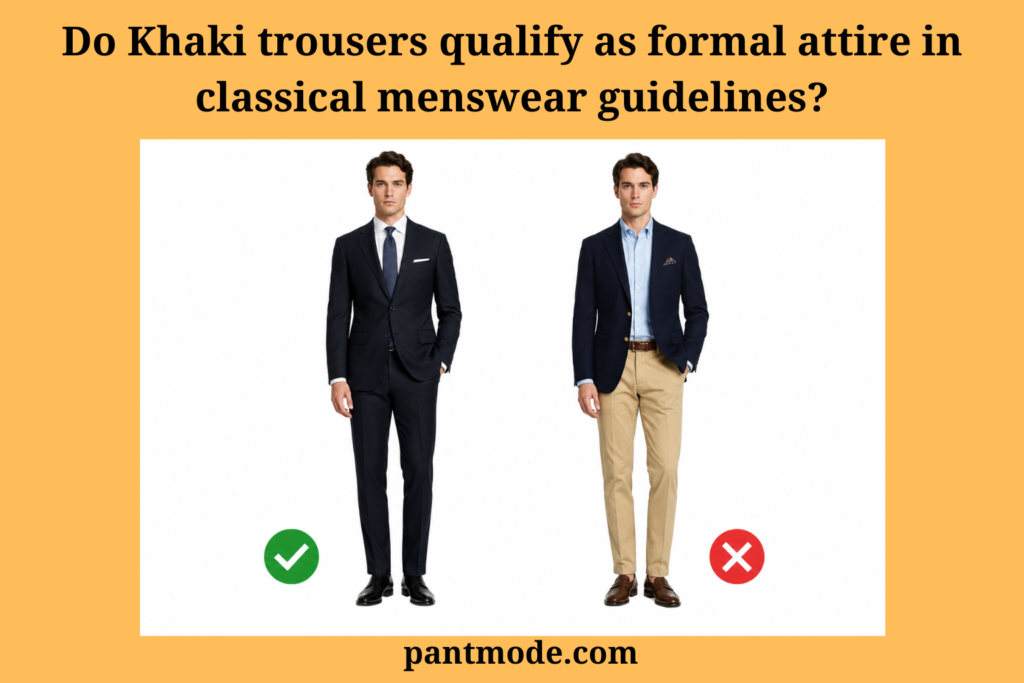
Do Khaki Trousers Qualify as Formal Attire in Classical Menswear?
Khaki trousers do not qualify as true formal attire in classical menswear because their cotton fabric, military utility history, and casual earth-tone identity place them below formal wool dress trousers.
Khaki trousers can look polished, but they remain outside strict formalwear. This guide explains dress-code rules, historical reasons, dressier khaki choices, correct styling, common mistakes, and a final wear/don’t-wear checklist using khaki features and the related chino formality as context.
Quick Answer: Do Khaki Trousers Qualify as Formal Attire?
No, khaki trousers do not qualify as true formal attire in classical menswear. They belong mainly in smart-casual, business-casual, country-casual, and refined daytime settings. Cotton twill khakis can look polished, but they cannot replace formal wool trousers, tuxedo trousers, or morning dress trousers.
Definition: Khaki Trouser Formality
Khaki trouser formality refers to the dress-code level that cotton khaki trousers can reach. Khakis sit above jeans and rugged casual pants when clean and tailored, but below wool dress trousers and formalwear because their cotton fabric, military utility history, and earth-tone identity remain casual.
Figure: khaki trousers sit in dressy-casual territory, not in strict formalwear.
What Determines Whether Khaki Trousers Qualify as Formal Wear in Classical Menswear Dress Codes?
Khaki trousers do not qualify as formal wear in classical menswear because formal dress codes require specific trouser fabrics, colors, cuts, and traditions that cotton khakis do not meet.
Rule: White tie, black tie, morning dress, and formal eveningwear require formal trousers. Reason: These dress codes depend on specific garments and formal tailoring traditions. Example: tuxedo trousers or formal wool trousers belong where cotton khakis do not.
Rule: Khaki trousers belong mainly in casual, smart-casual, business-casual, and country-casual settings. Reason: cotton fabric, utility history, and earth-tone identity keep them below formal tailored trousers. Example: khakis with a blazer can be business casual, but not formalwear.
Boundary note: Dressier khakis can be appropriate in some business-casual settings, but they should not be misclassified as formalwear.
Classical Dress Code Hierarchy Table
| Dress Code / Category | Khaki Trouser Suitability | Reason |
|---|---|---|
| White tie | Not suitable | Requires formal evening trousers and strict formalwear traditions |
| Black tie | Not suitable | Requires tuxedo trousers or formal eveningwear trousers |
| Morning dress | Not suitable | Requires traditional formal daytime trousers |
| Formal business | Usually not suitable | Wool dress trousers are safer and more correct |
| Business casual | Often suitable | Clean khakis can work with blazer, shirt, and leather shoes |
| Smart casual | Suitable | Khakis fit polished but relaxed dressing |
| Country casual | Suitable | Khakis align with practical and relaxed classic menswear |
| Weekend casual | Suitable | Khakis are naturally comfortable and informal |
Why Do Classical Menswear Rules Place Khaki Trousers Below Formal Dress Trousers?
Classical menswear rules place khaki trousers below formal dress trousers because khakis come from military and utility clothing traditions rather than formal tailoring traditions.
Origin: Khaki trousers developed from military, field, and utility clothing traditions. Sartorial meaning: their design language communicates practicality, durability, daytime function, and earth-tone restraint. Formality result: they sit below formal wool trousers.
Traditional khakis are usually cotton twill rather than worsted wool. Cotton can look polished when smooth and pressed, but it wrinkles more easily and lacks the crisp refinement of formal wool cloth; this is why cotton twill supports utility, not true formalwear.
Khaki color also contributes to the boundary. The earth-tone identity of khaki color reads more practical and daytime-oriented than the darker, refined palette of formal evening dress.
Boundary note: Khakis can be dressed up, but dressing up does not change their formal category.
Khaki Trouser Formality Matrix
| Factor | Dressier Khaki Choice | Formality Result | Boundary |
|---|---|---|---|
| Fabric | Smoother cotton twill | Cleaner appearance than rugged khaki cloth | Still below worsted wool |
| Cut | Straight or gently tapered tailoring | Sharper leg line | Not equivalent to formal trousers |
| Color | Medium or darker khaki tones | Easier jacket pairing | Color alone does not make khakis formal |
| Hem | Slight or no-break hem | Cleaner shoe line | Poor condition still lowers formality |
| Details | Minimal stitching and cleaner pockets | Less rugged visual identity | Utility heritage remains visible |
Which Fabrics and Cuts Make Khaki Trousers Appear Most Formal Within Classical Menswear Dress Codes?
The fabrics and cuts that make khaki trousers appear most formal are smoother cotton twill, tailored straight or gently tapered legs, clean waist construction, medium or darker khaki tones, and slight or no-break hems.
If the goal is maximum polish, choose smoother cotton twill. The result is cleaner surface texture than rugged khaki cloth, but cotton twill still remains below worsted wool.
If the goal is sharper leg line, choose straight or gently tapered tailoring. The result is a cleaner silhouette, but tailoring details support khaki formality rather than turning khakis into formal trousers.
If the goal is cleaner waist construction, choose neat belt loops or side adjusters. The result is a less rugged appearance, but the garment still belongs below formal dress trousers.
If the goal is better jacket pairing, choose medium or darker khaki tones. The result is easier coordination with blazers and sport coats, but shade alone cannot overcome poor fit, wrinkles, or the wrong dress code.
The wider classification still depends on color, fabric, construction, and context together; a useful way to verify this is through the tailoring test.
Boundary note: These choices make khakis dressier, not formal.
How Should You Style Khaki Trousers Within Classical Menswear Dress Codes?
You should style khaki trousers within classical menswear dress codes by keeping them in smart-casual, business-casual, country-casual, or refined daytime outfits rather than formalwear.
Smart casual: wear khaki trousers with an Oxford shirt, knitwear, and loafers. The result is polished but relaxed, but the outfit is not suitable for formal events.
Business casual: wear khaki trousers with a navy blazer, white or blue shirt, and brown leather shoes. The result is office-appropriate without becoming formal, but strict offices may prefer wool trousers.
Country casual: wear khaki trousers with a tweed sport coat, checked shirt, and suede shoes or boots. The result is traditional and practical, but it is too rustic for formal city events.
Summer daytime event: wear khaki trousers with a linen jacket, light shirt, and loafers. The result is refined daytime casual, but it is not evening formalwear.
Boundary note: These formulas stay within non-formal classical menswear.
Khaki Trouser Styling Framework
| Setting | Outfit Formula | Formality Result | Boundary |
|---|---|---|---|
| Smart casual | Khaki trousers, Oxford shirt, knitwear, loafers | Polished but relaxed | Not suitable for formal events |
| Business casual | Khaki trousers, navy blazer, white or blue shirt, brown leather shoes | Office-appropriate without becoming formal | Strict offices may prefer wool trousers |
| Country casual | Khaki trousers, tweed sport coat, checked shirt, suede shoes or boots | Traditional, practical, and contextually correct | Too rustic for formal city events |
| Summer daytime event | Khaki trousers, linen jacket, light shirt, loafers | Refined daytime casual | Not evening formalwear |
| Refined weekend | Khaki trousers, knit polo, suede loafers | Clean casual polish | Avoid if invitation asks for formal dress |
Figure: khaki trouser styling works best when dress code, fabric, jacket, shoes, and event risk align.
What Styling Mistakes Make Khaki Trousers Inappropriate for Classical Menswear Dress Codes?
Khaki trousers become inappropriate for classical menswear dress codes when they are worn in formal settings, paired with mismatched footwear, left wrinkled or faded, or styled as a substitute for formal suit trousers.
Mistake: wearing khakis to black tie, white tie, morning dress, or formal evening events. Why it fails: formal dress codes require specific eveningwear or formal wool trousers. Fix: wear tuxedo trousers or formal wool trousers instead.
Mistake: pairing light khaki cotton trousers with black patent shoes. Why it fails: footwear formality clashes with casual cotton fabric. Fix: choose brown loafers, suede shoes, derbies, or context-appropriate leather shoes.
Mistake: wearing wrinkled or faded khakis with a blazer. Why it fails: poor condition lowers the entire outfit. Fix: press, steam, or replace overly worn trousers.
Mistake: trying to imitate a formal suit with matching tan cotton separates. Why it fails: cotton khaki separates do not carry the authority of formal tailoring. Fix: use contrast through a navy blazer, sport coat, or tailored odd jacket.
Many errors come from confusing fabric, construction, and category. Khakis should be assessed through chinos and khakis instead of color alone.
Boundary note: Khakis are useful in the right context but risky when the dress code requires formal trousers.
Khaki Trouser Mistakes vs. Fixes Table
| Mistake | Why It Fails | Fix |
|---|---|---|
| Wearing khakis to black tie or formal evening events | Formal dress codes require specific eveningwear trousers | Wear tuxedo trousers or formal wool trousers instead |
| Pairing light khaki cotton trousers with black patent shoes | Footwear formality clashes with casual cotton fabric | Choose brown loafers, suede shoes, derbies, or context-appropriate leather shoes |
| Wearing wrinkled or faded khakis with a blazer | Poor condition lowers the entire outfit | Press, steam, or replace overly worn trousers |
| Trying to imitate a formal suit with matching tan cotton separates | Cotton khaki separates do not carry the authority of formal tailoring | Use contrast through a navy blazer, sport coat, or tailored odd jacket |
| Choosing overly casual khakis for business casual | Heavy fading, cargo details, or poor hems reduce polish | Choose cleaner twill, minimal details, and a proper hem |
How Do You Verify Whether Khaki Trousers Are Appropriate for a Specific Dress Code?
You verify whether khaki trousers are appropriate for a specific dress code by checking invitation wording, venue, time of day, garment condition, pairing items, and whether wool dress trousers would clearly be safer.
Check invitation wording. Verify the stated dress code before choosing khakis. If it says black tie, white tie, formal, morning dress, or evening formal, do not wear khaki trousers.
Check venue and time. Daytime, outdoor, coastal, country, office, or smart-casual settings may allow khaki trousers. Evening formal venues usually require safer formal trousers.
Check garment condition. Khakis should be clean, pressed, properly hemmed, and free from excessive fading. Poor condition lowers even a good outfit formula.
Check pairing items. Jacket, shirt, shoes, and belt should match the dressy-casual level of khaki trousers. Brown loafers, derbies, suede shoes, and refined leather shoes work better than black patent or athletic shoes.
Check dress-code risk. If wool dress trousers would clearly be safer, choose wool trousers instead. This rule prevents underdressing when the invitation or venue suggests higher formality.
Boundary note: Khakis should be avoided when the event explicitly requires formalwear.
Wear / Don’t Wear Decision Checklist
☐ Check invitation wording: If it says black tie, white tie, formal, morning dress, or evening formal, do not wear khaki trousers.
☐ Check venue and time: Daytime, outdoor, coastal, country, office, or smart-casual settings may allow khaki trousers.
☐ Check garment condition: Khakis should be clean, pressed, properly hemmed, and free from excessive fading.
☐ Check pairing items: Jacket, shirt, shoes, and belt should match the dressy-casual level of khaki trousers.
☐ Check footwear: Brown loafers, derbies, suede shoes, and refined leather shoes work better than black patent or athletic shoes.
☐ Check dress-code risk: If wool dress trousers would clearly be safer, choose wool trousers instead.
Key Takeaway
Khaki trousers are dressy casual, not formal attire. They work best for smart casual, business casual, country casual, and refined daytime outfits. Choose wool dress trousers instead when the invitation says black tie, white tie, morning dress, formal, or evening formalwear.
Frequently Asked Questions
No, khaki trousers do not qualify as true formal attire in classical menswear. They belong mainly in smart-casual, business-casual, country-casual, and refined daytime settings.
Khaki trousers are not formalwear because their cotton fabric, military utility history, and earth-tone identity place them below wool dress trousers and formal evening trousers.
Yes, khaki trousers can work for business casual when they are clean, pressed, properly hemmed, and paired with a blazer, shirt, and refined leather shoes.
No, khaki trousers should not be worn to black tie, white tie, morning dress, formal, or evening formalwear events.
Make khaki trousers look dressier by choosing smoother cotton twill, a tailored straight or gently tapered cut, medium or darker khaki tones, minimal detailing, a slight or no-break hem, and refined leather shoes.
Conclusion
Khaki trousers are best understood as dressy-casual trousers that can look polished in the right setting but do not qualify as formal attire in classical menswear.
Khakis are not formalwear because cotton fabric, military utility history, and earth-tone identity place them below formal wool dress trousers.
They work best in smart casual, business casual, country casual, and refined daytime dressing when they are clean, pressed, well hemmed, and paired with appropriate shoes and jackets.
If the invitation says formal, black tie, white tie, morning dress, or evening formalwear, choose wool dress trousers or the required formal trouser instead.
Wear khakis when the setting accepts dressy casual clothing, not when formalwear is required.