
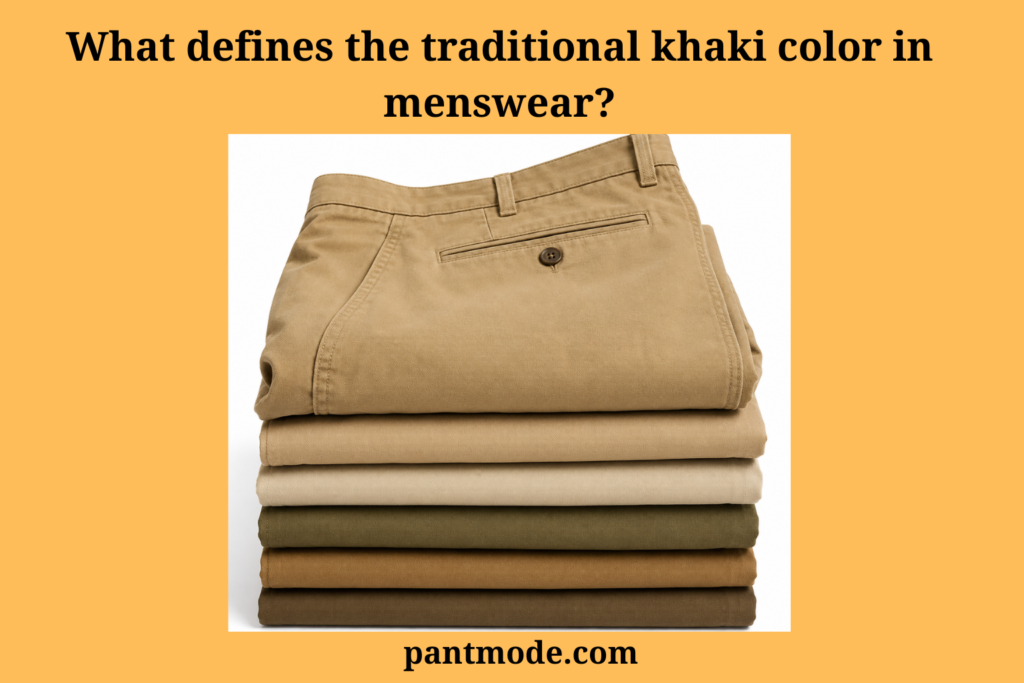
What Defines the Traditional Khaki Color in Menswear?
The traditional khaki color in menswear is a muted dust-brown or earthy tan shade shaped by military utility, low visual contrast, and practical wear in dry, dusty environments.
This guide explains the historical origin, authentic shade definition, modern beige-family confusion, skin-tone matching, classic menswear pairing, terminology correction, and final buying checks for authentic khaki menswear. The color should be understood separately from khaki pants, which are defined by garment structure as well as shade.
Quick Answer: What Defines the Traditional Khaki Color?
The traditional khaki color is a muted dust-brown, earthy tan, or military-inspired neutral with brown, tan, and sometimes muted green undertones. It is deeper and more practical-looking than pale beige, cream, stone, or sand, and it carries a restrained utility character in classic menswear.
Definition: Traditional Khaki Color
Traditional khaki color refers to an earth-toned menswear shade associated with military dust camouflage and practical utility. It usually appears as a muted tan-brown or drab neutral rather than a bright beige, pale cream, or clean stone color.
Figure: traditional khaki color combines dust origin, brown depth, muted neutrality, and utility character.
What Historical Origin Explains the Traditional Khaki Color in Menswear?
The traditional khaki color in menswear comes from military utility, where muted earth tones helped reduce visual contrast in dusty environments.
Military uniforms needed a color that looked practical in dry field conditions. A bright or clean color would stand out more sharply, while a dust-brown neutral could appear quieter and more functional.
The effect was a muted shade family built around brown, tan, and sometimes muted green undertones. That is why authentic khaki looks grounded, slightly drab, and more utilitarian than modern pale beige.
In modern menswear, the authentic khaki shade still signals restraint, field heritage, and utility. PantMode explains the broader background through military heritage.
Boundary note: Historical khaki influence does not mean every modern khaki garment must copy a military uniform. Modern khaki can preserve the color logic without preserving every historical construction detail.
Traditional Khaki Origin Timeline
| Stage | Color Need | Menswear Meaning |
|---|---|---|
| Dusty field environments | Muted earth tone with low visual contrast | Khaki begins as a practical utility shade |
| Military uniform adoption | Dust-brown, tan, and drab undertones | The color becomes associated with restraint and function |
| Civilian wardrobe adoption | Neutral shade that pairs with classic garments | Khaki enters casual, smart-casual, and heritage menswear |
| Modern retail expansion | Beige, stone, sand, and cream get mixed into khaki labels | Buyers must verify undertone and depth before calling a shade authentic khaki |
How Do You Identify the Authentic Khaki Shade Among Modern Beige and Sand Variations?
You identify the authentic khaki shade by looking for a dust-brown or muted tan tone with earthy undertones rather than a pale, clean, or bright beige-family color.
Traditional khaki appears practical, grounded, and slightly drab. Its color depth usually sits between tan, brown, and muted olive rather than pure cream or washed stone.
British khaki usually looks warmer and more yellow-brown. This shade can appear stronger, more heritage-driven, and more military-inspired than soft beige.
Stone is lighter, cooler, and cleaner. It can work well in summer outfits, but it lacks the dust-brown depth associated with the original khaki color.
Beige is softer and more neutral. It often appears dressier or smoother, but it is usually less historically accurate than authentic khaki.
Sand is pale and warm. It works for relaxed summer styling, but it is usually less traditional than military khaki because it lacks deeper earthy weight.
Boundary note: Store lighting can make beige, stone, sand, and khaki look closer than they are. Check the shade in natural light before deciding whether it has real dust-brown depth.
Khaki Shade Identification Matrix
| Shade Name | Undertone | Visual Difference | Best Use |
|---|---|---|---|
| Traditional khaki | Dust-brown or muted tan | Practical, grounded, slightly drab | Classic menswear, heritage outfits, everyday trousers |
| British khaki | Warmer yellow-brown | Stronger and more military-inspired | Heritage jackets, rugged trousers, workwear-inspired looks |
| Stone | Cooler pale neutral | Lighter and cleaner than traditional khaki | Summer outfits and softer tailoring |
| Beige | Soft neutral tan | Dressier but less historically rugged | Refined casual outfits and warmer-weather trousers |
| Sand | Pale warm tan | Light, airy, and less traditional | Resort wear, summer chinos, lightweight shirts |
Which Khaki Color Variation Works Best for Different Skin Tones?
The best khaki color variation depends on whether the shade creates enough contrast against the wearer’s skin tone and undertone.
Fair or pale skin usually needs deeper British khaki or darker military khaki. The added depth creates contrast and reduces the risk of a washed-out appearance.
Medium or olive skin usually works well with classic dust-brown khaki or muted tan. These shades harmonize naturally with warm, neutral, and olive undertones.
Dark skin can carry traditional khaki, British khaki, or richer tan shades with strong definition. The color contrast makes the outfit look clean and intentional.
Low-contrast coloring should avoid very pale beige when the goal is definition. A deeper dust-brown khaki usually gives the outfit more visual structure.
Traditional chino shades can overlap with khaki-family neutrals, but their garment context may differ. PantMode separates that broader color family inside chino colors.
Boundary note: Skin-tone guidance is a starting point, not a rule. Shirt color, jacket color, lighting, hair color, and outfit contrast can change how khaki appears.
Skin Tone and Khaki Shade Matching Table
| Skin Tone / Contrast Need | Choose This Khaki Shade | Result | Boundary |
|---|---|---|---|
| Fair or pale skin | Deeper British khaki or darker military khaki | Stronger contrast and less washed-out appearance | Avoid very pale beige near the face unless balanced with darker layers |
| Medium or olive skin | Classic dust-brown khaki or muted tan | Natural harmony with warm and neutral undertones | Very yellow khaki may look too warm on some olive undertones |
| Dark skin | Traditional khaki, British khaki, or richer tan | Clean contrast and strong visual definition | Extremely pale sand can look sharp but less traditional |
| Low contrast coloring | Medium-depth dust-brown khaki | Prevents the outfit from blending too closely with the skin | Use navy, brown, or olive to add definition when needed |
Figure: traditional khaki pairs best with menswear neutrals that either deepen contrast or reinforce earth-tone utility.
How Should You Style the Original Khaki Color With Classic Menswear Pieces?
You should style the original khaki color with classic menswear pieces by pairing it with navy, white, light blue, olive, brown, cream, dark brown leather, and suede.
Navy creates the most reliable menswear contrast with traditional khaki. A navy blazer, white shirt, traditional khaki trousers, and dark brown loafers create a grounded smart-casual outfit.
White and light blue brighten khaki without fighting its earth tone. A white Oxford shirt with khaki chinos and brown leather shoes gives the shade a clean daytime setting.
Olive, brown, and cream create heritage styling. An olive field jacket, cream knit, khaki trousers, and suede boots build a cohesive utility-inspired palette.
Black can work with khaki when the outfit has strong contrast, but dark brown often looks more natural because it supports khaki’s earthy undertone.
Fabric also changes the final impression because rugged cotton twill makes khaki look more traditional than sleek, shiny, or lightweight cloth. PantMode explains that fabric foundation in cotton twill.
Boundary note: Khaki pairing should respond to shade depth. Pale sand needs stronger contrast, while deeper military khaki can carry softer shirts and earth-tone jackets.
Khaki Color Pairing Matrix
| Pairing Color | Why It Works | Example Outfit | Boundary |
|---|---|---|---|
| Navy | Deepens the outfit while khaki keeps it grounded | Navy blazer, white shirt, khaki trousers, dark brown loafers | Best when khaki has enough brown depth |
| White | Brightens khaki without competing with the earth tone | White Oxford shirt, khaki chinos, brown leather shoes | Very pale khaki may need darker shoes or belt |
| Light blue | Adds clean contrast while staying classic | Light blue shirt, khaki trousers, navy jacket | Avoid washed-out combinations on low-contrast coloring |
| Olive | Creates a cohesive utility-inspired palette | Olive field jacket, cream knit, khaki trousers, suede boots | Use texture contrast so the outfit does not look flat |
| Brown | Supports khaki’s earthy undertone | Brown suede jacket, khaki trousers, white shirt | Use tonal separation between shoes and trousers |
| Cream | Softens the outfit while keeping it neutral | Cream knit, khaki trousers, brown loafers | Works best with deeper khaki rather than pale sand |
Why Do Men Confuse Khaki Color With Chinos, and How Can You Correct the Terminology?
Men confuse khaki color with chinos because retail language often uses “khakis” to describe casual cotton trousers, even when the garment is not khaki-colored.
The correction is simple: khaki properly describes a dust-colored shade, while chinos describe a trouser style or cotton twill garment category. A blue chino is not khaki-colored, even if a retailer places it in a “khakis” collection.
Chino construction belongs to garment structure, not shade. PantMode explains that difference in chino structure.
Beige, stone, sand, and khaki are also treated as identical in many product labels. Traditional khaki is earthier and more muted than many modern beige shades.
A buyer should verify undertone, depth, and dust-brown quality under natural light before trusting a retail color name.
For a broader garment comparison, PantMode separates shade and construction in chinos and khakis.
Boundary note: Khaki can refer to color and sometimes to a garment category in retail speech. For accuracy, separate color, fabric, construction, and product label before deciding what the item actually is.
Khaki vs. Chino Terminology Table
| Confusion | Correction | Verification |
|---|---|---|
| Khaki means any casual cotton trouser | Khaki primarily refers to a dust-colored shade | Check whether the garment is actually khaki-colored |
| Chinos and khakis are the same word | Chinos refer to a trouser style or cotton twill garment category | Check garment construction separately from color |
| A blue chino can be khaki | A blue chino is a chino, but it is not khaki-colored | Separate garment type from shade name |
| Beige, stone, sand, and khaki are identical | Traditional khaki is earthier and more muted | Compare undertone, depth, and dust-brown quality in natural light |
What Checklist Should You Use When Buying Authentic Khaki Menswear?
You should buy authentic khaki menswear by checking undertone, color depth, natural-light appearance, wardrobe compatibility, and terminology accuracy.
Start with undertone. Look for brown, tan, or muted green earthiness because those qualities make the shade more authentic than bright beige or yellow tan.
Check color depth. Traditional khaki should have visible dust-brown weight, while very pale cream or sand should be treated as a summer variation rather than the most authentic military khaki shade.
Check the shade in natural light. Store lighting can hide whether the color is truly muted or simply beige.
Test wardrobe compatibility against navy, white, olive, brown, and cream. Strong compatibility confirms khaki’s usefulness as a menswear neutral.
Confirm terminology accuracy before buying. Make sure the product is khaki-colored, not merely a chino-style garment labeled loosely as “khakis.”
Boundary note: Authentic khaki color is a shade decision, not a full garment-authenticity test. Fabric, fit, and construction still matter when the item is a trouser, jacket, or uniform-inspired garment.
Authentic Khaki Buying Checklist
☐ Check undertone: Brown, tan, or muted green earthiness is more authentic than bright beige or yellow tan.
☐ Check color depth: Traditional khaki should have visible dust-brown weight.
☐ Check natural light: View the shade outside harsh store lighting to confirm whether it is truly muted.
☐ Check wardrobe compatibility: Test the shade against navy, white, olive, brown, and cream.
☐ Check terminology accuracy: Confirm whether the product is khaki-colored or merely a chino-style garment.
☐ Check garment context: If the item is a trouser, fabric and construction still matter beyond shade.
Key Takeaway
Traditional khaki is not bright beige. It is a muted dust-brown or earthy tan shade shaped by military utility, low contrast, and classic menswear restraint. To identify authentic khaki, evaluate undertone, depth, natural-light appearance, wardrobe pairing, and whether the product label is describing color or garment type.
Frequently Asked Questions
The traditional khaki color is a muted dust-brown or earthy tan shade with military utility roots. It is deeper and more grounded than pale beige, cream, stone, or sand.
No. Beige is usually softer and more neutral, while traditional khaki has a dust-brown, muted tan, or slightly olive-earth undertone.
Fair or pale skin usually works better with deeper British khaki, darker military khaki, or richer dust-brown khaki because those shades create stronger contrast.
Traditional khaki pairs especially well with navy, white, light blue, olive, brown, cream, dark brown leather, and suede because these colors support classic menswear contrast.
Khaki is primarily a color term, while chinos refer to a trouser style or cotton twill garment category. A chino can be khaki-colored, but not every chino is khaki.
Conclusion
The traditional khaki color in menswear is best understood as a muted dust-brown or earthy tan shade shaped by military utility, restraint, and practical dressing.
Authentic khaki is deeper and more grounded than pale beige, cream, stone, or sand. It works best when its undertone, shade depth, and wardrobe pairing support classic menswear contrast.
Before buying khaki menswear, inspect the color in natural light, compare it against navy and earth tones, and confirm whether the label is describing a true khaki shade or simply a chino-style garment.