
What Fabric Choices and Construction Methods Define Chinos and Khakis?
Chinos and khakis are defined by overlapping cotton-twill traditions, but their fabric weight, surface finish, seam construction, pocket design, and garment structure usually create different style identities.
Chinos usually lean smoother, lighter, and more refined, while khakis usually lean heavier, more rugged, and more casual or utility-oriented. This guide explains fabric difference, weave clues, construction inspection, terminology myths, seasonal choice, and buying checks through practical garment details such as chino structure and khaki features.
Quick Answer: What Defines Chinos and Khakis by Fabric and Construction?
Chinos usually use lighter, smoother cotton twill with cleaner tailoring, while khakis usually lean heavier, more textured, and more rugged in construction. The difference is not only color; fabric weight, weave visibility, pocket design, seam finishing, and silhouette all help separate chinos from khakis.
Definition: Chino Fabric vs. Khaki Fabric
Chino fabric usually refers to a lighter, smoother cotton twill used for cleaner smart-casual trousers. Khaki fabric commonly refers to a heavier, more rugged cotton twill tradition associated with utility, military heritage, and casual durability, although modern labels may use the terms inconsistently.
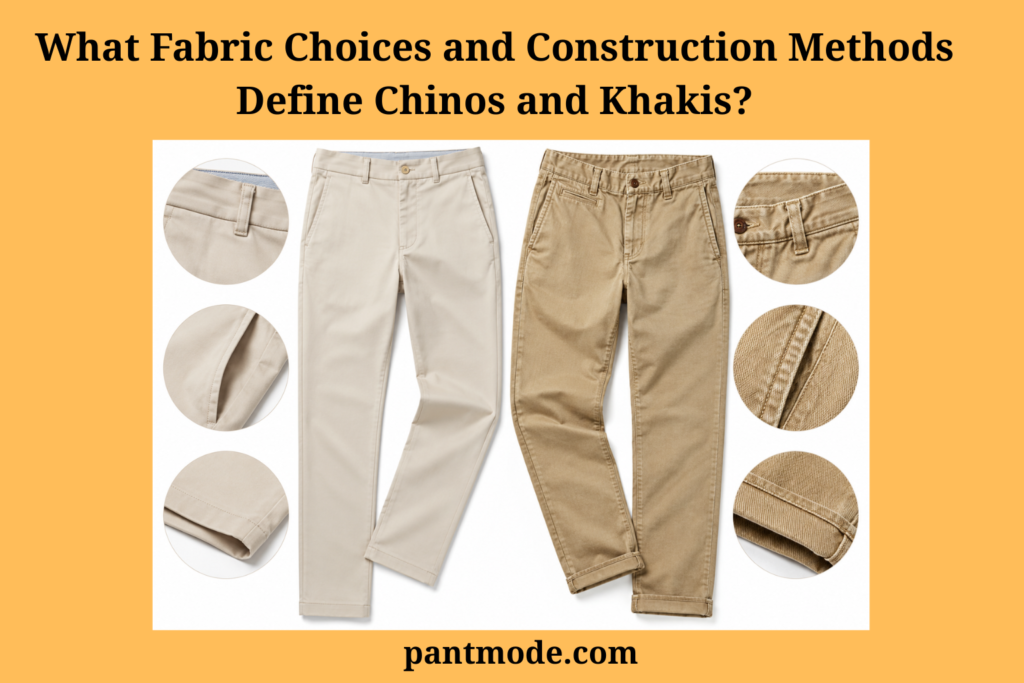
Figure: chinos and khakis separate through fabric weight, twill behavior, surface finish, and construction style.
How Do Chino Fabric and Khaki Fabric Create Different Garment Identities?
Chino fabric and khaki fabric create different garment identities because chinos usually use lighter, smoother twill for refined styling, while khakis usually use heavier, more rugged twill for casual durability.
Chinos usually lean lighter and smoother because fine cotton twill or cotton-stretch blends create a cleaner surface. This smoother finish supports office-casual, warm-weather, and refined daily wear.
Khakis usually lean heavier and more rugged because durable cotton twill supports sturdier construction. PantMode explains that traditional base more specifically in cotton twill.
Fabric identity matters because weight, density, and surface finish affect how the pant feels, drapes, wrinkles, and reads in a setting.
Boundary note: Modern retailers may blur the terms, so fabric alone should not be the only test. Confirm the category through weight, finish, pocket design, seam finishing, and silhouette.
Chino vs. Khaki Fabric Comparison Table
| Attribute | Chinos | Khakis |
|---|---|---|
| Typical fabric feel | Lighter, smoother, cleaner | Heavier, sturdier, more textured |
| Common fabric base | Fine cotton twill or cotton-stretch blend | Durable cotton twill |
| Style identity | Smart-casual, polished, refined | Casual, rugged, utility-influenced |
| Best use case | Office-casual, warm weather, refined daily wear | Weekend wear, cooler weather, casual durability |
| Boundary note | Some chinos can be casual | Some khakis can be refined |
How Does Weave Structure Distinguish Chinos From Khakis?
Weave structure distinguishes chinos from khakis through twill visibility, fabric density, and surface finish, which affect whether the garment reads polished or rugged.
Twill visibility is a key visual clue. Khakis often show a more noticeable twill texture, while chinos usually appear smoother and flatter from a distance.
Fabric density works as a comfort and durability clue. Heavier khaki twill can feel sturdier, while lighter chino twill can feel more breathable and easier to wear in warmer settings.
Surface finish affects dress-code compatibility. A clean chino finish can support smart-casual outfits, while a washed or textured khaki surface often reads more casual.
Boundary note: Weave clues should be used with label evidence, construction details, and pocket design. Weave visibility alone does not prove the garment category.
Chino and Khaki Weave Structure Guide
| Feature | Mechanism | Result |
|---|---|---|
| Twill visibility | Khakis often show a more noticeable twill texture, while chinos usually appear smoother | Khakis look more rugged; chinos look more polished |
| Fabric density | Khakis often use heavier cotton twill, while chinos frequently use lighter or finer twill | Khakis feel more durable; chinos feel more breathable |
| Surface finish | Chinos often have a cleaner, flatter finish, while khakis may show more texture after washing | Chinos fit smart-casual settings; khakis fit casual or utility settings |
| Wrinkle behavior | Lighter chinos may crease cleanly, while rugged khakis may wrinkle more casually | Chinos can look sharper; khakis can look more relaxed |
How Do Seam, Pocket, and Fly Construction Separate Chinos From Khakis?
Seam, pocket, and fly construction separate chinos from khakis by showing whether the pant was built for cleaner tailoring or more rugged utility.
Seams reveal whether the pant prioritizes polish or durability. Chinos often use cleaner, less visible finishing, while khakis may show heavier stitching and stronger construction cues.
Pockets reveal the styling and utility direction. Chinos commonly use slanted front pockets and cleaner rear welt pockets, while khakis may include larger or more utility-oriented pocket shapes.
Fly construction and waistband finishing add another clue. Chinos often use discreet closures and cleaner waistband finishing, while traditional khakis may lean more rugged in closure and waistband structure.
Silhouette completes the garment-level comparison. Chinos usually look slimmer and smoother, while khakis usually look roomier, sturdier, and more casual.
Tailoring details matter, but they do not classify khakis alone. PantMode explains that classification boundary in khaki tailoring.
Boundary note: Modern chinos and khakis can borrow details from each other. One pocket style, seam type, or fly detail should not be treated as exclusive proof.
Chino vs. Khaki Construction Map
| Inspection Point | Chino Construction | Khaki Construction |
|---|---|---|
| Seams | Cleaner, less visible seam finishing | Heavier stitching and more visible construction |
| Pockets | Slanted front pockets and cleaner rear welt pockets are common | Larger or more utility-oriented pockets may appear |
| Fly construction | Cleaner hidden zip or discreet closure | More rugged closures may appear in traditional versions |
| Silhouette | Slimmer, smoother, more tailored | Roomier, sturdier, more casual |
| Waistband | Cleaner waistband finish | More durable or utility-oriented waistband structure |
Why Do Buyers Confuse Chinos and Khakis, and How Can You Verify the Difference?
Buyers confuse chinos and khakis because the terms overlap in retail language, while khaki can describe both a tan color and a rugged cotton trouser tradition.
The first myth is that khaki is only a color. Khaki can describe a tan color, but it is also used for a rugged trouser tradition, so the reader should verify fabric weight, weave texture, pocket design, and construction style.
The second myth is that chinos and khakis are always the same. They overlap, but chinos usually read cleaner while khakis often read more rugged.
The third myth is that a product label always tells the full truth. Retailers may use the terms inconsistently, so inspection matters more than the product name alone.
Color can support identification, but it should not control the whole decision. PantMode separates the color meaning in khaki color.
Boundary note: The terms overlap, but fabric, weave, pocket design, seam finishing, and construction style reveal the practical difference.
Myth vs. Fact Verification Table
| Myth | Reality | Verification |
|---|---|---|
| Khaki is only a color | Khaki can describe a tan color, but it is also commonly used for a rugged cotton trouser tradition | Check fabric weight, weave texture, pocket design, and construction style |
| Chinos and khakis are always the same | They overlap, but chinos usually read cleaner while khakis often read more rugged | Compare fabric smoothness, stitching visibility, and pocket construction |
| A label always tells the full truth | Retailers often use the terms inconsistently | Inspect the garment rather than relying only on the product name |
| Tailoring details alone classify khakis | Tailoring matters, but fabric, utility, and construction also matter | Compare the full construction system, not one detail |
How Should You Choose Chinos or Khakis Based on Season and Setting?
You should choose chinos or khakis based on season and setting by matching fabric weight, surface finish, construction strength, and dress-code expectations to the situation.
Choose chinos for warm weather or office-casual settings because lighter fabric and smoother construction usually feel cooler and look cleaner. Very casual washes may look less polished, so setting still matters.
Choose khakis for cold weather, outdoor use, or rugged casual settings because heavier cotton twill and stronger construction provide more structure. Lightweight khakis may not offer the same warmth or durability.
Choose stretch chinos for travel because modern stretch blends improve movement and reduce wrinkling. Too much stretch can reduce structure and crease retention.
Choose khakis or relaxed chinos for casual weekend wear because both can work when the fabric weight matches the weather and the setting.
For office-casual or smart-casual decisions, compare finish and silhouette against the chino formality level.
Boundary note: Chinos are not always formal, and khakis are not always too casual. The setting, fabric finish, pocket style, and construction details decide the final impression.
Seasonal Chino and Khaki Selection Matrix
| Context | Choose | Reason | Boundary / Fit Note |
|---|---|---|---|
| Warm weather or office-casual | Chinos | Lighter fabric and smoother construction usually feel cooler and look cleaner | Very casual washes may look less polished |
| Cold weather or outdoor work | Khakis | Heavier cotton twill and rugged construction provide more durability and structure | Lightweight khakis may not feel warm enough |
| Travel | Stretch chinos | Modern stretch blends improve movement and reduce wrinkling | Too much stretch can reduce structure |
| Casual weekend wear | Khakis or relaxed chinos | Both can work, but khakis usually provide a sturdier casual appearance | Match the fabric weight to the weather |
| Smart-casual dinner | Cleaner chinos | Smoother finish and tailored silhouette read more refined | Avoid overly technical or utility-style details |
Figure: quality inspection should check the full construction system, not one detail alone.
What Construction Details Should You Inspect Before Buying Chinos or Khakis?
Before buying chinos or khakis, inspect pocket fabric, hem allowance, waistband construction, seam finishing, fabric recovery, and stitching quality.
Interior pocket fabric works as a durability clue. Strong cotton pocketing or sturdy pocket bags usually suggest better long-term wear than thin or weak pocket fabric.
Hem allowance works as an alteration-flexibility clue. Extra fabric at the hem gives more room for tailoring and length adjustment, while some casual garments have limited extra fabric.
Waistband construction works as a comfort and stability clue. A stable waistband, clean stitching, and rear shaping help the pant sit better during movement.
Seam finishing works as a construction-quality clue. Even stitching without loose threads, puckering, or twisting usually signals better garment construction.
Fabric recovery works as an all-day-wear clue. Fabric that returns to shape after light pulling or bending usually performs better during sitting, walking, and repeated movement.
Boundary note: No single detail proves quality. Fabric, seams, pockets, waistband, hem allowance, silhouette, and recovery should support the same use case.
Buyer Quality Inspection Checklist
☐ Check interior pocket fabric: Strong cotton pocketing or durable pocket bags usually indicate better long-term wear.
☐ Check hem allowance: Extra fabric at the hem gives more flexibility for tailoring and length adjustment.
☐ Check waistband construction: A stable waistband, clean stitching, and rear shaping improve comfort and fit control.
☐ Check seam finishing: Even stitching without loose threads, puckering, or twisting indicates better construction quality.
☐ Check fabric recovery: Fabric that returns to shape after light pulling or bending performs better for all-day wear.
☐ Check the full construction system: Fabric, seams, pockets, waistband, and silhouette should support the same use case.
Key Takeaway
Chinos and khakis overlap, but fabric and construction reveal the difference. Chinos usually look cleaner because of lighter twill, smoother finish, and neater tailoring. Khakis usually feel more rugged because of heavier cotton twill, visible texture, stronger seams, and more casual utility construction.
Frequently Asked Questions
Chinos usually use lighter, smoother cotton twill with cleaner tailoring, while khakis usually lean heavier, more textured, and more rugged in construction.
No. Chinos and khakis overlap in retail language, but fabric weight, weave texture, pocket design, seam finishing, and silhouette help verify the difference.
No. Khaki can describe a tan color, but it is also commonly used for a rugged cotton trouser tradition.
Inspect pocket fabric, hem allowance, waistband construction, seam finishing, fabric recovery, stitching quality, and whether the full construction system matches the use case.
Conclusion
Chinos and khakis overlap, but fabric weight, weave texture, surface finish, pocket design, seam construction, and waistband quality help reveal which garment best fits the setting.
Chinos usually lean lighter and smoother, while khakis usually lean heavier and more rugged. Chinos often use cleaner tailoring, while khakis often use more utility-oriented construction.
Labels can be inconsistent, so inspection matters. Choose chinos or khakis by matching fabric, construction, season, and setting instead of relying on the name alone.