
Where Do Chino Pants Sit on the Menswear Formality Scale?
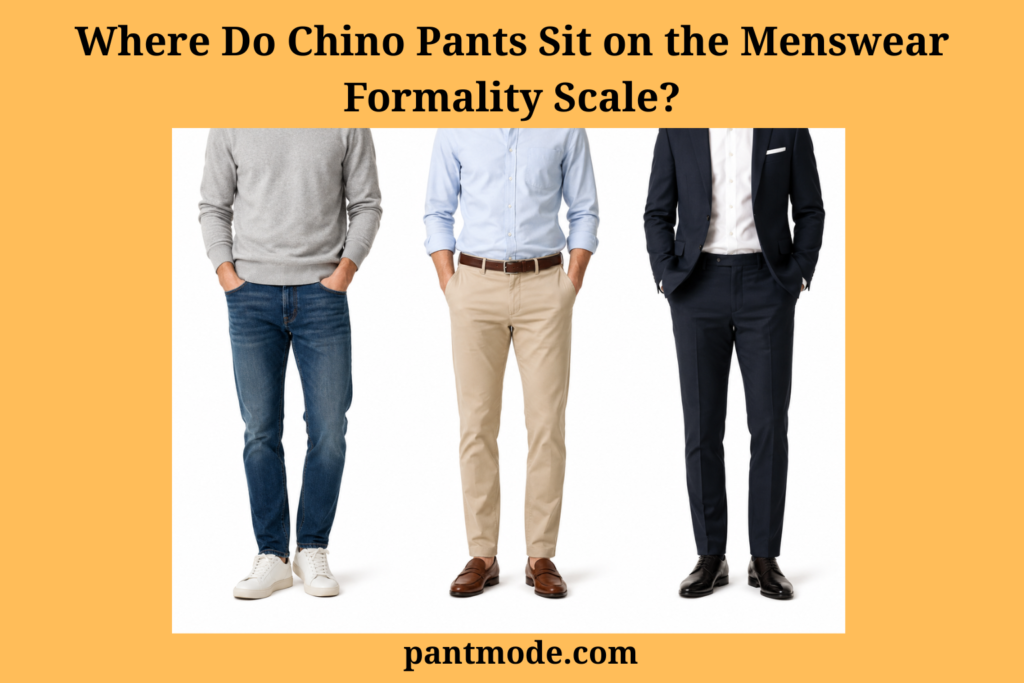
Chino pants sit in the middle of the menswear formality scale, above jeans and casual utility pants but below wool dress trousers, suit trousers, and formalwear.
The chino pants formality level depends on fabric smoothness, color depth, fit, condition, footwear, and surrounding garments. This guide explains baseline formality, dress-code suitability, elevation methods, common mistakes, and a final outfit check using the underlying chino structure and the effect of chino colors.
Quick Answer: Where Do Chino Pants Sit on the Menswear Formality Scale?
Chino pants sit in the middle of the menswear formality scale. They are dressier than jeans because smooth cotton twill looks cleaner than denim, but they are less formal than wool dress trousers because they remain cotton casual trousers. Chinos work best for smart casual and business casual settings.
Definition: Chino Pants Formality Level
Chino pants formality level refers to where chinos sit between casual denim and formal dress trousers. Their cotton twill fabric, clean fit, minimal detailing, darker colors, pressed condition, and leather footwear can raise formality, while fading, wrinkles, athletic shoes, and excess break lower it.
Figure: chinos occupy the middle ground between casual denim and tailored formal trousers.
What Is the Baseline Formality Level of Chino Pants on the Menswear Formality Scale?
Chino pants occupy the middle ground between casual denim and formal dress trousers because cotton twill looks cleaner than denim while remaining less formal than wool tailoring.
Rule: Chinos usually sit above jeans on the formality scale. Reason: Smooth cotton twill has a cleaner surface than denim. Example: Dark navy chinos look more polished than faded jeans.
Rule: Chinos remain below dress trousers. Reason: Cotton twill is less formal than wool tailoring. Example: Pressed chinos can support business casual, but wool dress trousers still read more formal.
Rule: Fabric refinement changes chino pants formality level. Reason: smooth, clean cotton twill looks sharper than faded, washed, or heavily stitched fabric. Example: clean welt-pocket chinos read more polished than rugged khaki-style chinos, especially when compared through chinos and khakis.
Boundary note: Chinos can move up or down the scale depending on condition, fit, color, fabric finish, hem break, and styling.
Chino Pants Formality Spectrum Table
| Menswear Category | Formality Position | Why It Sits There |
|---|---|---|
| Distressed jeans | Low casual | Denim, fading, and distressing read informal |
| Dark jeans | Casual to elevated casual | Dark color raises polish, but denim remains casual |
| Chino pants | Smart casual to business casual | Smooth cotton twill looks cleaner than denim but less formal than wool |
| Khakis | Casual to smart casual | Rugged cotton twill and utility heritage usually read more casual |
| Wool dress trousers | Business to formal | Tailored wool construction signals higher formality |
| Suit trousers | Formal business | Designed as part of structured tailoring |
| Black-tie trousers | Formal eveningwear | Required for formal evening dress codes |
Which Dress Codes Are Most Compatible With Chino Pants Formality?
Chino pants are most compatible with smart casual, business casual, and elevated casual dress codes when their fabric, color, fit, and footwear match the setting.
If the dress code is smart casual, wear chinos with a polo, knitwear, or a casual button-down. The result is balanced polish without looking overdressed. Avoid faded or wrinkled chinos because they pull the outfit back toward casual wear.
If the dress code is business casual, wear chinos with an Oxford shirt, blazer, and loafers. The result is professional without excessive formality. Strict offices may still require dress trousers, especially in conservative industries.
If the dress code is elevated casual, wear chinos with refined knitwear and leather footwear. The result is comfortable but intentionally polished. Athletic footwear or casual hoodies can weaken the effect.
If the dress code is formal or black tie, avoid chinos entirely. Formalwear generally requires dress trousers or formal trousers, not cotton twill chinos. This is the same boundary that separates casual khaki-based trousers from khaki formality.
Boundary note: Workplace dress codes vary by employer, industry, country, and occasion, so chinos should be verified against the destination before wearing.
Chino Pants Dress Code Decision Matrix
| Dress Code | Chino Pants Recommendation | Result | Boundary / Dress-Code Note |
|---|---|---|---|
| Smart casual | Wear chinos with a polo, knitwear, or casual button-down | Balanced and appropriate smart-casual appearance | Avoid faded or wrinkled chinos |
| Business casual | Wear chinos with an Oxford shirt, blazer, and loafers | Professional appearance without excessive formality | Strict offices may still require dress trousers |
| Elevated casual | Wear chinos with refined knitwear and leather footwear | Comfortable but intentionally polished styling | Athletic footwear lowers the effect |
| Weekend casual | Wear chinos with casual shirts, overshirts, or knit layers | Relaxed but cleaner than denim | Heavy fading or cargo-style details lower polish |
| Formal or black tie | Avoid chino pants entirely | Prevents underdressing | Dress trousers or formal trousers are required |
How Can You Elevate Chino Pants to the Highest Acceptable Formality Level?
You can elevate chino pants to their highest acceptable formality level by choosing smooth dark fabric, pressing a clean crease, minimizing casual detailing, and pairing them with structured menswear pieces.
Rule: Press a clean front crease. Reason: A crease visually connects chinos to tailored trousers. Example: pressed navy chinos with a blazer look sharper than unpressed chinos, but the crease does not make them wool dress trousers.
Rule: Choose darker colors. Reason: navy, charcoal, and deeper khaki shades read more polished than pale or faded colors. Example: navy chinos with loafers usually look more business casual than stone chinos with sneakers.
Rule: Minimize casual detailing. Reason: heavy stitching, utility pockets, and garment washing reduce refinement. Example: clean welt-pocket chinos look sharper than rugged khaki-style trousers, though khaki features can still be useful in casual and heritage settings.
Rule: Add structured menswear. Reason: blazers, Oxford shirts, loafers, and derbies raise the whole outfit. Example: an unstructured blazer, Oxford shirt, and derbies can move chinos into business-casual territory.
Boundary note: Elevation has limits. Chinos can look polished, but they still remain below true dress trousers and formalwear.
Figure: chino pants rise in formality through darker color, smooth fabric, clean crease, refined footwear, and structured upper garments.
Chino Pants Formality Elevation Framework
| Elevation Rule | Why It Raises Formality | Example | Boundary |
|---|---|---|---|
| Press a clean front crease | Creases visually connect chinos to tailored trousers | Pressed navy chinos with a blazer | A crease does not turn chinos into wool dress trousers |
| Choose darker colors | Darker shades read more polished and grounded | Navy or charcoal chinos | Dark colors still need clean condition and proper fit |
| Minimize casual detailing | Heavy stitching, washing, or utility pockets lower formality | Clean welt-pocket chinos | Plain detailing cannot fix poor fabric or wrinkles |
| Add structured menswear | Tailored layers elevate the whole outfit | Unstructured blazer, Oxford shirt, loafers | Structure must match the setting |
| Wear refined footwear | Leather shoes raise visual sophistication | Loafers, derbies, suede chukkas | Running shoes reduce formality |
What Common Mistakes Reduce the Formality of Chino Pants?
Common mistakes reduce the formality of chino pants when fabric break, fading, wrinkles, casual shoes, or visible utility details make the outfit look less structured.
Mistake: Excessive fabric break at the ankle. Why it hurts formality: pooling fabric appears sloppy and unstructured. Fix: tailor chinos to a slight or no-break hem.
Mistake: Heavily faded or washed chino fabric. Why it hurts formality: visual wear signals casual use. Fix: use darker, cleaner chinos for professional settings.
Mistake: Athletic running shoes. Why it hurts formality: technical sports footwear lowers sophistication. Fix: replace them with loafers, suede chukkas, derbies, or minimalist leather sneakers.
Mistake: Wrinkled chino pants. Why it hurts formality: wrinkles weaken visual structure. Fix: press or steam chinos before wear.
Mistake: Heavy utility details. Why it hurts formality: cargo-like pockets and heavy stitching shift the pant toward casual utility. Fix: choose cleaner pockets and minimal visible stitching.
Boundary note: Casual chinos can still look good, but they should not be used when the setting requires higher polish or formal tailoring.
Chino Pants Formality Mistakes vs. Fixes Table
| Mistake | Why It Hurts Formality | Fix |
|---|---|---|
| Excessive fabric break at the ankle | Pooling fabric appears sloppy and unstructured | Tailor chinos to a slight or no-break hem |
| Heavily faded or washed chinos | Visual wear signals casual use | Use darker, cleaner chinos for professional settings |
| Athletic running shoes | Technical sports footwear lowers sophistication | Replace with loafers, suede chukkas, derbies, or minimalist leather sneakers |
| Wrinkled chino pants | Wrinkles weaken visual structure | Press or steam chinos before wear |
| Heavy utility details | Cargo-like details shift the pant toward casual utility | Choose cleaner pockets and minimal visible stitching |
How Do You Verify That Your Chino Pants Outfit Matches the Intended Formality Level?
You verify that your chino pants outfit matches the intended formality level by checking color, garment condition, footwear, upper garments, fit, and destination dress code together.
Check color selection. Verify that the shade matches the setting. Darker chino colors generally pass higher-formality environments more easily than pale or faded colors.
Check garment condition. Verify that the chinos are clean, pressed, and free from excessive fading. Wrinkles and wear marks reduce polish even when the color is dark.
Check hem break. Verify that the hem sits cleanly. A slight or no-break hem looks sharper than pooling fabric.
Check footwear compatibility. Verify that shoes support the intended level. Loafers, derbies, chukkas, and clean leather sneakers increase formality, while technical athletic footwear decreases it.
Check upper garments. Verify that the top half supports the outfit. Oxford shirts, knitwear, and blazers elevate chinos better than hoodies or graphic tees.
Check destination dress code. Verify that chinos are allowed. If the destination requires formalwear or black tie, chinos fail the dress-code test.
Boundary note: One elevated element cannot compensate for a dress code that excludes chinos.
Chino Pants Final Outfit Verification Checklist
☐ Check color selection: Darker chino colors generally pass higher-formality environments more easily than pale or faded colors.
☐ Check garment condition: Clean, pressed chinos without excessive fading support elevated styling.
☐ Check hem break: A slight or no-break hem looks cleaner than pooling fabric.
☐ Check footwear compatibility: Loafers, derbies, chukkas, and clean leather sneakers increase formality; technical athletic footwear decreases it.
☐ Check upper garments: Oxford shirts, knitwear, and blazers support higher-formality outcomes better than hoodies or graphic tees.
☐ Check dress-code compliance: If the destination requires formalwear or black tie, chinos fail the dress-code test.
Key Takeaway
Chino pants are best understood as smart-casual to business-casual trousers. They can look polished with smooth fabric, darker colors, a clean hem, pressed condition, structured tops, and leather shoes, but they do not replace formal wool trousers for formal or black-tie dress codes.
Frequently Asked Questions
Chino pants sit in the middle of the menswear formality scale. They are dressier than jeans but less formal than wool dress trousers, suit trousers, and formalwear.
Chino pants are best understood as smart-casual to business-casual trousers. They are cleaner than denim but remain cotton casual trousers rather than formalwear.
Chino pants can work for many business-casual settings when they are dark, clean, pressed, properly hemmed, and paired with structured tops and refined footwear.
Make chinos look more formal by choosing smooth dark fabric, pressing a clean crease, minimizing casual details, tailoring the hem, and wearing leather loafers, derbies, or suede chukkas.
No. Chino pants do not replace formal wool trousers, suit trousers, or black-tie trousers because cotton twill remains less formal than tailored wool.
Conclusion
Chino pants sit between casual denim and formal dress trousers, making them strongest in smart casual, elevated casual, and many business-casual settings.
Chinos occupy the middle of the menswear formality scale because cotton twill looks cleaner than denim but remains less formal than wool tailoring.
You can elevate chinos through dark color, smooth fabric, pressing, clean hems, structured tops, and refined footwear.
Chinos do not replace formal wool trousers, suit trousers, or black-tie clothing.
Verify the outfit through color, condition, footwear, upper garments, fit, and destination dress code before wearing chinos.