
How Does Corduroy Wale Count Affect Pant Style, Drape, and Function?
Corduroy wale count affects pant style by changing the width of the fabric ridges, which influences texture, visual weight, drape, formality, and how the pants work with different silhouettes.
Corduroy wale count is the number of raised ridges per inch in corduroy fabric. Lower wale numbers create wider ridges, while higher wale numbers create finer ridges. This guide helps match wale size to straight-leg, casual, jogger, cargo, wide-leg, flared, slim-fit, tailored, workwear, and specialty corduroy pants.
Wale count affects appearance and texture directly, but warmth, breathability, wind resistance, durability, and recovery also depend on fabric weight, fiber content, stretch, lining, weave density, and garment construction. For the broader texture background, compare corduroy texture.
Quick Answer
Corduroy wale count affects pant style by changing the width of the raised ridges in the fabric. Lower wale counts create wider, chunkier ridges that look rugged and visually heavy. Higher wale counts create finer ridges that look smoother, cleaner, and more refined for slim, tailored, or smart-casual pants.
Definition
Corduroy wale count is the number of raised ridges, or wales, per inch of corduroy fabric. A lower wale count means fewer ridges per inch, so each ridge is wider. A higher wale count means more ridges per inch, so each ridge is finer and smoother.
Key Takeaway
Choose corduroy wale count by pant silhouette. Use standard wale for everyday straight-leg pants, wide wale for rugged casual or cargo pants, fine wale for tailored trousers and flares, and pinwale for slim-fit or cleaner smart-casual corduroy pants.
Source note: wale ranges should guide appearance decisions, not absolute performance claims. Fabric weight, fiber content, lining, stretch blend, weave density, and construction still control warmth, durability, recovery, and weather behavior.
External sources: This guide uses Sewport corduroy guide for wale-count and corduroy fabric terminology, and Cordings care guide for corduroy care, steaming, ironing, and storage guidance.
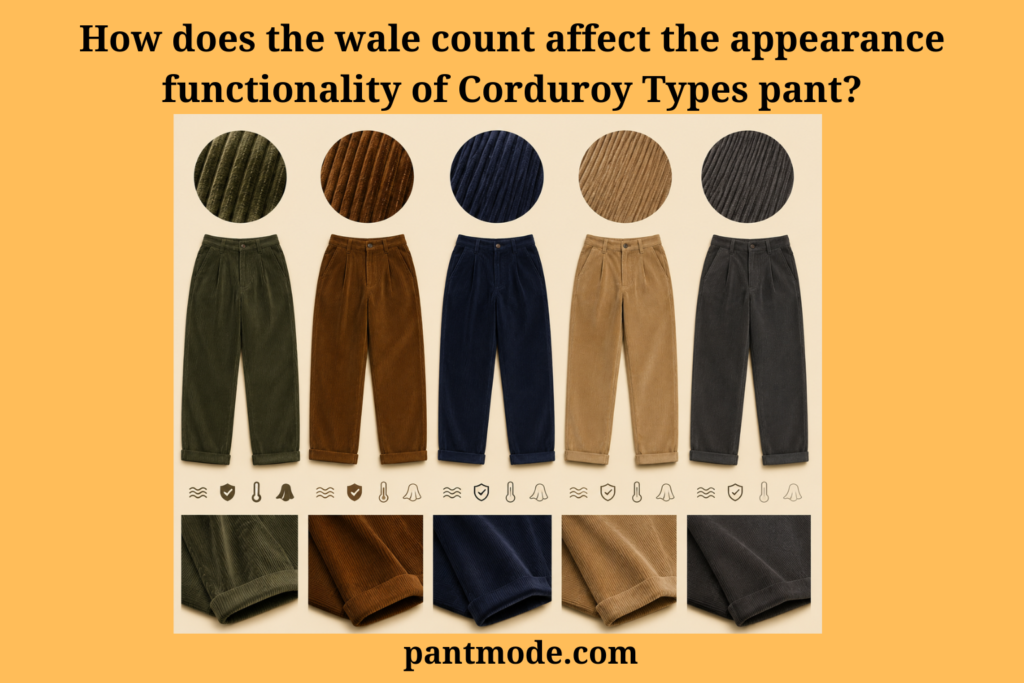
Figure: lower wale counts create wider ridges; higher wale counts create finer ridges that look smoother and cleaner.
What Is Corduroy Wale Count, and How Does It Change Pant Texture?
Corduroy wale count is the number of raised ridges per inch in corduroy fabric, and it changes pant texture by controlling how wide, bold, fine, or refined those ridges appear.
Lower wale count means wider ridges. A 6-wale corduroy looks bold, chunky, and rugged because fewer ridges share the same inch of fabric. This creates stronger visible texture in casual, cargo, workwear, and vintage-style pants.
Higher wale count means finer ridges. A 16+ wale pinwale corduroy looks smoother, cleaner, and more refined because more ridges fit into each inch. This supports slim-fit, tailored, pleated, and smart-casual corduroy pants.
Wale count affects appearance more directly than performance. Ridge width changes texture visibility, visual weight, and perceived formality, but it does not prove warmth, durability, recovery, or weather resistance by itself.
Chunkier ridges can create more structure. Finer ridges usually create a cleaner drape, while wide ridges can look more rugged and visually heavier. The better choice depends on pant silhouette, fabric weight, and styling purpose.
Corduroy Wale Reference Table
| Wale Type | Approximate Wale Count | Ridge Appearance | Best Pant Use | Watch-Out |
|---|---|---|---|---|
| Jumbo / elephant wale | 3–6 wales per inch | Very wide, bold, chunky | Rugged casual, vintage, statement pants | Can add visual bulk |
| Wide wale | 6–8 wales per inch | Thick and textured | Cargo cords, workwear cords, relaxed weekend pants | Can feel stiff in wide-leg cuts |
| Standard wale | 8–14 wales per inch | Balanced and classic | Straight-leg, casual, everyday corduroy pants | Needs good fit to avoid looking dated |
| Fine / medium-fine wale | 12–16 wales per inch | Cleaner and smoother | Flared, tailored, chino-style cords | Less rugged texture |
| Pinwale / needlecord | 16+ wales per inch | Very fine and refined | Slim-fit, pleated, dressier casual pants | May look too plain if texture is too subtle |
Which Corduroy Wale Count Works Best for Core and Casual Pant Styles?
The best corduroy wale count for core and casual pant styles depends on whether the pant needs balanced everyday texture, rugged casual structure, or a cleaner smart-casual finish.
Standard wale is the safest everyday choice for most straight-leg corduroy pants. It gives enough texture to look like corduroy without making the leg look overly chunky. Brown standard-wale cords with a merino sweater and boots create a balanced fall outfit.
Casual corduroy pants can use standard to wide wale. A 6–12 wale range adds seasonal texture when the outfit includes flannel, sneakers, knitwear, or relaxed jackets. Too-fine texture can look weak if the goal is rugged styling.
Corduroy joggers usually need fine to standard wale. Cuffs can look bulky with jumbo ridges, so a 12–16 wale range keeps the ankle cleaner.
Corduroy cargo pants can use standard to wide wale. Pocket structure benefits from visible texture, but cargo durability comes from fabric weight, stitching, pocket construction, and reinforcement, not wale count alone. For related construction logic, compare cargo utility.
Smart-casual corduroy trousers usually look cleaner in standard or fine wale. For everyday cut logic, compare cut and fabric.
Pant Type vs. Ideal Wale Matrix
| Pant Type | Ideal Wale Range | Why It Works | Best Outfit Example | Avoid |
|---|---|---|---|---|
| Straight-leg cords | 8–14 | Balanced texture and everyday versatility | Brown cords + merino sweater + boots | Jumbo wale for polished looks |
| Chino-style cords | 12–16 | Cleaner finish and sharper line | Navy fine-wale cords + Oxford shirt | Thick ridges that disrupt tailoring |
| Casual cords | 6–12 | Relaxed texture and seasonal feel | Olive cords + flannel + sneakers | Too-fine texture for rugged styling |
| Jogger cords | 12–16 | Softer drape and cleaner cuff | Fine-wale joggers + hoodie + trainers | Jumbo wale at ankle cuff |
| Cargo cords | 6–12 | Supports utility pocket styling | Wide-wale cargos + work jacket + boots | Pinwale that makes pockets look weak |
| Workwear cords | 4–8 or 6–10 | Bold, rugged visual structure | Wide-wale pants + chore coat | Assuming wale alone proves durability |
| Pleated cords | 12–16 | Helps pleats stay cleaner | Pinwale pleated trousers + knit polo | Chunky wale that distorts pleats |
| Slim-fit cords | 16+ | Reduces visual bulk | Pinwale slim cords + loafers | Wide wale that enlarges the leg |
How Does Corduroy Wale Count Affect Wide-Leg, Flared, and Draped Pants?
Corduroy wale count affects wide-leg, flared, and draped pants by adding or reducing visual weight across larger fabric volumes.
Wide-leg pants already use more fabric. Jumbo wale can make the silhouette look heavier because large ridges spread across a larger surface area. Chunky wale can still work when the goal is a bold, structured statement.
Standard or medium-fine wale usually supports smoother wide-leg drape. A 10–16 range gives corduroy texture without making the pant look tent-like.
Flared corduroy pants usually need fine to medium wale. The hem needs enough structure to hold shape without thick ridges making the flare look bulky.
Dark colors can control visual bulk when wider wale is used. Navy, charcoal, espresso, and dark olive reduce the intensity of wide ridges better than light tan or cream.
Footwear should match wale weight. Chunkier cords need boots or substantial sneakers, while finer wale can work with loafers or cleaner shoes. For more silhouette logic, compare body proportions.
Drape and Proportion Wale Guide
| Pant Silhouette | Best Wale Choice | Reason | Best Footwear | Risk if Wale Is Wrong |
|---|---|---|---|---|
| Wide-leg pants | 10–16 | Allows smoother fall and less stiffness | Boots, loafers, structured sneakers | Tent-like shape |
| Relaxed straight pants | 8–14 | Balanced texture and structure | Boots, sneakers | Can look shapeless if too wide |
| Flared pants | 12–16 | Holds flare without heavy ridges | Platforms, boots, loafers | Bulky hem |
| Baggy cords | 8–12 | Texture supports volume without extreme stiffness | Chunky sneakers, boots | Too much fabric weight |
| Pleated trousers | 12–16 | Keeps pleats cleaner | Loafers, dress boots | Pleats look bulky |
| Cropped cords | 10–16 | Cleaner ankle break | Loafers, sneakers | Thick ridges shorten the leg |
| Slim-fit cords | 16+ | Reduces visual bulk | Loafers, Chelsea boots | Wide ridges exaggerate tightness |
Which Corduroy Wale Count Works Best for Slim, Tailored, Workwear, and Specialty Pants?
Slim, tailored, workwear, and specialty corduroy pants need different wale counts because each pant category handles structure, surface texture, and visual bulk differently.
Slim-fit corduroy pants usually work best in pinwale or fine wale. Finer ridges reduce leg bulk and keep the silhouette cleaner. A slim pant can still pull at the knee, seat, or thigh if the fit is too tight or the fabric lacks recovery.
Tailored corduroy trousers usually need fine to standard wale. Thick ridges can interrupt darts, pleats, creases, and pocket edges. For fit structure, compare tailored fit.
Pleated corduroy pants work best in medium-fine wale. Pleats need to open and close without swelling, so fine or standard wale usually supports cleaner movement.
Workwear corduroy pants can use standard or wide wale. Wide ridges create rugged visual structure, but durability depends on garment construction, fabric weight, stitching, and reinforcement, not wale count alone.
Fashion corduroy pants with color blocking usually need standard or fine wale. Color and texture compete more easily when both are loud, so a cleaner wale can keep the outfit controlled.
Technical or outdoor-inspired corduroy pants should prioritize construction before wale count. Fiber composition, stretch, lining, weather-facing finish, pocket build, and seam quality matter more than ridge width alone.
How Can You Fix Styling Mistakes Caused by the Wrong Corduroy Wale Count?
Styling mistakes caused by the wrong corduroy wale count usually appear as excess bulk, stiff drape, poor formality matching, flattened knees, or unbalanced lower-body proportion.
Slim pants look bulky when wide or jumbo wale exaggerates the leg line. Use pinwale or fine-wale corduroy in darker colors with cleaner footwear.
Wide-leg pants look stiff when very low wale count meets heavy fabric. Use standard or medium-fine wale when the goal is drape instead of a bold structured statement.
Tailored outfits look too casual when chunky wale dominates the outfit. Use darker standard wale or pinwale with knitwear, loafers, or a blazer.
Knee bagging is often caused by poor recovery, weak fabric, or bad fit. Check fabric recovery and size instead of blaming wale count only.
Heavy wide-wale corduroy can feel too warm in transitional weather. Use lighter fine-wale or pinwale corduroy when the goal is less seasonal weight.
Styling Mistake Troubleshooting Table
| Visual Issue | Wrong Wale Used | Correct Wale / Fabric Choice | Better Styling Fix |
|---|---|---|---|
| Slim pants look bulky | Wide / jumbo wale | Pinwale or fine wale | Use darker color and cleaner footwear |
| Wide pants look stiff | Jumbo wale + heavy fabric | Standard or medium-fine wale | Choose fabric with softer drape |
| Tailored pants look casual | Chunky wale | 12–16 fine/standard wale | Pair with knitwear, loafers, or blazer |
| Knees bag out | Weak recovery fabric | Better fabric + possible stretch blend | Check fit and size, not wale only |
| Too warm in mild weather | Heavy wide wale | Lightweight fine wale | Use lighter layers |
| Legs look shorter | Cropped wide wale | Standard or fine wale | Match pants to shoes or use full length |
| Outfit looks too rugged | Wide wale + heavy layers | Standard wale | Add smooth knit or tailored jacket |
| Texture overload | Wide wale + chunky top | Finer wale or smoother top | Let one texture dominate |
How Do You Care for Corduroy Wale Texture to Prevent Flattening?
Corduroy wale texture is preserved by reducing friction, avoiding direct heat pressure, protecting the nap, and storing the pants without crushing the raised ridges.
Read the care label first. Corduroy varies by fiber content, dye, stretch blend, finish, and garment construction, so the label controls the safest method.
Turn corduroy pants inside out before washing when the care label allows. Close buttons and zippers first so the surface has less friction inside the machine.
Use cold or gentle washing with mild detergent when appropriate. Avoid harsh detergent, bleach, aggressive cycles, and overloaded machines because friction and chemicals can disturb the nap.
Avoid high dryer heat. High heat can shrink the garment, weaken stretch fibers, flatten the nap, or damage the finish. Air drying or the lowest suitable dryer setting depends on the care label.
Do not iron directly on the front ridges. Steam gently, iron inside out on low heat, or use a pressing cloth when needed. Heavy pressure can flatten the raised texture.
Brush only when needed and with the nap direction. Gentle brushing can refresh the surface, but rough brushing can create uneven shine.
Store corduroy without crushing the raised ridges. Avoid tight clips, compressed folds, overfilled closets, and overstuffed pockets.
Ultimate Corduroy Care Checklist
| Care Check | Yes / No |
|---|---|
| Did you read the care label before washing? | |
| Did you turn the pants inside out? | |
| Did you close buttons and zippers before washing? | |
| Did you use cold or gentle washing when allowed? | |
| Did you avoid harsh detergent, bleach, and aggressive cycles? | |
| Did you avoid high dryer heat? | |
| Did you avoid ironing directly on the front ridges? | |
| Did you steam or iron inside out if needed? | |
| Did you brush gently in the direction of the nap? | |
| Did you avoid tight clip hangers that crush the wales? | |
| Did you avoid overloading pockets and distorting the ridges? | |
| Did you store the pants without compressing the pile? |
What Final Checklist Helps You Choose the Right Corduroy Wale Count for Pants?
The best final checklist for choosing corduroy wale count compares the pant silhouette, ridge size, drape, visual bulk, season, outfit use, fabric recovery, and care practicality before purchase.
Choose wale count based on the pant cut and daily wear, not just fabric appearance. Verify whether the pant is slim, straight, wide, flared, pleated, casual, cargo, or workwear.
Check the ridge category. Decide whether the ridges are fine, standard, wide, or jumbo before judging the pant’s formality and visual weight.
Test drape by walking and sitting. A good wale choice should move with the pant instead of creating stiffness, knee bagging, or bulky folds.
Match wale and fabric weight to the season. Fine wale can feel lighter and cleaner, while wide wale can look more rugged and cold-weather focused.
Match the texture to outfit use. Use pinwale for polished outfits, standard wale for everyday outfits, and wide wale for rugged casual outfits.
Confirm care practicality. The final choice should be washable, dryable, steamable, and storable without flattening the wales.
Final Corduroy Wale Buying Checklist
| Buying Check | Yes / No |
|---|---|
| Does the wale count match the pant silhouette? | |
| Is the wale range appropriate for the outfit formality? | |
| Does the fabric drape well when walking and sitting? | |
| Does the wale avoid adding unwanted visual bulk? | |
| Does the pant feel seasonally appropriate for the weather? | |
| Does the color reduce or enhance the texture in the right way? | |
| Does the fabric recover after bending at the knee? | |
| Are the ridges evenly raised and not crushed? | |
| Does the wale work with your footwear choice? | |
| Can you style the pants in at least three outfits? | |
| Can you care for the pants without flattening the nap? | |
| Does the final choice match your body proportion and style goal? |
Frequently Asked Questions
Corduroy wale count is the number of raised ridges per inch in corduroy fabric. Lower wale counts create wider ridges, while higher wale counts create finer ridges.
Standard wale, usually around 8 to 14 wales per inch, is the safest everyday range for straight-leg, casual, and classic corduroy pants when the fit is clean.
Slim-fit corduroy pants usually work best in pinwale or fine wale because finer ridges reduce visual bulk along the leg.
No. Wale count affects appearance and texture directly, but warmth, durability, recovery, and weather resistance depend on fabric weight, fiber content, lining, stretch blend, weave density, and garment construction.
Protect corduroy wale texture by following the care label, reducing friction, turning pants inside out when washing is allowed, avoiding direct heat pressure on the front ridges, brushing gently with the nap, and storing without crushing the raised ridges.
Conclusion
Corduroy wale count is the key texture measurement that helps determine whether corduroy pants look rugged, classic, refined, structured, or smooth.
Lower wale counts create wider, bolder ridges. Higher wale counts create finer, cleaner ridges.
The best wale count depends on pant silhouette, outfit formality, drape, proportion, season, and care needs.
Wale count does not prove warmth, durability, recovery, or weather protection by itself. Fabric weight, fiber content, stretch blend, lining, weave density, and garment construction still matter.
The right corduroy pants are chosen by matching wale size to the cut, not by choosing the thickest or finest ridge automatically.