
Why Are Corduroy Pants Associated with Texture and Seasonal Styling?
Corduroy pants are associated with texture and seasonal styling because raised wales, cut-pile construction, fabric thickness, and nap direction create visual depth, softness, and cold-weather character.
Corduroy pants are not simply ribbed cotton trousers. Their wale count changes texture, proportion, and outfit formality, while fabric weight, nap direction, and pile behavior shape how they work in fall and winter outfits. This guide covers fabric mechanics, seasonal warmth, wale selection, texture pairing, styling mistakes, and care.
Quick Answer: Why Are Corduroy Pants Textured and Seasonal?
Corduroy pants are associated with texture and seasonal styling because their raised vertical ridges, called wales, create depth, softness, shadow, and visual warmth. The cut-pile surface makes corduroy feel more substantial than flat cotton trousers, while wale size changes the look: pinwale feels refined, standard wale feels classic, and wide wale feels rugged or vintage.
Definition: Corduroy Pants
Corduroy pants are trousers made from a woven pile fabric with raised vertical ridges called wales. The wale size, pile height, fabric weight, nap direction, and fiber content affect how the pants look, feel, style, and wear through fall and winter outfits.
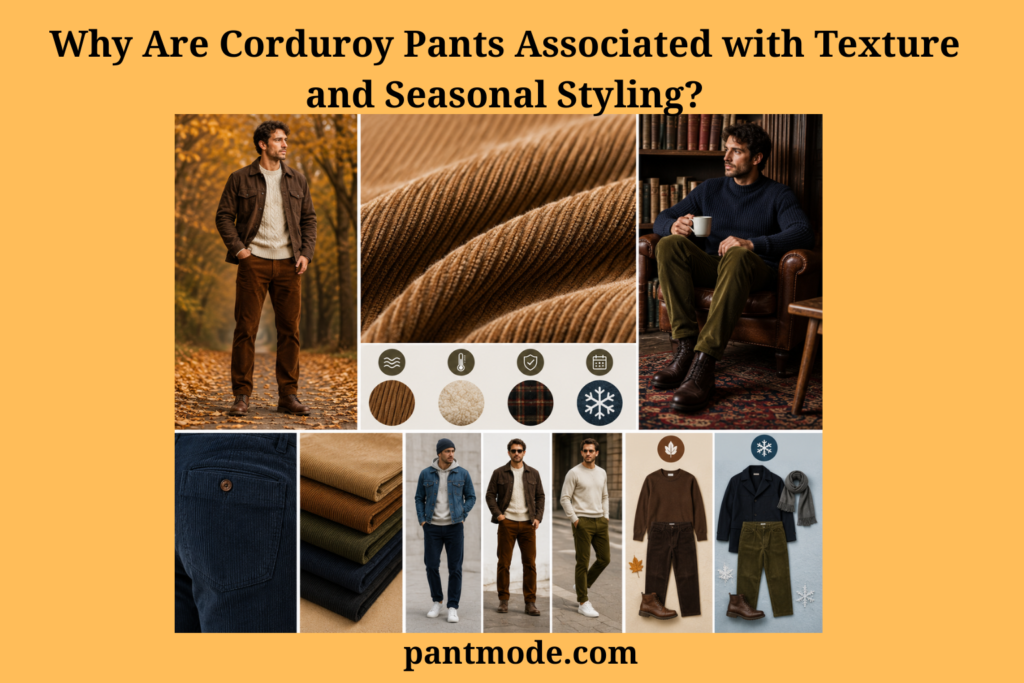
Figure: corduroy pants get their seasonal character from pile, raised wales, nap direction, fabric weight, and care.
What Gives Corduroy Pants Their Distinctive Ridged Texture?
Corduroy pants get their distinctive ridged texture from cut-pile construction that forms raised vertical rows called wales.
Corduroy pants are defined by vertical raised ridges called wales. These wales are formed when extra pile yarns are woven into a base fabric, cut, and brushed into raised rows. Medium-wale corduroy pants have a visible ribbed surface, while pinwale corduroy looks smoother and more refined.
Wale count changes how bold or subtle the pants look. More wales per inch create a finer texture, while fewer wales per inch create a thicker ridge. Pinwale can look almost velvety from a distance, while wide wale makes ridges a visual statement.
Corduroy texture affects both touch and styling. Raised pile gives the fabric softness, depth, shadow, and a stronger fall/winter feeling than flat cotton twill. Brown corduroy trousers feel more autumnal with knitwear than smooth khaki chinos.
Corduroy has a nap. The surface can look lighter or darker depending on the direction the pile is brushed. Two legs of the same corduroy pant may appear slightly different if the nap is crushed or brushed unevenly.
For where corduroy sits among everyday alternatives, compare non-denim pants.
Boundary note: corduroy should not be reduced to “ribbed cotton” only. Wale width, fabric finish, pile height, fiber content, and wear all change the final texture.
Fabric Texture Evidence Blocks
| Rule | Reason | Example | Boundary |
|---|---|---|---|
| Corduroy pants are defined by raised wales | Extra pile yarns are woven into a base fabric, cut, and brushed into raised rows | Medium-wale pants show a visible ribbed surface | Corduroy is not just ribbed cotton |
| Wale count changes visual strength | More wales per inch look finer; fewer wales look thicker | Pinwale looks smoother; wide wale looks bolder | Effect depends on color, cut, and finish |
| Raised pile changes touch and styling | Pile adds softness, depth, and shadow | Brown cords with knitwear feel autumnal | Texture is not weatherproofing |
| Corduroy has nap direction | Pile can reflect light differently depending on brush direction | Crushed nap may make one leg look lighter | Care should preserve nap direction |
Why Do Textured Corduroy Pants Work Best in Fall and Winter Outfits?
Textured corduroy pants work best in fall and winter outfits because raised pile, fabric thickness, shadow, and visual weight pair naturally with cold-weather layers.
If you need more warmth than flat lightweight cotton, use corduroy pants with a denser wale texture and raised pile. The fabric can feel warmer and more substantial in cool weather because pile adds texture and can trap small pockets of air. Warmth still depends on fabric weight, lining, fit, and layering.
If your fall outfit feels too flat, use corduroy pants to add surface depth. The ridged texture creates shadow and visual warmth in brown, olive, tan, burgundy, navy, and charcoal. Texture should not overload the outfit.
If you want pants that visually match cold-weather layers, choose corduroy over smooth summer fabrics. Textured corduroy pants pair naturally with wool sweaters, flannel shirts, suede jackets, leather boots, denim jackets, and heavier outerwear. Match wale weight to outfit weight.
If you want seasonal style without looking overly formal, choose standard-wale or relaxed corduroy trousers. They bridge casual and smart-casual outfits better than sweatpants while feeling softer than dress trousers. Fit still decides polish.
If you need true weather protection, do not rely on corduroy alone. Corduroy can feel warm, but weather protection depends on outer layers, fabric weight, lining, and garment construction. Corduroy is not automatically windproof or waterproof.
For everyday casual styling context, compare casual pants.
Boundary note: corduroy is not windproof or waterproof by default, and it does not replace winter outerwear.
Seasonal Role Evidence Blocks
| If Need | Use Feature | Result | Boundary |
|---|---|---|---|
| More warmth than flat lightweight cotton | Denser wale texture and raised pile | Feels more substantial in cool weather | Warmth depends on weight, lining, fit, and layering |
| A fall outfit that feels less flat | Ridged surface depth | Creates shadow and visual warmth | Texture should not overload the outfit |
| Cold-weather texture matching | Corduroy instead of smooth summer fabrics | Pairs with wool, flannel, suede, leather, denim, and knitwear | Match wale weight to outfit weight |
| Seasonal style without high formality | Standard-wale or relaxed corduroy trousers | Bridges casual and smart-casual looks | Fit still decides polish |
| True weather protection | Outer layers, lining, and garment construction | Better protection than relying on corduroy alone | Corduroy is not automatically windproof or waterproof |
Which Wale Count Should You Choose for Different Corduroy Pants Styles?
The best corduroy wale count depends on season, occasion, outfit formality, body proportion goals, fabric color, cut, and footwear weight.
Pinwale corduroy pants work best when you want polished comfort and cleaner texture. Fine, subtle ridges suit early fall, mild winter, office casual, and smart-casual outfits. Very fine wale may look too plain if the texture is barely visible.
Standard-wale corduroy trousers work best for everyday fall and winter wear. They look balanced, classic, and recognizable with flannel, boots, knitwear, and casual jackets. Poor fit can make standard wale look dated instead of intentional.
Medium-wide wale corduroy creates a warmer vintage effect. It suits rugged casual outfits, relaxed smart-casual looks, denim jackets, leather boots, and heavier textures. It can dominate light outfits.
Wide-wale corduroy pants create a bold, chunky, rugged statement. They work best in cold winter, vintage styling, workwear-inspired outfits, chunky knitwear, and heavy footwear. Wide wale can add visual weight, especially in light colors or loose cuts.
Extra-wide wale is a statement texture. It works for fashion-forward or vintage looks when the top half stays simple. It is harder to dress formally.
Boundary note: wale choice should match fit, color, footwear, and outfit weight. Avoid universal body-size rules.
Wale Size Decision Matrix
| Wale Type | Typical Texture Impression | Best Season | Best Occasion | Outfit Example | Watch-Out |
|---|---|---|---|---|---|
| Pinwale | Fine, smooth, subtle | Early fall, mild winter | Smart-casual, office casual | Navy pinwale trousers + merino sweater + loafers | Can look too plain if the wale is barely visible |
| Standard wale | Balanced, classic, recognizable | Fall and winter | Everyday casual, weekend, casual office | Brown standard-wale pants + flannel shirt + boots | Needs clean fit to avoid looking dated |
| Medium-wide wale | Textured, warm, vintage | Cold fall and winter | Rugged casual, relaxed smart-casual | Olive cords + denim jacket + leather boots | Can dominate light outfits |
| Wide wale | Bold, chunky, rugged | Cold winter | Workwear-inspired, vintage, relaxed weekends | Tan wide-wale pants + chunky knit + suede boots | Can add visual weight |
| Extra-wide wale | Statement texture | Cold weather styling | Fashion-forward or vintage looks | Dark wide cords + simple turtleneck + heavy boots | Harder to dress formally |
Body and Proportion Wale Guide
| Styling Goal | Better Wale Choice | Why It Works | Avoid |
|---|---|---|---|
| Cleaner leg line | Pinwale or standard wale | Finer texture looks smoother | Very wide wale in light colors |
| Rugged vintage look | Standard or wide wale | Stronger texture supports workwear layers | Ultra-slim cuts |
| Taller visual line | Dark medium wale | Texture stays subtle and vertical | Cropped wide wale with contrasting socks |
| More relaxed volume | Wide wale | Chunkier ridges match relaxed silhouettes | Thin shoes that look too delicate |
| Dressier outfit | Pinwale | Finer texture feels more polished | Thick wide wale with formal shoes |
| Balanced everyday wear | Standard wale | Most versatile texture level | Overly loose, shapeless cuts |
Figure: wale count changes how fine, classic, rugged, or statement-focused corduroy pants appear.
How Do You Style Warm Corduroy Pants With Complementary Cold-Weather Textures?
You style warm corduroy pants best by pairing their ridged pile with complementary cold-weather textures such as smooth knitwear, flannel, denim, leather, suede, wool, and simple outerwear.
Pair pinwale with smoother textures. Smooth merino, fine knitwear, crisp cotton, wool blazers, clean overshirts, loafers, and Chelsea boots keep pinwale refined.
Pair standard wale with familiar fall textures. Flannel, brushed cotton, medium knitwear, denim jackets, chore coats, suede chukkas, and leather boots make standard wale feel natural for everyday fall outfits.
Pair medium-wide wale with heavier layers. Chunky knits, heavyweight tees, flannel, waxed jackets, wool coats, work boots, and suede boots balance the stronger ridges.
Pair wide wale with simpler tops. A smooth turtleneck, simple sweatshirt, minimal coat, rugged jacket, heavy boots, or desert boots lets wide wale remain the main texture.
Use color harmony to control visual weight. Dark corduroy works with light knits and brown leather, while light corduroy often needs darker knitwear, denim shirts, neutral layers, and heavier footwear.
For broader fabric and cut selection, compare fabric pairing.
Boundary note: corduroy styling should avoid texture overload. Too many strong surfaces can make the outfit look heavy or cluttered.
Seasonal Texture Pairing Table
| Corduroy Pants Texture | Recommended Top Texture | Outerwear Match | Footwear Match | Occasion |
|---|---|---|---|---|
| Pinwale | Smooth merino, fine knit, crisp cotton | Wool blazer, clean overshirt | Loafers, Chelsea boots | Smart-casual |
| Standard wale | Flannel, brushed cotton, medium knit | Denim jacket, chore coat | Suede chukkas, leather boots | Everyday fall |
| Medium-wide wale | Chunky knit, heavyweight tee, flannel | Waxed jacket, wool coat | Work boots, suede boots | Weekend casual |
| Wide wale | Smooth turtleneck, simple sweatshirt | Minimal coat, rugged jacket | Heavy boots, desert boots | Vintage / rugged |
| Dark corduroy | Light knit, chambray, soft flannel | Navy coat, brown leather jacket | Black or brown boots | Polished winter |
| Light corduroy | Dark knit, denim shirt, neutral layers | Olive jacket, camel coat | Brown suede, cream sneakers | Transitional styling |
What Styling and Care Mistakes Should You Avoid With Corduroy Pants?
The main styling and care mistakes to avoid with corduroy pants are texture overload, busy wale clashes, direct front ironing, harsh washing, tight clip hangers, overloaded pockets, heavy mud exposure, and rough brushing against the nap.
Matching same-wale corduroy casually can create a heavy texture block. Mix corduroy pants with smooth or contrasting textures to make the outfit more balanced.
Wide wale with a busy textured top creates too much visual noise. Use a smooth knit or simple shirt so the corduroy remains the clear focus.
Direct front ironing can flatten the pile. Steam or iron inside out when the care label allows, and use a pressing cloth if needed.
Hot washing or harsh cycles can damage nap and color. Use a cold gentle wash inside out only when the care label allows.
Tight clip hangers can crush ridges. Fold corduroy pants or hang them carefully to avoid indentations.
Overstuffed pockets can distort wale direction. Keep pockets light so the drape stays cleaner.
Heavy rain, slush, or mud can mat the pile. Let the pants dry, then brush gently with the nap direction.
Rough brushing against the nap can create uneven shine. Use a gentle garment brush and follow the pile direction.
Boundary note: care instructions must follow the garment label because corduroy fiber content, dye, finish, and wale width vary by garment.
Styling Mistake and Fix Matrix
| Mistake | Why It Fails | Better Fix | Result |
|---|---|---|---|
| Matching same-wale corduroy casually | Creates heavy texture block | Mix with smooth or contrasting textures | More balanced outfit |
| Wide wale + busy top | Too much visual noise | Use smooth knit or simple shirt | Cleaner focus |
| Direct front ironing | Flattens pile | Steam or iron inside out | Preserves wales |
| Hot wash / harsh cycle | Damages nap and color | Cold gentle wash inside out when label allows | Longer fabric life |
| Tight clip hangers | Crushes ridges | Fold or hang carefully | Avoids indentations |
| Overstuffed pockets | Distorts wale direction | Keep pockets light | Cleaner drape |
| Wearing in heavy rain/mud | Mats the pile | Dry and brush gently | Restores texture |
| Brushing against nap roughly | Creates uneven shine | Brush gently with nap direction | More even surface |
How Can You Maintain the Texture and Wale Structure of Corduroy Pants?
You can maintain the texture and wale structure of corduroy pants by reducing friction, following the care label, avoiding high heat, protecting the pile, and storing the garment without crushing the ridges.
Read the care label before washing. Corduroy can contain cotton, polyester, elastane, or blended fibers, and each garment finish can behave differently.
Turn corduroy pants inside out when washing is allowed. Inside-out washing helps reduce surface friction against the raised pile.
Use cold water or the recommended temperature with mild detergent. Gentle handling protects nap, dye, and texture when the label permits home washing.
Avoid high dryer heat. High heat can shrink some fibers, affect finish, and flatten texture. Air drying or low heat is safer only when the label allows.
Steam instead of pressing the front surface. Steam can help refresh the nap without forcing direct pressure into the raised ridges.
Iron only inside out or with a pressing cloth if needed. Direct pressure on the pile can flatten wales and create shine.
Store corduroy without crushing the pile. Avoid tight clip marks, heavy folds under pressure, and overstuffed storage.
Brush lint gently with the nap direction. Light brushing helps keep the surface more even without roughing up the pile.
For broader pants taxonomy context, see all pant types.
Boundary note: corduroy fiber content, dye, wale width, and finish vary by garment, so avoid universal wash or dryer rules.
Corduroy Care & Wear Checklist
| Care / Wear Check | Yes / No |
|---|---|
| Did you read the care label before washing? | |
| Did you turn the pants inside out before washing? | |
| Did you use cold water or the recommended temperature? | |
| Did you use a gentle cycle and mild detergent? | |
| Did you avoid bleach and harsh chemicals? | |
| Did you avoid high dryer heat? | |
| Did you steam instead of pressing the front surface? | |
| Did you iron only inside out or with a pressing cloth if needed? | |
| Did you store the pants without crushing the wales? | |
| Did you avoid tight clip marks on the fabric? | |
| Did you brush lint gently with the nap direction? | |
| Did you avoid overloading pockets and distorting the pile? |
Key Takeaway
Corduroy pants work best when their wale size, fabric weight, color, and outfit texture match the season and styling goal. Choose pinwale for cleaner smart-casual outfits, standard wale for everyday fall and winter wear, and wide wale for rugged, vintage, or statement outfits. Preserve the texture by avoiding direct front ironing, harsh washing, tight clip hangers, and rough brushing against the nap.
Frequently Asked Questions
Corduroy pants are textured because cut-pile construction forms raised vertical rows called wales. Wale width, pile height, nap direction, fabric finish, and wear change how bold or subtle the texture appears.
Corduroy pants work well in fall and winter because raised pile, fabric thickness, shadow, and visual weight pair naturally with wool, flannel, denim, leather, suede, knitwear, and heavier outerwear.
Choose pinwale for cleaner smart-casual outfits, standard wale for everyday fall and winter wear, medium-wide wale for textured vintage looks, and wide wale for rugged or statement outfits.
Avoid direct high-heat ironing on the front pile because pressure can flatten the raised wales. Steam, iron inside out, or use a pressing cloth only when the care label allows.
Read the care label, turn the pants inside out when washing is allowed, use cold water or the recommended temperature, avoid harsh cycles and high dryer heat, steam instead of pressing the front pile, and store without crushing the wales.
Conclusion
Corduroy pants remain strongly associated with texture and seasonal styling because their raised wales, pile surface, wale count, fabric weight, and nap direction create a richer cold-weather trouser than flat cotton pants.
Corduroy pants are defined by raised wales, cut-pile construction, wale size, nap, and seasonal visual weight.
Pinwale, standard wale, and wide wale each serve different outfit goals, from refined smart-casual texture to classic everyday wear and rugged statement styling.
Corduroy works best with texture-aware pairings such as wool, flannel, denim, suede, leather, and knitwear.
Care depends on protecting the pile from direct pressure, harsh washing, high heat, rough brushing, and careless storage.
Choose corduroy pants by wale size, fabric weight, color, fit, footwear, and outfit texture, then preserve the ridges by following the care label and avoiding direct pile damage.