
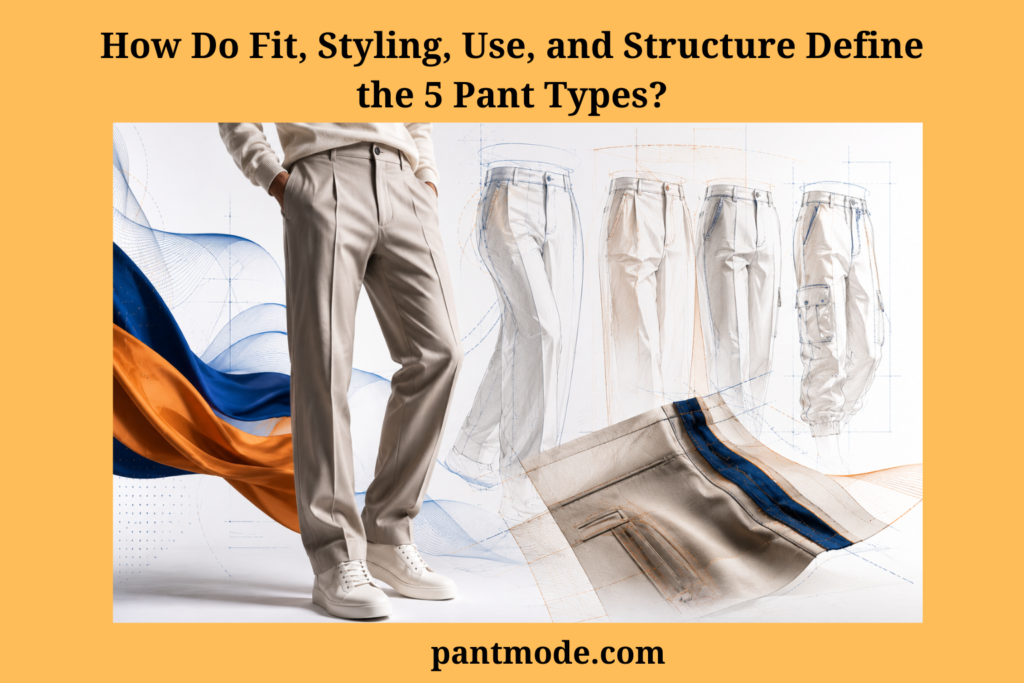
How Do Fit, Styling, Use, and Structure Define the 5 Pant Types?
Fit, styling, use, and structure define the 5 pant types by showing how each category creates a different silhouette, formality level, movement pattern, and wardrobe function.
This guide explains core pant types, casual pant types, wide and flared pant types, fit and detail pant types, and specialty and other pant types so each category stays clear, practical, and easy to compare.
Quick Answer
The 5 pant types are defined by the job each category performs. Core pant types create polished structure, casual pant types create daily ease, wide and flared pant types control volume and proportion, fit and detail pant types refine silhouette through construction details, and specialty pant types solve function-led needs such as movement, travel, workwear, or utility.
Definition
Pant types are garment categories organized by fit, styling, use, and structure. Fit explains how the pant sits on the body, styling explains the visual language, use explains the environment, and structure explains the waistband, leg shape, fabric behavior, closures, pockets, seams, and hem design.
Figure: pant types classification map supports pant type comparison without turning the guide into a product page.
Why does understanding pant types improve your styling strategy?
Understanding pant types improves styling strategy because each category communicates a different level of structure, formality, movement, and visual intent.
The rule is to match the pant type to the outfit’s formality, silhouette, and purpose.
A strong pant-type decision starts with four checks: the pant’s construction, its intended environment, the line it creates on the body, and whether the fabric supports the amount of movement required. This prevents choosing a pant by name alone.
For example, a pleated trouser, a wide-leg pant, and a cargo pant can all be comfortable, but they solve different problems. One adds tailored drape, one adds visual volume, and one adds utility. The category becomes accurate only when fit, styling, use, and structure agree.
Tailored wool trousers usually support sharper outfits because their structure and drape create polish, while relaxed sweatpants communicate comfort and casual movement.
| Pant Type | Primary Structure | Typical Use | Formality Level | Common Styling Goal |
|---|---|---|---|---|
| Core Pant Types | Structured waistband, controlled drape | Office, polished daily wear | Medium to high | Create a refined foundation |
| Casual Pant Types | Relaxed fabric and easy construction | Daily casual outfits | Low to medium | Support comfort and versatility |
| Wide & Flared Pant Types | Expanded leg volume | Statement silhouettes | Depends on fabric and styling | Control proportion and movement |
| Fit & Detail Pant Types | Pleats, taper, pockets, cropped hems | Detail-led styling | Context-dependent | Add shape, utility, or visual character |
| Specialty & Other Pant Types | Function-led construction | Travel, outdoor, workwear, movement | Use-dependent | Match garment structure to environment |
How Do Use, Fabric, and Fit Define Core Pant Types?
Use, fabric, and fit define core pant types by giving them the structure, polish, and versatility needed for refined daily outfits.
Structured waistbands, pressed creases, controlled drape, and refined fabrics help core pants hold a cleaner line.
The deeper test for core pants is whether they can anchor an outfit without relying on loud styling. A good core pant should hold the waist cleanly, fall smoothly through the leg, and support footwear without fighting the hem line.
Core wardrobe planning becomes clearer when core types act as the structured foundation of the outfit.
Figure: core pant structure supports pant type comparison without turning the guide into a product page.
| Pant Type | Fabric | Structure Level | Formality Level | Best Environment |
|---|---|---|---|---|
| Dress Pants | Refined woven fabric | High | High | Formal, office, polished events |
| Tailored Trousers | Wool or wool-like drape | High | Medium to high | Smart outfits and workwear |
| Chinos | Cotton twill | Medium | Medium | Smart casual rotation |
| Khakis | Cotton-based fabric | Medium | Medium | Casual office and daily wear |
How Do Versatility, Utility, and Styling Define Casual Pant Types?
Versatility, utility, and styling define casual pant types by making them adaptable to everyday outfits, relaxed movement, and practical wardrobe rotation.
If the pant has rugged denim, soft fleece, relaxed cotton, or utility details, pair it with equally casual textures and garments.
Casual pants should not be judged as less important than formal pants. They carry most daily outfits, so fabric comfort, pocket placement, wash level, waistband behavior, and shoe compatibility matter as much as the name of the pant type.
Everyday outfits work better when casual types support texture, comfort, utility, and ease.
How Do Fit, Styling, and Occasion Use Define Wide & Flared Pant Types?
Fit, styling, and occasion use define wide and flared pant types because expanded leg volume changes body proportion, outfit balance, and the formality of the silhouette.
The rule is to control upper-body proportion when the lower body gains volume.
The deeper wide-leg test is proportion control. A wide or flared pant needs enough rise, drape, and hem discipline to look intentional. If the fabric collapses, the hem drags, or the top half has no anchor, volume can look accidental instead of elegant.
Proportion control matters because wide/flared types change leg volume and silhouette balance.
Figure: wide and flared proportion control supports pant type comparison without turning the guide into a product page.
| Body Proportion | Recommended Rise | Recommended Leg Shape | Recommended Pant Types | Pant Types to Limit |
|---|---|---|---|---|
| Shorter torso / longer legs | Mid rise | Straight or softly wide | Chinos, straight trousers, relaxed wide-leg pants | Extremely high-rise shapes when balance is the goal |
| Longer torso / shorter legs | Mid to higher rise | Straight, tapered, or clean wide leg | Tailored trousers, cropped straight pants | Heavy stacking and low-rise shapes |
| Balanced proportions | Comfort-based rise | Most leg shapes | Core, casual, wide, and detail-led pants | Overly long hems that hide footwear |
How Do Fit, Silhouette, and Styling Define Fit & Detail Pant Types?
Fit, silhouette, and styling define fit and detail pant types by showing how pleats, tapering, pockets, cropped hems, and construction lines change the garment’s shape and purpose.
Pleats can add controlled front volume, tapering narrows the visual line, cargo pockets add utility emphasis, and cropped hems highlight footwear.
Fit and detail pants should be read like construction signals. Pleats add front room, darts shape contour, taper controls the lower leg, cropped hems frame footwear, and pocket placement can either support utility or disrupt proportion.
Small construction choices become easier to judge when fit details shape silhouette and use.
Figure: fit and detail impact map supports pant type comparison without turning the guide into a product page.
| Detail | Structural Change | Styling Impact | Best Proportion Use Case | Best Use Case |
|---|---|---|---|---|
| Pleats | Add front volume | Creates classic depth | When thigh ease or drape is desired | Smart casual, tailored outfits |
| Taper | Narrows toward the hem | Creates a cleaner leg line | When reducing lower-leg volume helps balance | Daily outfits, clean footwear styling |
| Cargo pockets | Add side utility volume | Creates functional character | When extra side detail suits the outfit | Casual, utility, streetwear styling |
| Cropped hem | Shortens visible pant length | Shows footwear and ankle line | When clean shoe visibility is desired | Modern casual and smart casual outfits |
How Do Fit, Structure, and Comfort Define Specialty & Other Pant Types?
Fit, structure, and comfort define specialty and other pant types by connecting garment design to movement, durability, utility, and environmental demands.
Outdoor work, travel, hiking, technical movement, and high-abrasion activities may require reinforced zones, stretch, mobility cuts, or secure pockets, but those functions need garment-level support.
Specialty pant types require the strictest boundary check because function claims should be visible in the garment. A travel pant should show comfort and security features; a workwear pant should show reinforcement; a movement pant should show mobility through cut, stretch, gussets, or waistband design.
Function-led outfits need clearer boundaries because specialty types connect fit, structure, and comfort to use.
| Environment | Movement Requirement | Fabric Requirement | Structural Requirement | Recommended Pant Types |
|---|---|---|---|---|
| Travel | Sitting, walking, repeated movement | Comfort-focused fabric | Flexible waistband or secure pockets | Travel pants, technical chinos |
| Outdoor casual use | Walking and bending | Weather-aware only when labeled | Mobility-friendly cut | Hiking pants, utility pants |
| Workwear styling | Standing, kneeling, carrying items | Durability only when supported by construction | Reinforced zones or functional pockets | Work pants, double-knee pants |
How do you choose the correct pant types for your body proportions?
You choose the correct pant types for your body proportions by matching rise, leg shape, drape, and hem length to the visual balance you want to create.
If you have a shorter torso and longer legs, a mid-rise pant may create easier balance than an extremely high-rise pant.
| Body Shape / Proportion Pattern | Recommended Rise | Recommended Leg Shape | Recommended Pant Types | Styling Objective |
|---|---|---|---|---|
| Shorter torso / longer legs | Mid rise | Straight, relaxed straight, soft wide | Chinos, straight trousers, relaxed pants | Reduce torso compression |
| Longer torso / shorter legs | Mid to high rise | Clean straight or tapered | Tailored trousers, chinos, structured denim | Create a longer leg line |
| Fuller lower-body volume | Comfort-based rise | Straight or softly wide | Pleated trousers, relaxed chinos | Allow ease without pulling |
How can you fix tailoring mistakes that ruin pant types?
You can fix tailoring mistakes that ruin pant types by identifying the visible error, tracing its structural cause, and choosing either a fit adjustment, length correction, or better pant category.
Pocket flare often signals insufficient seat or hip room rather than a body problem.
Excess stacking or fabric pooling usually points to length mismatch, while thigh restriction suggests the pant category may not match the movement or fit you need.
Figure: pant break diagnostic visual supports pant type comparison without turning the guide into a product page.
Pant Break Diagnostic Checklist
Use this checklist in front of a mirror with the shoes you actually wear. The correct pant break should support the pant type, not hide the leg shape.
- No break: Use for sharp tailoring, cropped styling, and clean footwear visibility. Best when the hem barely touches the shoe.
- Slight break: Use for the safest modern balance. The hem rests lightly on the shoe without repeated folds.
- Half break: Use for more traditional tailoring when fabric has enough weight to fold cleanly.
- Full break: Use carefully. It can look classic on heavier trousers but messy on soft, slim, or casual fabrics.
- Excess stacking: Treat as a warning sign. It usually means the inseam is too long or the leg opening is too narrow for the shoe.
- Fabric pooling: Fix immediately with hemming, cuffing, or a different cut because pooling hides the pant line and weakens the outfit.
Which essential pant types should anchor your wardrobe checklist?
Essential pant types should anchor your wardrobe by covering polished structure, casual versatility, silhouette variety, detail-driven styling, and environment-specific function.
A practical wardrobe does not need every pant variation; it needs clear category coverage.
| Pant Type | Essential Example | Primary Use | Recommended Color | Owned? |
|---|---|---|---|---|
| Core Pant Types | Tailored wool trousers | Polished outfits | Black, navy, charcoal, or grey | ☐ |
| Casual Pant Types | Dark straight-leg denim | Everyday outfits | Dark blue or black | ☐ |
| Wide & Flared Pant Types | Relaxed wide-leg trousers | Silhouette variety | Neutral tone | ☐ |
| Fit & Detail Pant Types | Pleated chinos or cargo pants | Detail-driven styling | Khaki, olive, navy, or black | ☐ |
| Specialty Pant Types | Technical or workwear pants | Function-specific use | Black, olive, or tan | ☐ |
5-Pant Wardrobe Decision Checklist
Use this checklist before buying another pair of pants. A complete wardrobe should cover structure, comfort, proportion, detail, and function without repeating the same role five times.
- Core foundation: Own one structured pant that works with shirts, knitwear, jackets, and polished shoes.
- Casual rotation: Own one daily pant that handles walking, sitting, errands, and relaxed styling without looking careless.
- Proportion tool: Own one wide, flared, or relaxed silhouette that changes the leg line and balances body proportions.
- Detail piece: Own one pant with a purposeful detail such as pleats, taper, cargo pockets, cropped length, or a distinctive waistband.
- Function piece: Own one specialty pant for travel, workwear, outdoor movement, cold weather, or another real environment in your life.
- Replacement rule: If a new pant does not improve one of these five roles, it is probably duplication, not a wardrobe upgrade.
Frequently Asked Questions
The 5 pant types are core pant types, casual pant types, wide and flared pant types, fit and detail pant types, and specialty pant types. A strong wardrobe usually needs one clear example from each category so your pants cover polish, comfort, proportion, detail, and function.
Start with your real use case. Choose core pants for polish, casual pants for daily wear, wide or flared pants for proportion control, fit and detail pants for silhouette refinement, and specialty pants for travel, workwear, outdoor use, or movement.
Yes. Jeans can be core or casual, chinos can be core or casual, and wide-leg trousers can be polished or relaxed. The final category depends on fabric, structure, fit, styling, and the environment where the pant is worn.
Fit and detail pant types usually help fastest because rise, pleats, taper, hem length, darts, and leg shape directly change the visual line. Wide and flared pant types also help when the goal is to balance volume or create a longer leg effect.
The biggest mistake is choosing by name only. A pant label does not guarantee fit, comfort, polish, or function. Always check rise, waistband behavior, thigh room, drape, hem break, fabric weight, and shoe compatibility.
A beginner can start with five: one structured core pant, one comfortable casual pant, one wide or relaxed silhouette, one detail-led pant, and one function-specific pant. This creates range without overbuying.
Conclusion
Pant types become easier to understand when they are classified by fit, styling, use, structure, and the specific role each category plays in a wardrobe.
Core, casual, wide and flared, fit and detail, and specialty pant types each solve a different styling problem when judged by silhouette, structure, comfort, and purpose.