
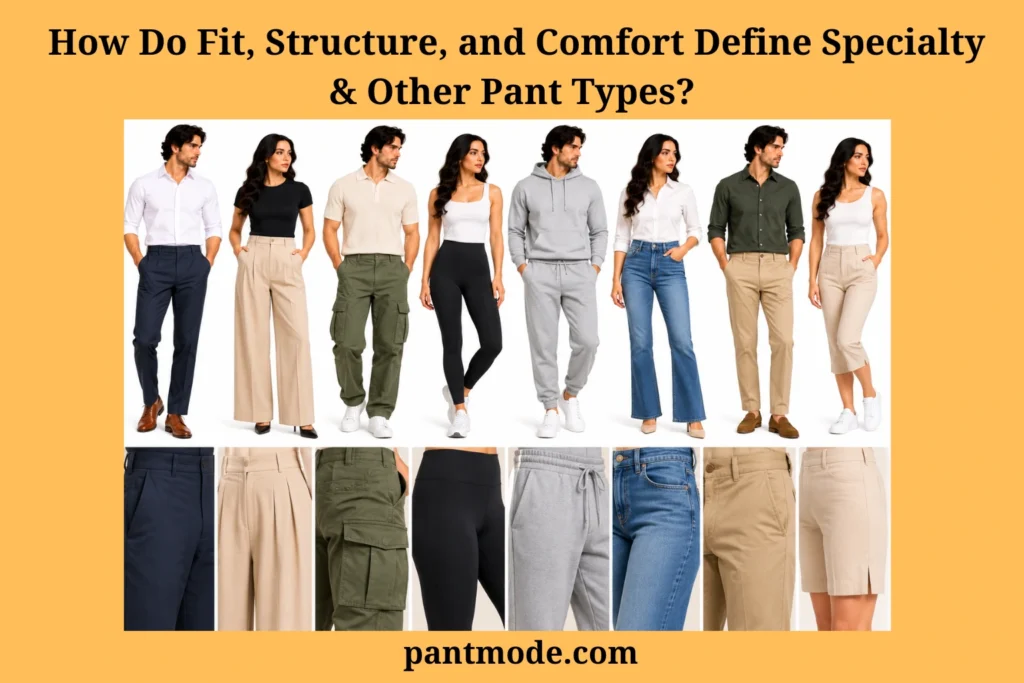
How Do Fit, Structure, and Comfort Define Specialty & Other Pant Types?
Fit, structure, and comfort explain the practical characteristics of specialty and other pant types, but garment identity and intended purpose determine which requirements those dimensions must satisfy.
A pant does not become specialized simply because it looks unusual. Specialty status begins with a recognizable functional, adaptive, activity-related, accessibility, work, movement, or configurable requirement and a relevant design response.
Within PantMode’s main pant type categories, specialty classification should therefore begin with identity and purpose before technical fit, structural details, comfort, or performance claims are evaluated.
Quick Answer
Specialty pant types are defined first by a recognizable specialized design requirement. Fit determines how the garment accommodates the wearer and intended movement, structure determines how the requirement is built into the garment, and comfort reflects the resulting wearing experience. “Other pant types” is an editorial grouping and does not automatically imply technical performance.
Definition
Specialty Pant Type: a pant design built around an identifiable specialized functional, adaptive, activity-related, accessibility, work, movement, or technical requirement.
Other Pant Type: a legitimate pant or related lower-body style grouped outside PantMode’s primary categories without necessarily having a specialized technical function.
Functional suitability: the evidence-based judgment that the garment’s identity, fit, construction, comfort conditions, and verified limitations are compatible with the intended requirement.
Key Takeaway
Identity and purpose determine the category; fit, structure, comfort, and evidence determine suitability.
How Do Fit, Structure, and Comfort Define Specialty and Other Pant Types?
Fit, structure, and comfort define the practical design of specialty and other pant types by explaining accommodation, construction, and wearer response relative to an identified purpose.
| Dimension | Role | Main Question |
|---|---|---|
| Identity | Defines the garment | What is it? |
| Purpose | Defines the requirement | Why is it designed this way? |
| Fit | Defines accommodation | How does it accommodate the wearer? |
| Structure | Defines construction mechanism | How is the requirement built in? |
| Comfort | Defines wearer response | How does it behave during relevant wear? |
| Evidence | Tests claims | What supports the claimed function? |
| Suitability | Final decision | Does it meet the defined requirement? |
What Distinguishes Specialty Pants from Other Pant Styles?
Specialty pants require a recognizable specialized requirement, while “other pant types” may simply occupy an editorial position outside PantMode’s primary pant families.
| Category | Required Evidence | Important Boundary |
|---|---|---|
| Specialty | Purpose + relevant design response | Unusual appearance alone is insufficient |
| Other | Legitimate editorial grouping | Does not automatically imply technical function |
| Conventional | Recognized ordinary garment identity | Can still contain specialized features |
| Traditional | Established cultural garment identity | Unfamiliarity does not make it technical |
| Hybrid | Multiple valid category signals | Do not force exclusivity |
How Does Fit Influence Specialized Trouser Design?
Fit influences specialized trouser design by controlling how garment dimensions, ease, shaping, and adjustment interact with the wearer and the intended movement or task.
Threads discusses pants fit, ease, and movement measurements, including how pant style affects which measurements matter and how thigh, knee, calf, rise, and ease relationships become important in closer-fitting constructions.
The source supports fit and measurement principles. It does not independently prove specialty classification, accessibility, gusset performance, protection, or any particular technical pant claim.
For PantMode’s broader construction taxonomy, see pant fit and construction details.
| Fit Variable | Potential Role | Diagnostic Question |
|---|---|---|
| Rise | Positions waist-to-crotch geometry | Does the rise support the intended stance and task? |
| Seat / thigh | Controls available upper-leg volume | Is movement accommodated without uncontrolled excess? |
| Knee | Supports flexion zone | Does shaping align with the intended knee position? |
| Calf / lower leg | Controls lower-leg clearance | Does the garment avoid unnecessary restriction? |
| Ease | Adds space between body and garment | Is ease distributed where the task requires it? |
| Adjustment range | Changes usable fit configuration | Can the adjustment be used effectively? |
Which Structural Features Matter in Specialty Pants?
Structural features matter when they provide a plausible construction response to a defined garment requirement.
| Structural Feature | Intended Mechanism | Required Verification |
|---|---|---|
| Gusset | Changes panel and seam geometry | Movement test |
| Articulated knee | Shapes knee region for bent-leg use | Alignment and movement test |
| Reinforced panel | Adds material or structure locally | Durability evidence if durability is claimed |
| Adjustable waistband | Changes usable circumference | Range and usability test |
| Accessible closure | Changes don/doff method | Operation test with intended user |
| Utility pocket | Adds storage and access | Placement and task test |
| Convertible section | Changes garment configuration | Test all intended configurations |
Cargo pant utility design provides a useful utility example because pockets and storage architecture can be structurally important. Cargo identity, however, does not automatically make every cargo pant a specialty garment.
How Do Comfort Requirements Shape Specialty Pants?
Comfort requirements shape specialty pants through the interaction of garment fit, materials, pressure, movement, thermal conditions, moisture transfer, contact, and use duration.
A textile-science review of clothing thermal and moisture comfort describes thermophysiological comfort as a skin–clothing–environment interaction involving heat transfer, moisture transfer, fabric properties, air gaps, microclimate, and environmental conditions.
This evidence supports thermal and moisture mechanisms. It does not prove that one particular specialty pant is comfortable or that one fabric is universally superior.
| Comfort Dimension | Relevant Variables | Evaluation Boundary |
|---|---|---|
| Mobility | Fit, ease, articulation, geometry | Stretch alone is insufficient |
| Pressure | Waist, seams, local compression | Immediate comfort may differ from prolonged wear |
| Friction | Surface contact, seams, movement | Depends on garment and use conditions |
| Thermal response | Material, air gap, environment | Fabric alone does not determine outcome |
| Moisture response | Transfer, retention, ventilation | Must be interpreted within use context |
| Prolonged wear | Duration, movement, pressure, environment | Short-term comfort is not complete evidence |
How Do Fit, Structure, and Comfort Interact?
Fit determines the accommodation requirement, structure supplies the construction response, and comfort reflects the resulting interaction during relevant use.
| Requirement | Fit Response | Structural Response | Comfort / Wear Response |
|---|---|---|---|
| Repeated knee flexion | Knee ease and alignment | Articulated shaping | Movement response |
| Variable waist | Usable fit range | Adjuster | Pressure and usability |
| Abrasion exposure | Stable coverage | Reinforcement | Weight and contact trade-off |
| Accessible dressing | User-compatible fit | Adapted closure | Operation effort |
| Configurable coverage | Fit across configurations | Removable or adjustable parts | Coverage and ventilation trade-off |
Which Specialty and Other Pant Types Demonstrate the Framework?
Representative garment types demonstrate the framework only when their established identity remains separate from any added technical or specialized features.
| Representative Type | Classification Lesson |
|---|---|
| Movement-oriented trousers | Specialty when construction is purpose-led and functionally relevant |
| Reinforced work trousers | Utility construction does not prove certified protection |
| Adaptive trousers | Accessibility must match the intended wearer and use |
| Convertible trousers | Configuration is a structural feature that must work in each mode |
| Cargo pants | Utility identity does not automatically equal specialty status |
| Traditional garments | Cultural identity must be preserved |
| One-piece related garments | Related lower-body coverage does not automatically make the garment specialty pants |
Traditional Sirwal pants demonstrate why an unfamiliar or culturally distinctive garment should not be relabeled as a technical specialty simply because its shape differs from conventional Western trousers.
Likewise, jumpsuit one-piece construction belongs to its own garment identity. A jumpsuit can contain specialized features, but it should not automatically be classified as a specialty pant.
Which Problems Cause Misclassification or Unsuitability?
Specialty pants become incorrectly classified or unsuitable when appearance substitutes for evidence or when the garment’s fit and construction fail to satisfy the actual requirement.
| Problem | Likely Cause | Verification |
|---|---|---|
| Unusual appearance = specialty | Taxonomy error | Identify actual purpose |
| Technical-looking decoration | Visual assumption | Inspect construction and use |
| Restricted movement | Fit or geometry mismatch | Movement test |
| Excess fabric interference | Poor ease distribution | Task simulation |
| Closure is difficult to operate | Accessibility mismatch | Operation test |
| Pressure discomfort | Local fit or seam issue | Wear test |
| Thermal discomfort | Garment / environment mismatch | Contextual comfort assessment |
| Traditional garment labeled technical | Identity error | Taxonomy review |
How Should Specialty and Other Pants Be Evaluated?
A controlled evaluation starts with garment identity and the intended requirement, then moves through construction, fit, usability, comfort, evidence, and trade-offs in a repeatable order.
Which Specialty Pant Design Should Be Chosen?
The correct choice begins with the requirement rather than a feature count or technical-looking appearance.
| Requirement | Selection Focus |
|---|---|
| Repeated knee movement | Fit + knee shaping + movement verification |
| Work utility | Task fit + storage + reinforcement evidence |
| Accessible dressing | User-compatible fit + operable closure |
| Adjustable conditions | Fit range + usable configuration system |
| Prolonged wear | Stable fit + contact + thermal/moisture conditions |
| Traditional identity | Correct cultural classification first |
| Uncommon everyday design | Treat as ordinary garment unless specialty evidence exists |
What Checklist Confirms Classification and Suitability?
Identity & Purpose
Fit & Movement
Structure & Comfort
Evidence & Suitability
Frequently Asked Questions About Specialty & Other Pant Types
Pants designed around identifiable specialized functional, adaptive, technical, or activity-related requirements.
It is PantMode’s editorial grouping for legitimate styles outside the site’s primary pant categories.
No. “Specialty” requires a specialized design requirement; “other” does not.
No. Movement also depends on where ease is distributed, garment geometry, articulation, material behavior, and the movement being performed.
No. Reinforcement changes local garment construction, but protective performance requires appropriate supporting evidence or certification.
What Final Rule Should Guide Specialty Pant Classification?
Do not classify from appearance and do not judge suitability from one feature. Identify the garment, define the requirement, inspect fit and construction, test the relevant wearing conditions, verify the evidence, record the trade-offs, and then make the classification and selection decision.
Specialty and other pant types should be classified from garment identity and intended purpose first, then evaluated through fit, structure, comfort, evidence, and trade-offs.
Fit explains how the garment accommodates the wearer and required movement. Structure explains how seams, panels, articulation, reinforcement, closures, pockets, adjusters, or configurable components respond to the design requirement. Comfort reflects the wearer’s response under relevant movement, contact, duration, thermal, and moisture conditions.
None of these variables should be converted automatically into performance proof. The strongest final decision comes from matching a defined requirement to observable construction, relevant measurements, controlled wear testing, appropriate evidence, and clearly stated limitations.