
How Do Utility and Design Shape the Structure of Cargo Pants?
Cargo pants structure is shaped by how utility pockets, durable fabric, reinforcement, mobility features, hem design, and silhouette control work together.
Cargo pants are not defined by pockets alone. Their usability depends on pocket placement, fabric support, reinforcement, mobility, and bulk control, which this guide explains through utility origin, cargo anatomy, fabric behavior, pocket layouts, structural flaws, and a final cargo structure evaluation checklist.
Quick Answer: How Do Utility and Design Shape Cargo Pants Structure?
Utility and design shape cargo pants structure through pocket placement, fabric durability, reinforcement, mobility features, and silhouette control. Well-designed cargo pants store items efficiently without creating saddlebag hips, sagging pockets, restricted movement, dragging hems, or unnecessary bulk.
Definition: Cargo Pants Structure
Cargo pants structure refers to the design system that combines utility pockets, durable fabric, reinforced stress points, mobility features, waistband stability, hem control, and silhouette balance. Good cargo structure allows storage and movement without ruining comfort, drape, or everyday wearability.
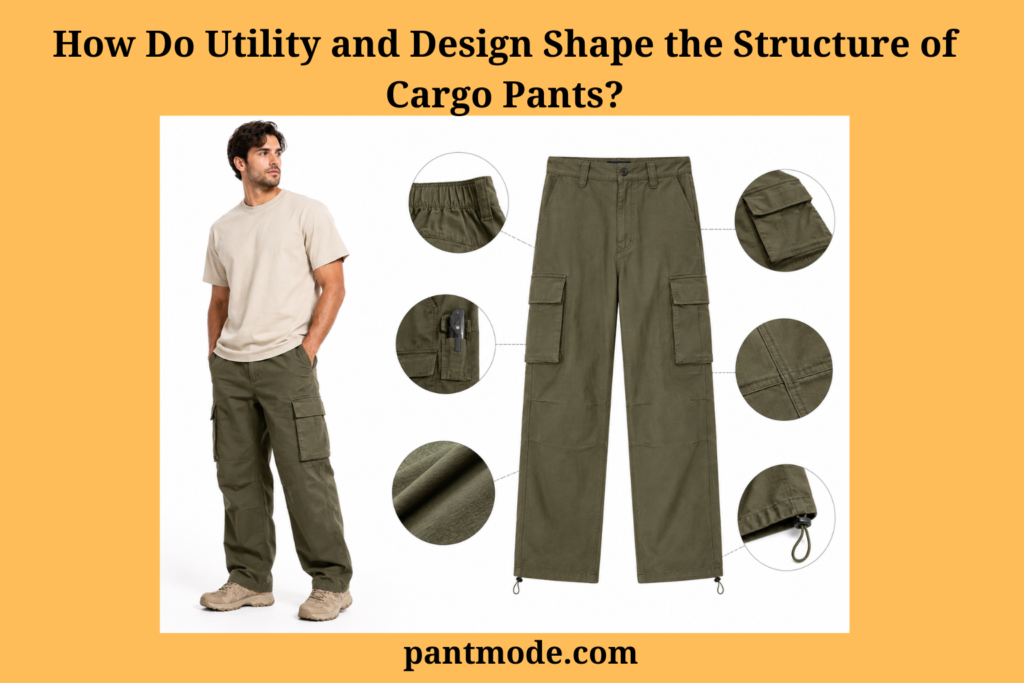
Figure: cargo pants structure works when pocket layout, fabric support, mobility, hem control, and bulk balance support the same use case.
How Did Military Utility Influence the Core Structure of Cargo Pants?
Military utility influenced cargo pants structure by moving storage from the waist area to external thigh pockets that stayed accessible during movement.
Cargo pants are commonly linked to military fieldwear where soldiers needed extra storage during movement. External pocket placement allowed essential items to be carried outside the main waist pockets. Trouser storage moved from only the hip area toward the thigh and leg, and the same storage logic now appears in workwear, streetwear, outdoor pants, tactical-inspired fashion, and everyday utility trousers.
Field movement required pants that could carry gear without fully blocking mobility. Wider legs, reinforced seams, pleated pockets, and adjustable hems balanced storage with movement. Cargo pants became structurally different from plain trousers because they were built around function, but utility should not destroy comfort or drape.
Utility pockets became a visual design language. Large thigh pockets, flap closures, cinch hems, and reinforced panels created a functional look. Modern cargo style can be rugged, minimal, technical, oversized, or streamlined, but the style should match the real use case.
For deeper historical context, see cargo origin.
Boundary note: modern cargo pants can be workwear, streetwear, outdoor, tactical-inspired, or everyday casual. They are not only military garments.
Utility Origin Rule Blocks
| Context | Cause | Effect | Modern Meaning | Boundary |
|---|---|---|---|---|
| Military fieldwear needed extra storage during movement | External pocket placement carried items outside waist pockets | Storage moved toward the thigh and leg | The logic appears in workwear, streetwear, outdoor, and casual utility pants | Cargo pants are not only military garments |
| Field movement required storage without blocking mobility | Wider legs, reinforced seams, pleated pockets, and adjustable hems balanced movement | Cargo pants became structurally different from plain trousers | Good cargo design still depends on storage, fabric, and fit working together | Utility should not destroy comfort or drape |
| Utility pockets became a visual design language | Thigh pockets, flaps, cinch hems, and reinforced panels created a functional look | Cargo pants became recognizable as casual fashion | Modern cargos can be rugged, minimal, technical, oversized, or streamlined | Style should match the real use case |
What Anatomical Features Define Modern Cargo Pants Structure?
Modern cargo pants structure is defined by expandable thigh pockets, secure closures, reinforced stress zones, articulated knees, gusseted mobility, adjustable hems, aligned seams, and stable waist construction.
Bellows or expandable thigh pockets create storage capacity. They expand when loaded and should lie flat when empty. A pocket that bulges even when empty creates unnecessary side bulk.
Pocket flaps, zippers, snaps, and hidden closures secure items. Secure closures improve function for travel, outdoor use, and daily carry. Weak closures or noisy flaps can reduce comfort and visual cleanliness.
Reinforced seats and knees handle abrasion. Double-layer fabric or dense fabric can improve durability in workwear and outdoor use. Reinforcement should not make the pant stiff or uncomfortable.
Articulated knees support bending. Knee darts or shaped panels allow the leg to bend more naturally. Poorly shaped panels can still pull across the thigh or calf.
Gusseted crotches reduce seam strain. A diamond gusset or mobility panel can improve stride and sitting comfort. Not every everyday cargo needs technical gusseting.
Adjustable hems control the leg opening. Drawcords, snap tabs, cuffs, or cinch openings help the pant work with footwear. Poorly designed drawcord hems can drag, twist, or bunch.
Side seams and waist structure keep the pant stable. Balanced panel construction, reinforced belt loops, and stable waistbands help the legs hang straight. Weak loops, twisted legs, or loose waists reduce utility and comfort.
Boundary note: not every cargo pant needs every feature. Workwear, streetwear, outdoor, travel, and everyday cargos require different anatomy priorities.
Core Cargo Anatomy Table
| Cargo Feature | Structural Purpose | Modern Design Equivalent | Quality Signal | Red Flag |
|---|---|---|---|---|
| Bellows thigh pocket | Expandable storage | Flat cargo pocket or oversized streetwear pocket | Expands but lies flat when empty | Bulges even when empty |
| Pocket flap / zipper | Secures items | Hidden zip, snap flap, Velcro flap | Easy access and secure closure | Weak closure or noisy flap |
| Reinforced seat | Handles abrasion | Double-layer seat or dense fabric | Durable without stiffness | Thin seat fabric |
| Articulated knee | Supports bending | Knee darts or shaped panel | Natural movement | Pulling at knee |
| Gusseted crotch | Reduces seam strain | Diamond gusset or mobility panel | Flexible stride | Crotch tightness |
| Adjustable hem | Controls leg opening | Drawcord, snap tab, cuff | Clean shoe interaction | Dragging or fraying hem |
| Side seams | Maintains leg alignment | Balanced panel construction | Straight hang | Twisted legs |
| Belt loops / waistband | Holds structure | Reinforced loops, stable waist | No rolling or sagging | Weak loops or loose waist |
How Do Fabric Choices Change Cargo Pant Utility, Drape, and Durability?
Fabric choices change cargo pant utility, drape, and durability by determining how well the pants support pocket weight, resist abrasion, move with the body, and hold their silhouette.
If the need is rugged workwear or outdoor casual wear, choose heavy cotton canvas. Canvas supports abrasion resistance and reinforced bellows pockets. The watch-out is stiffness and bulk in warm climates or city wear.
If the need is balanced everyday wear, choose cotton twill. Twill gives durable casual structure and supports flat or moderate cargo pockets. The watch-out is weight if the fabric is too heavy.
If the need is tear resistance, choose ripstop cotton. Ripstop supports outdoor and utility casual use while keeping a slightly crisp drape. The watch-out is wrinkling and a more technical texture.
If the need is travel, hiking, or techwear, choose nylon or ripstop nylon. Nylon can feel lightweight and technical while supporting zip or hidden pockets. The watch-out is shine or noise.
If the need is mobility and weather resistance, choose nylon-spandex. A flexible blend supports commuting and active use. The watch-out is a sporty look if the fabric is too shiny.
If the need is everyday comfort, choose cotton-stretch blends. Cotton-stretch fabric creates softer drape for daily casual cargos. The watch-out is knee bagging if the recovery is weak.
If the need is streetwear character, choose denim cargo fabric or structured cotton. Heavy fabric supports utility flap pockets and bold silhouette. The watch-out is stiffness and extra bulk.
If the need is smart-casual utility, choose refined twill or matte technical fabric. Cleaner materials support minimal cargo pockets and polished structure. For refined daily comfort, compare polished comfort.
For broader fabric behavior, see cut and fabric.
Boundary note: fabric must match pocket volume, climate, and intended use. No single cargo fabric is best for every setting.
Fabric Utility and Drape Matrix
| Fabric Choice | Utility Strength | Drape / Silhouette | Best Use Case | Main Risk | Best Pocket Type |
|---|---|---|---|---|---|
| Heavy cotton canvas | High abrasion resistance | Rigid and structured | Workwear, outdoor casual | Stiffness and bulk | Reinforced bellows pockets |
| Cotton twill | Durable and balanced | Clean casual structure | Everyday cargos | Can feel heavy | Flat or moderate cargo pockets |
| Ripstop cotton | Tear resistance | Slightly crisp | Outdoor / utility casual | Can wrinkle | Secure flap pockets |
| Nylon / ripstop nylon | Lightweight and technical | Fluid or parachute-like | Techwear, travel, hiking | Shine or noise | Zip or hidden pockets |
| Nylon-spandex blend | Mobility and weather resistance | Flexible and smooth | Commuting, active use | Too sporty | Low-profile zip pockets |
| Cotton-stretch blend | Comfort and casual wear | Softer drape | Everyday casual | Knee bagging | Flat-lay pockets |
| Denim cargo fabric | Rugged casual character | Heavy and structured | Streetwear | Can feel stiff | Utility flap pockets |
| Refined twill | Cleaner appearance | Polished structure | Smart-casual utility | Less rugged storage | Minimal cargo pockets |
Figure: cargo pockets work best when height, volume, closure, pant width, and use case stay balanced.
Which Cargo Pocket Placements Maximize Function Without Adding Impractical Bulk?
Cargo pocket placements maximize function without adding impractical bulk when pocket height, pocket volume, closure type, pant width, and carry needs stay balanced.
Symmetrical mid-thigh bellows pockets support workwear and outdoor use. They provide balanced heavy carry and create the classic cargo look. Avoid them if you want a slim silhouette.
Flat mid-thigh pockets support everyday city wear. They provide light storage while preserving a cleaner profile. Avoid them when you need high-capacity workwear storage.
Hidden zip pockets support commuting, travel, and techwear. They secure valuables and keep the outside minimal. Avoid them if you prefer visible heritage cargo styling.
Large flap pockets support streetwear and utility fashion. They add visual impact and storage. Avoid them if you dislike bulk or need a cleaner leg line.
Rear utility pockets support light storage. They keep the front cleaner, but they can reduce sitting comfort when overloaded.
Calf or ankle cargo pockets are niche. They can help seated work or tactical utility, but they disrupt the leg line during everyday walking.
Angled cargo pockets support active movement. They improve access during motion and create a technical appearance. Avoid them for cleaner formal-casual styling.
Internal cargo compartments support travel organization. They keep the outside sleek, but they are slower to access than external pockets.
Boundary note: storage should improve use, not distort the silhouette. More pockets do not automatically mean better cargo pant design.
Cargo Pocket Utility Matrix
| Pocket Placement / Type | Best Use Case | Utility Benefit | Design Effect | Avoid When |
|---|---|---|---|---|
| Symmetrical mid-thigh bellows | Workwear, outdoor use | Balanced heavy carry | Classic cargo look | You want a slim silhouette |
| Flat mid-thigh pockets | Everyday casual, city wear | Light storage | Cleaner profile | You need high capacity |
| Hidden zip pockets | Commute, travel, techwear | Security | Minimal and modern | You prefer heritage styling |
| Large flap pockets | Streetwear, utility fashion | Visual impact and storage | Bold silhouette | You dislike bulk |
| Rear utility pockets | Light storage | Keeps front clean | Functional but subtle | Sitting comfort matters |
| Calf / ankle pockets | Seated work, tactical utility | Niche accessibility | Disrupts leg line | Everyday walking |
| Angled cargo pockets | Active movement | Easier access | Technical appearance | Formal casual styling |
| Internal cargo compartments | Travel, security | Hidden organization | Sleek outside | Quick access is needed |
What Structural Flaws Should You Avoid When Fitting Cargo Pants for Everyday Wear?
The structural flaws to avoid in everyday cargo pants are saddlebag hips, dragging hems, restricted mobility, sagging pockets, overly tactical details, excessive bulk, broken leg lines, and weak waist stability.
Saddlebag hips happen when pockets sit too high, too wide, or too stiff. Lower flat-bellows pockets create a cleaner side profile and reduce hip expansion.
Dragging hems happen when the inseam is too long or the leg opening lacks control. A drawcord, taper, or proper hemming reduces fraying and keeps footwear interaction clean.
Restricted mobility can happen even in baggy cargos. A wide leg does not always solve movement if there is no gusset, stretch, or knee articulation. Ergonomic construction creates easier movement.
Sagging pockets happen when the pocket bag or pocket corners are weak. Reinforced pocket construction helps the pant carry items without collapsing.
An overly tactical look happens when too many visible details dominate the pant. Tonal hardware and fewer pockets create a more wearable design for everyday outfits.
Excessive bulk happens when heavy fabric, large pockets, and wide cut combine. Balancing fabric and pocket volume creates better proportion.
A broken leg line happens when pockets sit too low or become oversized. Mid-thigh placement creates a longer visual line and better structure.
Poor waist stability happens when the waistband or rise cannot support pocket weight. A stronger waistband and proper rise improve comfort and structure.
For fit correction by silhouette, see cargo fit.
Boundary note: most cargo problems come from imbalance between pocket volume, fabric weight, leg width, and use case. Focus on garment structure and proportion, not body blame.
Cargo Fit Troubleshooting Guide
| Fit Problem | Diagnosis | Best Fix | Result |
|---|---|---|---|
| Saddlebag hips | Pockets too high or too wide | Lower flat-bellows pockets | Cleaner side profile |
| Dragging hem | Inseam too long / no hem control | Drawcord, taper, or hemming | Less fraying |
| Restricted mobility | No gusset or knee articulation | Choose ergonomic construction | Easier movement |
| Sagging pockets | Weak pocket bag or corners | Reinforced pocket construction | Better utility |
| Overly tactical look | Too many visible details | Tonal hardware and fewer pockets | More wearable design |
| Excessive bulk | Heavy fabric + large pockets + wide cut | Balance fabric and pocket volume | Better proportion |
| Broken leg line | Low or oversized pockets | Mid-thigh placement | Longer visual line |
| Poor waist stability | Weak waistband / loose rise | Strong waistband and proper rise | Better comfort |
How Do You Evaluate the Ideal Cargo Pants Structure for Your Specific Lifestyle?
You evaluate the ideal cargo pants structure by matching primary environment, fabric weight, pocket capacity, pocket placement, mobility features, bulk control, hem design, reinforcement, style compatibility, and long-term wear.
Primary environment: ask whether the cargo is for outdoor, workwear, streetwear, travel, commute, or everyday casual. A clear use case prevents overbuilt or underbuilt design.
Fabric weight: ask whether the fabric matches the activity and climate. The pass standard is enough support for pockets without unnecessary stiffness.
Pocket capacity: ask whether the pocket volume is useful without adding bulk. The pass standard is storage that improves use without distorting the leg.
Pocket placement: ask whether cargo pockets sit around a balanced mid-thigh height. The pass standard is easy access and clean side profile.
Mobility features: ask whether the pant includes stretch, gussets, or articulated knees when movement matters. The pass standard is comfort while walking, bending, and sitting.
Bulk control: ask whether fabric, pockets, and leg width work together. The pass standard is a silhouette that avoids saddlebag hips and overloaded pockets.
Hem design: ask whether the hem works with your preferred footwear. The pass standard is no dragging, twisting, or heavy bunching.
Reinforcement quality: ask whether pocket corners, belt loops, and stress points are reinforced. The pass standard is durable construction where storage creates stress.
Style compatibility: ask whether the cargo design works with at least three realistic outfits. The pass standard is intentional utility, not costume-like overload.
Long-term wear: ask whether fabric and construction can handle repeated use. The pass standard is strong seams, useful pockets, stable waist, and controlled hem behavior.
For broader taxonomy placement, see all pant types. For everyday cluster context, see casual pants.
Boundary note: the best cargo pants are not the most pocket-heavy pair. They are the pair that fits the real use case.
Final Cargo Structure Evaluation Checklist
| Evaluation Check | Yes / No |
|---|---|
| Is the primary use case clear: outdoor, workwear, streetwear, travel, commute, or everyday casual? | |
| Does the fabric weight match the activity and climate? | |
| Is the pocket volume useful without adding unnecessary bulk? | |
| Are the cargo pockets placed at a balanced mid-thigh height? | |
| Do the pockets sit flat when empty? | |
| Are pocket corners, belt loops, and stress points reinforced? | |
| Does the pant include mobility support such as gussets, stretch, or articulated knees? | |
| Does the hem work with your preferred footwear? | |
| Does the silhouette avoid saddlebag hips, dragging hems, and overloaded pocket bulk? | |
| Can the pants work with at least three realistic outfits in your wardrobe? | |
| Does the cargo design look intentional rather than overly tactical or costume-like? | |
| Will the fabric and construction hold up after repeated wear? |
Key Takeaway
The best cargo pants structure balances storage with silhouette. Choose fabric that supports pocket weight, pockets that sit flat when empty, reinforcement at stress points, mobility features that reduce restriction, and hems that work with your footwear. Avoid oversized pocket bulk, low pocket placement, weak seams, and overly tactical details unless your use case truly requires them.
Frequently Asked Questions
Utility and design shape cargo pants structure through pocket placement, fabric durability, reinforcement, mobility features, and silhouette control. Good cargo pants store items efficiently without creating unnecessary bulk or restricting movement.
The main features of cargo pants include thigh pockets, secure closures, reinforced stress zones, articulated knees, gusseted mobility, adjustable hems, aligned seams, and stable waist construction.
The best cargo pant fabric depends on use case. Heavy canvas works for rugged use, cotton twill works for everyday cargos, ripstop works for utility wear, nylon works for travel, and refined twill works for cleaner casual styling.
Cargo pockets usually work best around the mid-thigh because that placement balances access, storage, movement, and visual weight better than pockets placed too high, too low, or too wide.
Cargo pants look bulky when pocket volume, fabric weight, leg width, and use case are not balanced. Oversized pockets, heavy fabric, low placement, and weak pocket structure can create saddlebag hips or broken leg lines.
Conclusion
Cargo pants structure works best when utility, pocket placement, fabric durability, mobility, reinforcement, hem control, and silhouette balance support the same real-world purpose.
Cargo pants are shaped by storage needs, external pocket placement, fabric support, reinforcement, and movement requirements.
The best cargo structure depends on lifestyle: workwear, streetwear, outdoor activity, travel, commuting, or everyday casual wear.
Pocket volume must match fabric weight and pant width.
Choose cargo pants by evaluating pocket usefulness, fabric support, mobility, bulk control, hem behavior, and long-term construction durability.