
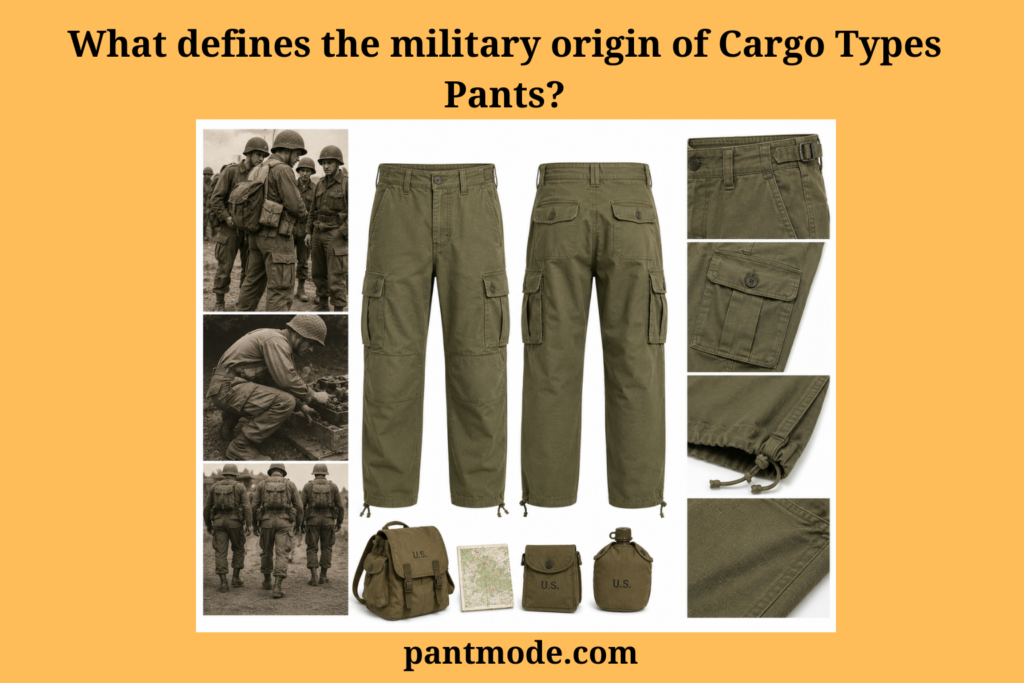
What Defines the Military Origin of Cargo Pants?
The military origin of cargo pants is defined by the development of leg-mounted utility storage in military trousers for field access, equipment management, and movement support.
Cargo pants did not begin as fashion decoration. British Battle Dress trousers introduced early leg-mounted utility-pocket logic, and U.S. M1942 paratrooper trousers later expanded cargo-pocket capacity for airborne use. This guide covers British origin, leg-pocket function, authentic feature inspection, British vs. U.S. comparison, myth correction, and a final identification checklist.
Quick Answer: What Is the Military Origin of Cargo Pants?
The military origin of cargo pants comes from the development of leg-mounted utility storage in military trousers. British Battle Dress trousers introduced early leg-pocket logic with an upper-left map pocket and a smaller shell-dressing pocket, while later U.S. M1942 paratrooper trousers expanded the idea with larger thigh cargo pockets for airborne utility. The original purpose was battlefield access and functional storage, not fashion decoration.
Definition: Military Origin of Cargo Pants
The military origin of cargo pants refers to the historical development of utility pockets placed on military trousers for field storage, access, and movement support. The key origin logic begins with British Battle Dress trousers and later expands through U.S. airborne cargo-pocket adaptations such as M1942 paratrooper trousers.
Figure: cargo pants history should separate British Battle Dress, U.S. M1942 airborne adaptation, later BDU recognition, and civilian fashion adoption.
What Triggered the Military Origin of Cargo Pants in British Battle Dress?
The military origin of cargo pants was triggered by the need for field-accessible trouser storage that supported soldiers carrying compact items without relying only on waist or jacket pockets.
Soldiers needed practical trouser storage for field items. British Battle Dress trousers introduced leg-mounted utility storage through a large front map pocket on the upper left leg and a smaller shell-dressing pocket on the upper right leg. This created an early military logic for moving functional storage onto the legs.
Field movement required accessible storage while standing, kneeling, marching, or working. Placing functional pockets on the upper leg helped separate mission storage from ordinary hip-pocket storage. This made leg-mounted pockets a recognizable design ancestor of later cargo trousers.
Military clothing needed standardization and field use. Battle Dress trousers used durable military cloth, concealed fastening details, and controlled pocket placement. For British 1937 Pattern examples, khaki serge is the correct fabric reference, not a generic cotton canvas claim.
Boundary note: do not call British Battle Dress trousers “BDU,” and do not reduce the British pocket layout to a single pocket.
Historical Timeline of Cargo Pants Military Development
| Period | Development | Key Design Detail | Historical Meaning |
|---|---|---|---|
| Late 1930s | British Battle Dress trousers emerge | Upper-leg map pocket and shell-dressing pocket | Early leg-mounted utility storage |
| 1938 era | British Armed Forces use Battle Dress | Functional storage integrated into uniform trousers | Foundation for military cargo-pocket logic |
| Early 1940s | U.S. airborne forces adapt cargo storage | Larger thigh cargo pockets on paratrooper trousers | Storage expands for airborne missions |
| 1942 | U.S. M1942 paratrooper trousers become iconic | Bellows-style cargo pockets and jump-specific utility | Cargo pockets become strongly associated with paratroopers |
| Post-WWII | Utility-pocket concepts continue in later field uniforms | More standardized military utility layouts | Cargo pockets evolve beyond original Battle Dress |
| 1981 | U.S. Battle Dress Uniform era begins | Camouflage BDU field uniform with utility pockets | Later military cargo styling enters modern recognition |
| 1990s–2000s | Cargo pants enter mainstream fashion | Civilian multi-pocket trousers | Military utility becomes casual fashion language |
Why Did Early Military Cargo Pants Use Leg-Mounted Pocket Placement?
Early military cargo pants used leg-mounted pocket placement because soldiers needed compact field storage that remained accessible during movement and separate from ordinary trouser pockets.
The upper-leg map pocket supported field access. British Battle Dress trousers used leg-mounted storage so flat or compact items could be carried without relying only on waist pockets. Modern cargo pants preserve the idea of leg-mounted storage, but the original purpose was not decoration.
The smaller shell-dressing pocket separated medical or field dressing storage. This opposite-leg pocket should not be described as a modern symmetrical cargo-pocket layout. It had a field-specific role, not a fashion-only role.
U.S. airborne trousers expanded the concept with larger bellows-style pockets. Paratroopers needed greater storage capacity for compact supplies during airborne operations. These expandable thigh pockets became highly recognizable, but they are a later airborne adaptation.
Reinforced pocket construction managed load stress. Loaded pockets create stress at corners, seams, and closures. Quality cargo pants still rely on reinforcement; weak stitching undermines utility claims.
Snag-conscious closures helped keep military storage secure. Covered buttons, secure flaps, snaps, and concealed fastening details are more historically plausible than assuming Velcro or fashion zippers prove WWII authenticity.
For modern pocket engineering, compare cargo utility. For later civilian styling, compare cargo style.
Boundary note: modern cargo pockets may be fashion details, but the origin logic was functional storage, not hand-warming.
Feature, Tactical Reason, and Modern Outcome Blocks
| Feature | Tactical Reason | Modern Outcome | Boundary |
|---|---|---|---|
| Upper-leg map pocket | Supported field access to flat or compact items | Modern cargos often preserve leg-mounted storage | Original purpose was not decoration |
| Shell-dressing pocket | Separated medical or field dressing storage | Modern cargos use multiple pocket zones | Do not call it modern symmetrical cargo layout |
| Bellows-style cargo pockets | Expanded capacity for airborne supplies | Expandable thigh pockets became recognizable | Frame as later airborne adaptation |
| Reinforced pocket construction | Managed stress at corners, seams, and closures | Quality cargos still need reinforcement | Weak stitching undermines utility claims |
| Snag-conscious closures | Kept storage secure and reduced catching | Covered buttons, snaps, and flaps appear in authentic-inspired cargos | Velcro or fashion zippers need period evidence |
How Do You Identify Authentic Military Cargo Features From Original Design Specifications?
Authentic military cargo features are identified by checking pocket layout, closure type, fabric period, reinforcement, seam quality, labels, markings, wear pattern, and documented provenance. Compare cut and fabric when evaluating material and construction.
If looking for British Battle Dress influence, check the pocket layout. A more historically consistent description includes an upper-left map pocket plus a smaller shell-dressing pocket. Modern symmetrical thigh cargo pockets labeled as original British are a red flag.
If looking for U.S. M1942 paratrooper influence, check storage capacity. Large thigh cargo pockets with mission-storage logic are more consistent with airborne adaptation than decorative flat pockets with no real capacity.
If inspecting closures, check whether they match the period. Covered buttons, snaps, and secure flaps are more plausible than Velcro or fashion zippers on claimed WWII originals unless documentation supports the detail.
If inspecting pocket construction, check stress points. Pleats, bellows, reinforcement, and strong stitching support military utility claims. Weak patch pockets and loose corners are less consistent.
If inspecting fabric, match the fabric to the exact model. British khaki serge and U.S. airborne combat cloth belong to different military garment systems. Generic “canvas” claims for every early model are weak.
If checking authenticity, look for labels, markings, and provenance. Plausible military labels, dates, contract marks, or documented ownership strengthen a claim. Without documentation, use “more consistent with” or “less consistent with,” not automatic authenticity.
Boundary note: undocumented garments should be described cautiously; appearance alone does not prove authentic military issue.
Authentic Military Spec Identification Checklist
| Inspection Point | More Historically Consistent | Red Flag / Less Consistent |
|---|---|---|
| British pocket layout | Upper-left map pocket plus smaller shell-dressing pocket | Symmetrical modern thigh cargo pockets labeled as original British |
| U.S. airborne layout | Large thigh cargo pockets with mission-storage logic | Decorative flat pockets with no capacity |
| Closures | Covered buttons, snaps, secure flaps | Velcro or fashion zippers on claimed WWII originals |
| Pocket construction | Pleats, bellows, reinforcement, stress-point stitching | Weak patch pockets with loose corners |
| Fabric claim | British khaki serge or U.S. airborne combat cloth depending on model | Generic “canvas” claim for every early model |
| Seams | Strong stitching and reinforced stress zones | Loose threads or fashion-only stitching |
| Labels / markings | Plausible military labels, dates, contract marks, or provenance | No documentation with strong authenticity claims |
| Wear pattern | Consistent aging at seams, pockets, knees, and hems | Artificial distressing with weak construction |
Which Design Differences Separated British Battle Dress Trousers From U.S. M1942 Paratrooper Trousers?
British Battle Dress trousers and U.S. M1942 paratrooper trousers differed in historical role, pocket layout, user context, storage capacity, fabric system, visual legacy, and mislabel risk.
Historical position separates the two designs. British Battle Dress trousers represent an early leg-pocket military origin point, while U.S. M1942 paratrooper trousers represent a later airborne adaptation with expanded cargo capacity.
Pocket layout separates asymmetrical utility from large cargo storage. British trousers used an upper-left map pocket and smaller upper-right shell-dressing pocket. U.S. M1942 paratrooper trousers used larger thigh cargo pockets.
User context separates general military uniform from specialized airborne role. British Battle Dress belonged to British military uniform use, while U.S. M1942 trousers were linked to airborne and paratrooper needs.
Storage logic separates compact field storage from high-capacity mission storage. British logic supported maps, shell dressing, and compact field items. U.S. airborne logic supported rations, ammunition, and jump-related supplies.
Visual legacy separates early utility placement from iconic cargo-pocket silhouette. Modern cargo pants visually resemble later large-pocket airborne-style cargo pockets more than the earliest British layout.
Boundary note: British Battle Dress supplied early leg-pocket logic, while U.S. airborne trousers amplified cargo capacity. They are connected, but not interchangeable.
British vs. U.S. Origin Comparison Table
| Criteria | British Battle Dress Trousers | U.S. M1942 Paratrooper Trousers | Key Difference |
|---|---|---|---|
| Historical position | Early leg-pocket military origin | Later airborne adaptation | Origin logic vs. expanded cargo capacity |
| Pocket layout | Upper-left map pocket and smaller upper-right shell-dressing pocket | Large thigh cargo pockets | Asymmetrical utility vs. larger cargo storage |
| Primary user context | British military Battle Dress | U.S. airborne/paratrooper use | General military uniform vs. specialized airborne role |
| Storage logic | Maps, shell dressing, compact field items | Rations, ammunition, jump-related supplies | Specific field storage vs. high-capacity mission storage |
| Fabric note | Khaki serge examples | U.S. combat cloth / twill-style airborne uniform context | Different military garment systems |
| Visual legacy | Early utility placement | Iconic cargo-pocket silhouette | Modern cargo pants borrow heavily from airborne-style cargo pockets |
| Mislabel risk | Calling it “BDU” | Treating it as the original British invention | Each design must be named separately |
Figure: British Battle Dress and U.S. M1942 trousers are connected in cargo-pocket history, but they should not be collapsed into one design.
What Myths Distort the Military Origin of Cargo Pants?
The main myths that distort the military origin of cargo pants are fashion-origin claims, hand-warmer-pocket claims, British symmetrical-pocket claims, M1942 origin claims, late-1990s BDU claims, all-canvas fabric claims, and false WWII authenticity cues.
The fashion-origin myth is inaccurate. Cargo pants evolved from military leg-mounted storage before becoming cargo style.
The hand-warmer-pocket myth confuses function. Original cargo logic supported maps, dressings, supplies, and mission items, not hand warming.
The British symmetrical-pocket myth misstates the layout. British Battle Dress used a map pocket and shell-dressing pocket, not modern matching side cargo pockets.
The M1942 origin myth collapses the timeline. U.S. M1942 paratrooper trousers were a major adaptation, not the complete British origin of cargo pants.
The late-1990s BDU myth is wrong. The U.S. BDU era began in 1981, and later cargo fashion should not be confused with BDU origin. For timeline context, see the BDU history reference.
The all-ripstop or all-canvas myth ignores period variation. Fabric must be matched to the exact uniform model, period, and force.
The Velcro authenticity myth creates false confidence. Zippers and Velcro can be red flags for WWII claims unless period-specific evidence documents them.
Boundary note: period, model, force, and provenance must control historical claims.
Myth vs. Reality Correction Matrix
| Myth | Reality | Better Historical Wording |
|---|---|---|
| Cargo pants began as fashion pants | They began from military utility-pocket logic | Cargo pants evolved from military leg-mounted storage |
| Original pockets were for hand-warming | They were for field storage | Pockets supported maps, dressings, supplies, and mission items |
| British trousers had modern side cargo pockets | British layout was asymmetrical | British Battle Dress used a map pocket and shell-dressing pocket |
| M1942 created the entire origin | M1942 expanded the cargo concept for airborne use | U.S. M1942 paratrooper trousers were a major adaptation |
| BDU began in the late 1990s | BDU began in 1981 | Later cargo fashion should not be confused with BDU origin |
| All authentic versions used ripstop | Fabric varied by period and design | Match fabric to exact uniform model |
| Zippers and Velcro prove tactical authenticity | They can be red flags for WWII claims | Verify closures against period specifications |
What Checklist Helps Identify Military-Inspired Cargo Pants Accurately?
A military-origin cargo pants checklist should verify the correct origin point, pocket placement, fabric period, closures, pocket function, reinforcement, U.S. airborne adaptation, BDU timeline, and documentation.
Correct origin naming: verify whether the article or garment description uses “cargo pants,” British Battle Dress trousers, or U.S. M1942 paratrooper trousers correctly. The pass standard is no “British BDU” label.
Pocket placement: verify whether the British map pocket and shell-dressing pocket are described accurately. The pass standard is not reducing the layout to one generic cargo pocket.
Fabric period: verify whether British 1937 Pattern examples are described with khaki serge. The pass standard is no blanket cotton canvas claim.
Closure type: verify whether closures match the claimed period. The pass standard is cautious wording around zippers and Velcro.
Pocket function: verify whether pockets are described as field storage. The pass standard is not calling original cargo pockets hand warmers.
Reinforcement: verify whether stress points, pocket corners, and seams support utility claims. The pass standard is construction evidence, not appearance alone.
U.S. airborne adaptation: verify whether M1942 is framed as a later airborne expansion. The pass standard is not treating it as the British origin.
BDU timeline: verify whether the U.S. BDU era is placed in 1981. The pass standard is not using late-1990s origin language.
For fit and silhouette development after the military-origin story, compare cargo fit. For the broader pants taxonomy, see all pant types.
Boundary note: “military-inspired” is not the same as “authentic military issue.” Provenance matters.
Final Military-Origin Cargo Pants Identification Checklist
| Identification Check | Yes / No |
|---|---|
| Does the article use “cargo pants,” not “Cargo Types Pants,” in the H1? | |
| Does it identify British Battle Dress as an early origin point? | |
| Does it describe the British map pocket and shell-dressing pocket correctly? | |
| Does it avoid calling British Battle Dress “BDU”? | |
| Does it separate British Battle Dress from U.S. M1942 paratrooper trousers? | |
| Does it explain U.S. M1942 as an airborne adaptation with larger cargo capacity? | |
| Does it avoid saying all early models were cotton canvas? | |
| Does it place the U.S. BDU era in 1981, not the late 1990s? | |
| Does it explain cargo pockets as functional field storage before fashion? | |
| Does it treat zippers and Velcro as red flags for WWII authenticity unless documented? | |
| Does it include a British vs. U.S. comparison table? | |
| Does it include a myth vs. reality correction matrix? |
Key Takeaway
Cargo pants did not begin as fashion decoration. Their origin lies in military leg-mounted storage: British Battle Dress trousers introduced early utility-pocket logic, and U.S. M1942 paratrooper trousers later expanded the design into larger airborne cargo pockets. Accurate history requires separating British Battle Dress, U.S. M1942 paratrooper trousers, later BDU uniforms, and modern civilian cargo fashion.
Frequently Asked Questions
The military origin of cargo pants comes from leg-mounted utility storage in military trousers. British Battle Dress trousers introduced early leg-pocket logic, while U.S. M1942 paratrooper trousers later expanded cargo capacity for airborne use.
British Battle Dress trousers used leg-mounted utility storage, including an upper-left map pocket and a smaller shell-dressing pocket on the upper right leg. They should not be described as modern symmetrical cargo pockets.
U.S. M1942 paratrooper trousers were a major airborne adaptation with larger cargo pockets, but they should not be framed as the British origin of cargo-pocket logic.
The U.S. Battle Dress Uniform era began in 1981. It should not be confused with British Battle Dress trousers or WWII paratrooper cargo trousers.
Identify military-inspired cargo pants by checking the correct garment name, pocket placement, fabric period, closures, pocket function, reinforcement, timeline, labels, markings, and documented provenance.
Conclusion
The military origin of cargo pants is best understood as a progression from British leg-mounted field storage to later U.S. airborne cargo-pocket expansion and eventual civilian fashion adoption. This history later influenced casual pants design.
British Battle Dress trousers introduced early leg-pocket utility logic.
U.S. M1942 paratrooper trousers expanded the cargo-pocket idea for airborne missions.
BDU, WWII paratrooper trousers, British Battle Dress, and modern fashion cargos should not be collapsed into one category.
Identify cargo-origin claims by checking garment name, pocket layout, fabric period, closures, reinforcement, and provenance.