
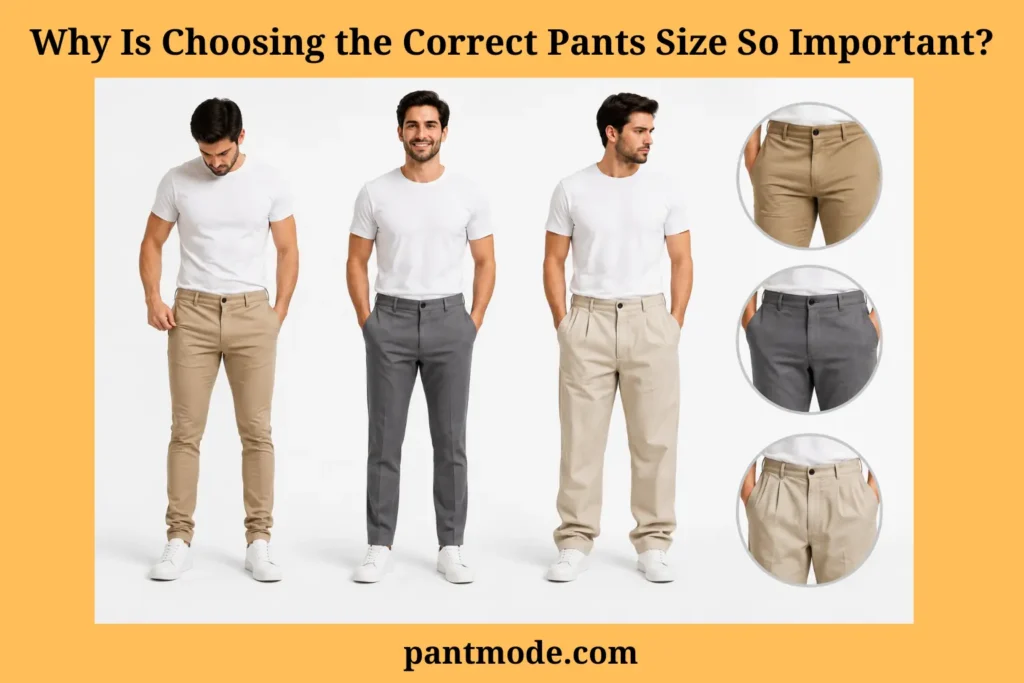
Why Is Choosing the Correct Pants Size So Important? A Complete Fit Guide
Choosing the correct pants size is important because size affects waistband security, rise comfort, seat room, thigh mobility, inseam length, leg opening, fabric behavior, and the intended silhouette during real movement.
The nominal tag is only a starting reference. Use the full pants-buying factors framework, then combine waist, hip or seat, rise, thigh, inseam, leg opening, current manufacturer sizing information, garment measurements where available, and movement.
Size cannot be evaluated independently of cut. Two trousers carrying the same nominal size can distribute room differently through the rise, seat, thighs, knees, and lower leg.
No universal size conversion, rise, cut, ease number, shrinkage adjustment, or automatic size-up rule works for every garment.
Quick Answer
The correct pants size is the size that stays secure at the intended waistband position, provides enough room through the seat and thighs, feels comfortable through the rise, creates the intended length and leg shape, and continues to work while sitting, walking, and bending.
Because size labels and sizing systems vary, the final decision should use measurements, the current manufacturer size chart, garment dimensions where available, fabric behavior, and real movement rather than the tag number alone.
Definition
Correct pants size means the garment’s waist, hip and seat room, rise, thigh room, inseam, leg opening, cut, and fabric behavior align with the wearer’s measurements, comfort requirements, and intended silhouette.
Key Takeaway
Use body measurements to identify a starting size, confirm the current manufacturer chart and garment measurements where available, then verify the waistband, rise, seat, thighs, length, leg opening, fabric behavior, and movement before keeping the pants.
Figure: correct pants size is confirmed through measurements, current sizing information, garment geometry, movement, and final verification.
Why Does Choosing the Correct Pants Size Matter for Comfort and Fit?
Choosing the correct pants size matters for comfort and fit because the waistband, rise, seat, thighs, inseam, leg opening, and fabric behavior determine how pants perform while standing, sitting, and moving.
Waistband security should feel stable rather than painfully tight. A secure waistband stays at the intended position without constant slipping, extreme belt tension, or excessive pressure.
Rise comfort changes how the upper block behaves. A waist measurement may look correct while the rise still pulls, sags, or shifts during sitting.
Seat and thigh room determine whether the size functions during movement. A garment can fit at the waist yet fail through the thighs or seat, so increasing the waist size is not automatically the best correction.
Inseam controls the finished length. Excess length can drag under footwear, while insufficient length can create unintended shortness.
Leg opening belongs to the intended silhouette. A narrow opening may be correct for one cut and restrictive for another, while extra volume can be intentional in relaxed or wide trousers.
Structural tightness can reveal a sizing or cut problem. Strong pocket distortion, crotch pulling, thigh stress, or persistent waistband pressure should trigger comparison with another size, rise, or pants fit direction rather than being ignored.
Correct Pants Size Principles Table
| Fit Area | Correct-Size Signal | Wrong-Size / Wrong-Cut Signal |
|---|---|---|
| Waist | Secure without excessive pressure | Digging, slipping, major gapping |
| Hip / Seat | Enough room for sitting and movement | Strong pulling or uncontrolled folds |
| Rise | Comfortable standing and sitting | Crotch pulling, sagging, riding down |
| Thigh | Allows normal stride and bending | Restriction or strong stress lines |
| Inseam | Creates intended finished length | Dragging or unintended shortness |
| Leg Opening | Matches intended silhouette | Restriction or unwanted excess volume |
| Pockets | Stay reasonably controlled | Strong flare or distortion |
| Overall | Works during normal movement | Constant adjustment |
What Signs Show That the Correct Pants Size May Be Wrong?
Signs that the correct pants size may be wrong include waist gapping, waistband pressure, pocket flare, crotch pulling, thigh restriction, excess seat fabric, hem drag, slipping, twisted seams, or poor recovery.
A back-waist gap can have several causes. Waistband shape, waist-to-hip relationship, rise, and nominal size can all contribute. Check the upper block before altering the waist.
Waist pressure may come from size, waistband shape, or rise placement. Compare another size or rise instead of assuming every pressure point is a simple waist-circumference issue.
Pocket flare can reflect restriction through the hip, seat, or thigh. Pocket construction and fabric can also influence flare, so diagnose the whole upper block before changing size.
Crotch pulling can involve rise, crotch length, seat, or thigh room. Crotch sagging can indicate excess upper-block room or a rise that does not suit the garment-wearer relationship.
Tight thighs may point to the wrong cut rather than the wrong waist size. Athletic, straight, or relaxed cuts can provide more upper-leg room without enlarging every part of the garment.
Hem drag is a length problem first. Do not increase or decrease waist size merely to solve an inseam problem when alternate lengths exist.
Twisted seams are not a normal sizing symptom. Visible seam rotation may indicate grain or construction problems and can justify comparing another garment.
Knee bagging requires a recovery check. Repeated bending, cut, construction, and pants fabric behavior can all contribute.
Troubleshooting Fit Matrix
| Symptom | Possible Cause | Better Next Step |
|---|---|---|
| Back waist gap | Waistband shape, waist/hip relationship, rise | Compare another waistband or rise |
| Waist pressure | Size or rise mismatch | Compare another size or rise |
| Pocket flare | Hip, seat, thigh restriction or pocket construction | Compare roomier upper block |
| Crotch pulling | Rise, crotch length, seat, thigh | Compare another rise or cut |
| Crotch sagging | Rise or upper block too large | Compare another size or rise |
| Tight thighs | Cut lacks room | Compare athletic, straight, or relaxed |
| Excess seat folds | Seat/rise shape mismatch | Compare another pattern or size |
| Hem drag | Excess inseam | Shorter inseam or hem |
| Unintended short hem | Insufficient inseam | Longer length |
| Pants slipping | Waist/rise/seat mismatch | Reassess upper block |
| Twisted seams | Construction/grain issue | Compare another garment |
| Knee bagging | Recovery, cut, repeated movement | Compare fabric and fit |
How Do You Measure Yourself Accurately for the Correct Pants Size?
You measure yourself accurately for the correct pants size by recording the waist, hip or seat, thigh, crotch depth or rise requirements, crotch length, and trouser length before comparing those dimensions with sizing information.
Start with the waistband position that matches the garment. Ready-to-wear trousers may sit above, at, or below the natural waist, so the practical measurement should reflect where that pair is intended to sit.
Measure the hip or seat around the fullest relevant area. Keep the tape level and avoid pulling it excessively tight.
Measure the fullest useful upper-thigh area. This gives a better starting point for evaluating whether the cut can provide enough room for movement.
Crotch depth helps evaluate vertical rise requirements. It is a useful reference when one pair rides upward while another sags, but ready-to-wear construction still affects the result.
Crotch length helps explain front-to-back rise relationships. Two trousers with the same nominal waist can feel very different through the crotch because their front and back rise geometry differs.
Length can be checked through side length and inseam. A well-fitting reference pair can help establish the inside-leg length and desired hem position.
Leg opening is a practical finished-garment comparison. Measure the hem of a reference pair that creates the desired silhouette instead of treating opening width as a body measurement.
The New Mexico State University pants-measurement guide is used here only for relevant waist, hip, thigh, crotch-depth, crotch-length, and trouser-length measurement concepts.
Pattern-ease boundary: numeric pattern-fitting allowances are not universal ready-to-wear shopping rules. Measurements identify a starting point; cut, construction, movement, and intended silhouette confirm the final size.
Step-by-Step Pants Measurement Table
| Measurement | Measurement Method / Reference | Sizing Role |
|---|---|---|
| Waist | Around relevant waistband/waist position | Waist security |
| Hip / Seat | Fullest hip and seat area | Upper-block fit |
| Thigh | Fullest upper thigh | Mobility |
| Crotch Depth | Waist-level reference to seated surface | Vertical rise requirement |
| Crotch Length | Front waist through crotch to back waist | Front/back rise relationship |
| Side Length | Waist to desired lower-leg point | Overall trouser length |
| Inseam | Compare body/reference-pair inside-leg length | Hem position |
| Leg Opening | Across hem of preferred reference pants | Silhouette comparison |
Figure: body measurements, finished-garment dimensions, and the nominal tag describe different parts of the sizing decision.
How Should Body and Garment Measurements Be Compared for the Correct Pants Size?
Body and garment measurements should be compared for the correct pants size by accounting for ease, cut, fabric behavior, and intended silhouette rather than expecting identical measurements.
Body measurements describe the wearer. Garment measurements describe the finished trousers, including built-in wearing room and deliberate design volume.
Wearing room is not the same as oversized fit. Trousers need room for movement, while relaxed, pleated, and wide silhouettes may intentionally contain additional design volume.
Stretch changes the comparison. Some stretch trousers can use less positive garment room, but a smaller garment measurement does not automatically prove that the size is correct.
Different cuts distribute room differently. Slim, straight, relaxed, pleated, and wide cuts can carry the same nominal tag while having different thigh, rise, seat, knee, and opening dimensions.
Use the manufacturer’s current chart carefully. Identify whether the chart shows body dimensions or finished garment dimensions, because the two should not be compared as though they are the same.
A known good-fitting pair is a useful comparison tool. Keep measurement locations consistent when comparing waistband, rise, thigh, inseam, and leg opening.
The NIST body-dimensions publication supports the broader principle that apparel sizing relies on defined body dimensions and sizing-system context rather than arbitrary labels alone. It does not provide current brand-by-brand size charts.
Body vs Garment Measurement Table
| Area | Body Measurement | Garment Measurement | Interpretation |
|---|---|---|---|
| Waist | Wearer’s circumference | Finished waistband dimension | Must support intended security |
| Hip / Seat | Wearer’s fullest circumference | Finished upper-block room | Must include movement/design requirements |
| Thigh | Upper-leg circumference | Finished garment thigh room | Depends on cut |
| Rise | Body depth/length requirement | Front/back garment rise | Controls crotch relationship |
| Inseam | Required inside-leg length | Finished garment inseam | Determines hem position |
| Leg Opening | Style/footwear preference | Finished hem width | Controls silhouette |
| Ease | Wearer needs movement | Garment contains added or designed room | No universal numeric rule |
Which Pant Cuts Help You Find the Correct Pants Size for Different Fit Needs?
Pant cuts help you find the correct pants size for different fit needs because each cut distributes room differently through the waist, rise, seat, thighs, knees, and lower leg.
For more thigh room, compare athletic taper, straight, and relaxed cuts. The goal is to solve upper-leg restriction without unnecessarily enlarging the waistband and lower leg.
For a streamlined silhouette, compare slim-straight, straight, and soft-taper directions. A close silhouette should still allow normal sitting, walking, and bending.
For more seat or hip room, compare shaped-fit, straight, and relaxed constructions. “Always size up” is too blunt because it can create new problems at the waist and hem.
For a different rise requirement, compare low, mid, and higher-rise options. The better choice depends on intended waistband position, comfort, and garment design rather than a universal rise rule.
For wide or relaxed silhouettes, allow intentional volume. Significant ease does not mean the size is wrong when the waist, rise, length, and drape remain controlled and the chosen pant style is deliberate.
Separate waist size from length whenever possible. If the garment offers alternate inseams, use the pants length option that creates the intended break instead of changing waist size only to gain length.
Fit Need & Cut Decision Matrix
| Fit Need | Cuts to Compare | Main Check | Avoid |
|---|---|---|---|
| More thigh room | Athletic taper, straight, relaxed | Thigh mobility | Automatically sizing up everywhere |
| Streamlined silhouette | Slim-straight, straight, taper | Movement plus controlled line | Equating tightness with fit |
| More seat/hip room | Shaped fit, straight, relaxed | Seat and pocket behavior | Assuming only waist size matters |
| Different rise requirement | Low, mid, higher rise options | Sitting and waistband stability | One universal rise rule |
| Comfort priority | Straight, relaxed, stretch-compatible | Movement | Letting stretch replace correct geometry |
| Wide-style preference | Wide, relaxed, pleated, barrel | Intentional volume | Treating volume as wrong size |
| More/less length | Same cut in alternate inseam where available | Hem and footwear | Changing waist unnecessarily |
How Do Size-Label Variation, Stretch, and Fabric Shrinkage Affect the Correct Pants Size?
Size-label variation, stretch, and fabric shrinkage affect the correct pants size because the number on the tag does not independently describe the garment’s measurements, recovery, cut, or post-care behavior.
Size-label variation is normal across systems and garments. The same nominal label does not guarantee identical finished dimensions, and national or international labels should not be treated as automatically interchangeable.
Use “vanity sizing” cautiously. The term can describe labels that differ from expected body or garment dimensions, but not every brand difference is intentional label inflation and no universal correction formula exists.
The current manufacturer chart should control the individual purchase. Check whether it lists body measurements, finished garment measurements, or both before comparing it with your own numbers.
Stretch affects movement but does not repair geometry. A stretch waistband cannot automatically correct the wrong rise, seat shape, or thigh cut.
Recovery matters as much as initial stretch. A fabric can stretch easily yet remain distorted at the knees or seat after repeated movement.
Rigid fabrics need adequate room at purchase. Do not assume every rigid textile will “break in” enough to fix an undersized garment.
Shrinkage guidance must remain garment-specific. Pre-shrunk, sanforized, unsanforized, shrink-to-fit, washable wool, linen, and stretch blends can require different instructions. Never apply one universal size-up percentage or laundering formula.
Size-Label Variation Chart
| Sizing Variable | Why It Matters | Better Response |
|---|---|---|
| Nominal tag | Label is not full garment geometry | Check current measurements |
| Manufacturer chart | Defines current brand/system guidance | Compare your measurements |
| Body vs garment chart | They may represent different dimensions | Identify chart type |
| International size label | Systems may differ | Use current conversion from manufacturer |
| Different cut | Same nominal size distributes room differently | Compare rise, seat, thigh, opening |
| Stretch fabric | Fit may change during wear | Evaluate recovery |
| Rigid fabric | Offers less immediate give | Require adequate room at purchase |
| Shrinkage guidance | Post-care dimensions may change | Follow manufacturer instructions |
Fabric Stretch and Recovery Table
| Fabric Behavior | What to Check | Sizing Implication |
|---|---|---|
| Low stretch | Waist, seat, thigh comfort immediately | Do not rely on future stretching |
| Moderate stretch | Mobility and recovery | Verify shape after movement |
| High stretch | Range of movement | Do not use compression as substitute for correct cut |
| Poor recovery | Fabric remains stretched | May change knee/seat appearance |
| Strong recovery | Returns toward original dimensions | Helps preserve intended shape |
| Rigid woven fabric | Minimal immediate give | Geometry matters strongly |
| Stretch woven | Movement may improve | Follow garment-specific sizing |
Shrinkage Guidance Table
| Garment / Fabric Situation | Correct Guidance |
|---|---|
| Pre-shrunk garment | Still follow actual care label and manufacturer information |
| Sanforized denim | Treat manufacturer description as controlling guidance |
| Unsanforized denim | Follow brand-specific shrinkage instructions |
| Shrink-to-fit product | Follow exact product process before deciding size |
| Wool trousers | Use garment-specific care instructions |
| Linen trousers | Do not assume a universal shrinkage amount |
| Stretch blend | Do not rely on laundering to correct wrong size |
| Unknown fabric treatment | Avoid guessing; use garment documentation |
Figure: F50 turns a sizing symptom into a measured, cause-based keep, change, alter, or return decision.
What F50 Checks Verify the Correct Pants Size Before Keeping or Returning Pants?
F50 checks verify the correct pants size before keeping or returning pants by turning fit symptoms, measurements, cut, size-label information, fabric behavior, exceptions, and movement tests into a controlled decision path.
Trigger: define the decision first. The reader may be choosing a size, comparing two sizes, troubleshooting a symptom, deciding to keep a pair, or deciding to return it.
Classification: identify the exact area where sizing fails—waist, hip, seat, rise, thigh, inseam, leg opening, seam, or fabric behavior.
Measurement: check the relevant dimension instead of changing the tag number blindly.
Cause: decide whether size, rise, cut, length, fabric, construction, or a chart mismatch best explains the symptom.
Recommendation: choose among keep, size up, size down, change rise, change cut, change inseam, use limited alteration, or return.
Red flag: do not ignore persistent painful pressure, severe crotch pulling, major thigh restriction, large uncontrolled seat folds, twisted seams, or unsupported shrinkage assumptions.
Exception: allow intentional wide volume, fuller break, statement silhouettes, verified break-in, or a manufacturer-defined shrink process when the context clearly supports it.
Verification: approve the size only after measurements, waistband, rise, seat, thigh, pockets, length, leg opening, fabric, and movement all make sense together.
F50 Correct Pants Size Decision-Control Table
| F50 Step | Control Question | Pass Standard |
|---|---|---|
| Trigger | Is the reader selecting, diagnosing, keeping, or returning? | Decision context is defined |
| Classification | Where does sizing fail? | Exact fit area and symptom identified |
| Measurement | Which measurement explains the problem? | Relevant dimension checked |
| Cause | Is the issue size, rise, cut, length, fabric, or construction? | Likely cause identified |
| Recommendation | What is the next action? | Action matches cause |
| Red Flag | Is there a major structural or comfort problem? | Problem is not ignored |
| Exception | Is apparent excess/tightness part of intentional design or verified product behavior? | Exception has evidence/context |
| Verification | Does the pair pass movement and visual checks? | Keep only after full test |
| Source Scope | Are NMSU and NIST used within scope? | No false attribution |
| URL Validation | Are internal URLs Pant Factors only? | No self-link or /pant-types/ |
How Can You Verify the Correct Pants Size Before Keeping a Pair?
You can verify the correct pants size before keeping a pair by testing the waistband, rise, seat, thighs, pockets, inseam, leg opening, seams, fabric recovery, and movement before removing the tags.
Stand naturally first. The waistband should stay in place without major gapping, slipping, or excessive pressure.
Sit normally. The rise should remain comfortable, the seat should provide enough room, and the waistband should not become intolerably tight.
Walk, bend, and perform a shallow squat where practical. Normal movement should not create severe crotch pulling, strong thigh restriction, or sudden pocket distortion.
Check the pockets and upper block. Pockets should remain reasonably controlled for the design, while remembering that construction can affect how they lie.
Check inseam and hem with intended footwear. The break should match the desired silhouette without accidental dragging or shortness.
Check leg opening and seam alignment. The opening should suit the intended cut, and the seams should not show obvious rotation.
For stretch fabrics, test recovery. Sit, bend, stand again, and observe whether the knees and seat return acceptably toward their intended shape.
Recheck the current manufacturer chart before keeping the pair. If the garment has a special shrinkage or break-in process, verify the instructions before removing tags whenever practical.
Final Fit Verification Checklist
| Verification Question | Yes / No |
|---|---|
| Does the waistband stay secure? | |
| Does it avoid excessive pressure? | |
| Is there no major uncontrolled back-waist gap? | |
| Does the rise feel comfortable standing? | |
| Does the rise remain comfortable sitting? | |
| Does the seat allow normal sitting? | |
| Do the pockets stay reasonably controlled? | |
| Can I walk naturally? | |
| Can I bend comfortably? | |
| Can I perform a shallow squat without severe restriction? | |
| Do the thighs have enough room for this cut? | |
| Does the crotch avoid severe pulling or sagging? | |
| Does the inseam work with my intended footwear? | |
| Does the leg opening suit the intended silhouette? | |
| Do the seams hang without obvious twisting? | |
| Does stretch fabric recover acceptably? | |
| Have I checked the current manufacturer size chart? | |
| Have I checked garment measurements where available? | |
| Have I checked special shrinkage guidance where relevant? | |
| Does the size still feel correct after several minutes of movement? |
Final Correct Pants Size Checklist
| Final Check | Pass / Fail |
|---|---|
| Have I identified where the waistband should sit? | |
| Have I measured my waist? | |
| Have I measured hip/seat? | |
| Have I checked thigh room? | |
| Have I considered rise/crotch depth? | |
| Have I considered crotch length where needed? | |
| Have I checked required inseam? | |
| Have I checked preferred leg opening? | |
| Have I compared measurements with the current size chart? | |
| Do I know whether the chart uses body or garment dimensions? | |
| Have I checked garment measurements where available? | |
| Does the waistband stay secure? | |
| Does the rise work standing and sitting? | |
| Does the seat allow movement? | |
| Do the thighs allow normal movement? | |
| Do the pockets remain reasonably controlled? | |
| Does the hem work with real footwear? | |
| Does the leg opening match the intended silhouette? | |
| Does stretch recover acceptably if present? | |
| Have I followed manufacturer-specific shrinkage guidance if relevant? | |
| Have I avoided universal size-up or conversion rules? | |
| Is this the correct pants size for this specific cut and garment? |
What Final Rule Should Guide the Correct Pants Size?
The final rule for the correct pants size is to choose the size that matches your measurements, supports movement, respects the intended cut, and passes real-world fit checks before trusting the tag number.
Confirm waistband position, waist, hip or seat, rise, crotch depth and length where useful, thigh room, inseam, leg opening, cut, garment measurements, current manufacturer chart, stretch, recovery, shrinkage guidance, and movement as one connected decision.
No universal size, conversion, rise, cut, ease number, shrinkage adjustment, or stretch solution works for every pair.
A correct nominal size in one cut may still be the wrong garment if the rise, thighs, seat, length, or silhouette do not work.
The correct pants size is the pair that stays secure, moves comfortably, matches the intended silhouette, respects the fabric’s behavior, and still feels right after sitting, walking, and bending.