
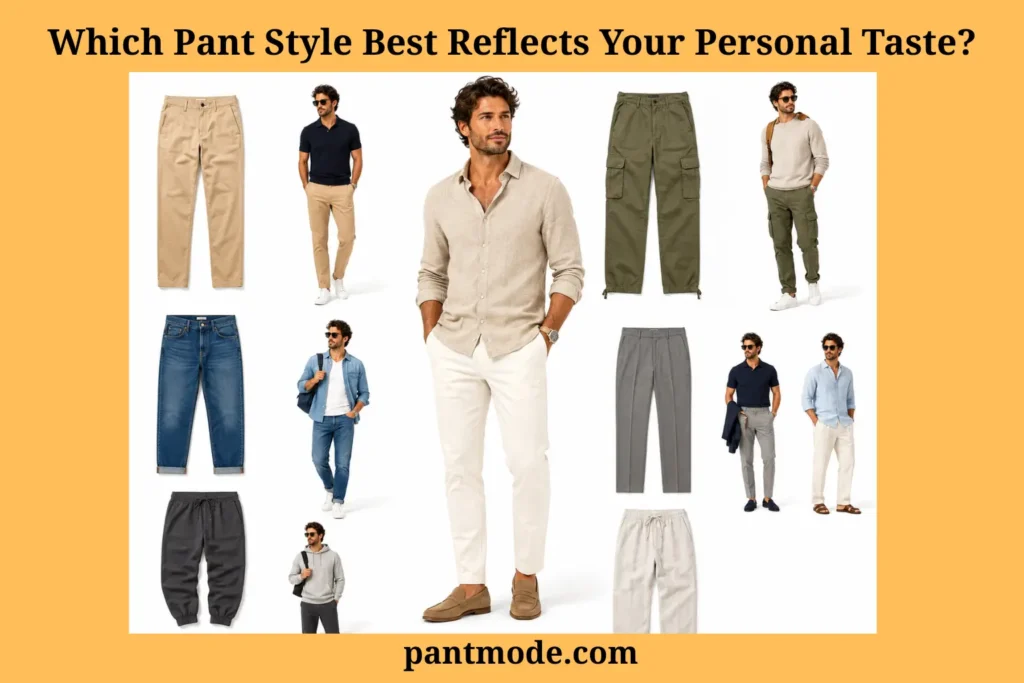
Which Pant Style Best Reflects Your Personal Taste?
You discover which pant style best reflects your personal taste by identifying the silhouettes, fabrics, colors, rises, details, and outfit formulas that repeatedly feel natural, useful, comfortable, and visually coherent.
Personal style is discovered through repeated preference plus deliberate experimentation. Place the style decision inside the wider pants-buying factors framework, then test whether a silhouette works with your real wardrobe, footwear, lifestyle, comfort needs, and repeat outfits.
Trends are not automatically bad. A trend can introduce a silhouette worth exploring, but exposure alone does not prove that the style belongs in your wardrobe.
No pant style suits every person. Straight, tapered, relaxed, wide, flared, cargo, tailored, jogger, cropped, and sculptural shapes can all work when they align with the wearer’s intended aesthetic and real-life use.
Quick Answer
The pant style that best reflects personal taste is the silhouette that repeatedly feels coherent with your real wardrobe, footwear, lifestyle, comfort needs, and preferred aesthetic.
Straight-leg trousers can support classic or minimalist wardrobes, cargos may support utilitarian or streetwear directions, tailored trousers may support polished aesthetics, and wide or sculptural silhouettes may support relaxed or expressive styles. These are exploratory directions rather than fixed rules.
Definition
Pant style is the visual and functional identity of trousers created by silhouette, rise, leg width, length, fabric, color, detail level, formality, and footwear interaction. Pant style reflects personal taste when the wearer experiences it as useful, comfortable, repeatable, and coherent with their real wardrobe.
Key Takeaway
Start with the trouser shapes you repeatedly enjoy, then test fabric, rise, color, footwear, lifestyle, comfort, wardrobe role, and outfit repeatability. A pant style is a strong match when it feels personally natural or intentionally expands your style without depending entirely on trend pressure.
Figure: personal pant style becomes clearer when silhouette, fabric, footwear, lifestyle, and repeatability align.
Why Does Pant Style Strongly Influence Your Overall Personal Style?
Pant style strongly influences your overall personal style because leg width, rise, length, drape, fabric, and detail level shape a major part of the outfit’s visual structure.
Trousers occupy a large visual area in many outfits. They do not matter more than every other garment, but their silhouette strongly affects proportion, movement, and the relationship between top, outerwear, and footwear.
Leg width changes the outfit’s structure. Straight lines can feel controlled, tapered legs make footwear more visible, relaxed trousers add ease, wide legs add volume, flares shift attention toward the lower leg, and cropped hems expose more ankle and shoe.
Rise changes the visual and practical relationship with tops. A higher waistband can make tucked or cropped tops interact differently from a lower rise, but neither option is universally better.
Fabric modifies the same silhouette. Wide wool trousers may read refined and architectural, while wide washed canvas trousers may read rugged or utilitarian. The same basic shape can therefore support different aesthetics.
Repeated success reveals useful preference patterns. If similar silhouettes repeatedly work in real outfits, they can provide evidence of personal taste. A new silhouette can still become authentic style when it integrates deliberately.
Style expression should remain separate from body correction. Actual pants fit still matters for comfort and intended silhouette, but no body type is required to choose or avoid a particular style.
Trouser Hierarchy Table
| Pant Shape | Defining Feature | Typical Style Signal | Common Formality Range |
|---|---|---|---|
| Straight-leg | Relatively consistent leg width | Classic, minimal, versatile | Casual to formal |
| Slim-straight | Close upper-leg fit with controlled straight line | Refined, modern, understated | Casual to smart casual |
| Tapered | Narrows progressively toward ankle | Modern, structured, footwear-visible | Casual to smart casual |
| Cropped | Intentionally shorter finished length | Contemporary, light, footwear-focused | Casual to smart casual |
| Wide-leg | Significant volume through leg | Relaxed, dramatic, minimalist, expressive | Casual to formal |
| Relaxed | Added ease through seat and leg | Comfortable, casual, contemporary | Casual to smart casual |
| Flared | Widens noticeably below knee | Retro, expressive, line-emphasizing | Casual to elevated |
| Bootcut | Subtle widening below knee | Classic, western-influenced, balanced | Casual to smart casual |
| Cargo | Utility-pocket construction | Utilitarian, streetwear, military-influenced | Casual |
| Tailored trouser | Structured waist and controlled drape | Polished, refined, formal | Smart casual to formal |
| Jogger | Elastic/drawstring waist with tapered or cuffed leg | Sporty, casual, comfort-led | Casual |
| Barrel-leg | Curved leg volume with controlled hem | Directional, sculptural, fashion-forward | Casual to elevated |
What Foundational Pant Style Options Should You Understand Before Defining Your Personal Aesthetic?
Foundational pant style options help you define your personal aesthetic by giving names to the trouser shapes, construction details, and visual signals you repeatedly prefer.
Straight-leg pant style: the leg maintains a relatively consistent line. Depending on fabric and construction, straight trousers can read classic, minimal, tailored, casual, or rugged.
Wide-leg pant style: the leg carries significant volume. It can support minimalism, dramatic tailoring, relaxed dressing, Bohemian styling, or fashion-forward outfits depending on drape, length, color, and supporting pieces.
Relaxed pant style: added ease through the seat and leg changes the visual signal according to fabric, hem, top proportion, and footwear.
Tapered pant style: the leg narrows toward the ankle, increasing the visual exposure of footwear and making hem control more noticeable.
Cropped pant style: the shorter finished length is intentional. It should be separated from an accidentally short inseam by deliberate shoe and hem interaction.
Flared and bootcut pant style: both widen below the knee, but bootcut usually opens more subtly. Shoe height, toe shape, and hem length affect the finished line; no universal “elongating” claim is needed.
Cargo and utility pant style: pockets and functional detailing can support utility, workwear, or streetwear directions. Too many repeated utility signals can make the outfit feel costume-like unless that effect is intentional.
Tailored pant style: a structured waist, controlled drape, refined fabric, and cleaner details can create polished or formal visual language.
Jogger pant style: elastic, drawstring, tapered, or cuffed construction usually signals casual or sporty dressing.
Barrel-leg pant style: curved volume with a controlled hem makes the silhouette itself a focal point.
A pant type explains category context, while pant style explains how silhouette, fabric, detail, and styling create a visual identity.
Historical boundary: the V&A Mary Quant article is used only as a limited historical example of fashionable women’s trouser experimentation and changing silhouettes. It is not treated as a complete history of trousers or evidence for the modern categories in this guide.
Foundational Pant Style Vocabulary Table
| Pant Style | Structural Trait | Style Possibilities | Main Watch-Out |
|---|---|---|---|
| Straight-leg | Controlled consistent line | Classic, minimal, tailored, casual | Poor hem can disrupt line |
| Wide-leg | Added volume through leg | Dramatic, relaxed, minimalist, Bohemian | Volume should feel intentional |
| Relaxed | Extra ease through seat and thigh | Comfortable, contemporary, casual | Unmanaged length can look accidental |
| Tapered | Narrows toward ankle | Modern, sporty, smart casual | Footwear becomes more prominent |
| Cropped | Intentionally shorter hem | Contemporary, preppy, shoe-focused | Avoid accidental shortness |
| Flared | Wider below knee | Retro, expressive, Bohemian | Hem depends strongly on footwear |
| Bootcut | Controlled opening below knee | Classic, western-influenced | Shoe-aware length matters |
| Cargo | Utility pockets | Streetwear, utility, workwear | Excess utility signals may feel costume-like |
| Tailored trouser | Structured waist and controlled drape | Classic, formal, polished, elevated casual | Fabric and shoe mismatch can disrupt signal |
| Jogger | Elastic/drawstring construction and soft shape | Sporty, casual, comfort-led | Limited formal range |
| Barrel-leg | Curved volume with controlled hem | Sculptural, directional | Supporting pieces should preserve intentional shape |
Which Pant Style Best Aligns With Different Personal Style Archetypes?
The pant style that best aligns with different personal style archetypes is the style direction that translates a preferred aesthetic into repeatable silhouettes, fabrics, colors, and outfit formulas.
These archetypes are editorial discovery tools, not FIT or V&A classifications. They help organize preferences without creating fixed identities.
Minimalist: explore straight-leg, clean tapered, and tailored wide-leg pants with restrained details, controlled silhouettes, and a focused palette.
Classic: explore straight trousers, chinos, tailored pants, and restrained pleats that repeat familiar proportions across many settings.
Streetwear: relaxed cargos, baggy denim, parachute pants, and wide utility trousers can support volume, utility, and stronger footwear presence.
Vintage-inspired: flares, bootcut shapes, pleats, corduroy, and high-rise straight trousers can create historical references without requiring costume dressing.
Bohemian: wide-leg, fluid, drawstring, and softly flared trousers can emphasize movement, texture, and relaxed layering.
Sporty: joggers, track-influenced pants, commuter trousers, and technical tapered shapes can support mobility and athletic visual language.
Utilitarian: cargo, fatigue, workwear, canvas, and technical trousers can foreground functional detailing.
Fashion-Forward: barrel-leg, exaggerated wide-leg, sculptural pleats, and unusual crops make silhouette a deliberate focal point.
Readers can combine archetypes. The FIT image-consulting program supports broad concepts such as fashion styles, clothing personalities, comfort zones, lifestyle, personal image, wardrobe analysis, combinations, and capsule dressing; it does not establish this guide’s eight pant-style archetypes or the exact recommendations below.
Figure: editorial archetypes are discovery tools; they are not fixed identities or FIT/V&A classifications.
Personal Taste Decision Matrix
| Editorial Style Direction | Pant Styles to Explore | Fabric Direction | Color Direction | Key Signal |
|---|---|---|---|---|
| Minimalist | Straight, tailored, wide-leg | Wool, twill, structured cotton | Black, cream, navy, grey | Clean lines |
| Classic | Straight, chinos, tailored trousers | Cotton, wool, denim | Navy, beige, charcoal, brown | Familiar proportion |
| Streetwear | Cargo, baggy, parachute | Nylon, denim, canvas | Black, olive, grey, washed tones | Volume and utility |
| Vintage-inspired | Flare, bootcut, pleated, corduroy | Corduroy, denim, wool | Brown, rust, cream, indigo | Historical reference |
| Bohemian | Wide-leg, fluid, relaxed | Linen, cotton, soft blends | Earth tones, cream, muted colors | Movement and texture |
| Sporty | Jogger, tapered tech | Nylon, polyester, stretch blends | Black, grey, navy | Athletic visual language |
| Utilitarian | Cargo, fatigue, work pant | Canvas, twill, technical fabric | Olive, khaki, black, brown | Functional detail |
| Fashion-Forward | Barrel, exaggerated wide, sculptural pleats | Structured cotton, wool blends, technical fabric | Neutral or statement color | Silhouette focal point |
How Do You Build Daily Outfits Around the Pant Style That Matches Your Taste?
You build daily outfits around the pant style that matches your taste by turning your preferred silhouette into repeatable formulas with tops, footwear, fabric language, color balance, and intentional proportion.
Step 1: establish a repeatable foundation. Start with a frequently used color, a familiar silhouette, common tops, and the real settings in which the pants will be worn.
Step 2: control volume intentionally. Wide or relaxed trousers can work with fitted, tucked, cropped, structured, or deliberately oversized tops. Baggy pants do not universally require a tight top.
Step 3: match or contrast structure deliberately. Decide whether the outfit should read soft, tailored, rugged, sporty, technical, or fluid. Contrast can work when the relationship looks intentional.
Step 4: include footwear early. Shoe shape, sole, visual weight, formality, and heel height where relevant influence the hem and the whole trouser line.
Step 5: add variation after the core formula works. Change texture, color, outerwear, proportion, or statement detail while keeping the silhouette coherent.
The fabric can shift the entire style signal, so evaluate pants fabric as a supporting style filter rather than treating the silhouette in isolation.
Outfit Balance and Proportion Matrix
| Pant Silhouette | Useful Top Approaches | Outerwear Directions | Main Proportion Check |
|---|---|---|---|
| Slim-straight | Fitted, relaxed, tucked, layered | Blazer, bomber, overshirt | Avoid accidental all-over restriction |
| Straight-leg | Broad range of controlled proportions | Coat, blazer, denim jacket | Preserve intentional overall line |
| Wide-leg | Fitted, cropped, tucked, structured, deliberate oversized | Cropped jacket, long coat, blazer | Keep volume deliberate |
| Tapered | Knit, tee, shirt, polo | Bomber, chore coat, blazer | Keep ankle and shoe interaction clean |
| Cropped | Tucked or untucked depending on rise | Short jacket, blazer | Make ankle gap intentional |
| Flared | Fitted, tucked, fluid depending on aesthetic | Cropped or long structured layer | Preserve flare line |
| Cargo | Simple tee, knit, overshirt, utility layer | Bomber, field jacket | Avoid uncontrolled utility overload |
| Barrel-leg | Fitted, cropped, structured, simple oversized | Cropped jacket, structured coat | Let sculptural shape remain visible |
How Should Footwear Support the Pant Style That Reflects Your Personal Taste?
Footwear should support the pant style that reflects your personal taste by interacting intentionally with the trouser’s hem width, length, fabric weight, formality, and silhouette.
Footwear does not need to match the pants literally. Intentional contrast can work, but the shoe and hem should look like they belong to the same styling decision.
Straight-leg pants: sneakers, loafers, boots, flats, and dress shoes can all work depending on fabric and formality.
Wide-leg pants: sleek footwear, boots, substantial sneakers, or platforms can all work depending on intent. The hem should not accidentally drag or swallow the shoe.
Tapered pants: the shoe becomes more visible, so ankle exposure and hem width need deliberate control.
Cropped pants: the exposed ankle gap and footwear become part of the styling rather than a hidden finishing detail.
Flared and bootcut pants: shoe height and toe shape can change hem behavior, so finished length should be tested around the intended footwear.
Cargo pants: shoe visual weight should interact with the fabric, pocket scale, and utility signal.
Tailored trousers: footwear changes formality. Refined sneakers can create intentional high-low contrast where the pant occasion allows it.
Pant-to-Footwear Matching Table
| Pant Style | Footwear Directions to Test | Main Hem Consideration |
|---|---|---|
| Straight-leg | Sneakers, loafers, boots, flats | Clean intentional break |
| Wide-leg | Sleek shoes, boots, substantial sneakers, platforms where desired | Prevent accidental dragging |
| Tapered | Sneakers, loafers, ankle boots | Keep ankle line deliberate |
| Cropped | Loafers, flats, sneakers, ankle boots | Make exposed ankle intentional |
| Flared | Boots, platforms, heeled or flat shoes depending on hem | Shoe changes finished length |
| Bootcut | Boots, sneakers, heeled or flat footwear depending on cut | Preserve controlled opening |
| Cargo | Boots, trainers, rugged or minimal sneakers | Coordinate visual weight |
| Tailored | Loafers, dress shoes, refined sneakers, boots | Preserve or deliberately contrast formality |
| Barrel-leg | Sleek shoes or deliberate substantial footwear | Avoid accidental proportion conflict |
What Styling Mistakes Can Make Your Chosen Pant Style Feel Inconsistent?
Styling mistakes can make your chosen pant style feel inconsistent when the hem, fabric, rise, footwear, formality, volume, or styling theme does not support the intended aesthetic.
Hem and footwear mismatch: dragging pants, a flare collapsing over the shoe, or an accidental crop can make an otherwise strong silhouette feel unresolved. Test the real shoes before altering length.
Fabric-language mismatch: shiny sporty pants inside a traditional formal outfit or rugged workwear fabric inside a delicate polished outfit can feel disconnected when the contrast is accidental. Contrast itself is not the problem; unclear intent is.
Rise and top conflict: waistband position can fight with top length. Test tucked, cropped, untucked, and structured-layer options rather than assuming one proportion rule.
Volume overload: wide pants, an oversized top, large outerwear, and heavy shoes can work together, but all the signals need deliberate structure. A tight top is not a universal fix.
Costume effect: utility on every layer or too many period-specific references can make the theme feel literal. Contemporary basics can reduce the repetition when desired.
Trend mismatch: a pair can look compelling online but fail at home if the purchase was driven mostly by exposure rather than wardrobe, comfort, lifestyle, and repeatability.
Narrow footwear compatibility: a pant that works with one shoe is not automatically a bad purchase. The narrow role can be valid for a statement or special-use pair when intentional.
Personal Style Mistake/Fix Matrix
| Styling Problem | Possible Cause | Better Adjustment |
|---|---|---|
| Hem looks wrong | Shoe and length mismatch | Test real footwear before altering |
| Outfit feels disconnected | Fabric or formality signals conflict unintentionally | Align signals or create deliberate contrast |
| Wide pants feel chaotic | Multiple volume signals compete | Simplify or structure one area |
| Rise feels awkward | Top proportion conflicts with waistband | Test alternative top lengths |
| Cargo outfit feels costume-like | Utility details dominate every layer | Reduce repeated utility cues |
| Vintage styling feels theatrical | Too many historical references appear simultaneously | Mix with contemporary basics |
| Minimal outfit feels flat | No useful texture or silhouette distinction | Add controlled texture, shape, or detail |
| Trend pants feel wrong | Trend exposure overrode real wardrobe preference | Repeat compatibility test |
| Pants work with few shoes | Hem has narrow footwear range | Decide whether narrow role is intentional |
| Outfit feels unlike wearer | External aesthetic pressure dominates | Return to real repeated preferences |
How Can You Build a Capsule Wardrobe Around Your Preferred Pant Style?
You can build a capsule wardrobe around your preferred pant style by choosing a small set of trouser roles that repeat your favorite visual language while covering everyday, elevated, comfort, seasonal, utility, and statement needs.
Everyday core: choose the silhouette you wear most, in a highly compatible color and fabric that fits your normal routine.
Elevated: use a more polished or tailored version of your preferred visual language for smart or formal settings.
Comfort: choose a relaxed, stretch-compatible, soft, or movement-friendly direction that still feels like your style.
Seasonal: use lighter linen or cotton directions for warm conditions and wool, corduroy, or heavier twill for cooler conditions when those materials fit your taste.
Utility: include cargo, fatigue, workwear, or technical trousers only when the function and visual signal are genuinely relevant.
Statement: allow one stronger silhouette, color, pattern, texture, or detail. A capsule does not require every garment to be neutral or maximally interchangeable.
Wardrobe analysis and capsule dressing are broad image-consulting concepts, but the exact allocation below is PantMode’s practical editorial framework rather than a FIT classification.
Capsule Wardrobe Building Table
| Wardrobe Role | Pant Direction | Color Strategy | Primary Goal |
|---|---|---|---|
| Everyday core | Most-repeated preferred silhouette | Highly compatible wardrobe color | Repeat wear |
| Elevated | More tailored version of preferred visual language | Charcoal, navy, cream, black, or personal palette | Polished settings |
| Comfort | Relaxed or stretch-compatible direction | Compatible core color | Long-wear ease |
| Warm-season | Linen or lightweight construction | Stone, cream, tan, or preferred light palette | Climate compatibility |
| Cool-season | Wool, corduroy, heavier twill | Brown, charcoal, navy, olive, or preferred palette | Warmth and texture |
| Utility | Cargo, fatigue, workwear if personally relevant | Olive, khaki, black, brown, or wardrobe palette | Function |
| Statement | Flare, barrel, exaggerated wide, pattern, texture, or strong color | Personal preference | Expression |
What F50 Checks Verify Whether Pant Style Reflects Personal Taste?
F50 checks verify whether pant style reflects personal taste by turning aesthetic preference, silhouette, fabric, footwear, wardrobe role, styling red flags, intentional exceptions, and repeatability into a controlled decision path.
Trigger: identify whether you are shopping, troubleshooting, experimenting, replacing a core pair, or responding to a trend.
Classification: organize aesthetic direction, silhouette, rise, fabric, detail level, formality, footwear, wardrobe role, and repeatability before making a recommendation.
Recommendation: use the classification to choose pant directions worth testing. Recommendations are editorial exploration tools, not objective prescriptions.
Red flag: catch hem conflict, fabric-language mismatch, uncontrolled volume, awkward rise/top relationships, formality conflict, footwear mismatch, trend pressure, or narrow compatibility that was not intentional.
Exception: allow statement garments, intentionally oversized outfits, narrow footwear ranges, contrasting formality, experimental silhouettes, historical references, and trend-led experiments when the role is deliberate.
Verification: approve the pant style only after comfort, outfit, shoe, setting, wardrobe role, and personal-identity checks make sense together.
F50 Pant Style Decision-Control Table
| F50 Step | Control Question | Pass Standard |
|---|---|---|
| Trigger | Is the reader choosing, questioning, or integrating a pant style? | Decision context is clear |
| Classification | What aesthetic, silhouette, fabric, detail, formality, footwear, and wardrobe role apply? | Preferences are organized before recommendation |
| Recommendation | Which pant directions fit the classification? | Recommendation matches wardrobe and lifestyle |
| Red Flag | Does hem, fabric, volume, rise, formality, footwear, or trend pressure create conflict? | Conflict is identified |
| Exception | Is the unusual choice deliberately serving a statement or experimental role? | Narrow use is intentional |
| Verification | Does the style work with comfort, outfits, shoes, settings, and identity? | Pant style passes real-life test |
| Source Scope | Are FIT and V&A used only within evidence limits? | No false attribution |
| URL Validation | Are all internal URLs approved Pant Factors URLs? | No self-link, /pant-types/, or invented URL |
How Can You Evaluate Whether a Pant Style Genuinely Matches Your Personal Taste Before Buying?
You can evaluate whether a pant style genuinely matches your personal taste before buying by testing repeated preference, outfit compatibility, footwear, fabric, comfort, real-life settings, wardrobe role, and trend independence.
Repeated preference test: ask whether the silhouette resembles shapes you already enjoy. If not, decide whether it represents a deliberate new direction rather than requiring previous ownership.
Top compatibility test: where your wardrobe size allows, try the pants with approximately three existing tops. This is a practical wardrobe exercise, not a scientific threshold or FIT recommendation.
Footwear compatibility test: where practical, try approximately two real shoes. This is also an editorial heuristic rather than an industry standard, and a statement pant may intentionally work with fewer shoes.
Hem test: check the break, crop, flare, and shoe interaction with the footwear you actually plan to wear.
Fabric test: ask whether the material supports the desired aesthetic and still fits your climate and routine.
Rise and comfort test: confirm that waistband placement feels comfortable and works visually with your common top proportions.
Palette test: ask whether the color integrates with your wardrobe or deliberately expands the palette in a way you want to style.
Setting test: identify the real places where the pants will be worn rather than buying for an abstract lifestyle.
Wardrobe role test: decide whether the pair is core, elevated, comfort, seasonal, utility, or statement.
Trend independence test: ask whether you would still appreciate the silhouette if it were less visible online. A “no” does not automatically disqualify the pair because trend experimentation can still be deliberate.
Identity test: ask whether you feel comfortable presenting yourself in the silhouette or intentionally exploring that new visual direction.
Figure: a pant style deserves wardrobe space when preference, outfits, footwear, settings, comfort, and role make sense together.
Ultimate Trouser Evaluation Checklist
| Evaluation Question | Pass / Fail |
|---|---|
| Does this pant style match an aesthetic I genuinely enjoy or deliberately want to explore? | |
| Does the silhouette feel personally comfortable? | |
| Can I create realistic outfits with existing tops? | |
| Have I tested approximately three tops where my wardrobe size allows? | |
| Does it work with footwear I actually use? | |
| Have I tested approximately two shoes where practical? | |
| Is a narrow footwear range intentional if this is a statement pair? | |
| Does the hem work with those shoes? | |
| Does the rise feel comfortable and visually intentional? | |
| Does the fabric suit my climate? | |
| Does the fabric suit my routine? | |
| Does the color integrate with or intentionally expand my palette? | |
| Does the texture support the desired aesthetic? | |
| Can I identify real settings where I will wear it? | |
| Does it fill a clear wardrobe role? | |
| Is the style adding value rather than accidental duplication? | |
| Is trend influence only one factor rather than the entire reason? | |
| Do I feel comfortable representing myself in this silhouette? |
Final Pant Style Selection Checklist
| Final Check | Pass / Fail |
|---|---|
| Have I identified my recurring or desired silhouette direction? | |
| Have I identified the aesthetic the pants should support? | |
| Does the pant style work with real tops? | |
| Does it work with real footwear? | |
| Does the hem support those shoes? | |
| Does the rise feel intentional? | |
| Does the fabric match the desired style language? | |
| Does the color fit or intentionally expand the wardrobe palette? | |
| Does the detail level match my taste? | |
| Does the pant work in real settings? | |
| Does it fill a defined wardrobe role? | |
| Can I imagine repeat outfits? | |
| Is limited versatility intentional if it is a statement garment? | |
| Is trend influence intentional rather than automatic? | |
| Does the pant style feel personally authentic or intentionally exploratory? |
What Final Rule Should Guide Pant Style Selection?
The final rule for pant style selection is to choose the silhouette that repeatedly feels useful, comfortable, coherent, and personally natural—or intentionally expands your style—before trusting a trend or rigid fashion rule.
Use repeated preference and deliberate experimentation to confirm silhouette, rise, fabric, color, details, footwear, lifestyle, comfort, wardrobe role, repeatability, and trend independence.
No universal best pant style or universally flattering silhouette exists. No body type forbids a silhouette, archetypes remain exploratory, trends can inspire without dictating identity, statement pieces may have narrow versatility, and personal style can evolve.
The best pant style is the one that feels like you, works with your real wardrobe and daily life, or deliberately expands your aesthetic in a way you genuinely want to keep wearing.