
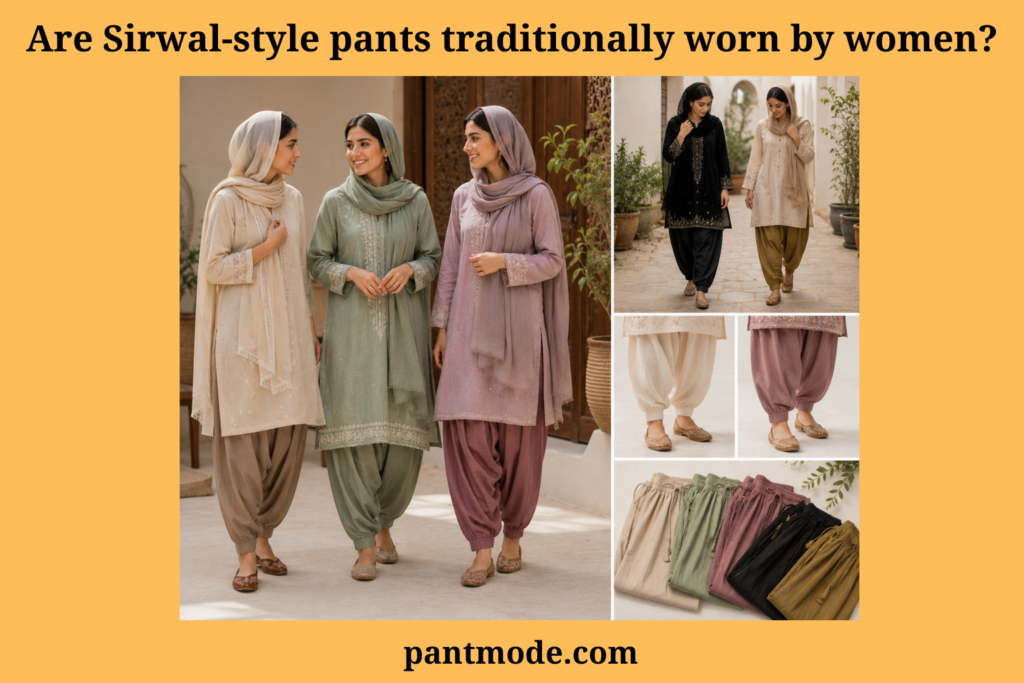
Are Sirwal-Style Pants Traditionally Worn by Women?
Women’s Sirwal forms exist traditionally, and they should be identified through documented context, construction, garment pairing, and terminology rather than through modern fashion labels alone.
Yes, Sirwal-style pants have traditionally been worn by women. The strongest direct evidence used in this guide comes from documented Gulf and UAE women’s dress examples.
Women’s Sirwal may work as an underlayer, modesty garment, or decorative lower-leg garment. Ottoman şalvar, salwar, shalwar, sarouel, seroual, and harem pants can help with comparison, but they should not be treated as automatic synonyms.
Quick Answer
Yes, Sirwal-style pants have traditionally been worn by women. Documented Gulf and UAE examples show women’s sirwal with tapering ankles, drawstring fastening, roomy construction, and decorated lower-leg details. Related terms such as Ottoman şalvar, salwar, shalwar, and sarouel are useful for comparison, but they do not always describe the same garment.
Definition
Women’s Sirwal refers to traditional loose trousers worn by women and identified through documented context, roomy construction, practical waist fastening, tapered or decorated ankles, fabric choice, and garment pairing.
Key Takeaway
Women’s Sirwal exists traditionally, but identification requires caution. Check the structure, ankle shape, waistband, fabric, garment pairing, regional terminology, and documented description before using the name.
External sources: This guide uses Zay Initiative for Gulf and UAE women’s Sirwal evidence, and The Met for Ottoman women’s şalvar comparison.
Figure: women’s Sirwal is identified through documented context, structure, ankle treatment, garment pairing, and terminology.
Why do people mistakenly believe women’s Sirwal pants do not exist historically?
People mistakenly believe women’s Sirwal pants do not exist historically because many modern explanations focus on male under-robe use and ignore documented women’s regional trouser examples.
Sirwal is not a male-only garment family. Traditional trouser systems can include men’s and women’s forms with different uses, visibility, and decoration.
Women’s Sirwal is not simply modern harem pants. Bagginess alone does not establish identity. Traditional naming depends on documented use, construction, regional description, and garment pairing.
Men’s and women’s forms do not need to look identical. Women’s examples may show narrow lower legs, visible cuffs, embroidery, lace, crochet, or metal-thread decoration in some documented contexts.
Myth vs Reality Table
| Myth | Reality | Better Explanation |
|---|---|---|
| Sirwal is only for men | Women’s Sirwal forms also exist | Sirwal is a traditional trouser family with gendered and regional variations |
| Women’s Sirwal is just harem pants | Harem pants are a broad fashion label | Use women’s Sirwal only when cultural or documented context supports it |
| All Sirwal has one fixed cut | Cuts vary by region and use | Check waist, crotch, ankle, fabric, length, and decoration |
| Sirwal is only Arab | One-origin claims require stronger evidence | Use careful regional language |
| Decoration proves authenticity | Decoration is a supporting clue | Check context, structure, and terminology together |
| Modern elastic pants are automatically Sirwal | Modern styles may only be inspired | Label adaptations honestly |
What historical evidence supports traditional women’s Sirwal garments?
Traditional women’s Sirwal garments are best supported by documented regional examples rather than broad unsupported claims about every loose-trouser tradition.
Gulf and UAE examples provide the strongest direct evidence used here. These examples support women’s use, Sirwal terminology, tapering ankles, drawstring fastening, roomy construction, and decorated lower-leg details.
Ottoman women’s şalvar is a useful comparison, not an automatic synonym. The Met example supports the presence of baggy trousers called şalvar in Ottoman women’s dress, but the regional term should remain intact.
Related terms need careful boundaries. Salwar, shalwar, sarouel, and seroual can help explain broader trouser relationships, but the current evidence does not prove that every regional form is women’s Sirwal. For wider background, review the Sirwal origin .
Women’s Sirwal Evidence Table
| Evidence Area | What It Supports | Safer Article Wording |
|---|---|---|
| Gulf / UAE women’s sirwal | Direct women’s Sirwal evidence | Women’s Sirwal forms are documented in Gulf and UAE dress contexts |
| Sirwal construction | Tapered ankle, drawstring, gusset, narrow legs, cuff detail | Construction offers useful identification clues |
| Ottoman women’s şalvar | Related women’s trouser comparison | Ottoman şalvar is a comparable regional term |
| South Asian salwar / shalwar | Related terminology | Discuss as related, not automatically identical |
| North African sarouel / seroual | Related naming comparison | Use carefully when regional context requires it |
| Modern harem pants | Fashion-label contrast | Harem pants are not automatically traditional Sirwal |
| Provenance | Authenticity boundary | Construction supports identification but does not prove origin alone |
What traditional construction features define women’s Sirwal garments?
Women’s Sirwal garments are traditionally defined by loose upper-leg construction, practical waist fastening, roomy crotch structure, ankle control, and documented lower-leg detail.
Loose upper-leg volume supports movement and coverage. A roomy thigh and seat can make sitting, walking, and layering under dresses or robes easier.
A practical waistband supports adjustable fit. Drawstring, folded, or gathered waists can secure the garment without using a flat Western trouser block.
A roomy crotch or gusset improves mobility. Extra fabric or a separate panel can support sitting and movement while keeping the lower leg controlled.
Tapered or narrow ankles manage fabric volume. Some women’s examples also use embroidery, trim, zari, lace, crochet, or other visible craft details around the cuff. These clues should be read with the wider Sirwal features .
Important boundary: construction, terminology, and regional context can support identification, but they cannot independently prove cultural provenance or historical authenticity.
Figure: useful construction clues include an adjustable waist, roomy seat, crotch room, ankle control, and documented cuff treatment.
Women’s Sirwal Construction Anatomy Table
| Construction Feature | Function | Identification Clue | Boundary |
|---|---|---|---|
| Loose upper leg | Movement and modest coverage | Roomy thigh and seat | Not provenance proof alone |
| Roomy crotch / gusset | Sitting and mobility | Extra panel or dropped seat | Needs documented context |
| Drawstring waist | Adjustable fit | Tie or waist channel | Traditional and modern garments may share it |
| Gathered waist | Controls fabric volume | Fabric gathered at waistband | Not gender proof by itself |
| Tapered ankle | Controls loose fabric | Narrow lower leg | Strongest with Sirwal context |
| Decorated cuff | Visible ornament | Embroidery, trim, zari, lace, or crochet | Regional clue, not universal rule |
| Narrow lower leg | Works under dresses or robes | Slim calf area | Needs pairing context |
| Rich fabric | Formal or cultural display | Satin, silk blend, or metal-thread work | Useful only when documented |
How do women’s Sirwal cuts differ structurally from men’s traditional trousers?
Women’s Sirwal cuts differ structurally from men’s traditional trousers mainly through visibility, decoration, garment pairing, and lower-leg treatment, not through one universal gender rule.
Men’s everyday or under-robe forms may be plainer. Their lower legs may be tapered, shortened, or designed mainly for function under thobes, qamis, robes, or tunics.
Women’s forms may use more visible lower-leg treatment. Narrow cuffs, embroidery, trim, lace, or metal-thread work can appear when the ankle area remains visible beneath a dress or robe.
Both can share loose upper construction. A roomy seat, practical waist, and controlled lower leg can appear in more than one gendered tradition. Compare these differences with men’s Sirwal .
Male vs Female Sirwal Comparison Table
| Feature | Men’s Sirwal Forms | Women’s Sirwal Forms | Accurate Interpretation |
|---|---|---|---|
| Use | Under robe, under qamis, or outer trouser | Under dress, under robe, or visible lower-leg garment | Use depends on region and outfit |
| Waist | Drawstring, gathered, simple, elastic, or pleated | Drawstring, gathered, folded, or modern elastic | Waist alone does not define gender |
| Crotch | Roomy, practical, sometimes low seat | Roomy or gusseted for movement and layering | Both can share loose construction |
| Ankle | Tapered, shortened, plain, or controlled | Tapered, cuffed, decorated, or narrow | Decoration varies by context |
| Fabric | Often plain for daily or hidden wear | Plain or ornate depending on occasion | Fabric reflects use and region |
| Decoration | Usually minimal in underlayer forms | Embroidery, trim, lace, or metal-thread may appear | Not universal |
| Visibility | Hidden or visible | Hidden with visible cuff, or visible as trousers | Layering changes design |
| Main caution | Do not call Sirwal male-only | Do not reduce it to harem pants | Both belong to related trouser traditions |
Which related regional trouser terms are often compared with women’s Sirwal?
Related regional trouser terms are often compared with women’s Sirwal because many cultures use loose lower-body garments, but comparison does not make every term identical.
Gulf and UAE women’s sirwal is the direct evidence area used in this article. It provides a clear basis for discussing women’s use, construction, and lower-leg detail.
Ottoman şalvar is a documented comparison. It belongs to Ottoman and Turkish clothing context and should keep its regional name.
Salwar, shalwar, sarouel, and seroual are related terms. They can clarify broader trouser families, but should not be renamed women’s Sirwal without supporting context. The broader distribution of these terms is explained through Sirwal regions .
Related Regional Trouser Terms Matrix
| Term / Context | Why It Is Compared | Boundary |
|---|---|---|
| Gulf / UAE women’s sirwal | Direct documented women’s Sirwal evidence | Strongest evidence area for this article |
| Ottoman şalvar | Documented Ottoman women’s trouser comparison | Related term, not automatic synonym |
| Salwar / shalwar | Related loose-trouser terminology | Use as comparison unless context supports it |
| Sarouel / seroual | Related loose or low-crotch naming | Use the local term when known |
| Harem pants | Visual similarity in loose fashion | Broad fashion label, not cultural proof |
| Sirwal-inspired trousers | Modern adaptation | Not automatically traditional or authentic |
How do women’s Sirwal trousers differ from harem pants, salwar, shalwar, sarouel, and şalvar?
Women’s Sirwal trousers differ from harem pants, salwar, shalwar, sarouel, and şalvar because each term carries a different cultural, regional, linguistic, or fashion context.
Women’s Sirwal usually requires Sirwal-specific context. Loose structure, ankle control, underlayer use, and regional description work together to support the name.
Salwar and shalwar have their own strong regional associations. They may describe tunic-paired trousers in South Asian, Persian-linked, or Central Asian contexts.
Şalvar belongs more clearly to Ottoman and Turkish contexts. Sarouel or seroual often appears in North African, French, or fashion naming. Harem pants is the broadest modern fashion label.
Modern designs may borrow shape without preserving provenance. Use the term “inspired” when traditional construction or documented cultural context is unclear. This distinction is central to understanding modern Sirwal .
Figure: visual similarity does not erase regional naming differences.
Women’s Sirwal vs Related Trousers Matrix
| Term | Shared Feature | Key Difference | Use This Term When |
|---|---|---|---|
| Women’s Sirwal | Loose trouser, often ankle-controlled | Requires Sirwal-specific context | Culturally specific women’s Sirwal |
| Salwar | Loose trouser with tunic pairing | South Asian clothing context | Salwar-kameez or kurta pairing |
| Shalwar | Related loose-trouser term | Persian-linked or Central Asian association | Regional description supports it |
| Şalvar | Wide gathered trouser | Turkish and Ottoman context | Ottoman or Turkish women’s trousers |
| Sarouel / seroual | Loose or low-crotch trouser | North African or French-linked term | Maghreb or fashion naming |
| Harem pants | Loose or drop-crotch silhouette | Broad fashion label | Modern fashion without traditional specificity |
| Sirwal-inspired pants | Borrows traditional shape | May lack documented context | Modern modest adaptations |
How can women’s Sirwal be worn in modern modest outfits without losing context?
Women’s Sirwal can be worn in modern modest outfits without losing context when styling preserves the garment’s loose structure, ankle treatment, and cultural terminology.
Daily use can stay simple. Plain cotton or linen Sirwal-style trousers can work with long shirts, tunics, or abayas when the garment’s structure remains visible and the name is used accurately.
Formal use should protect the craft detail. A decorated cuff or richer fabric works best with restrained outer layers so the lower-leg detail remains meaningful.
Modern adaptations should be labeled honestly. If the garment borrows the silhouette but lacks documented traditional context, “Sirwal-inspired” is more accurate than “traditional women’s Sirwal.”
Short Modern Use Table
| Use Case | Better Styling Approach | Boundary |
|---|---|---|
| Daily modest wear | Cotton or linen Sirwal with tunic, long shirt, or abaya | Keep terminology tied to construction |
| Formal cultural wear | Decorated Sirwal with kaftan, robe, abaya, or long coat | Do not overload competing embellishments |
| Lounge or movement | Soft woven or jersey Sirwal-inspired trousers | Do not call every elastic pant traditional |
| Modern modest streetwear | Simplified Sirwal-inspired trouser with longline top | Use “inspired” when provenance is unclear |
What criteria should you check when buying traditional or Sirwal-inspired women’s trousers?
When buying traditional or Sirwal-inspired women’s trousers, check construction, terminology, documented description, seller provenance, and intended use before calling the garment women’s Sirwal.
Inspect the ankle treatment. The lower leg may taper, gather, cuff, narrow, or carry intentional decoration.
Check where the volume sits. Roominess should support movement, layering, and coverage rather than only creating an exaggerated fashion shape.
Review the waistband and crotch structure. Drawstrings, gathered waists, folded channels, secure elastic, roomy seats, or gussets can support identification.
Look for provenance information. Maker details, region of production, collection notes, seller explanations, and documented garment descriptions add useful context.
Do not treat appearance as proof. Construction, terminology, and regional context can support identification, but they cannot independently prove a garment’s cultural provenance or historical authenticity.
Traditional or Sirwal-Inspired Buying Checklist
| Buying Check | What It Supports | Boundary |
|---|---|---|
| Loose upper-leg or roomy seat construction | Sirwal-style structure | Not proof of authenticity alone |
| Tapered, gathered, cuffed, narrow, or decorated ankle | Identification clue | Decoration is not universal |
| Drawstring, gathered, folded, or secure elastic waist | Practical fastening clue | Modern adaptations may share it |
| Opaque fabric | Underlayer or outerwear use | Fabric alone does not prove origin |
| Correct regional term | Better terminology accuracy | Use local term when known |
| Documented garment description | Stronger identification | Prefer descriptions tied to region or collection |
| Maker or seller provenance | Better authenticity context | Absence does not always mean fake |
| Region of production or tradition | Cultural context | Do not infer from appearance only |
| Traditional vs Sirwal-inspired label | Honest classification | Inspired is not the same as traditional |
| Avoids generic harem label only | Stronger terminology | Harem pants is a broad fashion term |
What final checklist proves women’s Sirwal is traditional, identifiable, and wearable today?
The final checklist proves women’s Sirwal is traditional, identifiable, and wearable today when the article confirms documented use, construction accuracy, gender nuance, terminology control, and provenance limits.
Use the checklist below as a final pass-or-fail review. The strongest identification combines reliable evidence, useful construction clues, careful terminology, and honest limits.
Final Women’s Sirwal Identification Checklist
| Final Check | Pass / Fail |
|---|---|
| Does the article clearly state that women’s Sirwal forms exist traditionally? | |
| Does it support the claim with documented women’s Sirwal evidence? | |
| Does it avoid saying Sirwal is exclusively male? | |
| Does it avoid saying Sirwal is purely modern fashion? | |
| Does it identify loose upper-leg, roomy-seat, or gusset clues? | |
| Does it identify tapering, gathering, cuff, or decoration clues? | |
| Does it explain waistband clues such as drawstring, folded, gathered, or elastic adaptation? | |
| Does it compare women’s Sirwal with men’s Sirwal accurately? | |
| Does it compare salwar, shalwar, sarouel, şalvar, and harem pants cautiously? | |
| Does it avoid unsupported Abbasid-era claims? | |
| Does it use modest coverage language instead of unrelated religious-law discussion? | |
| Does it include terminology comparison instead of one fixed global definition? | |
| Does it explain that construction alone cannot prove provenance or authenticity? | |
| If most checks pass, is the article historically careful, culturally nuanced, and practically useful? |
Frequently Asked Questions About Women’s Sirwal
Yes. Documented Gulf and UAE dress examples confirm that women traditionally wore Sirwal-style trousers.
No. Harem pants are a broad modern fashion label, while women’s Sirwal requires cultural, construction, regional, or documented context.
Common clues include a loose upper leg, roomy seat or gusset, practical waistband, tapered or narrow lower leg, and sometimes decorated cuffs.
They can share loose construction, but women’s forms may differ through visibility, garment pairing, lower-leg treatment, and decoration in documented regional examples.
No. Construction can support identification, but documented context, terminology, regional description, and provenance are also needed.
Conclusion
The final rule for women’s Sirwal identification is to read the garment’s documented context, structure, region, use, and name together before labeling it traditional Sirwal.
Women’s Sirwal forms exist traditionally and should not be dismissed as male-only garments. Depending on the documented context, they may function as underlayers, modesty garments, or decorative lower-leg garments.
The main recognition signals are a reliable description, roomy construction, practical waist, crotch room, tapered or decorated ankle, suitable fabric, garment pairing, and accurate regional terminology.
Women’s Sirwal should not be confused with every modern harem pant or drop-crotch trouser. Construction, terminology, and regional context can support identification, but they cannot independently prove cultural provenance or historical authenticity.
The most accurate women’s Sirwal identification comes from reading the garment’s structure, region, use, documented context, and name together.