
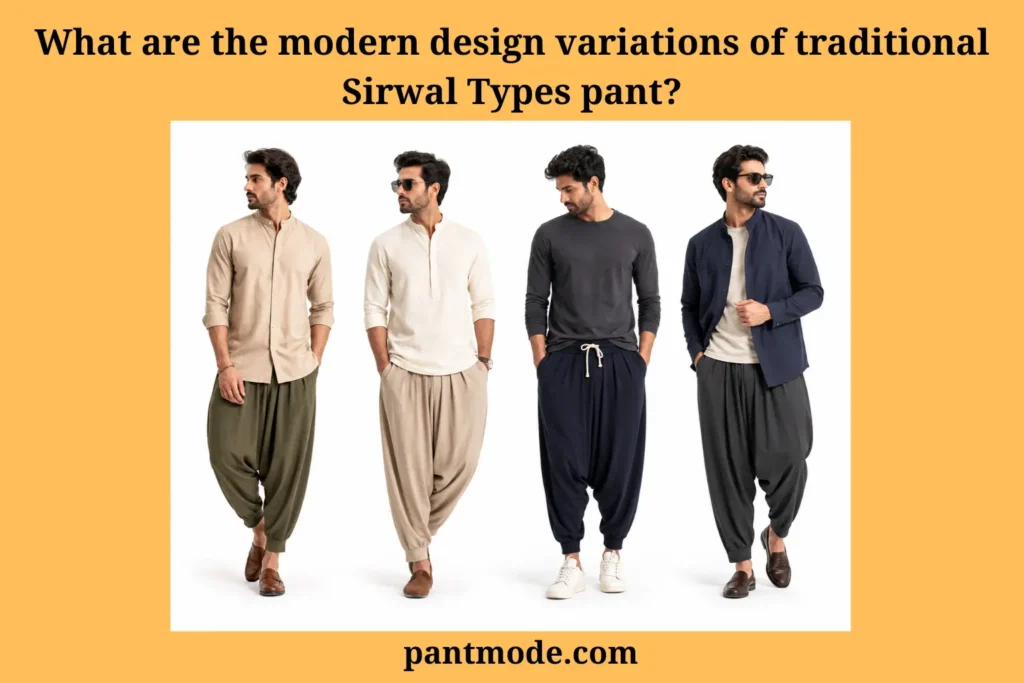
What Are the Modern Design Variations of Traditional Sirwal Pants?
Modern Sirwal variations reinterpret traditional Sirwal design logic through updated silhouettes, controlled crotch depths, revised waist construction, contemporary lower-leg finishes, modern fabrics, utility details, and new use-case styling.
For this guide, PantMode uses seven practical design directions: tapered contemporary, streetwear-oriented, utility/cargo, movement-oriented, minimalist tailored, formal/refined, and contemporary modestwear. These are comparison tools rather than a universal historical taxonomy. Traditional Sirwal pants vary by region, so a loose or drop-crotch trouser should never be classified from silhouette alone.
PantMode Modern Sirwal Design Continuity Framework
PantMode evaluates a contemporary design through five connected signals rather than one visual shortcut. The stronger the agreement between these signals, the stronger the case for calling the garment a modern Sirwal rather than merely Sirwal-inspired.
Quick Answer
For this guide, PantMode groups modern Sirwal adaptations into seven practical design directions: tapered contemporary, streetwear-oriented, utility/cargo, movement-oriented, minimalist tailored, formal/refined, and contemporary modestwear. These designs reinterpret recognizable Sirwal logic through changes in crotch depth, leg volume, waist construction, lower-leg control, fabric behavior, pockets, and styling proportion. A loose or drop-crotch trouser should not be called Sirwal from silhouette alone.
Definition
A modern Sirwal variation is a contemporary trouser design that preserves a recognizable relationship to Sirwal construction or design logic while adapting silhouette, waist, lower-leg treatment, material behavior, utility details, or intended use.
What Design Features Distinguish Modern Sirwal Variations From Traditional Sirwal Forms?
Modern Sirwal variations differ from traditional forms through changes in crotch depth, leg-volume control, waistband construction, lower-leg treatment, pockets, fabric behavior, and finishing while retaining some recognizable Sirwal design relationship.
A useful traditional baseline is generous upper-seat or leg ease, practical waist adjustment, and some form of lower-leg control, but no single crotch, gusset, waistband, fabric, or ankle finish is universal. The dedicated Sirwal features page provides the strongest internal construction reference.
One documented UAE example from The Zay Initiative’s traditional UAE Sirwal documentation describes loose construction, drawstring fastening, tapering ankles, a gusset in that specific example, and decorated lower-leg details. Those features are useful evidence for that documented garment, not a universal Sirwal pattern.
Modernization can move the crotch higher or lower, reduce or exaggerate upper-leg volume, replace ties with elastic or internal drawcords, add flat-front or structured waist sections, change gathered ankles to clean hems or rib cuffs, and add modern pocket systems.
Traditional vs. Modern Design Comparison
| Design Attribute | Traditional Baseline | Possible Modern Adaptation | Design Effect |
|---|---|---|---|
| Crotch depth | Regionally variable | Standard to exaggerated | Alters drape and proportion |
| Upper-leg volume | Often generous but variable | Controlled to exaggerated | Changes silhouette |
| Waist | Tie, gather, or regional fastening | Elastic, drawcord, flat-front, hybrid | Changes fit and appearance |
| Lower leg | Narrowed, gathered, tapered, or regional finish | Rib cuff, taper, clean hem, zip, crop | Controls lower-leg volume |
| Pockets | Tradition varies | Hidden, welt, zip, cargo | Adds utility or refinement |
| Fabric | Regional textiles | Stretch woven, stable knit, refined woven, performance-oriented fabric | Changes drape and function |
| Finish | Practical or region-specific | Minimalist, utility, movement-oriented, refined | Signals contemporary use |
PantMode treats modernization as a relationship between inherited design logic and contemporary structural change.
Evidence Scope
Historical and regional Sirwal forms vary. This guide uses documented traditional examples to establish design clues, while PantMode’s seven modern design directions are a practical editorial classification framework rather than a universal historical taxonomy.
Which Practical Design Directions Define Modern Sirwal Variations?
For this guide, PantMode groups modern Sirwal variations into seven practical design directions: tapered contemporary, streetwear-oriented, utility/cargo, movement-oriented, minimalist tailored, formal/refined, and contemporary modestwear.
Tapered contemporary keeps moderate upper volume but cleans the lower-leg line for easier everyday use. Streetwear-oriented uses deliberate contrast between upper volume, crotch depth, cropped or tapered hems, layering, and footwear visibility.
Utility/cargo adds storage, reinforcement, and adjustable details. Movement-oriented controls fabric interference through stable waists, measured ease, and lower-leg containment. Minimalist tailored reduces visual clutter through clean waists, controlled pleats, and discreet pockets.
Formal/refined relies on intentional drape, restrained hardware, clean finishing, and proportion control. Contemporary modestwear emphasizes coverage, ease, opacity, breathability, and compatibility with longer layers.
Modern Sirwal Variation Taxonomy
| Design Direction | Volume | Crotch Position | Dominant Modern Change | Typical Use |
|---|---|---|---|---|
| Tapered contemporary | Moderate | Standard to moderately lowered | Cleaner taper | Everyday casual |
| Streetwear-oriented | Moderate to generous | Variable / often lowered | Deliberate proportion | Streetwear |
| Utility/cargo | Moderate | Standard to lowered | Functional storage | Utility casual |
| Movement-oriented | Controlled | Standard to moderately lowered | Reduced fabric interference | Movement-focused wear |
| Minimalist tailored | Low to moderate | Controlled | Structured refinement | Smart casual |
| Formal/refined | Variable | Controlled | Drape and finish | Refined occasions |
| Contemporary modestwear | Moderate | Variable | Coverage and layering compatibility | Modest contemporary styling |
The seven-category framework is editorial and practical, not a claim of universal historical taxonomy.
How Do Streetwear-Oriented Modern Sirwal Variations Update Traditional Proportions?
Streetwear-oriented modern Sirwal variations update traditional proportions by deliberately balancing upper-leg volume, crotch depth, lower-leg control, layer length, and footwear visibility.
How Do Utility and Cargo Modern Sirwal Variations Add Function Without Losing Silhouette Control?
Utility and cargo modern Sirwal variations add function through storage, reinforcement, stable waist construction, and controlled hems while preserving enough silhouette clarity to remain visually intentional.
Cargo pockets add carrying capacity, zip or hidden pockets secure smaller items, reinforced stress areas support repeated use, and stable drawcord or hybrid waist systems control the garment under load.
Every added pocket, zipper, reinforcement layer, and adjustable hem also adds visual and physical weight. The strongest utility version distributes those features so the garment still reads as a coherent Sirwal-derived silhouette.
New Mexico State University’s Clothing Construction Standards support general inspection of secure stitching, closures, pockets, cuffs, hems, and functional garment construction. They help evaluate construction quality, not Sirwal identity.
How Do Movement-Oriented Modern Sirwal Variations Control Volume for Easier Motion?
Movement-oriented modern Sirwal variations control excess fabric through measured crotch ease, stable waist construction, lower-leg control, and materials selected for the movement demands of the garment.
Controlled thigh ease can preserve mobility without leaving large amounts of loose fabric to swing or catch during repeated motion. Stable waist construction reduces shifting, while tapering, a secure cuff, or another lower-leg treatment can keep fabric away from the feet.
Stretch is the ability of a material to extend under force. Recovery is the ability to return toward its original shape after extension. A fabric can stretch well but recover poorly, so the two should not be treated as the same property.
Breathability, moisture behavior, fabric weight, abrasion exposure, and shape retention should be matched to the actual activity rather than inferred from one fiber label. AATCC textile test methods and procedures provide standardized ways to evaluate measurable textile properties. Do not claim a specific garment meets a performance level unless it has actually been tested for that property.
How Do Tailored and Formal Modern Sirwal Variations Create a More Polished Silhouette?
Tailored and formal modern Sirwal variations create a more polished silhouette by controlling excess volume, refining pleats, structuring the waistband, simplifying pockets and hardware, and selecting fabric with intentional drape.
Controlled thigh volume reduces bulk while preserving enough ease to retain a Sirwal relationship. Shallow or disciplined pleats can organize fullness without producing a swollen front profile.
Structured waist construction creates a cleaner top edge, while discreet pockets and restrained hardware reduce visual interruption. Controlled seam lines and a polished hem support a refined finish.
A design can become so narrow and conventionally tailored that the recognizable Sirwal relationship weakens. Refinement should control volume rather than erase every characteristic signal.
How Do Contemporary Modestwear Sirwal Variations Balance Coverage, Ease, and Proportion?
Contemporary modestwear Sirwal variations balance coverage, ease, opacity, controlled volume, and compatibility with longer or layered upper garments.
Seat and thigh ease can support coverage and movement, while a controlled taper prevents the lower half from becoming visually heavy beneath longer layers. Opacity, breathability, fabric weight, fluidity, and wrinkle behavior all influence the result.
This use direction can overlap with both men’s Sirwal and women’s Sirwal contexts, but modestwear is only one contemporary application and should not be treated as the sole purpose or meaning of Sirwal.
Which Fabric and Construction Choices Best Match Modern Sirwal Variations?
The best fabric and construction choices for modern Sirwal variations depend on the garment’s required drape, movement, stability, coverage, abrasion exposure, shape retention, and level of refinement.
Fiber composition should be read together with fabric structure, woven-versus-knit behavior, weight, stretch, recovery, opacity, breathability, moisture behavior, finish, pocket support, seam construction, and shape retention.
Streetwear benefits from enough structure to hold deliberate volume. Utility designs need stable fabric and reinforced stress areas. Movement-oriented versions need controlled behavior rather than maximum looseness. Tailored and formal directions need clean drape, while modestwear often requires a balance between opacity, breathability, fluidity, and weight.
Fabric & Construction Decision Matrix
| Use Direction | Priority Properties | Suitable Fabric Behavior | Construction Direction | Main Trade-Off |
|---|---|---|---|---|
| Streetwear | Drape + shape | Medium weight, controlled structure | Moderate volume + taper | Structure vs. bulk |
| Utility | Stability + abrasion management | Supportive fabric | Reinforced high-stress areas | Weight |
| Movement | Stretch/recovery + low interference | Movement-friendly structure | Controlled volume | Less traditional fullness |
| Tailored | Shape + clean drape | Refined stable fabric | Pleat and waist control | Less relaxed ease |
| Formal/refined | Surface refinement + drape | Smooth or fluid refined fabric | Minimal visual clutter | Care / maintenance |
| Modestwear | Opacity + breathability + drape | Opaque but wearable fabric | Balanced ease | Coverage vs. heat |
How Can You Fix Proportion Problems When Styling Modern Sirwal Variations?
You can fix proportion problems in modern Sirwal variations by adjusting upper-body volume, layer length, crotch depth, thigh volume, taper, fabric drape, ankle weight, and footwear scale according to the actual visual problem.
The correction should target the cause rather than simply making the trousers slimmer. If the problem is heavy fabric plus a long top, reduce one source of visual weight. If the garment feels too narrow to communicate the intended Sirwal reference, restore thigh ease, pleating, or softer drape.
Proportion Troubleshooting Matrix
| Problem | Likely Cause | Adjustment | Boundary |
|---|---|---|---|
| Too bulky | Heavy fabric + excess volume + long top | Reduce one source of volume | Do not erase Sirwal identity |
| Too narrow | Insufficient thigh ease or drape | Add volume, pleat, or softer drape | Avoid turning it into a standard trouser |
| Costume-like | Exaggerated crotch + competing details | Moderate one or more visual extremes | Do not overcorrect into jogger styling |
| Heavy ankle | Wide hem + bulky footwear | Adjust hem width or footwear scale | No universal shoe rule |
| Unbalanced upper body | Competing garment volume | Shorten or simplify upper layers | Context matters |
| Too technical | Excess zips, straps, or pockets | Reduce hardware | Preserve useful function |
How Can You Distinguish Modern Sirwal Variations From Generic Drop-Crotch or Harem-Style Trousers?
You can distinguish modern Sirwal variations from generic drop-crotch or harem-style trousers by checking whether multiple design and contextual signals point back to recognizable Sirwal construction or design logic.
A low crotch, loose volume, elastic waist, taper, ankle cuff, or harem-style marketing label is never enough by itself. Stronger evidence can include documented Sirwal reference, appropriate terminology, recognizable upper-volume distribution, waist logic, lower-leg control, and intentional reinterpretation.
The regional Sirwal forms page is the stronger internal reference when terminology or traditional context matters. A contemporary garment with only partial continuity should be called Sirwal-inspired.
Sirwal vs. Sirwal-Inspired Classification Table
| Label | Use When | Evidence Standard | Avoid |
|---|---|---|---|
| Traditional Sirwal | Documented traditional / regional form | Cultural context + construction + terminology | Calling modern fashion trousers traditional |
| Modern Sirwal | Contemporary adaptation with clear Sirwal relationship | Multiple recognizable design/reference signals | Using low crotch alone |
| Sirwal-inspired | Selected Sirwal traits remain but continuity is weaker | Clear inspiration + substantial modernization | Overclaiming authenticity |
| Harem-style trousers | Broad fashion label best describes garment | Fashion context dominates | Treating it as precise Sirwal terminology |
| Generic drop-crotch trousers | Crotch position is the dominant identifier | No meaningful Sirwal evidence | Forcing cultural classification |
PantMode separates continuity from resemblance so loose or dropped silhouettes are not overclassified.
F50 Modern Sirwal Classification Control
| F50 Step | Control Question | Pass Standard |
|---|---|---|
| Trigger | Is the reader classifying, choosing, or correcting a contemporary Sirwal-related design? | Decision task is clear |
| Classification | Which traditional reference, modern change, silhouette, waist, lower-leg treatment, fabric behavior, and use apply? | Signals are identified before naming |
| Recommendation | Which practical design direction best matches the garment’s actual construction and use? | Category follows evidence |
| Red flag | Is one feature such as low crotch, bagginess, cuff, cargo pocket, or stretch carrying the label? | Single-feature classification is rejected |
| Exception | Does a highly modern design still preserve enough Sirwal relationship to justify the label? | Boundary is stated explicitly |
| Verification | Do multiple design and contextual signals support modern Sirwal rather than Sirwal-inspired or another trouser category? | Final label is no stronger than evidence |
What Checklist Helps Identify the Right Modern Sirwal Variation for a Specific Use?
The right modern Sirwal variation should be identified by matching intended use with traditional reference, silhouette, crotch depth, upper-leg volume, waist stability, lower-leg control, fabric behavior, utility details, and styling proportion.
Final Modern Sirwal Identification Checklist
Final Classification Decision
Key Takeaway
Classify a modern Sirwal by reading multiple signals together: traditional reference, silhouette, crotch depth, leg volume, waist construction, lower-leg control, fabric behavior, utility details, and intended use. Use “Sirwal-inspired” when only selected traits remain and the traditional design relationship is weak or uncertain.
What Final Rule Should Guide Classification of Modern Sirwal Variations?
The final rule for classifying modern Sirwal variations is to evaluate traditional reference, silhouette, crotch depth, leg volume, waist construction, lower-leg control, fabric behavior, utility details, and intended use together rather than relying on one visual feature.
No single universal Sirwal pattern exists across every region. Low crotch placement, bagginess, one gusset, one cuff, one fabric, one waistband, or one cargo detail therefore cannot prove the classification.
PantMode’s seven-category framework is a practical modern comparison tool, not historical canon. Modern adaptation and traditional authenticity are different questions, and Sirwal-inspired is the safer label when the relationship is limited.
Modern Sirwal variations are best understood as contemporary design adaptations, not as proof that every low-crotch or voluminous trouser is traditional Sirwal.
What FAQ Questions Clarify Modern Sirwal Variations?
The most useful FAQ questions about modern Sirwal variations clarify how contemporary designs differ from traditional forms, how PantMode’s practical categories work, and when a garment should be described as Sirwal-inspired instead.
Modern versions may change crotch depth, volume, waist construction, lower-leg treatment, fabric, pockets, and intended use while preserving a recognizable relationship to Sirwal design logic.
For this guide, PantMode uses seven practical directions: tapered contemporary, streetwear-oriented, utility/cargo, movement-oriented, minimalist tailored, formal/refined, and contemporary modestwear. This is an editorial comparison framework, not a universal historical taxonomy.
Movement-oriented designs prioritize controlled fabric, stable fit, lower-leg management, and material behavior for easier motion. Streetwear versions can place greater emphasis on deliberate volume, crop, layer contrast, and visual proportion.
No. Crotch depth may range from relatively standard to strongly lowered. A low crotch is one silhouette attribute and cannot identify Sirwal by itself.
No. Similar silhouette alone is insufficient. Use “modern Sirwal” only when multiple Sirwal design signals remain, and use “Sirwal-inspired” when the relationship is partial or uncertain.
Modern Sirwal variations preserve a recognizable relationship to traditional Sirwal design while changing silhouette, waist construction, lower-leg control, material behavior, utility, finishing, and intended use. The strongest classification depends on how several design signals work together rather than one dramatic feature.
Tapered, streetwear, utility, movement-oriented, tailored, formal, and modestwear directions can all reinterpret Sirwal in different ways. When traditional continuity becomes weak or uncertain, describing the garment as Sirwal-inspired keeps the classification precise without overstating authenticity.