
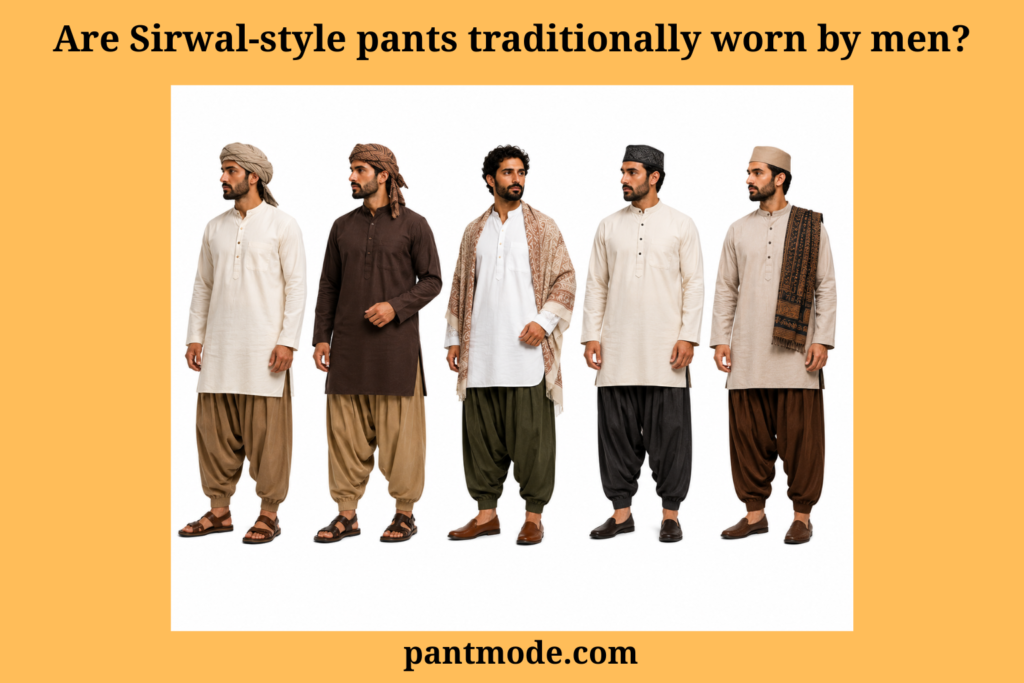
Are Sirwal-Style Pants Traditionally Worn by Men?
Men’s Sirwal-style pants are traditionally worn by men in several regional clothing systems, but they are not exclusively male garments.
The direct answer is yes. Sirwal-style pants have traditionally been worn by men in Middle Eastern, Gulf, Islamic-influenced, Ottoman-influenced, North African, and South Asian clothing contexts.
Related women’s Sirwal forms also exist, so “Sirwal-style” should mean loose traditional trousers with regional meaning, not every modern harem pant or drop-crotch fashion trouser. For the wider historical frame, compare Sirwal origin.
Quick Answer
Yes, Sirwal-style pants are traditionally worn by men in several Middle Eastern, Gulf, Islamic-influenced, Ottoman-influenced, North African, and South Asian clothing contexts. They are usually loose through the seat or upper leg, practical at the waist, and controlled at the ankle or used as an underlayer beneath thobes, qamis, robes, tunics, or regional garments.
Definition
Men’s Sirwal-style pants are traditional loose trousers worn by men as visible regional trousers, under-robe trousers, or tunic-paired trousers. They are recognized by roomy construction, simple waist fastening, controlled lower legs, short or long length, and regional naming such as Sirwal, sarawil, sherwal, shalwar, salwar, şalvar, or sarouel.
Key Takeaway
Men’s Sirwal-style pants are traditional male garments in many regions, but they are not exclusively male. Related women’s Sirwal forms also exist, so male use must be explained with gender, regional, and terminology nuance.
External sources: This guide uses Zay source for Sirwal construction and gender nuance, and Saudipedia source for Saudi thobe context.
Figure: men’s Sirwal-style pants are identified through use, region, layering, construction, and terminology.
What confirms that men’s Sirwal-style pants belong to traditional male dress?
Men’s Sirwal-style pants belong to traditional male dress because men have worn loose Sirwal-related trousers in several regional clothing systems.
Yes, Sirwal-style pants have traditionally been worn by men. Male use appears in Middle Eastern, Gulf, Islamic-influenced, Ottoman-influenced, North African, and South Asian dress contexts.
Male use does not mean exclusive male use. Related Sirwal forms also appear in women’s traditional dress, so the safest answer is yes with gender nuance.
Sirwal-style does not mean every modern loose pant. The phrase should refer to loose traditional trousers with regional meaning, construction clues, and garment-pairing context.
Quick Verdict Box
| Question | Answer |
|---|---|
| Are Sirwal-style pants traditionally worn by men? | Yes |
| Are they exclusively men’s garments? | No |
| Do women’s Sirwal forms also exist? | Yes |
| Are all loose drop-crotch pants Sirwal? | No |
| What defines traditional men’s Sirwal-style pants? | Regional use, loose construction, simple waist, controlled ankle, or underlayer function |
| What should the article avoid? | Treating Sirwal as only male, only Arab, or identical to modern harem pants |
Men’s Sirwal Use Table
| Use Signal | What It Shows | Article Meaning |
|---|---|---|
| Men wear Sirwal-style pants in several regional dress systems | Male traditional use exists | The answer is yes |
| Women’s forms also exist | Use is not exclusive to men | Avoid male-only claim |
| Pants may be hidden under robes | Underlayer function matters | Do not expect every pair to be visible |
| Pants may be visible outer trousers | Regional forms vary | Avoid one-shape definition |
| Terms vary by region | Naming is contextual | Use Sirwal, sarawil, sherwal, shalwar, salwar, şalvar, or sarouel carefully |
| Harem pants are modern fashion labels | Visual similarity is not enough | Separate traditional use from fashion reinterpretation |
Why are men’s Sirwal-style pants common in regional and Islamic-influenced dress systems?
Men’s Sirwal-style pants are common in regional and Islamic-influenced dress systems because loose covered trousers support movement, modesty, layering, comfort, and fabric control.
Loose construction supports daily movement. A roomy seat and upper leg can help walking, sitting, bending, kneeling, and practical activity.
Covered legwear can support modest dress. Men may wear Sirwal-style pants alone, under robes, or beneath long upper garments.
Simple waist systems make the trousers practical. Drawstring or gathered waists adjust without complex tailoring, while tapering, narrowing, cuffing, or short length controls loose fabric.
Use varies by region. Some men wear Sirwal-style pants beneath thobes, while other traditions use visible outer trousers.
Function Table
| Function | How Men’s Sirwal-Style Pants Support It | Cultural Result |
|---|---|---|
| Movement | Loose seat and upper leg allow bending and walking | Practical daily wear |
| Modesty | Covered lower body can work under robes or tunics | Fits modest dress systems |
| Layering | Can be hidden under thobe, qamis, robe, or tunic | Works as underlayer |
| Comfort | Drawstring or gathered waist adjusts easily | Flexible fit |
| Fabric control | Narrowed, cuffed, or short lower leg manages volume | Prevents loose cloth from dragging |
| Climate adaptation | Fabric and length vary by region | Localized comfort |
| Regional identity | Names and cuts differ by place | Avoids one-size-fits-all definition |
How are men’s Sirwal-style pants worn under thobes, qamis, robes, and tunics?
Men’s Sirwal-style pants are worn under thobes, qamis, robes, and tunics as modesty layers, comfort layers, or regional lower garments.
Under a thobe, Sirwal-style pants can function as modesty and comfort legwear. The thobe gives the long outer shape, while the trousers provide practical lower-body coverage.
With a qamis or tunic, Sirwal-style pants can form part of a complete traditional outfit. The exact name may change by region, especially where shalwar, salwar, or sarouel terms apply.
In some contexts, Sirwal-style pants are visible outer trousers. Rural, Ottoman-influenced, North African, Levantine, and South Asian traditions may show the trouser silhouette more clearly.
Short men’s sarawil can function as underlayer garments beneath longer clothing. Length and visibility help define the garment’s role.
Figure: traditional male use includes under-robe legwear, tunic pairing, and visible regional trousers.
Outfit Pairing Table
| Pairing | Purpose | Recognition Clue | Article Note |
|---|---|---|---|
| Sirwal + thobe | Modesty and comfort under robe | Plain trousers partly hidden | Common in Gulf-style contexts |
| Sirwal + qamis | Full traditional outfit | Loose trouser beneath long shirt | Use regional wording carefully |
| Sirwal + tunic | Traditional trouser and upper-garment pairing | Visible lower leg or ankle | May overlap with shalwar / salwar contexts |
| Sirwal as outer trouser | Visible regional garment | Roomy seat, tapered leg, strong silhouette | Common in some Levantine, Ottoman, or North African contexts |
| Short sarawil under robe | Hidden underlayer | Shorter length, simple waistband | Do not confuse with visible outer trousers |
| Şalvar with regional top | Ottoman / Turkish-influenced outfit | Wide gathered trousers | Use şalvar when context is Turkish/Ottoman |
| Shalwar / salwar with kameez | South Asian or Persian-linked outfit | Loose trousers with tunic | Do not automatically call it Sirwal |
What design features identify men’s Sirwal-style pants?
Men’s Sirwal-style pants are identified by loose upper-leg construction, a roomy seat, simple waist fastening, controlled lower-leg shape, plain or practical fabric, and regional garment pairing.
A loose upper leg or roomy seat allows movement, sitting comfort, and modest coverage. This is a stronger clue than bagginess alone.
Drawstring, gathered, elasticated, or simple waistbands make the garment adjustable and practical. Tapered, narrowed, cuffed, or shortened lower legs control fabric around the ankle or keep the garment hidden under longer clothing.
Plain fabric and minimal decoration often support everyday wear or underlayer use. Men’s under-thobe or under-qamis Sirwal may be less decorated than some visible women’s regional examples.
Regional cut and pairing connect the trouser to traditional clothing systems. For the full taxonomy, compare traditional features.
Figure: construction clues include a simple waist, roomy seat, crotch volume, and ankle control.
Men’s Sirwal Construction Anatomy Table
| Construction Feature | Function | Male-Wear Signal | Watch-Out |
|---|---|---|---|
| Loose upper leg | Movement and comfort | Supports daily use | Do not call every loose pant Sirwal |
| Roomy seat | Sitting, bending, prayer postures, work | Traditional loose-trouser logic | Not always exaggerated like fashion harem pants |
| Drawstring waist | Adjustable fit | Common in practical sarawil | Elastic may indicate modern adaptation |
| Gathered waist | Controls fabric volume | Traditional loose silhouette | Needs regional context |
| Tapered ankle | Manages loose fabric | Common in visible or layered trousers | Not all related forms taper equally |
| Short length | Underlayer function | May be worn beneath robes | Do not treat all Sirwal as full-length |
| Plain fabric | Everyday or hidden use | Common in men’s undergarment-style versions | Decoration varies by region |
| Strong outer silhouette | Visible regional use | Levantine, Ottoman, North African, or South Asian contexts | Use correct regional term |
Which regions show men’s Sirwal-style pants most clearly?
Men’s Sirwal-style pants appear most clearly in Gulf, Arab, Levantine, Ottoman-influenced, North African, and South Asian clothing contexts, although the exact term and shape vary by region.
Gulf and Saudi contexts may include long or short sarawil, often under robes or thobes. Arab and broader Middle Eastern contexts may use Sirwal-style trousers as modest traditional lower garments or underlayers.
Levantine sherwal contexts may show visibly roomy trousers with a low seat and narrowed lower leg. Ottoman and Turkish şalvar contexts may show loose trousers in rural or regional dress influenced by Ottoman traditions.
North African sarouel or seroual contexts may show related loose trousers with local naming. South Asian shalwar and salwar contexts use related loose trousers with kameez, kurta, or similar upper garments.
Regional background matters. For regional clothing context, compare regional use.
Regional Male Sirwal Comparison Matrix
| Region / Context | Male Trouser Term | Male Use Pattern | Recognition Detail | Naming Caution |
|---|---|---|---|---|
| Gulf / Saudi | Sirwal / sarawil | Long or short under-robe trousers | Plain, practical, under-thobe use | Do not treat all forms as visible outer trousers |
| Arab / Middle Eastern | Sirwal | Modest lower garment or underlayer | Loose upper leg, controlled lower leg | Not purely Arab in historical origin |
| Levant | Sherwal / Sirwal-related | Visible roomy trousers | Low seat, narrowed ankle | More visibly baggy than under-thobe sarawil |
| Ottoman / Turkish | Şalvar | Regional or rural loose trousers | Gathered waist, wide seat | Use şalvar for Turkish/Ottoman context |
| North African | Sarouel / seroual | Regional loose trousers | Local naming and silhouette | Avoid harem pants when regional term is known |
| South Asian | Shalwar / salwar | Trousers worn with tunic or kameez | Loose trouser + long top | Related, but not always best called Sirwal |
| Modern fashion | Harem pants / drop-crotch pants | Fashion reinterpretation | Exaggerated crotch, elastic waist | Not automatically traditional Sirwal |
How do long and short men’s Sirwal-style pants differ?
Long and short men’s Sirwal-style pants differ by length, visibility, layering function, and regional garment pairing.
Long Sirwal-style pants reach the ankle or lower leg. They may work as visible trousers or under-robe legwear depending on region.
Short sarawil end above the lower leg or function as shorter undergarment-style trousers. They are often defined by hidden use, plain fabric, and simple fastening.
Tapered ankle Sirwal usually uses a full or lower-leg length with controlled ankle shape. Visible outer Sirwal or sherwal usually functions as the main trouser and shows a stronger regional silhouette.
Length depends on region, garment pairing, climate, visibility, and use. A short underlayer and a visible outer trouser should not be described as the same type.
Long vs Short Men’s Sirwal Table
| Type | Length | Traditional Function | Recognition Clue | Best Description |
|---|---|---|---|---|
| Long Sirwal | Ankle or lower leg | Visible trouser or under-robe legwear | Full lower-body coverage | Long men’s Sirwal |
| Short sarawil | Above lower leg or underlayer length | Hidden undergarment-style use | Simple fabric, worn under robe | Short men’s sarawil |
| Tapered Sirwal | Full or lower-leg length | Controls loose fabric | Narrow ankle | Tapered men’s Sirwal |
| Visible sherwal | Long, roomy, often low-seat | Outer regional trouser | Baggy upper section | Levantine or regional sherwal |
| Şalvar-related trouser | Full and gathered | Ottoman/Turkish regional use | Wide gathered silhouette | Men’s şalvar where context applies |
| Shalwar / salwar | Long trouser with tunic pairing | South Asian or Persian-linked outfit | Paired with kameez or kurta | Men’s shalwar / salwar |
How do men’s Sirwal-style pants differ from women’s Sirwal forms?
Men’s Sirwal-style pants differ from women’s Sirwal forms mainly through use, visibility, decoration, garment pairing, and regional context rather than through one universal gender rule.
Both men’s and women’s forms can share loose construction. A roomy seat, simple waist, and controlled lower leg can appear in more than one gendered clothing tradition.
Men’s forms may be plain and practical, especially under robes. Women’s forms may include more visible lower-leg decoration in some regions.
Men’s versions may use ankle control for practicality. Women’s versions may use the ankle area for decorative display, but decoration is not a universal gender rule.
Gender difference should be explained by context. For the related page, compare women’s Sirwal.
Men’s Sirwal vs Women’s Sirwal Comparison Table
| Feature | Men’s Sirwal-Style Pants | Women’s Sirwal Forms | Accurate Interpretation |
|---|---|---|---|
| Use | Under robe, under qamis, outer trouser, regional garment | Under dress, under robe, visible lower-leg garment | Use depends on region |
| Decoration | Often plain in underlayer forms | May include decorated cuffs or lower-leg panels | Decoration is not universal |
| Waist | Drawstring, gathered, elastic, or simple | Drawstring, gathered, or traditional closure | Waist does not determine gender |
| Ankle | Tapered, narrowed, short, or controlled | Tapered, narrow, decorated, or cuffed | Ankle can be functional or decorative |
| Visibility | Hidden or visible depending on outfit | Often visible at ankle in some traditions | Visibility shapes design |
| Fabric | Plain daily fabric or regional cloth | Plain or ornate fabric | Fabric reflects use and occasion |
| Best explanation | Men traditionally wear Sirwal-style pants | Women’s forms also exist | Not exclusively male |
Which terms are confused with men’s Sirwal-style pants?
The terms most often confused with men’s Sirwal-style pants are sarawil, sherwal, shalwar, salwar, Ottoman şalvar, sarouel, seroual, harem pants, and under-thobe pants.
Sirwal and sarawil refer to loose traditional trousers in Arabic and Islamic-influenced clothing contexts. Sherwal often refers to a related Levantine or regional visibly baggy trouser.
Shalwar and salwar carry stronger Persian, Central Asian, and South Asian associations. Ottoman şalvar should be used when the garment belongs to Turkish or Ottoman-influenced contexts.
Sarouel and seroual often appear in North African, French, or fashion-linked naming contexts. Harem pants are broad modern fashion labels and not precise replacements for culturally specific terms.
Under-thobe pants is descriptive but less historically precise. Use Sirwal or sarawil where the regional term applies. For modern naming boundaries, compare modern variations.
Figure: related names overlap, but harem pants should not replace culturally specific Sirwal terms.
Sirwal Terminology Matrix
| Term | Overlap With Men’s Sirwal-Style Pants | Key Difference | Use Carefully When |
|---|---|---|---|
| Sirwal | Loose traditional trousers | Arabic/Middle Eastern context | Discussing traditional regional trousers |
| Sarawil | Plural/related Arabic form | Often used for long or short men’s forms | Discussing under-thobe or male traditional use |
| Sherwal | Loose baggy trouser | Levantine or regional association | The garment is visibly roomy and regional |
| Shalwar | Related loose trouser | Persian / Central Asian link | Discussing Persian-linked trouser forms |
| Salwar | Related loose trouser | South Asian garment system | Discussing salwar-kameez or kurta pairing |
| Şalvar | Wide gathered trouser | Turkish / Ottoman context | The context is Ottoman, Turkish, or Balkan |
| Sarouel / seroual | Related loose trouser naming | North African or French-linked use | The context is Maghreb or fashion terminology |
| Harem pants | Loose/drop-crotch fashion silhouette | Broad Western fashion label | Discussing modern fashion, not traditional specificity |
| Under-thobe pants | Functional description | Less historical precision | Regional term is unknown |
What mistakes distort men’s Sirwal-style pants in fashion explanations?
The mistakes that distort men’s Sirwal-style pants in fashion explanations usually come from exclusive gender claims, Arab-only claims, loose-pants generalization, and confusion with modern harem pants.
Saying Sirwal-style pants are only men’s clothing erases women’s forms and regional variation. The accurate statement is that men traditionally wore them, but not exclusively.
Saying Sirwal-style pants are only Arab oversimplifies the wider context. Persian, Central Asian, Islamic-influenced, Ottoman, North African, and South Asian connections should be handled carefully.
Calling every loose pant Sirwal creates entity confusion. Construction, name, region, and traditional use must be checked.
Treating modern harem pants as identical to traditional Sirwal weakens cultural accuracy. Harem pants are fashion-market labels, not precise cultural terms.
Misconception/Fix Checklist
| Mistake | Risk | Better Fix |
|---|---|---|
| Saying Sirwal is only men’s clothing | Ignores women’s forms | Men traditionally wear them, but not exclusively |
| Saying Sirwal is only Arab | Oversimplifies history and region | Mention wider regional connections carefully |
| Calling all loose pants Sirwal | Entity confusion | Check construction and cultural context |
| Equating Sirwal with harem pants | Fashion label confusion | Separate traditional term from modern label |
| Ignoring under-thobe use | Misses hidden male function | Explain long and short sarawil |
| Ignoring women’s decorated forms | Weak gender comparison | Compare male and female uses accurately |
| Using under-thobe pants only | Less historical precision | Use Sirwal or sarawil when applicable |
| Treating one shape as universal | Overgeneralization | Explain regional variation |
How can readers identify men’s Sirwal-style pants from garment clues?
Readers can identify men’s Sirwal-style pants from garment clues by checking the upper leg, seat, waist, lower leg, pairing, visibility, region, name, modern features, and gender context.
Start with the upper leg, seat, and crotch. Check whether the trouser is loose through the upper leg, roomy through the seat, or lowered through the crotch.
Check the waist and lower leg. Look for drawstring, gathering, elastic, pleats, or simple adjustable construction, then inspect whether the lower leg is tapered, cuffed, shortened, gathered, or controlled at the ankle.
Check the outfit pairing. Determine whether the garment is worn under a thobe, qamis, robe, tunic, or as visible regional trousers.
Choose the term after checking context. Decide whether the garment is traditional, an underlayer, a regional trouser, or a fashion drop-crotch pant.
Men’s Sirwal Identification Checklist
| Identification Step | What to Check | Meaning |
|---|---|---|
| Upper leg | Loose, roomy, or wide | Supports traditional loose trouser logic |
| Seat / crotch | Roomy or lowered | Allows sitting and movement |
| Waist | Drawstring, gathered, simple, elastic, or pleated | Shows fastening system |
| Lower leg | Tapered, cuffed, narrowed, or short | Controls fabric volume |
| Pairing | Thobe, qamis, robe, tunic, or regional top | Confirms male outfit context |
| Visibility | Hidden under garment or visible outer trouser | Helps classify use |
| Region | Gulf, Levant, Ottoman, North African, South Asian | Helps choose correct term |
| Name | Sirwal, sarawil, sherwal, shalwar, salwar, sarouel, şalvar | Prevents terminology errors |
| Modern features | Fashion exaggeration or elastic-only styling | May indicate harem pants or adaptation |
| Gender context | Men’s use plus awareness of women’s forms | Avoids exclusive-gender claim |
What final checklist proves men’s Sirwal-style pants are traditionally worn by men?
The final checklist that proves men’s Sirwal-style pants are traditionally worn by men should verify traditional loose-trouser form, male cultural context, garment pairing, construction signals, terminology accuracy, and gender nuance.
A loose traditional trouser form supports Sirwal-style classification. Regional male use supports discussion as traditional men’s wear.
Pairing with a thobe, qamis, tunic, robe, or regional upper garment supports male traditional context. Roomy seat, simple waist, controlled ankle, or short underlayer function supports construction accuracy.
Accurate terminology prevents replacing every loose trouser with Sirwal. Gender nuance requires saying men traditionally wore Sirwal-style pants, but not exclusively.
Final Male Sirwal Tradition Checklist
| Final Check | Pass / Fail |
|---|---|
| Is the garment a loose traditional trouser rather than a standard Western trouser? | |
| Is there a cultural or regional context for male use? | |
| Is the garment paired with a thobe, qamis, tunic, robe, or regional upper garment? | |
| Does the construction include a roomy seat, simple waist, controlled ankle, or short underlayer function? | |
| Is the garment identified by region rather than by appearance alone? | |
| Is the term Sirwal, sarawil, sherwal, shalwar, salwar, sarouel, or şalvar used carefully? | |
| Does the article avoid calling every loose pant Sirwal? | |
| Does the article separate traditional Sirwal-style pants from modern harem pants? | |
| Does the article explain that men traditionally wore them, but not exclusively? | |
| Does the article mention women’s related Sirwal forms where relevant? | |
| Does the final explanation remain historical, cultural, explanatory, and terminology-precise? |
Frequently Asked Questions
Yes. Sirwal-style pants are traditionally worn by men in several Middle Eastern, Gulf, Islamic-influenced, Ottoman-influenced, North African, and South Asian clothing contexts.
No. Men traditionally wore Sirwal-style pants, but related women’s Sirwal forms also exist, so male use should not be treated as exclusive.
They are recognized through loose upper-leg construction, roomy seat, simple waistband, controlled ankle or short underlayer function, garment pairing, regional context, and accurate terminology.
No. Harem pants are a broad modern fashion label, while Sirwal-style pants refer to culturally specific traditional trouser forms.
They may be worn under thobes, qamis, robes, or tunics, or as visible regional trousers depending on culture, region, length, and garment function.
Conclusion
Men’s Sirwal-style pants are traditionally worn by men, but their meaning is most accurate when male use, regional context, garment construction, and related women’s forms are explained together.
Men traditionally wore Sirwal-style pants in several regional clothing systems. Male use includes visible outer trousers and hidden under-robe or under-qamis forms.
The main recognition signals are roomy seat, loose upper leg, simple waist, controlled ankle, short or long length, and garment pairing.
Sirwal-style pants are not exclusively male and should not be confused with every modern harem pant.
The most accurate answer is yes, men traditionally wore Sirwal-style pants, but the garment must be identified through region, construction, pairing, and terminology.