
How Does Functionality and Stretch Enhance Comfort in Leggings?
Stretch and functional design improve leggings comfort by controlling how the fabric moves, recovers, holds, covers, stores, and feels during real activity.
Comfortable leggings are not defined by stretch alone. This guide explains stretch direction, recovery, compression feel, waistband structure, gussets, seams, pockets, fabric choice by activity, troubleshooting, and pre-purchase testing without making medical compression, circulation, weight-loss, or treatment claims.
Quick Answer: How Does Functionality and Stretch Enhance Comfort in Leggings?
Stretch and functional design improve leggings comfort by helping the fabric move with the body, recover after bending, stay opaque under tension, hold the waistband in place, reduce seam friction, support pockets, and match the activity. The most comfortable leggings balance 4-way stretch, recovery, compression, fabric weight, waistband structure, gusset design, seam placement, and activity-specific fabric choice.
Definition: Stretch and Functionality in Leggings
Stretch and functionality in leggings refer to how fabric direction, elastane/spandex content, knit structure, recovery, compression, waistband support, gusset shape, seam construction, opacity, moisture handling, and pockets work together to support movement comfort, fit security, and everyday wearability.
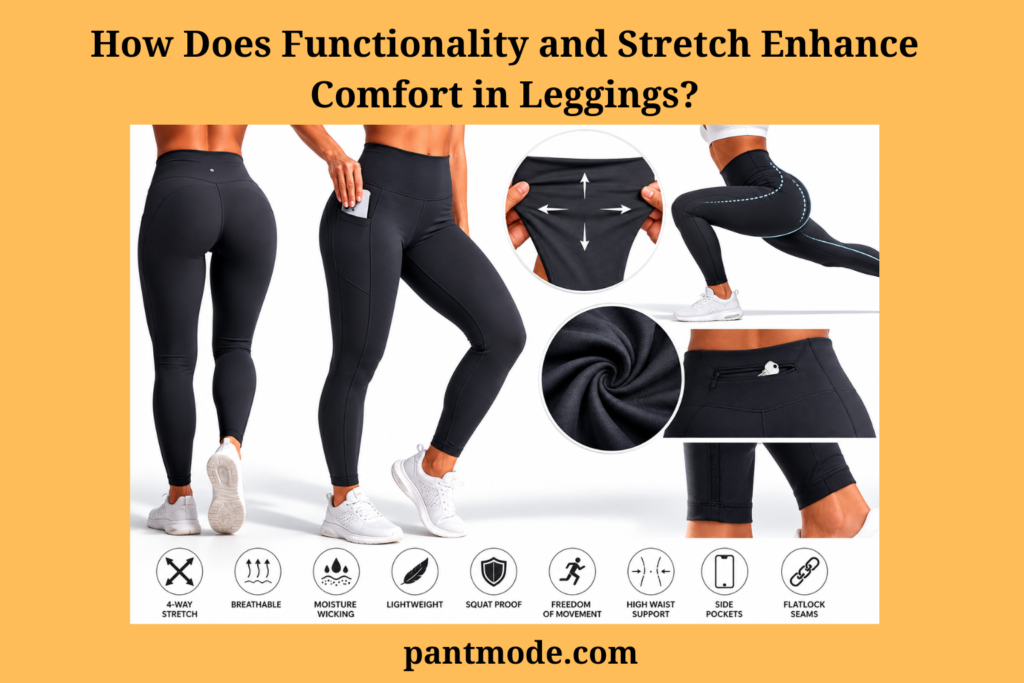
Figure: leggings comfort depends on stretch direction, recovery, waistband hold, opacity, and activity matching.
Why Do Stretch Recovery and Fabric Direction Matter in Leggings Comfort?
Stretch recovery and fabric direction matter in leggings comfort because they control how the fabric moves with the body, returns to shape, stays opaque, and supports movement without sagging or restriction.
2-way stretch and 4-way stretch behave differently. 2-way stretch usually moves more in one direction, while 4-way stretch supports movement across and along the fabric. 4-way stretch usually feels better for squats, lunges, yoga poses, running strides, and sitting, but it still needs recovery and opacity.
Stretch recovery controls shape retention. Recovery describes how well fabric returns to shape after being stretched. Strong recovery helps reduce knee bagging, waistband looseness, crotch sagging, and fabric distortion, but recovery depends on the fabric system and care.
Elastane or spandex supports stretch but does not guarantee quality alone. More stretch is not always better. Comfort depends on elastane percentage, knit structure, fabric weight, intended compression, and activity.
Compression level changes support feel. Light compression suits lounging and travel, medium compression suits casual wear and everyday activity, and firmer compression may suit high-impact workouts if it feels comfortable. Regular leggings should not be described as medical compression garments.
Fabric weight and opacity affect confidence during movement. Thin fabric may stretch too far and become sheer, while very heavy fabric may feel hot or restrictive. Opacity should be tested under stretch and bright light.
Boundary note: regular leggings should not be used to make medical compression, circulation, swelling, pain, injury-prevention, or treatment claims.
Stretch Concept Comfort Blocks
| Concept | Why It Matters | Comfort Outcome | Boundary |
|---|---|---|---|
| 2-way vs. 4-way stretch | 4-way stretch supports movement across and along fabric | Better for squats, lunges, yoga, running, and sitting | Still needs recovery and opacity |
| Stretch recovery | Shows how well fabric returns to shape | Helps reduce knee bagging, sagging, and distortion | Depends on fabric system and care |
| Elastane or spandex content | Adds stretch but must work with knit and weight | Balances flexibility with shape retention | Higher percentage is not automatically better |
| Compression level | Light, medium, and firm compression feel different | Helps match comfort to lounging, training, or high-impact use | Avoid medical compression claims |
| Fabric weight and opacity | Too-thin fabric can become sheer; too-heavy fabric can feel restrictive | Supports coverage and movement confidence | Opacity must be tested under stretch |
What Design Features Add Functional Comfort to Leggings?
Functional leggings feel more comfortable when the waistband, gusset, seams, pockets, fabric weight, and edge reinforcement work together to support movement and reduce irritation.
A high wide waistband spreads pressure and improves hold. It helps during squats, travel, and daily wear. The warning sign is a waistband that rolls or folds.
An internal drawcord adds security. It can help during running or HIIT, but it should not dig into the waist.
A triangle or diamond gusset reduces seam pressure and pulling. It supports yoga, Pilates, squats, and sitting. Poor placement can still cause sagging or seam irritation.
Flatlock stitching reduces rubbing. It can help during running, walking, and training. Rough seam edges are the warning sign.
Seamless construction reduces friction points. It can feel smooth for lounging and yoga, but some seamless leggings need stronger waistband structure.
Side pockets and waistband pockets add storage. They are useful for walking, errands, and gym use, but a heavy phone can pull weak waistbands or distort leg fabric.
Medium fabric weight and reinforced waistband edges improve coverage and stability. The fabric should not feel too thin, too hot, or weak at the top edge.
For everyday styling beyond workouts, leggings can also work as base layers under dresses or skirts when the fabric weight, opacity, and waistband comfort match the outfit.
Boundary note: no single feature guarantees comfort. The fabric, cut, size, and intended activity must work together.
Feature-to-Benefit Table
| Functional Feature | Comfort Benefit | Best Use Case | Warning Sign |
|---|---|---|---|
| High wide waistband | Spreads pressure and improves hold | Squats, travel, daily wear | Rolls or folds |
| Internal drawcord | Adds waistband security | Running, HIIT | Digs into waist |
| Triangle / diamond gusset | Reduces seam pressure and pulling | Yoga, Pilates, squats | Poor placement causes sag |
| Flatlock stitching | Reduces rubbing | Running, walking, training | Rough seam edges |
| Seamless construction | Smooth feel with fewer friction points | Lounging, yoga | Lacks structure |
| Side pockets | Adds functional storage | Walking, errands, gym | Pocket pulls fabric down |
| Medium fabric weight | Improves coverage and shape | Strength training, daily wear | Too thin or too hot |
| Reinforced waistband top edge | Helps prevent rolling | High-waist leggings | Weak elastic recovery |
Figure: leggings fabric should be chosen by activity demand, compression comfort, opacity, and weather.
Which Leggings Fabrics Work Best for Training, Yoga, Lounging, and All-Day Wear?
The best leggings fabric depends on the activity’s stretch demand, compression preference, moisture handling, opacity need, softness level, and recovery requirement.
HIIT and running usually need nylon-spandex or supportive performance blends. The result is smoother movement and better recovery under repeated motion. Watch for weak waistbands that slide.
Strength training needs structured performance knit and opacity. Medium-firm compression and squat-proof testing matter because fabric stretches under load. Avoid thin fabric that turns sheer.
Yoga and Pilates usually need 4-way brushed stretch and a gusseted crotch. The result is smoother movement through poses. Watch for restrictive seams or a waistband that folds.
Walking, errands, and gym use can benefit from balanced stretch knit with pockets. Side pockets add convenience, but pocket drag should be tested with the actual item you plan to carry.
Lounging and travel usually need softer recovery fabrics. Cotton-elastane, modal-spandex, or soft brushed blends can work when compression is light enough for long sitting. Avoid tight top seams.
Skirt layering and cold-weather or hot-weather wear need different fabric priorities. Thermal fleece-lined stretch adds warmth but can restrict movement. Lightweight quick-dry blends can help in heat but must still pass opacity checks.
For broader fabric and cut basics, compare cut and fabric. For daily comfort context across bottom types, compare casual pants.
Boundary note: fabric choice should follow the main use case, not only the softest hand-feel.
Fabric Stretch Comparison Matrix
| Fabric / Blend | Stretch Feel | Recovery Level | Best For | Main Risk |
|---|---|---|---|---|
| Nylon-spandex | Smooth, supportive | High | Running, HIIT, training | Can slide if waistband is weak |
| Polyester-spandex | Durable, quick-dry | Medium-high | Gym, walking, hot weather | May feel less soft |
| Brushed polyester-spandex | Soft, flexible | Medium | Yoga, Pilates, lounging | Can pill with friction |
| Cotton-elastane | Breathable, gentle | Medium-low | Lounging, casual wear | May bag out faster |
| Modal-spandex | Soft, drapey | Medium | Comfort wear, travel | Less compression |
| Thermal fleece-lined stretch | Warm, thicker | Medium | Cold-weather wear | Can restrict movement |
| Compression knit | Firm, supportive | High | Strength training, high-impact workouts | May feel too tight for lounging |
| Seamless knit | Smooth, flexible | Medium-high | Yoga, daily comfort | Needs strong waistband structure |
Activity-to-Fabric Decision Table
| Activity | Best Fabric Direction | Compression Level | Best Design Feature | Avoid |
|---|---|---|---|---|
| HIIT / running | Nylon-spandex | Medium-firm | Drawcord waistband | Weak waistband |
| Strength training | Structured performance knit | Medium-firm | Squat-proof opacity | Thin fabric |
| Yoga / Pilates | 4-way brushed stretch | Light-medium | Gusseted crotch | Restrictive seams |
| Walking / errands | Balanced stretch knit | Medium | Side pockets | Pocket drag |
| Lounging | Cotton/modal elastane | Light | Soft waistband | Overly firm compression |
| Travel | Soft recovery fabric | Light-medium | Non-digging waistband | Tight top seam |
| Cold-weather training | Thermal stretch | Medium | Brushed interior | Stiff fabric |
| Hot-weather wear | Lightweight quick-dry blend | Light-medium | Breathable knit | Sheerness |
How Do You Fix Poor Stretch, Sagging, Rolling, and Sheerness in Leggings?
Poor stretch, sagging, rolling, and sheerness in leggings are usually caused by weak recovery, wrong size, poor fabric weight, weak waistband structure, pocket drag, seam friction, or activity mismatch.
Waistband rolling usually comes from weak recovery or a narrow waistband. A high wide waistband or drawcord can help. The pass standard is a waistband that stays flat during movement.
Sheerness usually comes from fabric that is too thin or overstretched. Choose denser squat-proof fabric and test it in a deep squat under bright light. The pass standard is coverage under tension.
Crotch sagging usually comes from poor rise or weak recovery. A better gusset and stronger recovery can help. The pass standard is no dropping or sharp pulling.
Knee bagging usually comes from low-recovery fabric. Nylon-spandex or compression knit can improve snap-back. The pass standard is fabric that returns to shape after bending.
Pocket drag usually comes from weak waistband support or heavy items. Reinforced pockets and stronger waist construction can help. The pass standard is a phone that does not pull fabric downward.
Chafing seams usually come from rough stitching. Flatlock or seamless construction can reduce rubbing. The pass standard is repeated movement without irritation.
Restrictive feel usually comes from too much compression or the wrong size. 4-way stretch or lower compression can restore full movement comfort.
Fabric pilling usually comes from friction-prone soft fabric used for the wrong activity. Activity-matched fabric helps the surface stay smoother longer.
Boundary note: fit issues should be solved through fabric, construction, sizing, and activity match—not body criticism.
Fit Troubleshooting Matrix
| Fit Problem | Likely Cause | Best Fix | Pass Standard |
|---|---|---|---|
| Waistband rolling | Weak recovery / narrow waistband | High wide waistband or drawcord | Stays flat during movement |
| Sheerness | Fabric too thin or overstretched | Denser squat-proof fabric | Opaque in deep squat |
| Crotch sagging | Poor rise / weak recovery | Gusset + better recovery | No dropping or pulling |
| Knee bagging | Low recovery fabric | Nylon-spandex or compression knit | Snaps back after bending |
| Pocket drag | Weak waistband / heavy pocket | Reinforced pocket + stronger waist | Phone does not pull fabric |
| Chafing seams | Rough stitching | Flatlock or seamless design | No rubbing |
| Restrictive feel | Too much compression / wrong size | 4-way stretch or lower compression | Full movement comfort |
| Fabric pilling | Friction-prone soft fabric | Use activity-matched fabric | Surface stays smoother longer |
How Do You Test Stretch and Functionality Before Buying Leggings?
You can test stretch and functionality before buying leggings by checking opacity, recovery, waistband hold, pocket stability, seam comfort, crotch fit, compression comfort, care compatibility, and activity match.
Squat test: bend into a squat and check whether the fabric stays opaque and recovers. The pass criteria are coverage and snap-back; the fail criteria are sheerness, rippling, or sagging.
Pinch-and-release test: stretch a small area and release it. The pass criteria are quick recovery without rippling.
Waistband bend test: bend, sit, and twist. The pass criteria are no rolling, digging, or sliding.
Pocket load test: place your phone or daily item in the pocket. The pass criteria are no downward pull or leg distortion.
Seam comfort test: repeat walking, lunging, or bending motions. The pass criteria are no rubbing or sharp seam pressure.
Crotch fit test: check for sagging, bunching, or sharp pulling. The pass criteria are smooth movement and stable rise.
Opacity stretch test: check the fabric under bright light while stretched. The pass criteria are consistent coverage.
Two-hour comfort prediction: ask whether the compression, waistband, fabric hand, and seams would still feel secure after long sitting or movement. One test alone does not prove complete quality.
For broad taxonomy placement, see all pant types.
Boundary note: testing should reflect your real use case: training, yoga, travel, errands, base layering, or all-day comfort.
Pre-Purchase Functionality Checklist
| Functionality Test | Pass / Fail |
|---|---|
| Squat test: fabric stays opaque and recovers immediately | |
| Pinch test: fabric snaps back without rippling | |
| Waistband test: waistband does not roll, dig, or slide | |
| Pocket test: phone does not pull fabric downward | |
| Seam test: seams do not rub during repeated movement | |
| Crotch fit test: no sagging, bunching, or sharp pulling | |
| Opacity test: fabric remains covered under bright light | |
| Recovery test: knees and seat return to shape after bending | |
| Compression test: support feels comfortable, not restrictive | |
| Activity match test: fabric suits your main use case | |
| Care check: fabric label matches your washing routine | |
| Confidence check: leggings feel secure through movement |
Key Takeaway
The best leggings are not defined by stretch alone. They should stretch in the right directions, recover after movement, stay opaque under tension, hold securely at the waistband, avoid seam irritation, support pockets without dragging, and match the activity you plan to use them for.
Frequently Asked Questions
Stretch and functional design improve leggings comfort by helping the fabric move with the body, recover after bending, stay opaque under tension, hold the waistband in place, reduce seam friction, support pockets, and match the activity.
No. Spandex or elastane supports stretch, but comfort depends on the full fabric system, including knit structure, fabric weight, recovery, compression, waistband design, and intended activity.
Squat-proof leggings should remain opaque when the fabric is stretched during a squat and viewed under bright light. Opacity should be tested, not assumed from fabric color.
Leggings often roll at the waistband because of weak recovery, a narrow waistband, wrong rise, wrong size, or poor top-edge reinforcement.
Test leggings with squat, pinch-and-release, waistband bend, pocket load, seam comfort, crotch fit, opacity, recovery, compression, activity-match, care-label, and confidence checks.
Conclusion
Stretch and functional design improve leggings most when fabric direction, recovery, compression, waistband support, gusset design, seam comfort, opacity, pockets, and activity match work together.
Leggings comfort depends on the whole fabric-and-construction system, not stretch alone.
4-way stretch, recovery, fabric weight, waistband structure, gussets, seams, and pockets should match the main use case.
Common problems such as rolling, sagging, sheerness, pocket drag, and seam irritation can usually be traced to fabric, fit, or construction mismatch.
Test leggings with squat, pinch, waistband, pocket, seam, crotch, opacity, recovery, compression, activity-match, and care-label checks before buying.