
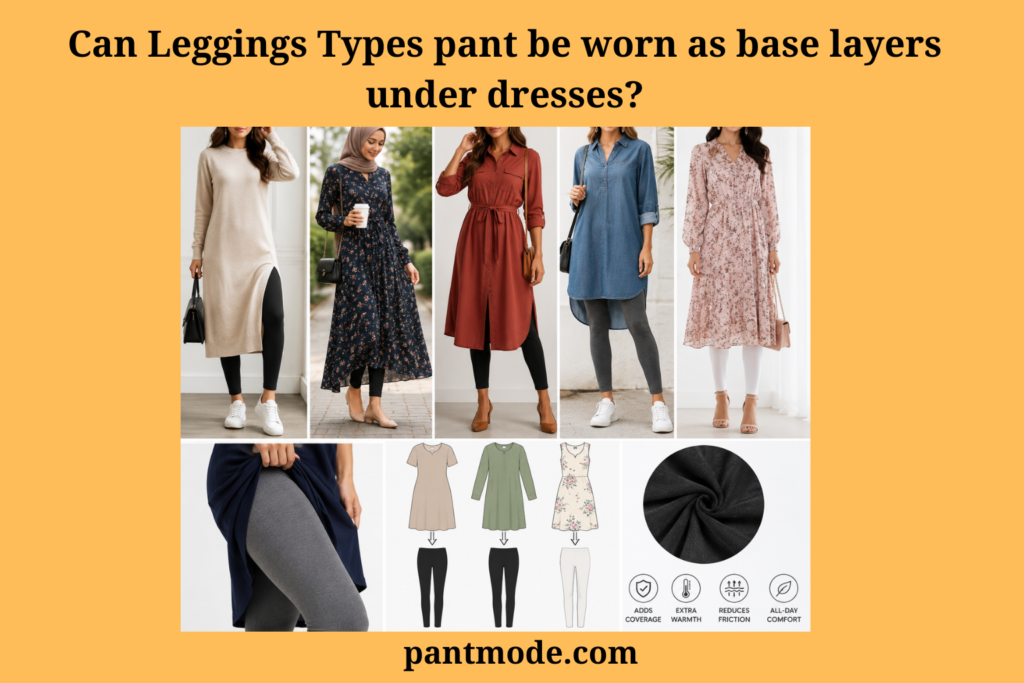
Can Leggings Types pant be worn as base layers under dresses?
Leggings can be worn as base layers under dresses when their opacity, fabric finish, waistband smoothness, length, and footwear pairing support the dress instead of adding bulk.
Leggings under dresses can add warmth, coverage, comfort, and styling flexibility. This guide explains why the layering works, which leggings to choose, how to style them, how to fix static or bulk, and how to assess the final outfit before leaving.
Quick Answer: Can Leggings Types pant be worn as base layers under dresses?
Yes, leggings can be worn under dresses when they are chosen as intentional base layers. The best leggings under dresses are opaque, smooth, low-bulk, and matched to the dress fabric, length, season, and footwear. Seamless ankle-length leggings work well for clean everyday outfits, thermal leggings work under sweater or structured dresses, and refined footless tights work better when the outfit needs a thinner, more polished finish.
Definition: Leggings as Base Layers Under Dresses
Leggings as base layers under dresses means wearing opaque, seamless, thermal, ankle-length, or lightweight stretch leggings beneath a dress to add warmth, coverage, comfort, and styling flexibility while controlling bulk, static cling, visible lines, and hemline proportion.
Figure: leggings under dresses work best when the base layer supports the dress instead of competing with it.
Why Should You Wear Leggings Under Dresses as Seasonal Base Layers?
You should wear leggings under dresses as seasonal base layers when the outfit needs warmth, coverage, comfort, and movement without changing the dress itself.
Use leggings when the dress needs warmth without losing its shape. Opaque black leggings under a floral midi dress can make the dress more wearable during cooler months. Thermal weight still needs to match the dress structure.
Prioritize opacity when leggings are visible below the hem. Leggings under dresses function as part of the outfit, not hidden underwear. Matte opaque leggings usually look more intentional than thin semi-sheer leggings under a knee-length dress.
Match the base layer to the dress mood. A casual cotton dress can handle casual leggings, but a polished dress needs smoother, cleaner leggings. Seamless ankle-length leggings usually work better under a knit midi dress than shiny gym leggings.
Use leggings to add coverage without sacrificing movement. Footless tights or lightweight leggings under a shirt dress can add coverage for commuting, errands, or travel while keeping the guidance body-positive and comfort-focused.
For a related base-layer comparison, see leggings under skirts.
Boundary note: leggings under dresses should look intentional, not like last-minute warmth. Sheer leggings under short dresses can look accidental unless the outfit deliberately uses a hosiery-like finish.
| Rule | Reason | Example | Boundary |
|---|---|---|---|
| Use leggings when the outfit needs warmth | Leggings extend lightweight or seasonal dresses | Opaque leggings under a floral midi dress | Thermal weight must match dress structure |
| Prioritize opacity | Visible leggings become part of the outfit | Matte opaque leggings under a knee-length dress | Hosiery-like finishes should be intentional |
| Match the dress mood | Formality affects how polished the layer looks | Seamless ankle leggings under a knit midi dress | Sporty fabrics can clash with polished dresses |
| Add coverage without limiting movement | Dresses can ride up, catch wind, or feel exposed in daily routines | Footless tights under a shirt dress | Coverage guidance should stay body-positive |
| Treat leggings as visible layers with short dresses | Mini and tunic dresses make leggings part of the silhouette | Tunic sweater dress with ankle leggings and boots | Sheer leggings can look accidental |
Which Leggings Fabrics and Lengths Work Best Under Different Dress Styles?
The best leggings fabrics and lengths under dresses depend on dress material, silhouette, season, opacity, waistband smoothness, and footwear pairing.
Lightweight and flowy dresses need thin seamless leggings. Smooth nylon, modal, or microfiber fabrics reduce friction under chiffon, fluid knits, and soft midi dresses. Thick fleece can distort the dress line.
Sweater dresses can handle thermal leggings. Fleece-lined or brushed opaque leggings work best when the dress has enough structure to hide thermal bulk. Knee boots or ankle boots usually complete the winter line.
Bodycon and fitted dresses need seamless leggings. A matte finish, flat waistband, and no pocket outlines prevent visible ridges. Pockets and bulky seams are the main risks.
Shirt dresses and wrap dresses need smooth ankle leggings. Cotton-modal or smooth stretch fabrics can support everyday wear, while ankle boots, flats, loafers, or clean sneakers decide the outfit mood.
Slip and formal dresses need a refined, thinner finish. Thin matte microfiber leggings or refined footless tights can work in casual-polished styling, but sporty yoga leggings usually clash with delicate fabrics or formal dress codes.
Mini, tunic, and maxi dresses need length control. Mini and tunic dresses often need full-length opaque leggings. Maxi dresses need smooth full-length or thin thermal options that do not bunch at the ankle.
For stretch and movement comfort, compare leggings stretch comfort. For fabric basics, compare cut and fabric.
Boundary note: delicate fabrics need smoother, thinner base layers. Bulky leggings should stay under knit, sweater, tunic, or structured dresses.
Dress & Legging Pairing Matrix
| Dress Style | Best Legging Type | Best Fabric / Finish | Best Length | Ideal Footwear | Avoid |
|---|---|---|---|---|---|
| Flowy chiffon dress | Thin seamless leggings | Smooth nylon/modal | Ankle | Ballet flats, sleek boots | Thick fleece |
| Sweater dress | Thermal leggings | Fleece-lined or brushed opaque | Ankle/full length | Knee boots, ankle boots | Shiny gym fabric |
| Bodycon dress | Seamless leggings | Matte, flat waistband | Full length | Sleek boots | Pockets or bulky seams |
| Shirt dress | Matte leggings | Cotton-modal or smooth stretch | Ankle | Sneakers, loafers, ankle boots | Capri cuts |
| Slip dress | Lightweight base leggings | Thin matte microfiber | Ankle | Boots, loafers | Ribbed or thick leggings |
| Mini/tunic dress | Opaque leggings | Dense matte knit | Full length | Boots, sneakers | Sheer leggings |
| Maxi dress | Thin thermal leggings | Smooth low-friction fabric | Full length | Boots | Bunchy ankles |
| Wrap dress | Smooth high-waist leggings | Matte stretch fabric | Ankle | Ankle boots, flats | Rolling waistband |
| Formal dress | Refined footless tights | Smooth, thin, opaque | Ankle | Sleek heels or boots | Sporty yoga leggings |
How Can You Style Leggings Under Dresses Without Adding Bulk?
You can style leggings under dresses without adding bulk by matching formality, smoothing the waistband, choosing the right length, controlling fabric weight, and finishing the outfit with compatible footwear.
Match leggings formality to dress formality. Casual dresses can accept cotton-modal or matte leggings, while polished dresses need smoother ankle leggings or refined footless tights.
Use a smooth waistband under fitted dresses. A high-waist flat waistband or seamless waistband prevents ridges under bodycon, slip, wrap, and knit dresses.
Choose ankle length for the cleanest visual line. Ankle-length leggings work under midi, shirt, wrap, and knit dresses because they connect easily to flats, loafers, and ankle boots.
Use darker matte leggings with heavier or darker dresses. Dense matte knit can ground sweater dresses, tunic dresses, and cold-weather outfits without looking like gymwear.
Use lightweight leggings under delicate dresses. Thin seamless leggings or footless tights help flowy dresses move without showing thick seams or pocket outlines.
Let footwear complete the base-layer line. Boots create warmth and continuity, loafers polish shirt dresses, ballet flats soften flowy dresses, and clean sneakers keep errands outfits casual.
Avoid bulky pocket leggings under fitted or formal dresses. Pockets can show through thin fabric, distort the side line, or create uneven weight under a smooth dress.
For daily comfort outside dress layering, compare casual pants.
Boundary note: footwear and hemline determine whether the base layer looks intentional. Test the outfit with the actual shoes.
Styling Formula Table
| Style Goal | Dress Type | Legging Choice | Footwear | Result |
|---|---|---|---|---|
| Winter casual | Sweater dress | Fleece-lined opaque leggings | Knee boots | Warm and cohesive |
| Errands outfit | T-shirt dress | Matte pocket leggings | Clean sneakers | Casual and practical |
| Polished casual | Shirt dress | Smooth ankle leggings | Loafers or ankle boots | Neat and wearable |
| Soft feminine | Flowy midi dress | Thin seamless leggings | Ballet flats | Light and balanced |
| Modern layered | Slip dress | Thin matte leggings | Boots + sweater | Intentional contrast |
| Minimal outfit | Knit midi dress | Seamless black leggings | Sleek ankle boots | Clean silhouette |
| Travel outfit | Tunic dress | Opaque stretch leggings | Slip-on sneakers | Comfortable and covered |
| Formal-leaning | Wrap dress | Refined footless tights | Sleek boots | Smooth and polished |
Legging Length and Footwear Guide
| Legging Length | Best Dress Pairing | Best Footwear | Works Best When | Avoid When |
|---|---|---|---|---|
| Full length | Mini, tunic, sweater, maxi | Boots, sneakers | You need warmth and coverage | Fabric bunches at ankle |
| Ankle length | Midi, shirt, wrap, knit | Loafers, ankle boots, flats | You want the cleanest line | Hem sits too high above shoe |
| Capri length | Casual summer dresses | Sneakers, sandals | Styling is intentionally sporty | Wearing boots or midi dresses |
| Stirrup style | Sleek knit or formal casual dresses | Loafers, pointed shoes | You want a taut leg line | Foot loop pulls uncomfortably |
| Footless tight style | Dresses needing hosiery-like finish | Flats, boots, loafers | You want thin coverage | You need heavy insulation |
Figure: hemline, legging length, and footwear should create one planned outfit line.
How Do You Fix Static Cling, Bunching, and Visible Lines When Layering Leggings Under Dresses?
Static cling, bunching, and visible lines usually happen when dress fabric, legging texture, waistband thickness, seam stacking, length, and dry-air friction are not working together.
Static cling comes from synthetic fabric friction or dry air. Spot-test anti-static spray inside the dress before use, choose smoother fabric pairings, or reduce dryness at the skin layer so the dress moves freely.
Waist bunching comes from thick or low waistbands. Seamless high-waist leggings create a smoother midsection under fitted or wrap dresses.
Visible lines come from stacked seams. Seamless underwear plus seamless leggings can reduce ridges under bodycon, slip, or fluid knit dresses.
Awkward hem breaks come from the wrong legging length. Ankle or full-length leggings usually make a cleaner line than capri lengths under midi dresses or boots.
Dress riding up comes from fabric friction. Smoother leggings or a slip can help the dress fall naturally instead of catching against the base layer.
Sporty mismatch comes from shiny fabric, visible logos, or gym construction. Matte logo-free leggings usually look more polished under dresses.
Thermal bulk comes from thick fabric choice under delicate dresses. Use thermal leggings only with structured, sweater, knit, or tunic dresses when the dress can hide the added thickness.
Sheer base layers need replacement with opaque leggings or refined footless tights. The pass standard is confident visible coverage under movement and light.
Boundary note: anti-static products should be spot-tested inside the dress before use, especially on delicate fabrics.
Static & Friction Troubleshooting Checklist
| Issue | Likely Cause | Best Fix | Pass Standard |
|---|---|---|---|
| Static cling | Synthetic fabric friction or dry air | Spot-tested anti-static spray, smoother pairing, or skin moisture support | Dress moves freely |
| Waist bunching | Thick or low waistband | Seamless high-waist leggings | Smooth midsection |
| Visible lines | Stacked seams | Seamless underwear + seamless leggings | No obvious ridges |
| Awkward hem break | Wrong legging length | Ankle/full-length leggings | Clean leg line |
| Dress riding up | Fabric friction | Smoother leggings or slip | Dress falls naturally |
| Sporty mismatch | Shiny fabric or logos | Matte logo-free leggings | More polished outfit |
| Bulk under dress | Thick thermal fabric | Use thermal only with structured/knit dresses | Shape stays clean |
| Sheer base layer | Fabric too thin | Opaque leggings or footless tights | Confident coverage |
What Checklist Helps You Assess Leggings Under Dresses Before Leaving?
A good leggings-under-dresses outfit checklist tests opacity, waistband smoothness, static movement, hemline proportion, fabric harmony, footwear match, bulk control, comfort, and outfit intention.
Opacity: check whether the leggings are covered enough for visible wear under the dress. The pass standard is coverage while standing, sitting, and walking.
Waistband smoothness: check whether the waistband stays flat under the dress. The pass standard is no ridging, folding, or bunching.
Static movement: walk, sit, and turn to check whether the dress moves freely without clinging to the leggings.
Hemline proportion: check whether the legging length works with the dress hem. The pass standard is a clean leg line without awkward gaps.
Fabric harmony: compare the legging finish to the dress texture and formality. Matte smooth leggings work better under polished dresses than shiny gym fabrics.
Footwear match: wear the actual shoes before deciding. Boots, flats, loafers, sneakers, and heels each change the final base-layer line.
Bulk control: check for bulky seams, pocket outlines, thick thermal edges, or ankle bunching.
Comfort: sit, walk, and bend to check whether the base layer adds warmth or coverage without distorting the dress.
Outfit intention: step back and ask whether the leggings look planned, seasonally appropriate, and aligned with the dress mood.
For broader bottom-type context, see all pant types.
Boundary note: the final check should happen with the actual shoes and outerwear, because footwear and layers change the outfit line.
Final Outfit Assessment Checklist
| Outfit Check | Yes / No |
|---|---|
| Are the leggings opaque enough for visible wear under the dress? | |
| Does the waistband stay smooth under the dress? | |
| Does the dress move without static cling? | |
| Does the legging length work with the dress hem? | |
| Does the footwear complete the outfit line? | |
| Does the legging fabric match the dress texture and formality? | |
| Are there no visible bulky seams or pocket outlines? | |
| Does the outfit stay comfortable when sitting and walking? | |
| Does the base layer add warmth or coverage without distorting the dress? | |
| Does the final look feel intentional, stylish, and seasonally appropriate? |
Key Takeaway
Leggings work best under dresses when they look like a deliberate base layer. Choose opaque fabric, a smooth waistband, a length that works with the dress hem, a finish that matches the dress mood, and footwear that completes the line. Avoid bulky pockets, shiny gym fabrics, thick seams, sheer fabric, and thermal leggings under delicate or fitted dresses.
Frequently Asked Questions
Yes. Leggings can be worn under dresses when they are selected as intentional base layers that match the dress fabric, length, season, and footwear.
Opaque, smooth, low-bulk leggings work best. Seamless ankle leggings suit clean everyday outfits, thermal leggings suit sweater or structured dresses, and refined footless tights suit thinner polished outfits.
Use seamless leggings with a flat waistband, avoid pockets, avoid thick seams, and choose a matte low-friction fabric that does not create ridges under the dress.
Use smoother fabric pairings, spot-test anti-static spray inside the dress before use, and avoid textured leggings under clingy synthetic dresses.
No. Leggings are not appropriate under every formal dress. If the outfit needs a polished hosiery-like finish, refined footless tights or a different base layer may work better than sporty leggings.
Conclusion
Leggings work as base layers under dresses when opacity, fabric smoothness, waistband flatness, hemline proportion, footwear, and dress texture create one intentional outfit.
Leggings under dresses can add warmth, coverage, comfort, and styling flexibility.
Fabric weight, opacity, waistband smoothness, length, and footwear decide whether the outfit looks intentional.
Static, bunching, visible lines, and sporty mismatch can usually be solved through smoother fabric, better length, flat waistbands, and dress-compatible finishes.
Assess the outfit by testing opacity, waistband smoothness, static movement, hemline proportion, fabric harmony, footwear match, bulk control, comfort, and outfit intention before leaving.