
How Does a Drawstring Waistband Affect Pant Fit Compared With an Elastic Waistband?
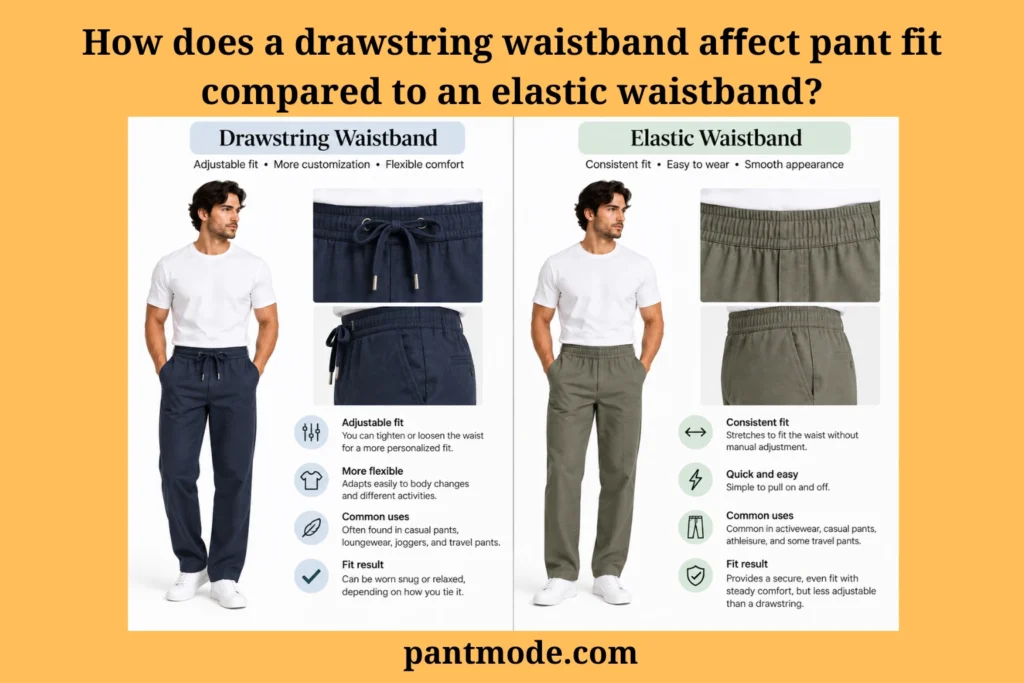
A drawstring waistband gives the wearer direct manual control over waist tension, while an elastic waistband creates holding tension through elastic extension and restoring behavior.
A hybrid waistband combines those mechanisms: elastic provides baseline hold while the drawstring adds manual fine adjustment. None of the three systems determines whole-pant fit by itself because rise, hips, seat, thighs, crotch geometry, size, and construction still matter.
Security should also be separated from tightness. A waistband should keep the pants reasonably stable at the intended position without requiring extreme pressure or repeated correction. PantMode’s broader fit & detail pant types framework places waistband mechanics inside that wider fit system.
Quick Answer
A drawstring waistband gives manual control over waist tightness, while an elastic waistband creates holding tension through elastic extension and restoring behavior. A hybrid waistband combines baseline elastic hold with manual drawstring adjustment. The best system depends on correct garment size, security needs, pressure comfort, movement, construction quality, and how much manual adjustment the wearer wants.
Definition
A drawstring waistband uses a cord to reduce the effective waistband opening manually. An elastic waistband uses an elastic element that extends under force and creates restoring tension. A hybrid waistband combines elastic tension with a drawstring for additional manual adjustment.
What Fit Difference Do Drawstring and Elastic Waistbands Create?
Drawstring and elastic waistbands create different fit behavior because drawstrings depend mainly on user-set tension, while elastic waistbands respond through material extension and restoring tension.
A drawstring lets the wearer tighten or loosen the waistband directly, so holding behavior depends on how the cord is set and secured. Elastic responds more automatically within its usable range and normally requires less deliberate adjustment during routine movement.
A hybrid waistband combines baseline elastic response with manual refinement through the cord. That added control does not make the hybrid system universally superior; all three systems still depend on compatible garment size and construction.
New Mexico State University’s waistband construction guidance covers casings used for both elastic and drawstring systems and emphasizes fitting elastic in the garment before final securing.
Drawstring vs. Elastic Fit Comparison Matrix
| Fit Factor | Drawstring | Elastic | Hybrid |
|---|---|---|---|
| Main control | Manual | Elastic response | Both |
| Manual adjustability | High | Low | High |
| Automatic movement response | Limited | Higher | Higher |
| Holding behavior | Cord-setting dependent | Elastic dependent | Combined |
| Failure risk | Loosening / over-cinching | Fatigue / rolling / tension issue | Either system can fail |
| Wrong-size correction | Limited | Limited | Limited |
How Do Drawstrings and Elastic Waistbands Generate Holding Tension Differently?
A drawstring creates holding tension by mechanically reducing the waistband opening, while an elastic waistband creates tension when the elastic is extended from its resting condition.
For a drawstring, the mechanism is direct: pull the cord, reduce the effective opening, increase the holding effect, and secure the cord. The usable adjustment range is limited by garment circumference, cord routing, knot or hardware security, and how much gathering the wearer can tolerate.
Elastic behaves differently. Extension describes how much the elastic lengthens under force; tension is the force associated with that extension; recovery describes how the material returns after extension. These properties should not be treated as synonyms.
ASTM D4964 treats tension and elongation of elastic fabrics as distinct measurable relationships under specified test conditions, which is why “more stretch” does not automatically mean stronger holding or better recovery.
Waistband Tension-Mechanism Matrix
| System | Tension Source | Adjustment | Key Dependency |
|---|---|---|---|
| Drawstring | User-applied cord tension | Manual | Cord security + garment size |
| Elastic | Elastic tension under extension | Automatic within range | Elastic properties + construction |
| Hybrid | Elastic + cord | Automatic + manual | Both components + base fit |
How Do Waistband Systems Affect Security, Pressure, and Movement?
Waistband security, pressure, and movement comfort depend on how tension is created and distributed, not simply on whether the waistband contains a cord or elastic.
Security means that the garment remains reasonably stable at its intended position. It does not mean maximum tightness. A drawstring can increase hold when tightened, but a narrow cord or strong cinching can concentrate pressure depending on routing, casing, and tension.
Elastic may distribute holding tension across a broader waistband area, but actual pressure depends on elastic width, construction, extension, waistband geometry, and base fit. Automatic response can accommodate temporary expansion during sitting or bending, yet that response remains limited by the elastic system’s usable range.
Hybrid construction can reduce the need for strong cord tension when the elastic already supplies useful baseline hold, but it can still fail through poor sizing, weak recovery, rolling, twisting, or over-cinching.
Fit-Effect Matrix
| Attribute | Drawstring | Elastic | Boundary |
|---|---|---|---|
| Security | User controlled | Material controlled | Base fit matters |
| Pressure | Can localize when strongly cinched | May spread more broadly | Construction matters |
| Adjustment | Direct manual | Material range | Neither is unlimited |
| Movement | Tie setting stays fixed unless changed | Extends within usable range | Recovery matters |
| Readjustment | May require retying | Usually less manual | Weak or poor elastic can change this |
Which Fit Problems Can a Waistband Fix, and Which Require a Different Pant Fit?
A waistband can refine waist-level security, but it cannot fully correct a pant pattern that is fundamentally wrong through the rise, hips, seat, thighs, or crotch.
A drawstring or elastic system can often help with limited waist looseness, preference for slightly more or less tension, or temporary movement accommodation. It cannot directly correct a restrictive seat, inadequate hip ease, wrong thigh fit, unsuitable rise, or crotch-depth and crotch-length problems.
PantMode’s relaxed vs. classic fit page owns the broader whole-garment ease comparison. Waist contour also should not be confused with dart-based contouring, which shapes the pattern rather than creating adjustable waistband tension.
NMSU’s pants-fitting guidance treats waist, hip, thigh, crotch depth, and crotch length as separate fit variables and emphasizes comfort while standing, sitting, and walking.
Base-Fit Boundary Matrix
| Problem | Waistband May Help? | Check Separately |
|---|---|---|
| Slight waist looseness | Often | Overall size still matters |
| Pants very oversized | Limited | Size / pattern |
| Seat restriction | No direct fix | Seat ease |
| Hip restriction | No direct fix | Hip fit |
| Thigh pulling | No direct fix | Thigh fit |
| Crotch discomfort | No direct fix | Rise / crotch geometry |
| Waist position changes during movement | Possibly | Rise + waistband + whole fit |
What Problems Show That a Drawstring or Elastic Waistband Is Not Working Correctly?
A waistband may not be working correctly when the pants repeatedly slip, dig, bunch, roll, twist, loosen, or require frequent readjustment during normal wear.
Slipping can come from insufficient cord or elastic hold, worn elastic behavior, wrong garment size, rise, or broader fit problems. Digging can come from over-tightening, high elastic tension, unsuitable size, waistband position, or construction.
Bunching can appear when a drawstring is cinched hard around too much garment circumference or when bulky fabric gathers inside the casing. Rolling or twisting can involve casing geometry, elastic width, internal anchoring, tension, movement, and fit rather than simply proving that the pants are too small.
Drawstring loosening can involve knot security, cord friction, routing, hardware, or excessive dependence on the cord because the pants are too large. Seam-based fit problems should also be diagnosed separately; PantMode’s seam positioning page owns that structural boundary.
Waistband Diagnostic Matrix
| Problem | Waistband Cause | Other Possible Cause | First Check |
|---|---|---|---|
| Slipping | Low cord / elastic hold | Size / rise / base fit | Fit + tension |
| Digging | Excess tension | Size / rise | Loosen and reassess |
| Bunching | Over-cinching | Excess waistband circumference | Base waist |
| Rolling / twisting | Casing / elastic instability | Size / movement | Construction |
| Cord loosens | Knot / friction / routing | Oversized pant | Cord + size |
| Constant readjustment | Limited useful range | Poor base fit | Whole pant |
How Should Drawstring, Elastic, and Hybrid Waistbands Be Tested During Movement?
Waistband fit should be tested after the pants already fit reasonably through the rest of the garment, then checked during standing, sitting, bending, and walking.
First confirm rise, hip, seat, thigh, and crotch comfort. Then set the waistband normally: tighten a drawstring only until the pants remain stable, observe elastic baseline hold without deliberately overstretching it, and evaluate a hybrid system’s elastic before using the cord for refinement.
After movement, check for slipping, digging, pressure changes, bunching, rolling, twisting, cord loosening, and repeated readjustment. If the waistband must be pushed to an extreme setting to keep the pants usable, reassess the size or pattern instead of treating tension as the only solution.
Which Drawstring, Elastic, or Hybrid Waistband Best Matches Different Fit Priorities?
The most suitable waistband system depends on whether the priority is direct manual adjustment, automatic elastic response, minimal manual readjustment, or a combination of elastic hold and fine-tuning.
Choose a drawstring direction when direct user-set tension is the priority. Choose an elastic direction when baseline automatic response and less manual adjustment are more important. Consider a hybrid when both elastic baseline hold and occasional manual refinement are useful.
Before deciding, verify base size, rise, construction, activity needs, pressure comfort, and stability. Material stretch also deserves its own analysis; PantMode’s fabric stretch and fit page owns that deeper relationship.
Drawstring vs. Elastic vs. Hybrid Decision Matrix
| Priority | Drawstring | Elastic | Hybrid |
|---|---|---|---|
| Manual fine control | Strong | Limited | Strong |
| Automatic response | Limited | Stronger | Stronger |
| Minimal manual input | Lower | Higher | Higher |
| Fine-tuning over baseline hold | Moderate | Limited | Strong |
| Slight waist looseness | Can help | Depends on elastic | Can help |
| Severe wrong size | Poor solution | Poor solution | Poor solution |
| Movement response | Depends on setting | Depends on elastic | Combined |
| Main trade-off | Requires adjustment / security | Elastic properties matter | More complexity |
How Can You Verify That the Waistband Gives the Pants the Right Fit?
A waistband gives the pants the right fit when it maintains the intended waist position with acceptable pressure, useful movement response, and little unnecessary readjustment without disguising a larger fit problem elsewhere.
Check the base garment first, then security, pressure, construction, and movement. A mechanically functioning waistband can still exist on pants that are wrong through the hips, seat, thighs, rise, or crotch.
Base Garment
Security
Pressure
Construction
Movement
Key Takeaway
Drawstrings provide manual tension control, elastic waistbands provide elastic tension and automatic response within their usable range, and hybrid systems combine both functions. None is universally better. Judge the waistband only after confirming the pants fit correctly through the rise, hips, seat, and thighs, then choose the mechanism that maintains stable position without excessive pressure, bunching, rolling, or constant readjustment.
What FAQ Questions Clarify Drawstring vs. Elastic Waistband Fit?
These five questions clarify the core mechanism difference, hybrid boundary, sizing limit, rolling diagnosis, and final fit check.
A drawstring uses manual tightening and loosening, while elastic creates holding tension through extension and restoring behavior.
No. It combines elastic baseline hold with manual adjustment, but correct sizing and construction still matter.
Only to a limited degree. Heavy gathering or extreme cinching can signal that the garment is simply too large.
Possible causes include casing design, elastic width, anchoring, tension, movement, and overall fit.
The pants stay in position, feel secure without persistent digging, move comfortably, and do not need constant readjustment.
What Final Rule Should Guide Drawstring vs. Elastic Waistband Fit?
The final rule is to confirm the pants fit correctly first, then choose the waistband mechanism according to the type of waist-level control you actually need.
Use drawstring tension for manual adjustment, elastic for automatic elastic response, or a hybrid when both functions are useful—but only after confirming that the waistband is refining a correctly fitting pair of pants rather than compensating for the wrong size, rise, or body fit.
Drawstring, elastic, and hybrid waistbands control the waist in different ways. Drawstrings rely on manual cord tension, elastic relies on extension and restoring behavior, and hybrid systems layer manual adjustment over elastic baseline hold.
The useful choice depends on correct base fit, the amount of manual control desired, elastic behavior, construction quality, movement demands, pressure tolerance, and whether the waistband remains stable without excessive tightening or constant readjustment. When the rest of the pants fit poorly, changing the waistband mechanism is not a substitute for choosing a better size, rise, or pattern.