
How Do Darts Affect the Contoured Fit of Pants?
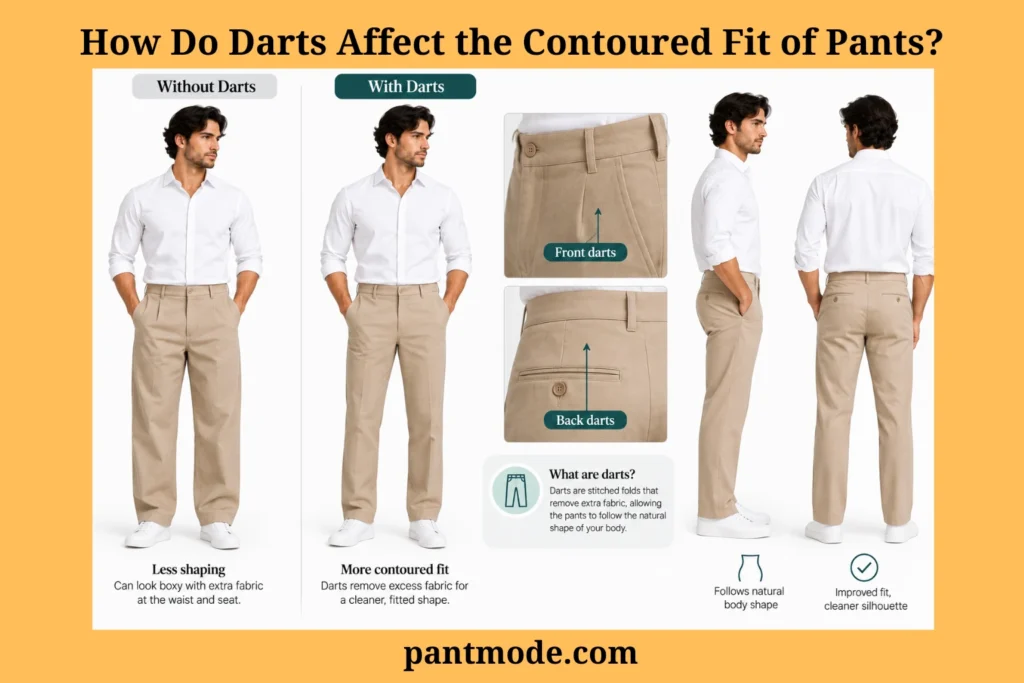
Pant darts affect contoured fit by taking up controlled fabric in a tapered stitched fold so a flat pant panel can transition more smoothly between narrower and fuller body areas.
The dart reduces effective circumference only in the area where its intake is sewn. That controlled shaping can help a flat panel follow waist-to-hip or waist-to-seat contours without reducing the entire panel equally.
Darts are only one part of the fit system. Waistbands, seams, rise, crotch geometry, seat and hip ease, and fabric behavior can create similar symptoms, so PantMode’s broader fit & detail pant types framework remains the diagnostic parent context.
Quick Answer
Pant darts create contour by taking up a controlled wedge of fabric in a tapered stitched fold. This reduces effective circumference in a selected area and helps the pant panel transition between narrower areas such as the waist and fuller areas such as the hips or seat. The result depends on dart intake, length, placement, orientation, pressing, fabric behavior, and the rest of the pant pattern.
Definition
A pant dart is a tapered stitched fold used to shape a flat fabric panel into a more three-dimensional form. Its two legs converge toward a dart point, allowing selected fullness to be controlled without reducing the entire panel equally.
What Do Pant Darts Do to Create a More Contoured Fit?
Pant darts create contour by taking up selected fabric where the garment needs less effective circumference and tapering that shaping into the surrounding panel.
The two dart legs define the wedge being taken up. When those legs are brought together and stitched, part of the panel’s available circumference is controlled locally while the surrounding fabric remains available to accommodate fuller areas such as the hips or seat.
The taper matters because the shaping must fade into the surrounding panel rather than end abruptly. This converts a flat pattern section into a more three-dimensional contour instead of simply making the entire panel uniformly smaller.
Utah State University Extension’s dart guidance describes darts as wedge-shaped tucks used to give form to flat fabric over body contours. A standard sewn dart therefore takes up fabric through folding and stitching rather than simply cutting away the shaping.
Pant-Dart Mechanism Matrix
| Dart Action | Fabric Effect | Fit Result |
|---|---|---|
| Takes up a wedge | Reduces effective local circumference | Closer contour |
| Tapers toward point | Gradually reduces shaping | Smoother transition |
| Targets local excess | Concentrates fit correction | Cleaner waist / hip / seat relationship |
| Works with surrounding pattern | Shares shaping with seams and other features | Balanced overall fit |
How Do Dart Intake, Length, Placement, and Orientation Change Pant Contour?
Dart intake, length, placement, and orientation control different parts of the shaping process, so changing one variable can improve one area while creating distortion elsewhere.
Intake controls how much local circumference is taken up. More intake creates stronger local shaping, but more is not automatically better; excessive intake can create pull lines or an over-pinched contour, while too little can leave bagging.
Length controls how gradually that shaping tapers into the panel. A transition that is too abrupt can create a point or bubble, while one that extends too far can place shaping beyond the area that needs it.
Placement determines where the correction acts. Orientation determines the direction in which that shaping aims. Neither should be treated as decoration because a dart can only correct excess that falls within the shaping path it controls.
Dart Variable & Fit-Effect Matrix
| Variable | What It Changes | Too Little / Poor Choice | Too Much / Poor Choice |
|---|---|---|---|
| Intake | Local circumference | Bagging remains | Pulling / over-pinching |
| Length | Transition distance | Abrupt shaping | Shaping extends too far |
| Placement | Location of correction | Excess remains elsewhere | Tension redirected |
| Orientation | Direction of shaping | Weak contour alignment | Distorted contour |
| Pressing | Finished smoothness | Visible bulk | Cannot fix wrong geometry |
Where Should a Pant Dart Point, and Why Should It Stop Short of Fullness?
A fitting dart generally points toward the area of fullness it is shaping but tapers out before the fullest point so the contour transitions smoothly rather than ending in a sharp projection.
The dart direction guides the shaping toward the volume it serves. If the point ends directly on the fullest area, the transition can become visually abrupt and create a cone-like or pointed effect instead of blending smoothly.
The correct stop-short distance depends on the pattern, dart intake, fabric behavior, and contour being shaped, so one universal number should not be used for every pair of pants.
New Mexico State University’s Clothing Construction Standards states that fitting darts should point toward and stop short of the fullest area and should taper smoothly without puckering or bubbling.
How Do Front and Back Pant Darts Shape Different Areas?
Front and back pant darts can control different areas of excess because their location changes which portion of the upper pant receives the shaping.
Back darts commonly help manage the transition between a narrower back waist and fuller hip or seat area. Depending on the pattern, that shaping may be concentrated in one dart or distributed across more than one.
Front darts can manage localized excess through the front waist or upper-hip area, but they are not mandatory in every trouser design. Some patterns use seams, yokes, elastic systems, stretch, or different pattern geometry instead.
For the distinction between dart shaping and seam positioning, treat seams as a separate contouring system. Likewise, trouser pleats manage fullness differently and should not be treated as interchangeable with darts.
Front vs. Back Pant Dart Matrix
| Dart Location | Common Shaping Role | Typical Fit Contribution | Boundary |
|---|---|---|---|
| Back dart | Waist-to-seat transition | Controls back-waist excess | Pattern dependent |
| Front dart | Front waist / upper-hip shaping | Controls front local excess | Not always needed |
| Multiple darts | Distributes shaping | Reduces concentration | Not automatically better |
| No visible dart | Alternative shaping system | Seams / stretch / yoke may shape | Still requires fit analysis |
How Should Pant Darts Be Adjusted Without Creating New Distortion?
Pant darts should be adjusted only after the excess or tension has been located, and one major variable should be changed at a time before the garment is refitted.
Start by identifying the symptom and tracing where the excess or tension actually originates. Check whether the waistband, side seam, rise, crotch geometry, or another pattern area could be responsible before assuming the dart is the cause.
If the dart is responsible, choose one major variable—intake, length, placement, or orientation—and make the smallest meaningful change. Refit the garment before changing another variable.
NMSU’s Making Perfect Pants evaluates dart position together with side seams and the waistline during fitting, while NMSU’s Pattern Alteration guide treats dart redrawing as one alteration method among broader pattern corrections.
Waistband behavior may also need separate diagnosis; PantMode’s waistband fit page owns deeper waistband-adjustment systems.
What Fit Problems Suggest a Dart Is Too Deep, Too Shallow, Too Short, or Misplaced?
Dart-related fit problems usually appear near the shaped area as persistent bagging, a sharp dart-point bubble, pull lines, over-pinching, or contour distortion, but each symptom can also have non-dart causes.
Local waist bagging can come from too little intake or poor placement, but the waistband, side seam, size, or pattern block may be responsible. A dart-tip bubble can come from abrupt taper, unsuitable intake, length, pressing, fabric stiffness, or sewing quality.
Pull lines can result from excessive or misaligned intake, but they can also come from hip, seat, rise, or crotch tension. Over-pinching may indicate concentrated shaping, while a perfectly smooth dart can still exist in pants with a poor overall rise, crotch, seat, or hip fit.
Fabric behavior also matters. PantMode’s fabric stretch and fit page owns the deeper stretch-related fit classification; stretch does not replace correct pattern shaping.
Dart-Fit Diagnostic Matrix
| Symptom | Possible Dart Cause | Other Possible Cause | First Diagnostic Direction |
|---|---|---|---|
| Local waist bagging | Too little / misplaced intake | Waistband / seam / size | Locate excess |
| Dart-tip bubble | Abrupt taper / excess shaping | Fabric / pressing | Inspect point + fabric |
| Pull lines | Too much / misaligned intake | Hip / seat / rise tension | Trace tension direction |
| Over-pinched contour | Intake concentrated | Side-seam imbalance | Redistribute shaping |
| Smooth dart, bad overall fit | Dart may be correct | Rise / crotch / seat / hip | Diagnose other pattern area |
| Puckering | Construction / pressing | Fabric behavior | Inspect sewing first |
Which Dart Configuration Best Supports Different Pant-Shaping Needs?
The most appropriate dart configuration depends on where excess exists, how strongly the pattern must transition between circumferences, and how the fabric and surrounding seams distribute shaping.
One larger dart can concentrate correction in one location, but that concentration also increases the risk of an abrupt or over-pinched transition if the shaping is too strong. Several smaller darts can distribute contour more gradually, but they add pattern and construction complexity.
Fewer or no visible darts can also be valid when shaping is carried by seams, yokes, elastic systems, stretch-responsive fabrics, or different pattern geometry. The absence of a dart does not mean the garment lacks contouring.
Dart Configuration Decision Matrix
| Shaping Situation | Possible Approach | Main Benefit | Main Boundary |
|---|---|---|---|
| Strong localized waist shaping | One controlled dart | Concentrated correction | Avoid over-pinching |
| Shaping spread across area | Multiple smaller darts | Distributed contour | More complexity |
| Softer contour requirement | Lower intake / fewer darts | Less concentrated shaping | May leave excess if insufficient |
| Seam-shaped pattern | Darts + seams or fewer darts | Shared shaping | Seam fit must remain correct |
| Stretch-responsive design | Reduced visible darting may be possible | Cleaner surface | Stretch does not replace pattern fit |
How Can You Verify That Pant Darts Are Creating the Correct Contour?
Pant darts are working correctly when the intended area is smoothly contoured, the dart tapers without a visible bubble, and the surrounding pant remains balanced and comfortable during movement.
Inspect the dart first: the intake should match the shaping need, the taper should be smooth, the point should aim toward and stop short of the fullness it serves, and pressing should support the intended contour.
Then inspect the whole upper pant. The waistband should remain stable, side seams should balance, hip and seat contour should remain smooth, and rise and crotch fit should be comfortable. A technically clean dart does not prove that every other pattern area fits correctly.
Dart Geometry
Construction Quality
Fit Result
Whole-Pant Diagnosis
Movement
Key Takeaway
A pant dart improves contour only when it takes up fabric in the correct place and tapers that shaping smoothly toward—but short of—the fullness it serves. More intake is not automatically better. Diagnose the whole upper-pant pattern, change one dart variable at a time, and verify the garment again after every meaningful adjustment.
What FAQ Questions Clarify How Pant Darts Affect Fit?
These five questions clarify the dart mechanism, intake, point placement, the dart-versus-pleat boundary, and whole-pant diagnostic limits.
They take up a controlled wedge of fabric so a flat panel can form a more three-dimensional contour.
Dart intake is the amount of fabric taken into the stitched dart.
A fitting dart generally points toward the fullness it shapes and tapers out before the fullest area.
No. Darts take up fabric into a tapered stitched fold, while pleats manage fullness through folded fabric.
No. Waistbands, seams, rise, crotch geometry, seat and hip fit, and fabric behavior may require separate diagnosis.
What Final Rule Should Guide Pant-Dart Fit Adjustments?
The final rule is to adjust a pant dart only when the excess or distortion is actually dart-related, then change one variable at a time and refit the entire upper pant before making another correction.
Locate the actual excess first, use the dart only for the shaping it owns, keep the point smooth and short of the fullness, adjust one variable at a time, and verify that the correction improves contour without creating a new fit problem elsewhere.
Pant darts create contour by taking up controlled fabric in a tapered stitched fold, reducing effective circumference locally while allowing the surrounding panel to accommodate fuller areas. Their success depends on the relationship between intake, length, placement, orientation, dart-point transition, pressing, fabric behavior, and the rest of the pattern.
The most reliable fitting method is therefore diagnostic rather than automatic. Confirm that the dart actually owns the problem, separate dart issues from waistband, seam, rise, crotch, seat, and fabric issues, change one major variable at a time, and refit the entire upper pant before making another correction.